Roof Design
ROOF DESIGN : Car roof design encompasses a range of factors that automotive engineers and designers consider when creating the roof structure of a vehicle. These factors include safety, aerodynamics, aesthetics, functionality, and manufacturing constraints.
TOP ROOF :
Designing a car roof involves a complex and interdisciplinary process that combines engineering, aesthetics, safety, and functionality. Here are the general steps and considerations to create a car roof design:
-
Define the Design Objectives:
- Determine the primary goals for the roof design. Are you aiming for a sporty look, maximum interior space, aerodynamic efficiency, or something else?
-
Research and Benchmarking:
- Study existing car roof designs in the market to understand trends and gather inspiration.
- Research safety standards and regulations that pertain to roof design in your target market.
-
Sketch and Ideation:
- Begin with hand-drawn sketches to explore different roof shapes, proportions, and design concepts.
- Consider how the roof integrates with the overall vehicle design.
-
3D Modeling:
- Transition from 2D sketches to 3D computer-aided design (CAD) modeling. Use specialized software (e.g., AutoCAD, SolidWorks, CATIA) to create detailed 3D representations of your design.
-
Material Selection:
- Choose appropriate materials for the roof structure. Options may include steel, aluminum, carbon fiber, or composites. Consider factors like weight, strength, and cost.
-
Safety Considerations:
- Ensure that your design complies with safety standards for roof strength, rollover protection, and side-impact protection.
- Use computer simulations to analyze and validate the roof's structural integrity in crash scenarios.
-
Aerodynamics:
Optimize the roof shape to minimize aerodynamic drag. This can involve wind tunnel testing or computational fluid dynamics (CFD) simulations.
FRONT ROOF RAIL:
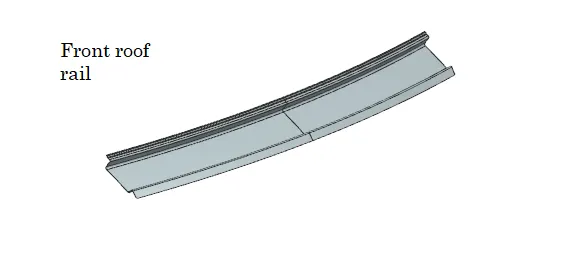
A car's front roof rail, often referred to as the A-pillar or A-post, is a structural component that runs vertically along the front edge of the vehicle's roof, connecting the roof to the front body structure. It provides support to the roof and contributes to the vehicle's overall structural integrity and safety. The A-pillar also plays a critical role in windshield support and provides a mounting point for side-impact airbags and other safety features.
REAR ROOF RAIL :
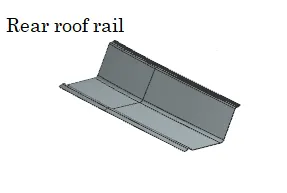
In most passenger vehicles, the term "rear roof rail" is not commonly used to describe a specific structural component, as it typically refers to a part of the roof structure that provides reinforcement and structural integrity toward the rear of the vehicle. Instead, the rear roof area usually consists of elements like the C-pillars, rear window, and roofline. However, some vehicles have unique design features in the rear roof area that are worth mentioning.
BOW ROOF :
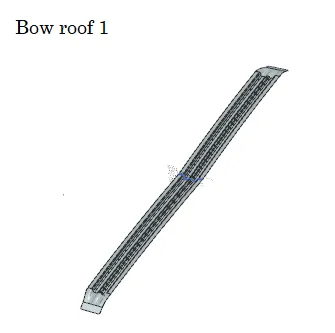
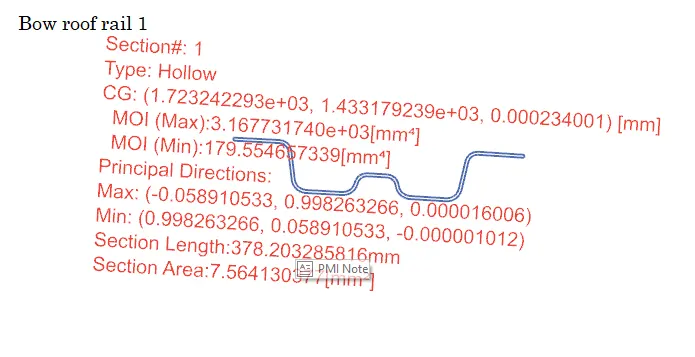
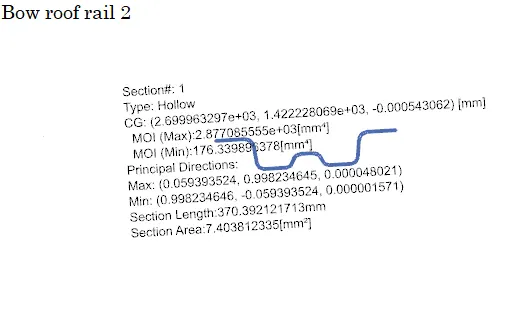
The bow roofs are give to improve the torsional stiffness and load bearing capacity of the roof structure . The number of bow roof present is depends on the overall size of the roof .
CENTER ROOF RAIL:
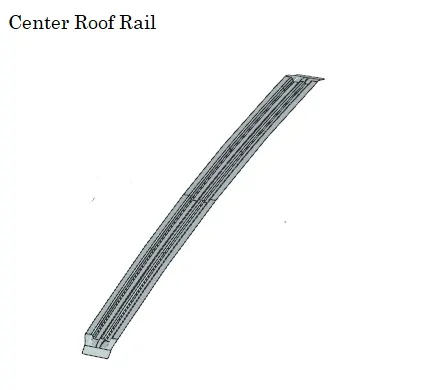
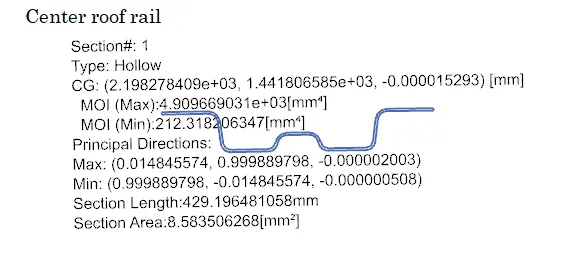
Car center roof rails, also known as roof racks or roof bars, are structural components mounted on the roof of a car. They are designed to provide additional storage and carrying capacity for various items such as luggage, bicycles, kayaks, skis, or cargo boxes. These roof rails are typically installed in pairs and run horizontally along the roof's centerline
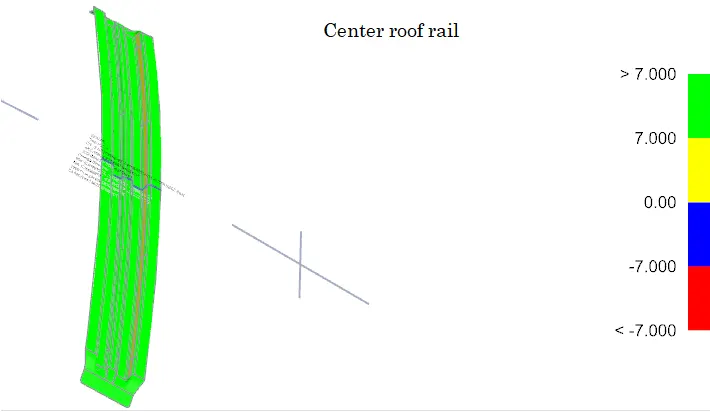
draft analysis
Center roof rail:
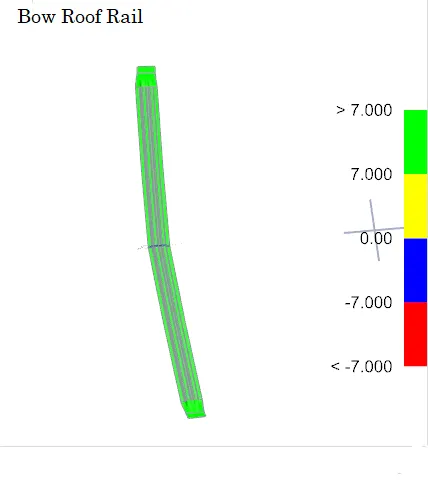
BOW ROOF RAIL 1 :
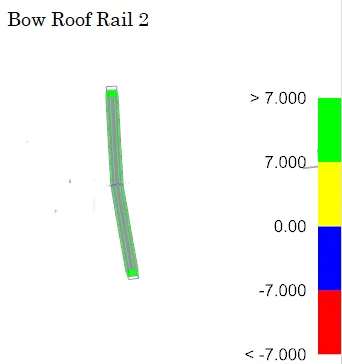
BOW ROOF RAIL 2:
Bow–Roof Prediction Formula & Calculation
Rear Roof Rail to Bow Roof Rail 2 :
W = [1.73 x 10^(-3) x L] + [1.85 x 10^(-8) x (R^2)/t] + [ 1.10x10^(-3) x l] - 2.68
Where,
L = 2016.46mm
R = 5316.78mm
R = 2(Rx*Ry)/(Rx+Ry)
Rx = 3251.46mm
Ry =5316.78mm
t = 0.75mm
l = 329mm
|
Bow position |
RX | RY | R | L | I | t | W | OK/NG |
|
Rear roof rail to Bow roof rail 2 |
3251.46 | 14778.46 | 5316.78 | 2016.46 | 329 | 0.75 | 2.064 | OK |
|
Bow roof rail 2 to Centre roof rail |
3915.21 | 10901.15 | 5760 | 2016.46 | 425.12 | 0.75 | 2.2 | OK |
|
Centre roof rail to Bow roof 1 |
4856.12 | 6664.05 | 5628.79 | 2016.46 | 397.38 | 0.75 | 1.53 |
OK |
|
Bow roof 1 to Front roof rail |
5723.83 | 2759.08 | 3723.37 | 2016.46 | 452.67 | 0.75 | 2.5 | OK |
Judgment Condition
OK< 2>
Snow Load Prediction Formula
Qr = [Iy x t2] / [α x s x [(Rx + Ry)/2]2 x 10-8]
Note: The Qr value given over here is correct. There was a typo error in the formula given in the video.
Where,
α = My x Lx2 x 10-12 , My = Y(Ly-Y)
t =0.75mm My=y(Ly-y)
Ly =1976.82mm =461.10(1976.82-4616.10)
Lx =1043mm My=698898.492mm
Y = 461.10mm a=My*Lx^2*10^-12
s = 481.97 a=0.760
s = L1/2 + L2/2 , L1=461.10, L2=502.85
Iy =174.340mm^4
Rx =3958.74mm
Ry =16663.88mm
|
Bow position |
t |
Ly |
Lx |
y |
s |
iy |
RX |
RY |
a |
My |
Qr |
OK/NG |
|
R.R.R & B.R 2 |
0.75 |
1976.82 |
1043 |
461.10 |
481.97 |
176.340 |
3958.74 |
16663.88 |
0.760 |
698898.492 |
3.92 |
OK |
|
B.R 2 & C.R.R |
0.75 |
1976.82 |
1057.06 |
963.81 |
489.19 |
212.31 |
4289.49 |
11280.55 |
1.090 |
976339.038 |
2.706 |
NG |
|
C.R.R & B.R |
0.75 |
1976.82 |
1082.39 |
1438.48 |
510.00 |
179.55 |
3793.56 |
6594.46 |
0.9072 |
774391.32 |
1.235 |
NG |
Iy = Geometrical moment of inertia of Roof BOW (Y cross-section )[mm4]