Section Modulus calculation and optimization
SECTION MODULUS :
The section modulus is an important geometric property of a cross-sectional shape that measures its resistance to bending. It's often used in structural engineering and mechanics to determine how a particular shape will perform under bending loads. The section modulus is a measure of the shape's ability to withstand bending stresses without excessive deformation.
Mathematically, the section modulus (Z) is calculated as the moment of inertia (I) of the shape's cross-section divided by the distance (Y) from the neutral axis to the outermost fiber of the section:
Z=I/Y
Here, (I) represents the moment of inertia of the shape's cross-section, which is a measure of its resistance to bending about a specific axis, and (Y) is the distance from the neutral axis (the axis that experiences no deformation during bending) to the outermost fiber of the section.
Optimizing the section modulus involves selecting a cross-sectional shape that maximizes its bending resistance while minimizing material usage. Here's a general approach to optimize the section modulus
CASE-1
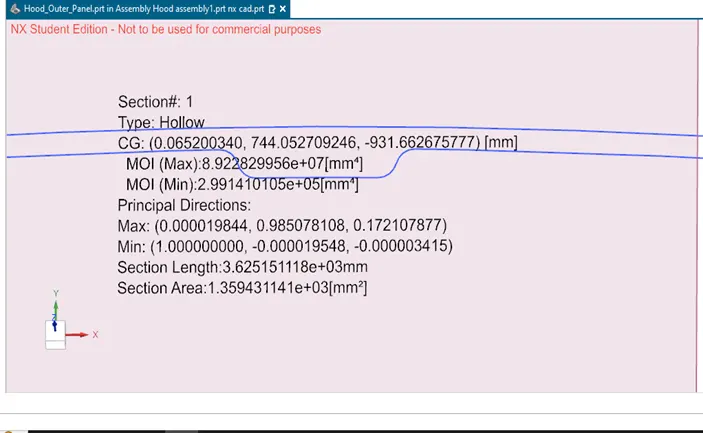
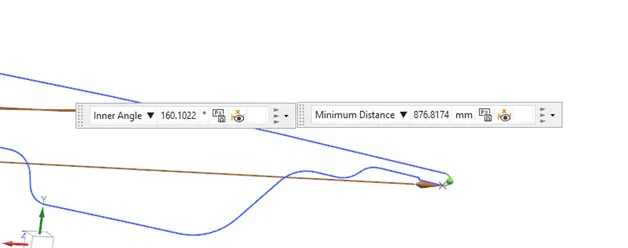
Moment of inertia (min) =2.991410105*10^5 mm^4
Y=876.8174/2
Y=438.4087mm.
Z=2.991410105*10^5 mm^4 / 438.4087mm
Z=682.8529199mm3.
Section modulus is 682.8529199mm3.
MODIFIED CASE -2
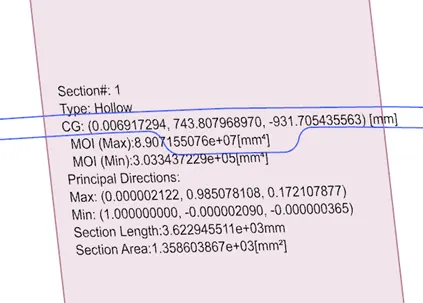
Moment of inertia (min) = 3.033437229e+05[mm^4]
Y=876.8174/2
Y=438.4087mm.
Z=3.033437229e+05[mm^4] / 438.4087mm
Z=691.8927949mm3
Modified Section modulus is 691.8927949mm3.