Roof Design
Provide appropriate dimensions and check for Draft analysis.
Do a curvature study on the roof and perform calculations to determine the position of the Bow-roofs.
Suggest and implement remedies in the design if the criterion is not full-filling
Start with creating a roof ditch area with a tool opening angle of 7 degrees.
Develop the reinforcements as separate parts
ROOF DESIGN AND ITS CALCULATIONS
OBJECTIVE
The main objective of this project is to understand the design process to design the roof with all the roof rails and to understand the calculations behind it. We also learn about the different tools used in NX cad for designing.
DESCRIPTION
DESIGN CONSIDERATION-
-
Visibility criteria
-
Head clearance
-
Curvature study
-
Hear distortion and snow load criteria
-
Draft analysis.
ROOF:
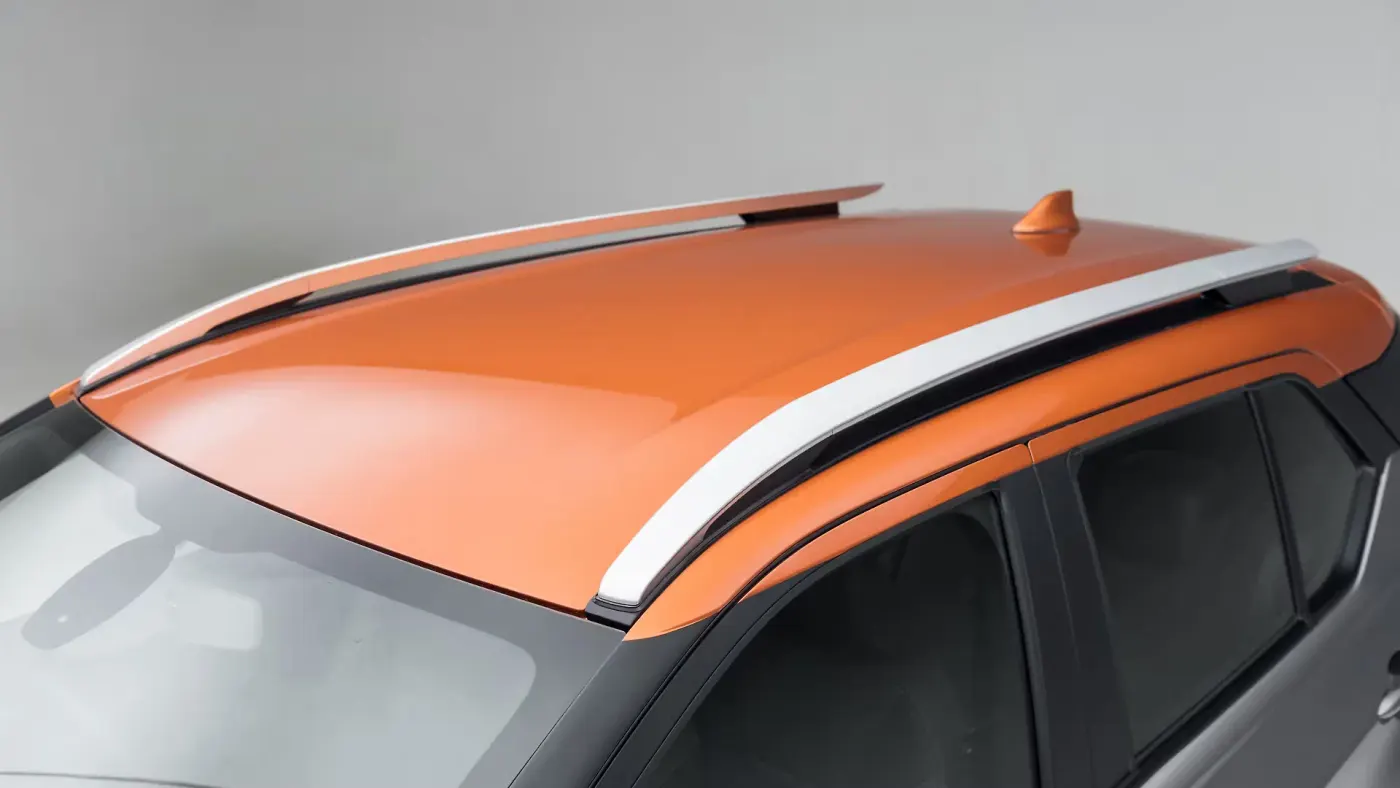
An Automobile roof is the portion of the automobile that sits above the passenger compartment and protects the occupants from sun, wind, rain, and other external elements. While designing a car roof forces due to impact, falling objects, vehicle rollover, temperature, roof loading, aesthetics, etc. must also be taken into account. There are different types of roofs, the most prominent are as follows
- Hardtops
- Soft tops
- Targa tops
- Glass roofs
- T-tops
Some roofs have a window on them and are called sunroofs, while convertibles have special mechanisms that allow the roof to be retracted and stowed away through a wide array of methods depending on the design.
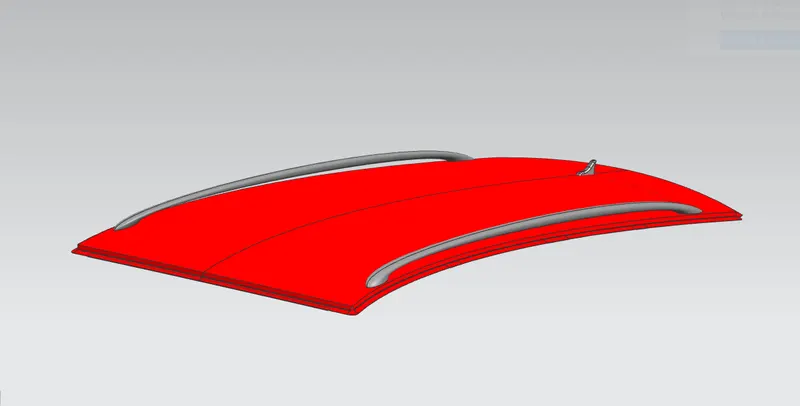
The roof of the car is made up of multiple parts that provide support and strength to the roof component. The actual roof sheet and the roof rails support the roof sheet. There are 3 primary roof rails in a car the front, the center, and the rear, while additional roof rails are called Bow roof rails. The number of bow roof rails depends on the size of the roof. Headroom, visibility criteria, and target region also play a key role in roof design.
INTRODUCTION :
The design of any product starts from a requirement. The design engineer sketches the product based on the requirement. Then the 2D sketch with the proper dimensions is converted into the 3D model using advanced CAD software. Another important thing in the design is that every product that is designed should be able to manufacture. so the role of the design engineer is to design a product that can be easily manufactured and with less cost-effective. This is the place where the Design for manufacturing [DFM] and Design of assembly [DFA] takes a role while developing any product. The process of development of design carries on until the design satisfies the customer's needs.
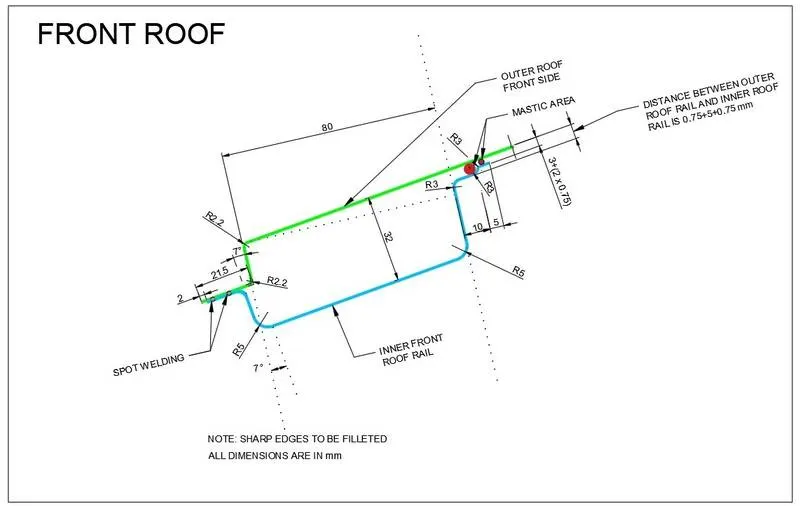
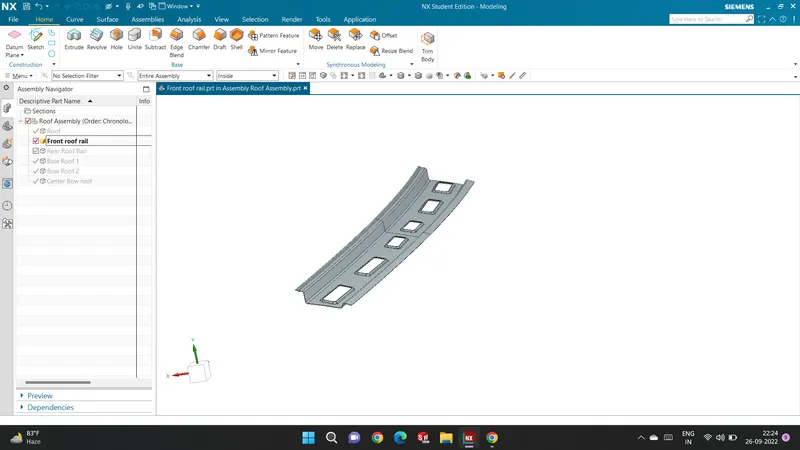
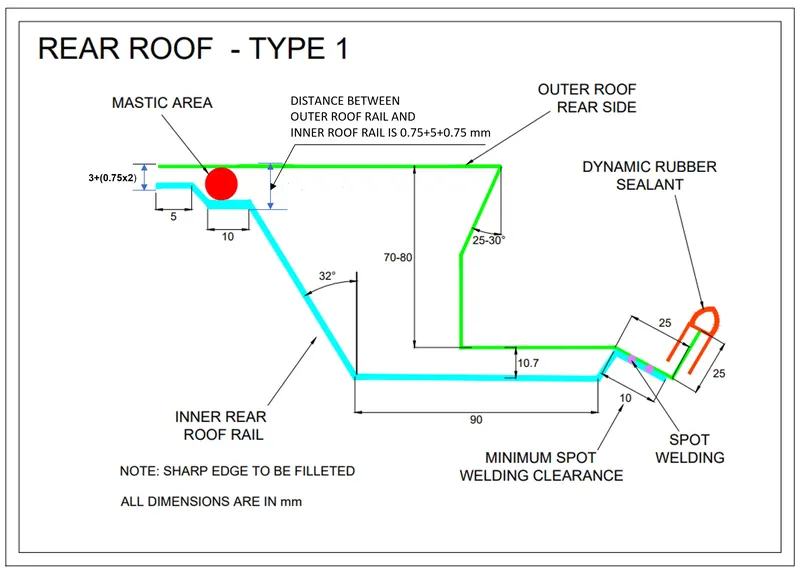
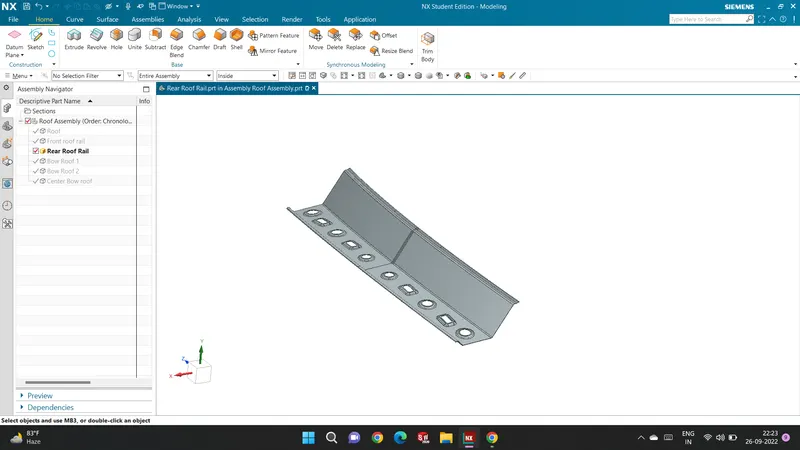
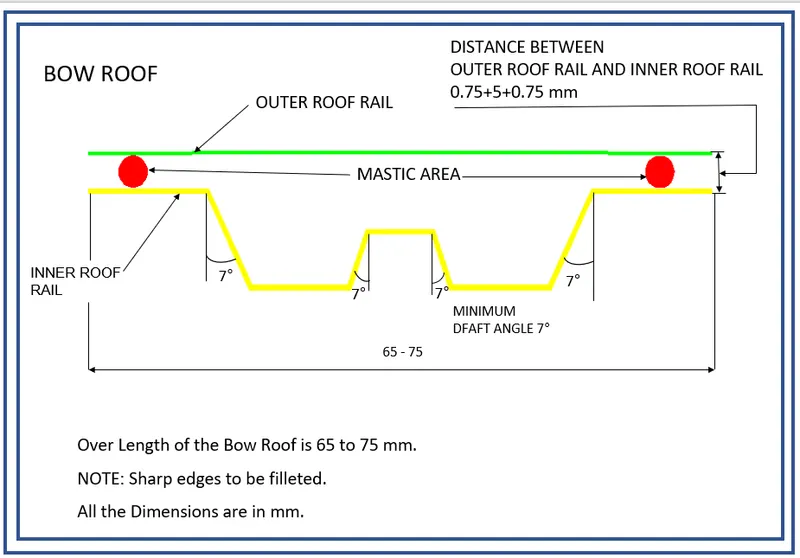
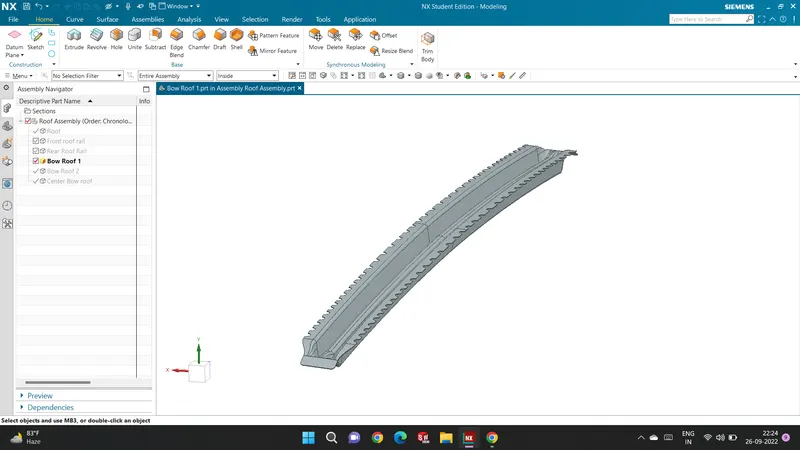
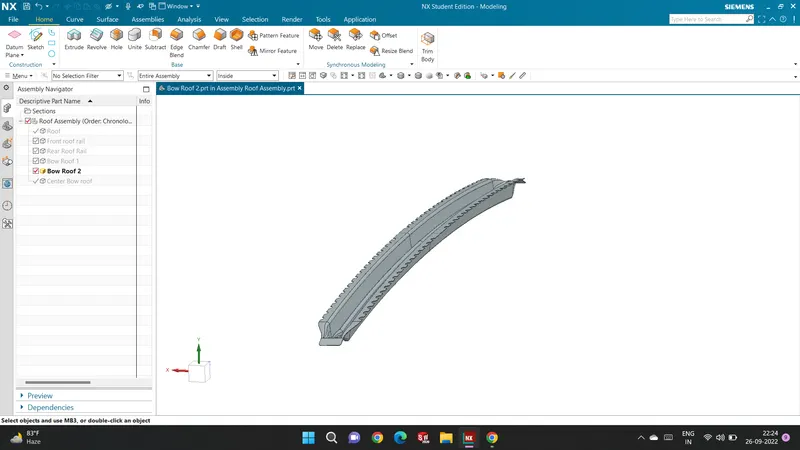
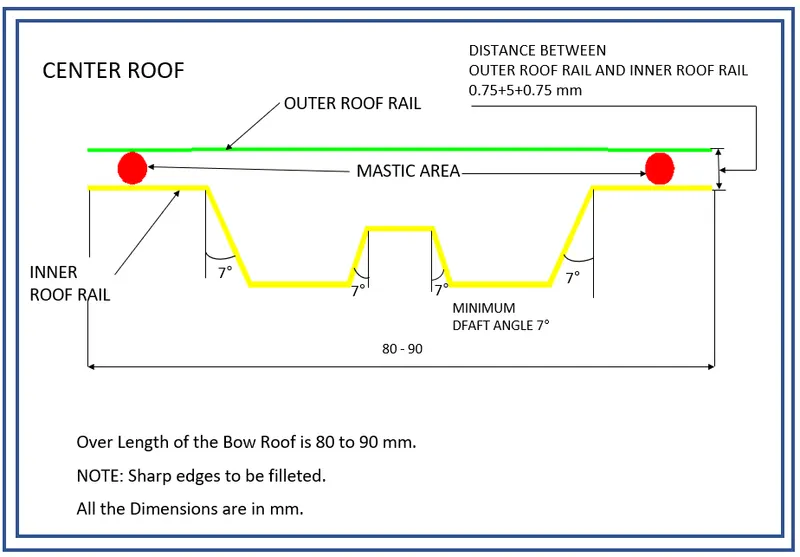
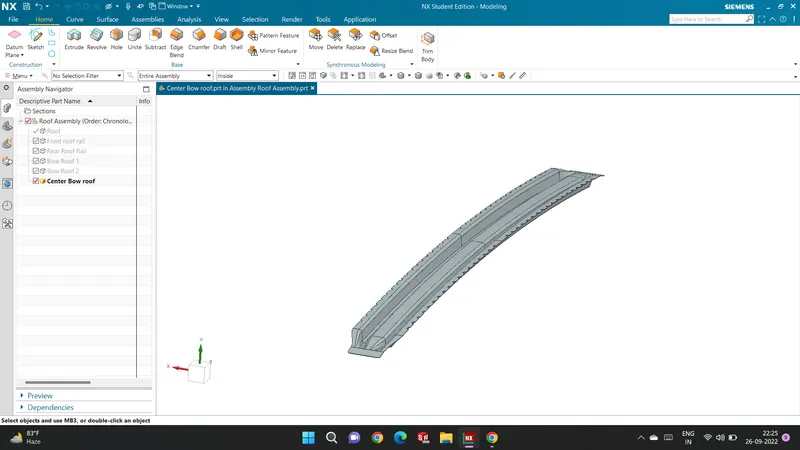
Draft Analysis
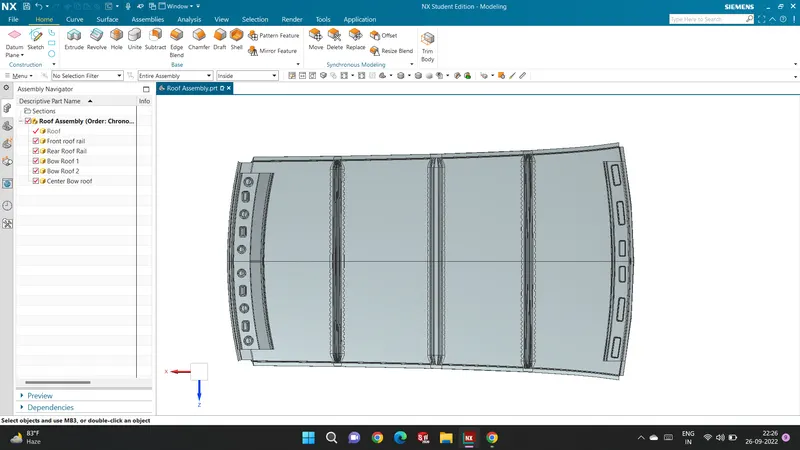
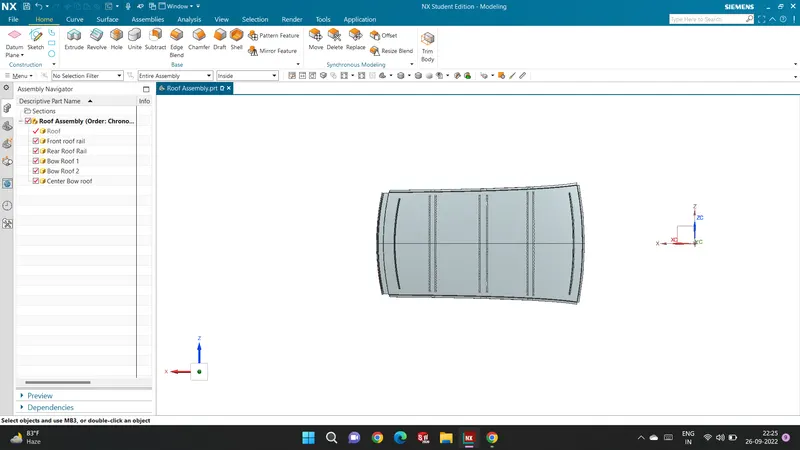
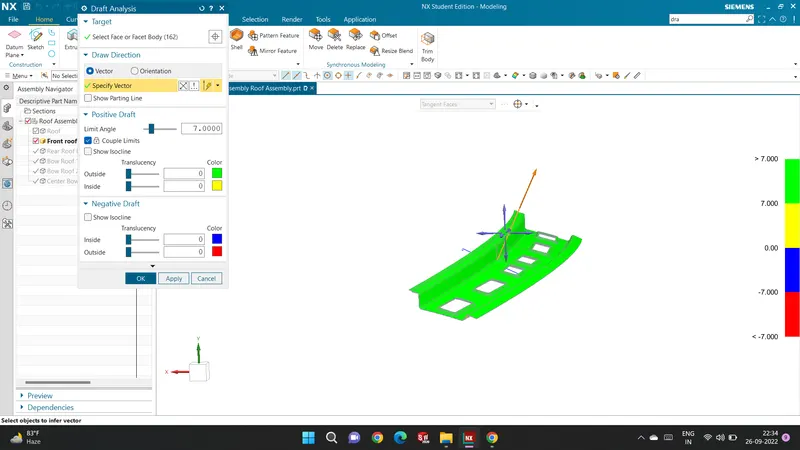
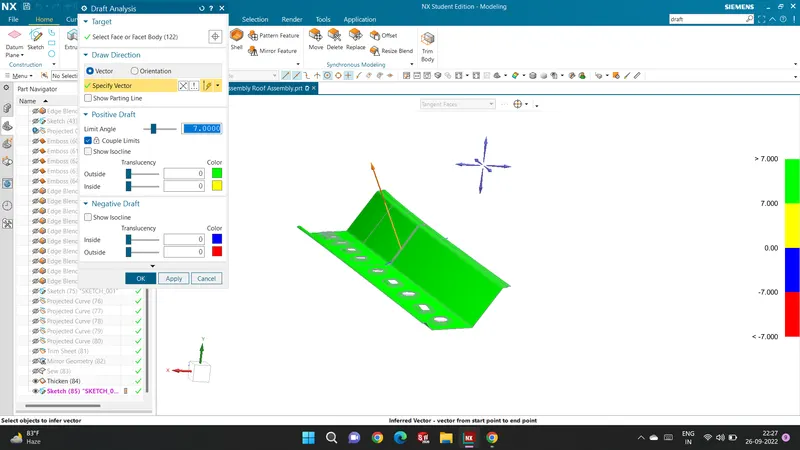
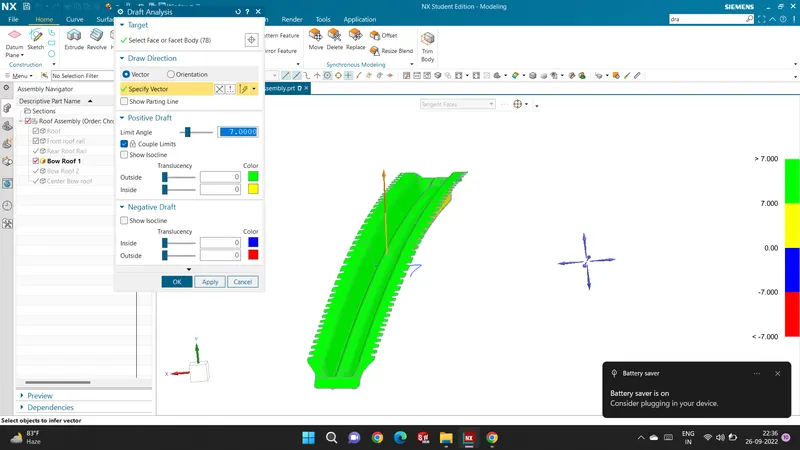
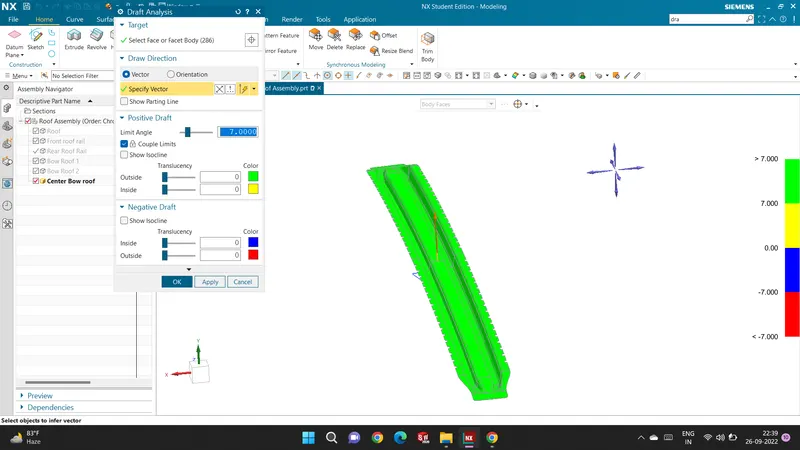
For checking that the draft we were given for this design is good or is in under the conditions that we all know that the minimum draft for the sheet metal design is 7 degree
after that, we analyzed the draft angle, and here following are the pics for the draft analysis
Front Roof Rail
Rear Roof rail
Bow roof 1
Bow roof 2
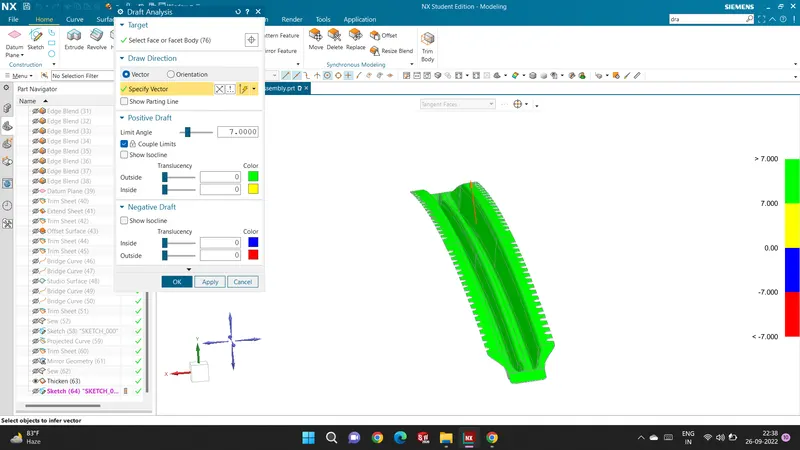
Center bow roof
Bow–Roof Prediction Formula
HEAT DISTORTION STUDY ON THE ROOF :
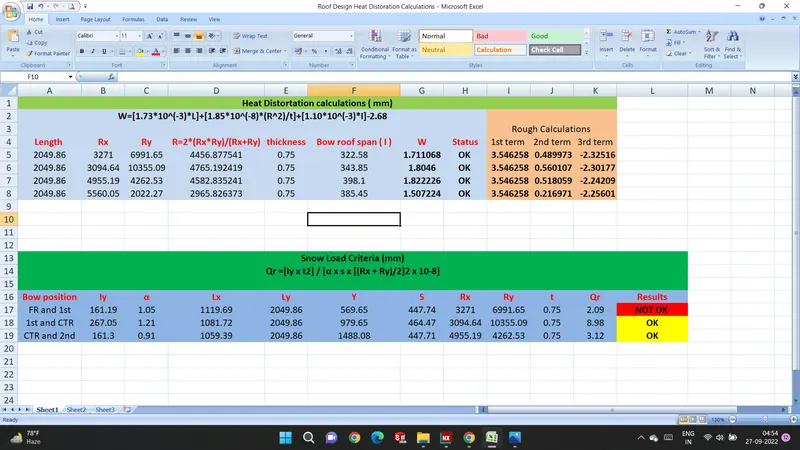
The heat distortion study plays a major role in sheet metal usage. heat distortion temperature is a temperature limit above which the material cannot be used for structural applications. This study is used to predict the heat distortion temperature at where the material starts to soften when exposed to a fixed load at an elevated temperature. In order to avoid bending or damage to the roof, based on the heat distortion temperature, this study will predict the bow roof position which helps to strengthen the roof.
W = [1.73 x 10^(-3) x L] + [1.85 x 10^(-8) x (R^2)/t] + [ 1.10x10^(-3) x l] - 2.68
Where,
L = Roof Length in X-Direction[mm](Roof dimension in 0-Y)
R = Roof curvature
R = 2(Rx*Ry)/(Rx+Ry)
Rx = X curvature
Ry = Y curvature
t = Roof plate thickness [mm]
l = Bow Roof Span [mm]
Judgment Condition
OK< 2.7
Snow Load condition:
The roof of a vehicle is normally not designed to hold up weight but for regions with snowfall, it must be properly reinforced to hold up the weight of accumulated snow on the roof, if done improperly it may cause the roof to bend and intrude into the passenger compartment which is dangerous. This calculation is done in order to check if the location and strength of the roof rails are enough to avoid plastic deformation of the roof.
Snow Load Prediction Formula
Qr = [Iy x t2] / [α x s x [(Rx + Ry)/2]2 x 10-8]
Note: The Qr value given over here is correct. There was a typo error in the formula given in the video.
Where,
α = My x Lx2 x 10-12 , My = Y(Ly-Y)
t = Roof plate thickness [mm]
Ly = Distance between the front and rear roof Rails on the Vehicle along with 0Y[mm]
Length of Roof panel with the center point between Roof rail Front /Rear as the front and rear reference point.
Lx = Distance between the Left and Right end of the roof on the Roof BOW [mm]
The width of the roof panel is exposed on the surface.
Y = Distance front Front Roof Rail to Roof BOW[mm]
s = Distance for which Roof BOW bears divided load [mm]
s = L1/2 + L2/2
Iy = Geometrical moment of inertia of Roof BOW (Y cross-section )[mm4]
Rx = Lateral direction curvature radius of roof panel Y cross-section on Roof BOW [mm]
Roof panel curvature Radius of the Length Lx in Front view
Ry = Longitudinal Direction curvature radius of the Roof panel X cross-section on Roof BOW [mm]
Roof panel X curvature radius of length s in Side view
Judgment condition
Qr ≥ 3.1
250 ≤ s ≤ 380
Conclusion
For The snow load condition we needs to improve our design strength in order to bear the load of the snow in the season of snowfall. for this we have to make some more embossed on our design so we can protect it.