Roof Design
Objective:-
- Create a roof assembly by developing the essential flanges for the outer roof and creating the reinforcements.
- Perform the draft analysis.
- Do a curvature study on the roof and perform calculations to determine the position of the Bow-roofs.
- Calculate snow load prediction value.
ROOF -
A roof refers to the topmost structural component of a car that encloses the passenger compartment and provides protection from the elements. It is typically a solid or retractable structure that covers the interior space of the vehicle, separating it from the external environment.
The purposes of a roof on a car are as follows:
-
Shelter and Protection: The primary function of a car roof is to provide shelter and protection to the occupants from various external elements such as rain, snow, wind, sunlight, and debris.
- Structural Integrity: The roof plays a crucial role in maintaining the structural integrity of the vehicle. It provides support and rigidity to the car's body, enhancing overall stability and safety.
- Noise Reduction: A well-designed roof contributes to reducing external noise from reaching the interior cabin.
-
Aerodynamics: The shape and design of the roof can influence the aerodynamics of the vehicle. A streamlined roof helps reduce air resistance and drag, which can enhance fuel efficiency and overall performance.
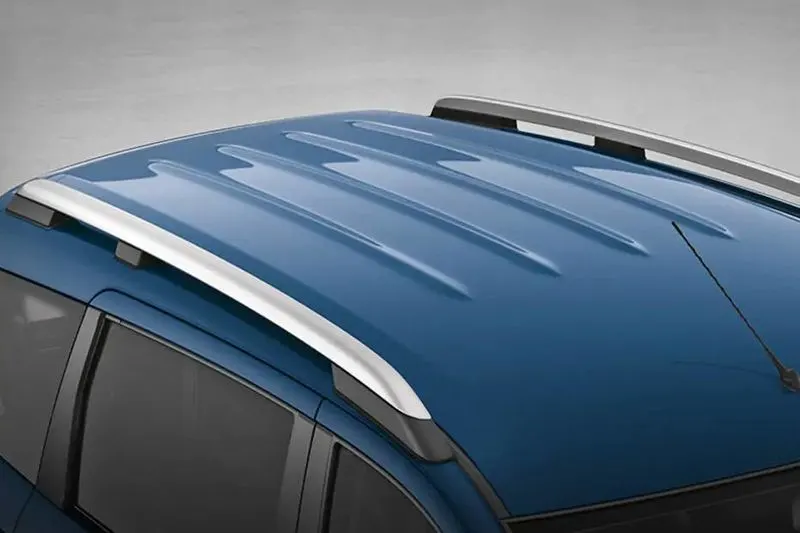
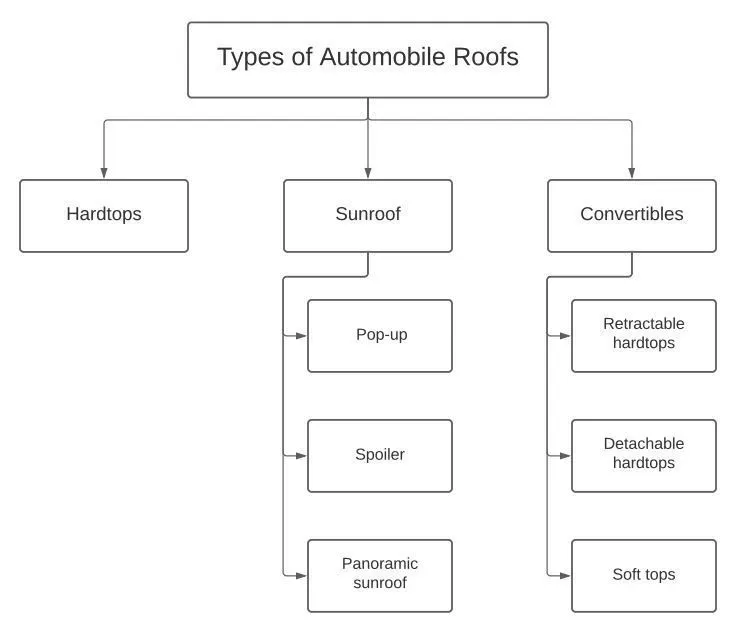
There are several types of roofs found on cars, each with its design and functionality. The most common types of car roofs include:
-
Hardtop: A hardtop roof is a fixed and solid roof that is typically made of metal or composite materials. It provides a permanent and secure enclosure for the passenger compartment and offers excellent protection from the elements. Hardtops can be found in various styles, such as sedan roofs, coupe roofs, and hatchback roofs.
-
Soft Top: Soft tops, also known as convertible or cabriolet roofs, are typically made of fabric or vinyl materials. These roofs can be manually or electronically folded down or removed, allowing the vehicle to be driven with an open-top configuration. Soft tops are commonly found on convertible cars and provide the option to enjoy open-air driving.
-
Targa Top: A targa top is a removable roof panel that typically covers only a portion of the passenger compartment, usually the area above the front seats. It is commonly found in sports cars and offers a compromise between a hardtop and a convertible. Targa tops provide an open-top driving experience while still maintaining some structural rigidity.
-
Sunroof: A sunroof is a panel installed on the roof of a car that can be opened or tilted to allow fresh air and sunlight into the passenger compartment. Sunroofs can be manually operated or motorized, and they come in various designs, including pop-up sunroofs, sliding sunroofs, and panoramic sunroofs that extend over a larger portion of the roof.
INPUTS:-
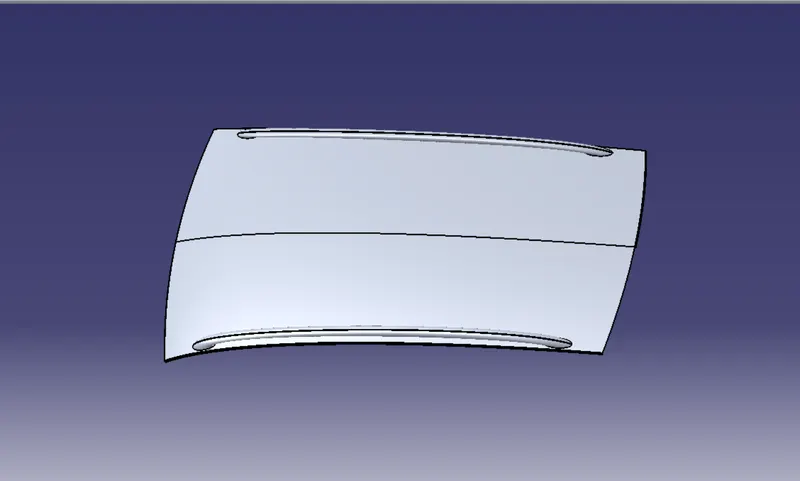
The Styling Surface of the Roof.
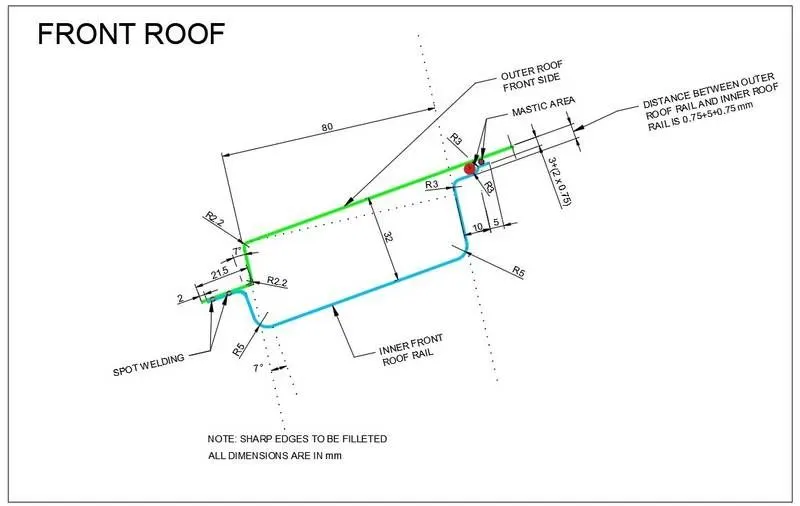
Master Section of the Front Roof Rail-
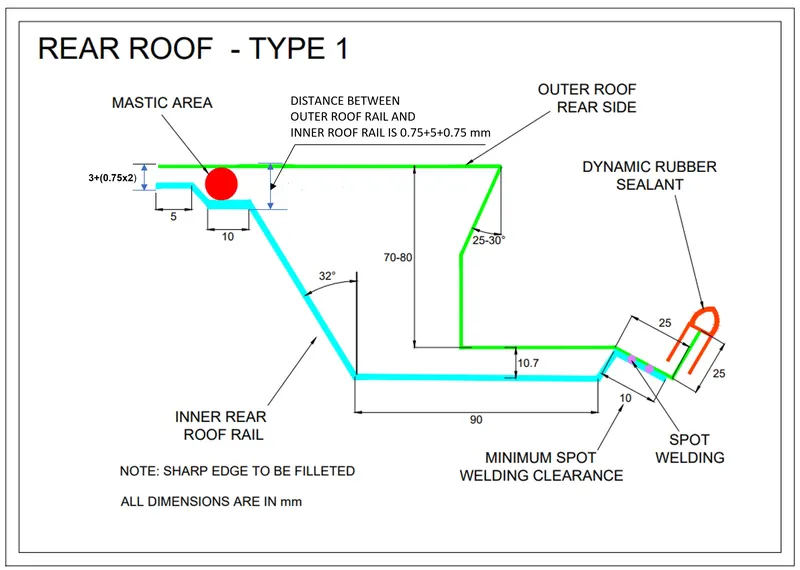
Master section of the Rear Roof Rail-
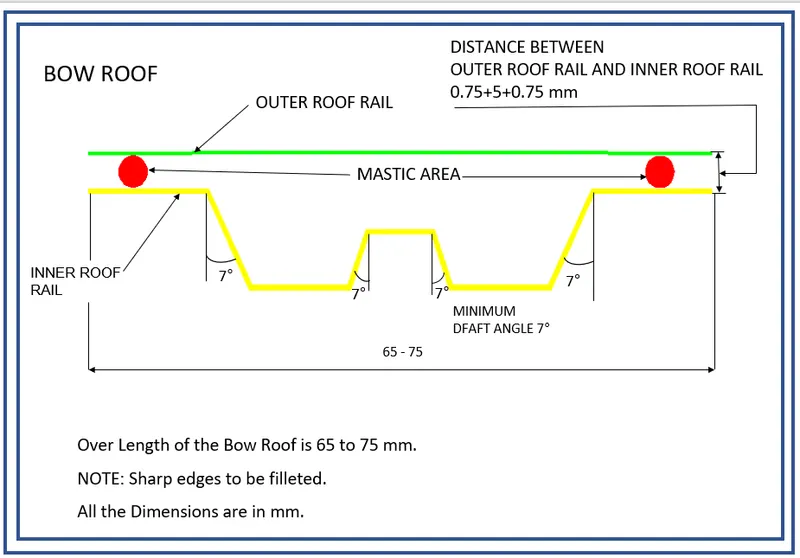
Master section of Bow Roof-
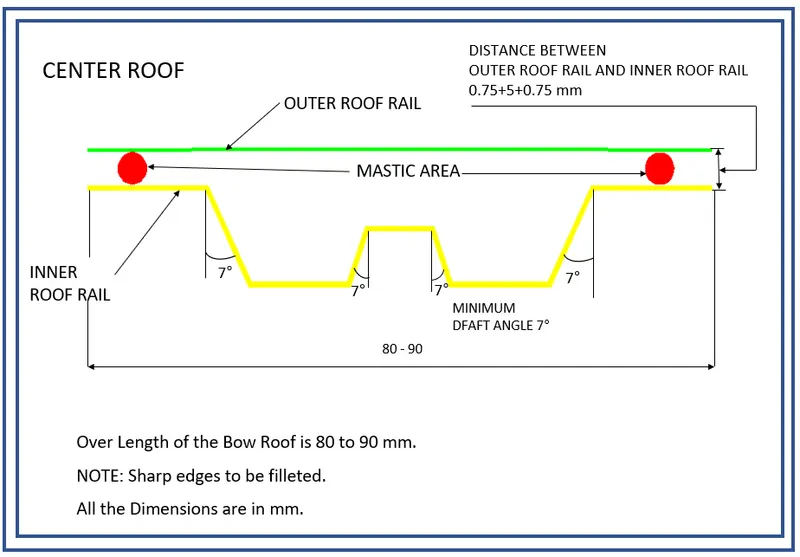
Master section of Center Reinforcement Rail-
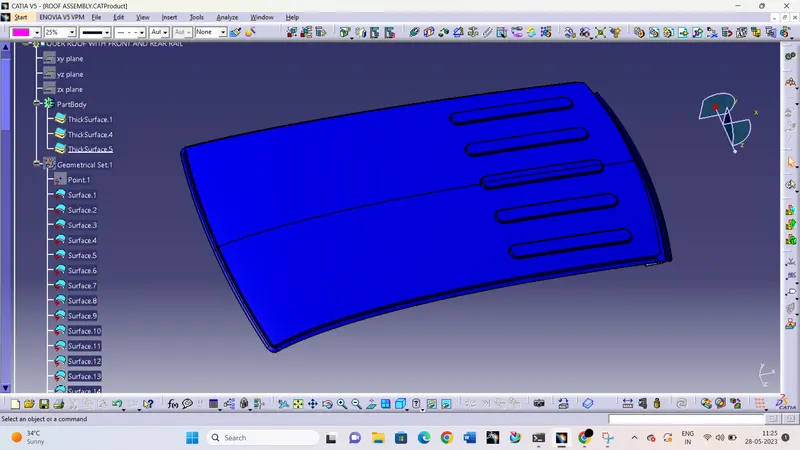
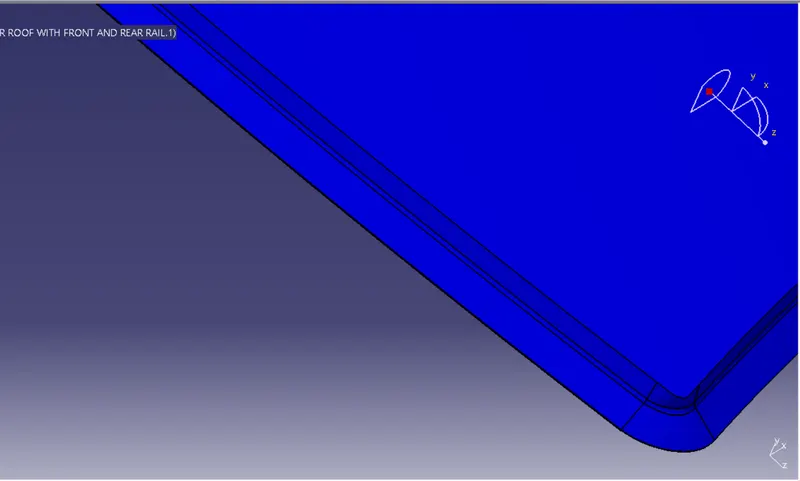
ROOF DITCH AREA AND FLANGES:
The roof ditch area and flanges are created in relation to visibility criteria, safe head distance, headliner, and various other factors which govern the size of the roof rails and also which are related or connected to the roof like a windshield.
ROOF RAILS-
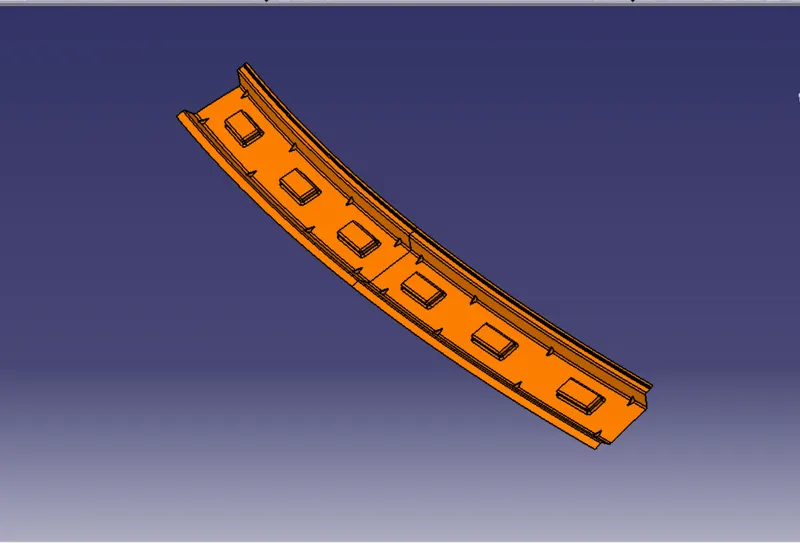
1.) FRONT ROOF RAILS-
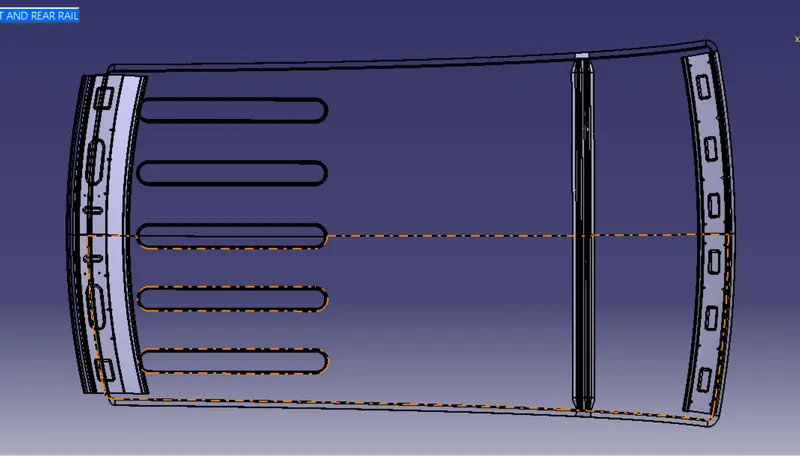
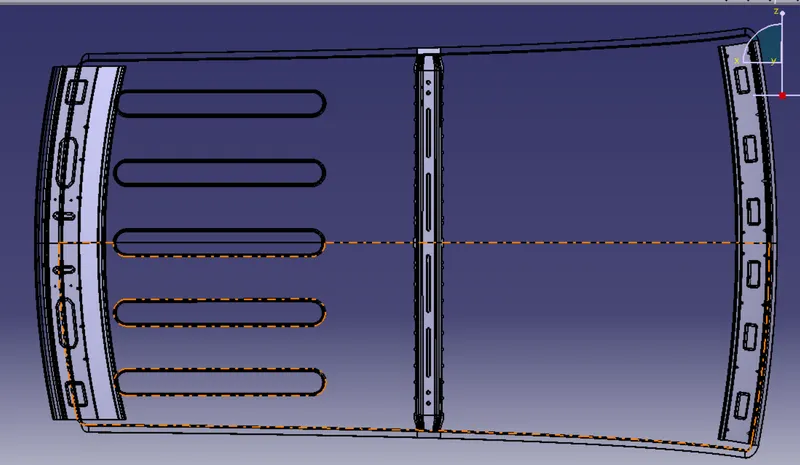
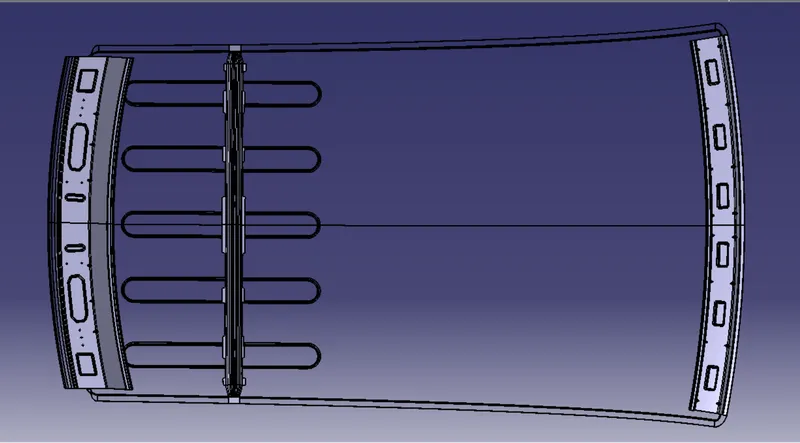
Front Roof Rail is a reinforcement that features to back of the bracket lamp and the room lamp and it also serves the purpose of attaching the windshield. The development of the FRR is based on the given master section and also references from the given styling and the front ditch area are taken into consideration. Embosses and darts are incorporated for strengthening the part.
2)REAR ROOF RAIL
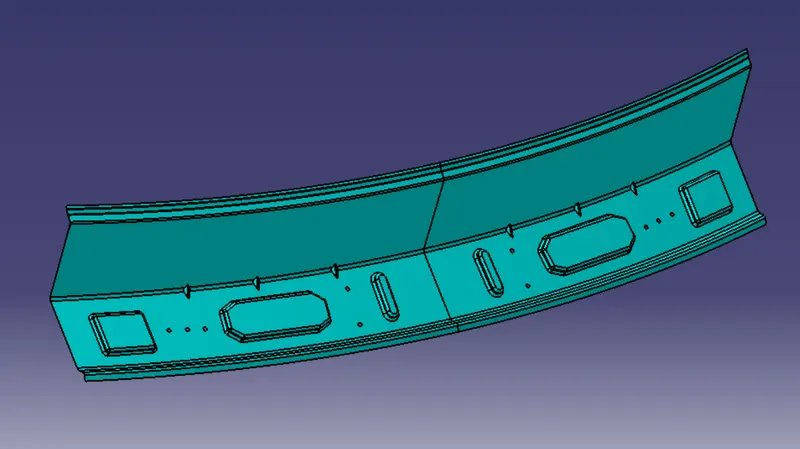
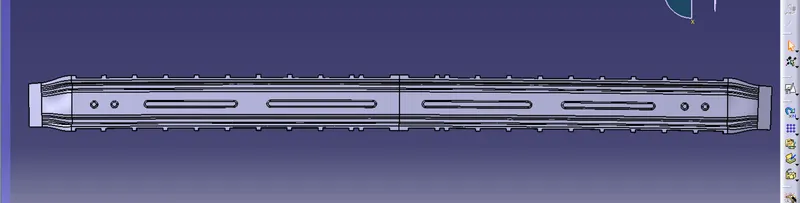
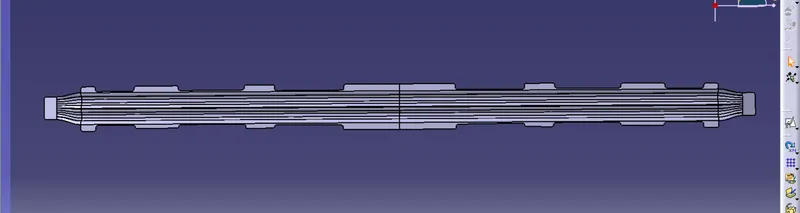
The rear roof rail is connected to the backdoor part so it plays a vital role in the design of the roof as it is co-related with the other part as well.
3) BOW ROOF 1
4) CENTER ROOF RAIL:
5) BOW ROOF 2
HEAT DISTORTION CRITERIA:
In this criterion, we check the heat distortion capacity of the roof at higher temperatures with the fixed load on it. So when the surrounding temperature is high and the roof is loaded with some weight on it then if the roof is deformed it fails, so to calculate whether the roof deforms or not, according to the position of the bow we do these calculations as follows:
Bow–Roof Prediction Formula
W = [1.73 x 10^(-3) x L] + [1.85 x 10^(-8) x (R^2)/t] + [ 1.10x10^(-3) x l] - 2.68
Where,
L = Roof Length in X-Direction[mm](Roof dimension in 0-Y)
R = Roof curvature
R = 2(Rx*Ry)/(Rx+Ry)
Rx = X curvature
Ry = Y curvature
t = Roof plate thickness [mm]
l = Bow Roof Span [mm]
Judgment Condition
OK< 2.7
STEPS TO CALCULATE HEAT DISTORTION:
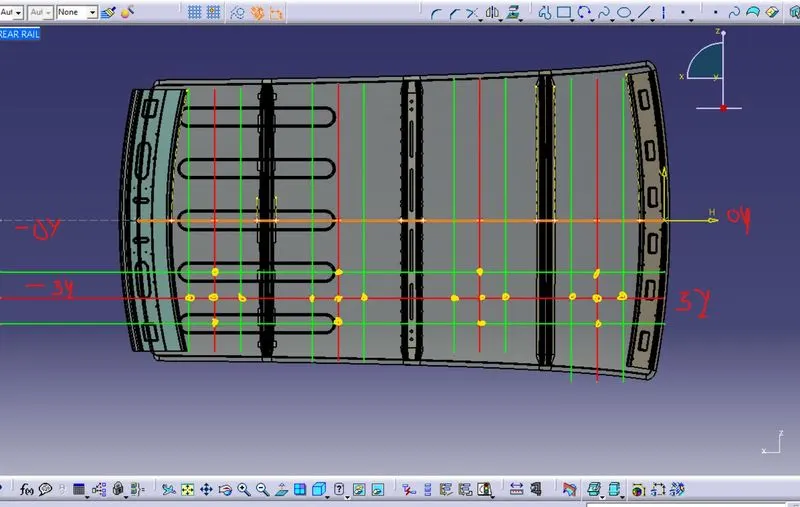
- Create two points on the roof styling surface at the start and at the end in parallel to the xy plane section and create a line(O-Y) on the center using these two points.
- First we offset the center y-axis line to 300mm distance apart from it represented as (-3Y to 3Y red line).
- After that we offset this -3Y to 3Y to 100mm offset each side represented with the green line.
- We draw the vertical red line at the center of the two consecutive bow rood span. Next, we offset this red line to 100 on each side.
- Now we have three horizontal lines and three 12 vertical lines we take the intersection points of the vertical red line with three horizontal lines and a horizontal red line we take the intersection of the vertical lines with that line.
- After getting all the points we project these points on the roof surface and draw the three points curve along the x-axis point to get the radius of curvature of Ry and along the y-axis points to get the radius of curvature of Rx.
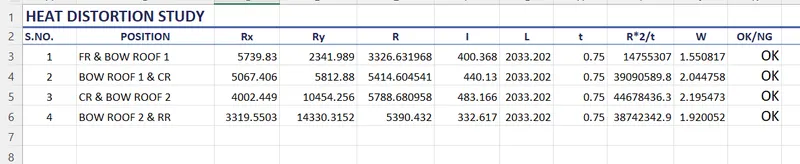
For the front roof rail and bow roof 1
`Rx = 5739.83mm`
Ry = 2341.989mm
R = 2(Rx*Ry)/(Rx+Ry) = 2(5739.83*2341.989)/(5739.83+2341.989) = 3326.631968
`I= 400.368mm`
L = 2033.202mm
t = 0.75mm
Putting all values in the equation,
W = [1.73 x 10^(-3) x L] + [1.85 x 10^(-8) x (R^2)/t] + [ 1.10x10^(-3) x l] - 2.68
W + [1.73 * 10^(-3) * 2033.202] + [1.85 x 10^(-8) x (3326.631968^2)/0.75] + [ 1.10x10^(-3) x 400.368] - 2.68
W=1.55
The condition for the heat distortion criteria is W<2.7 so the result value is less than 2.7 so the position of the bow 1 is correct according to the heat distortion criteria.
We will calculate the rest of the bow roof and center roof rail by the same method.
SNOW LOAD CONDITION :-
This snow load condition calculation is done to check the strength of the roof when there is dead weight on the roof. As we know that in some regions we have snowfalls so when snow falls on the roof then this act as dead weight because in some the rate of snowfall is more so the roof should sustain this dead weight for that we do this calculation to check the position of the bow and its sectional area.
Snow Load Prediction Formula
Qr = [Iy x t2] / [α x s x [(Rx + Ry)/2]2 x 10-8]
Note: The Qr value given over here is correct. There was a typo error in the formula given in the video.
Where,
α = My x Lx2 x 10-12 , My = Y(Ly-Y)
t = Roof plate thickness [mm]
Ly = Distance between the front and rear roof Rails on the Vehicle along with 0Y[mm]
Length of Roof panel with the center point between Roof rail Front /Rear as the front and rear reference point.
Lx = Distance between the Left and Right end of the roof on the Roof BOW [mm]
The width of the roof panel is exposed on the surface.
Y = Distance front Front Roof Rail to Roof BOW[mm]
s = Distance for which Roof BOW bears divided load [mm]
s = L1/2 + L2/2
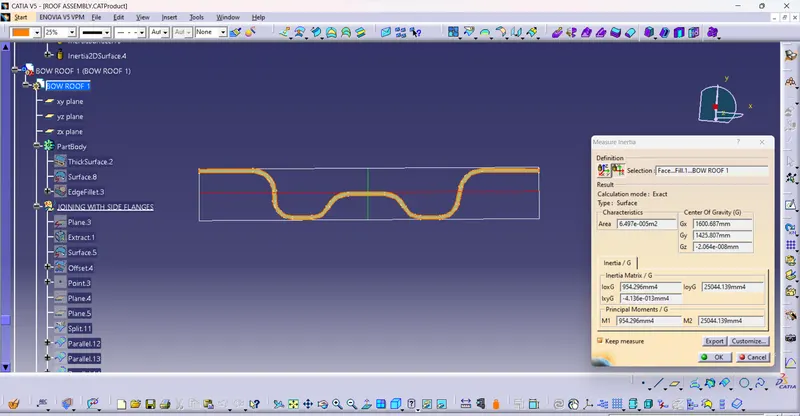
Iy = Geometrical moment of inertia of Roof BOW (Y cross-section )[mm4]
Rx = Lateral direction curvature radius of roof panel Y cross-section on Roof BOW [mm]
Roof panel curvature Radius of the Length Lx in Front view
Ry = Longitudinal Direction curvature radius of the Roof panel X cross-section on Roof BOW [mm]
Roof panel X curvature radius of length s in Side view
Judgment condition
Qr ≥ 3.1
250 ≤ s ≤ 380
Moment of Inertia of BOW ROOF 1:-
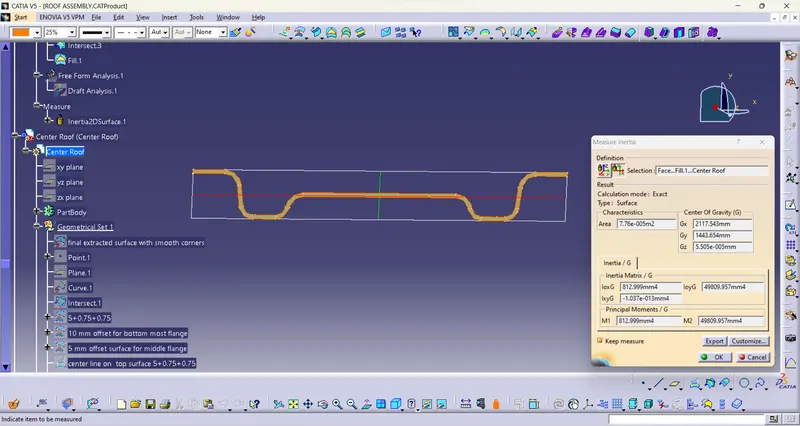
Moment of Inertia of Center ROOF:-
Moment Of Inertia of BOW ROOF 2:-
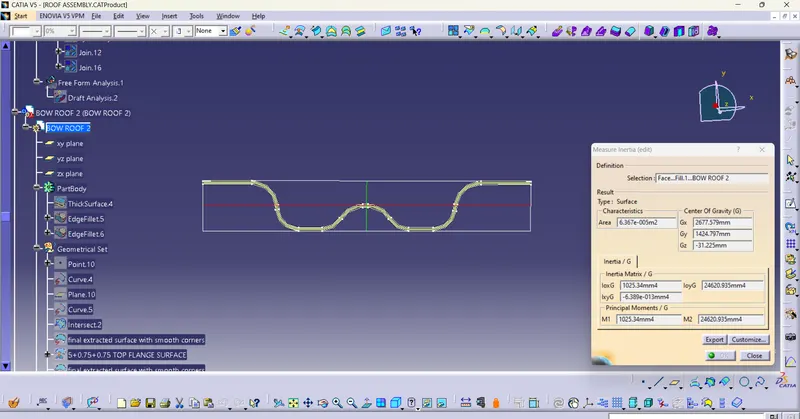

From the above-resulted values, the positioning of bow roofs is capable enough to meet the snow load parameter conditions and also satisfies it.
DRAFT ANALYSIS:-
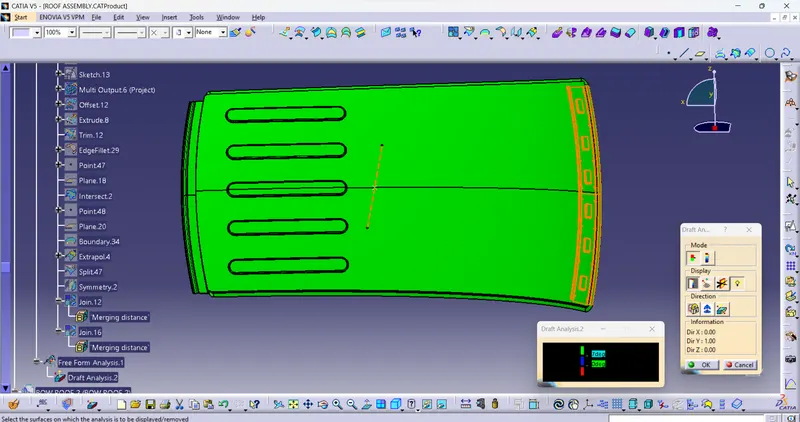
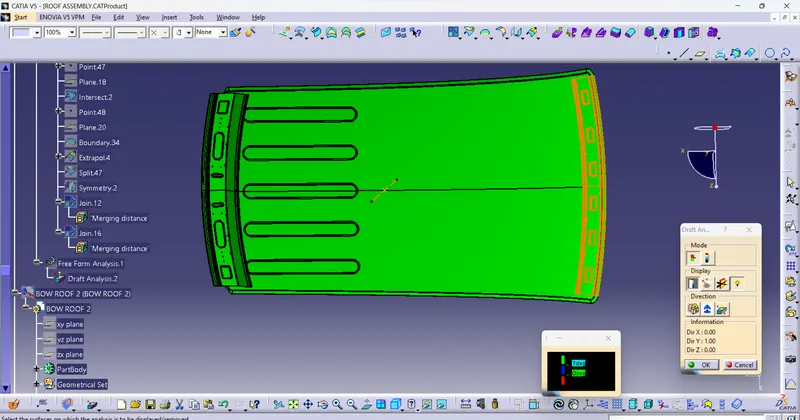
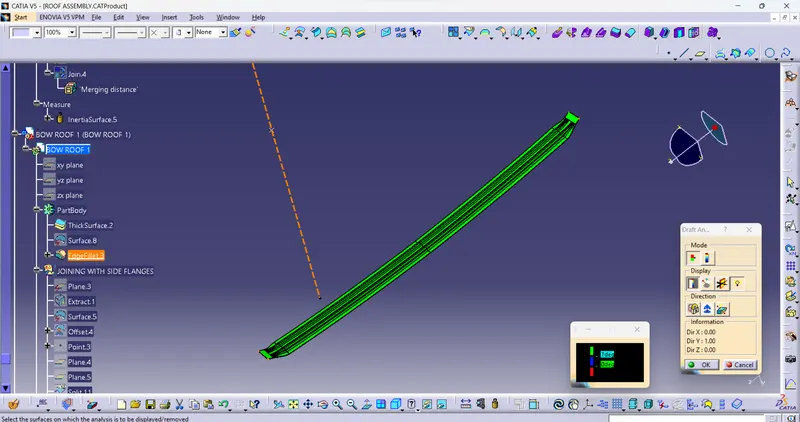
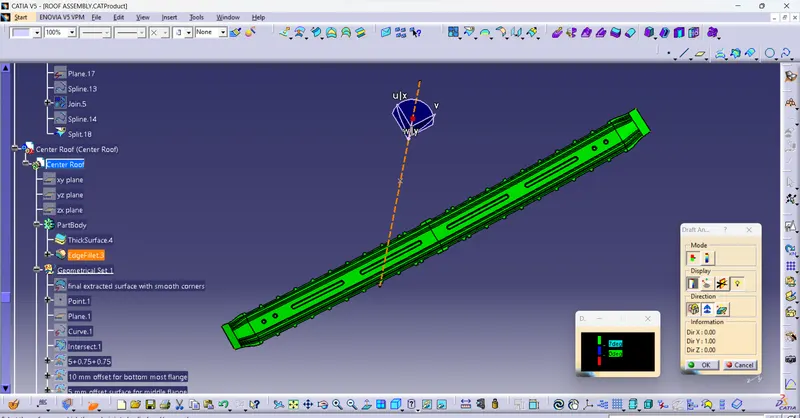
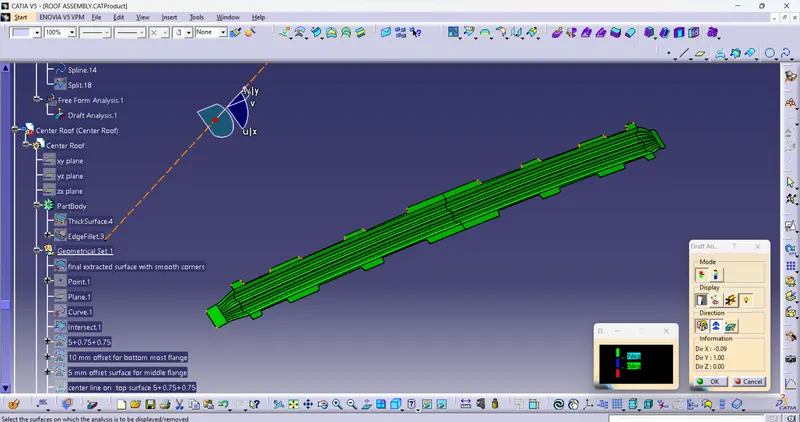
Draft Analysis is carried out to check the manufacturing feasibility of the roof and all the reinforcements rails. All the components should be designed by considering at least the minimum draft value of 7 Deg.
ROOF OUTER:
FRONT ROOF RAIL & REAR ROOF RAIL:
BOW ROOF 1:
CENTER ROOF RAIL:
BOW ROOF 2:
CONCLUSION:
Now, we have understood the types of roofs and their purposes, and also give strength to roofs by providing bow roofs and center reinforcement roofs. We also studied how can we predict the location of bow roofs by doing a curvature study i.e. Heat Distortion Study and also learned to calculate the snow load parameter for better designing of roofs.
So we have designed the roof with considering all the rules and parameters.