Roof Design
AUTOMOBILE ROOF
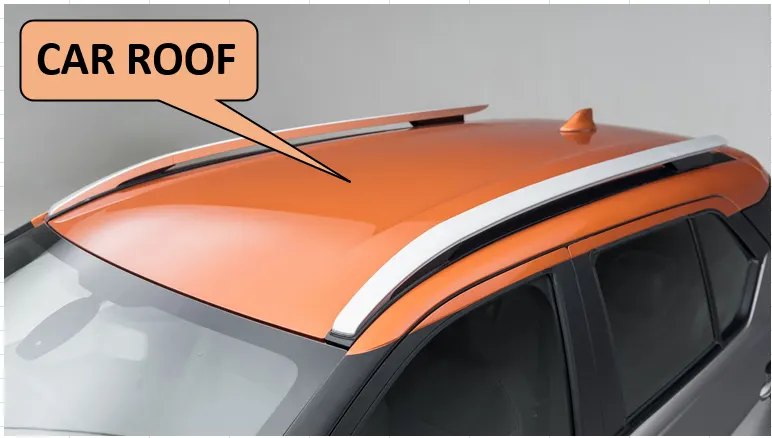
Automobile Roof or Car top is the portion of an automobile that assembled over the passenger compartment, main purpose of roof is to protect the occupants from sun, wind, rain, snow, dust and other external elements. Roof also prevent occupants from any injury when the car get crashed or rolled over or something heavy fall on it.
- TYPE OF ROOF
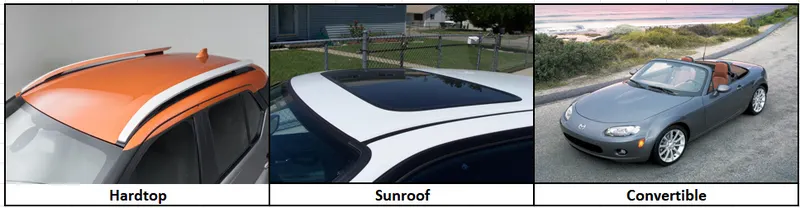
Some of the commonly used car roof that are used in modern days are :
- Hardtop : Hardtop is the rigid form of automobile roof, typically made up of metal, and integral to the strength, design and style of the vehicle.
- Sunroof : Sunroof refer to the movable panel that open up to uncover the window of automobile roof allows fresh air and light enter into the passenger compartment.
- Convertible : Convertible is a passenger car that can be driven with or without the roof. The convertible roof is retract and stored in the car.
- COMPONENTS OF ROOF
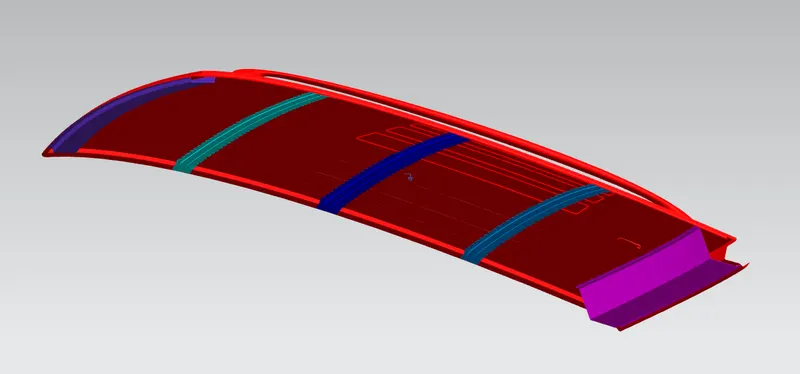
As the outer roof panel along not withstand the load exerted by the external agents such as snow. So, to improve its stength in such condition reinforcement is to be attached with roof outer panel in the form of componenet such as Front roof rail, Centre roof rail, Rear roof rail and bow roof rails. Thats provide strength to the roof to withstand the load exerted by snow or other external agent on roof top and prevent it from dent.
1. Front Roof Rail
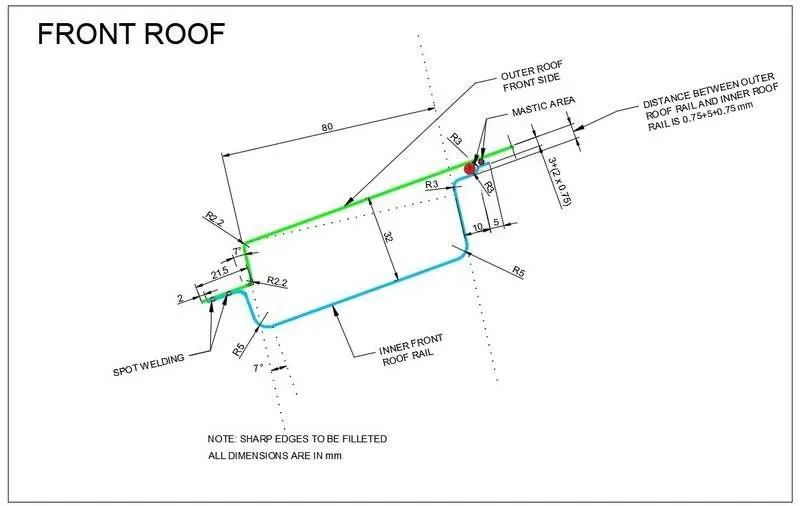
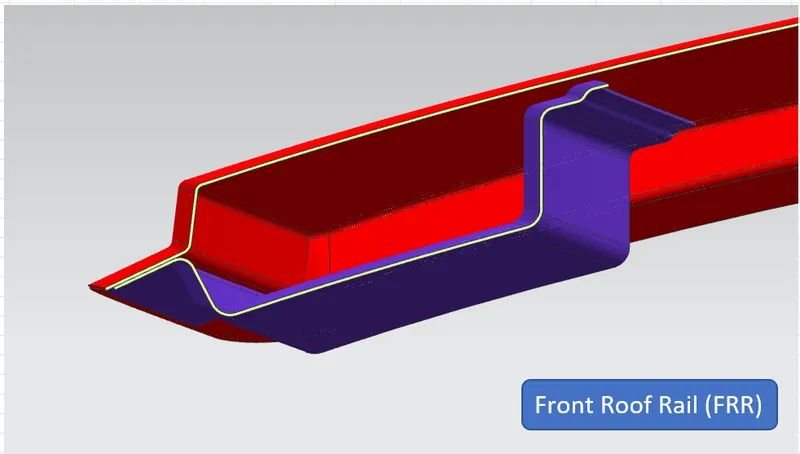
Front roof rail is attached to the front end of the roof outer panel. it provide strength to the front section of roof outer panel. Also, allow the joining of wind shied glass to the roof of automobile.
- Joining Mechanism : Front extended part or wind shield end of the front roof rail is spot welded to the roof outer panel and the rear part of the front roof rail is joined with roof outer panel with mastic seal to provide strength to roof in front section.
- Design Consideration : Head room clearance of passenger and visibility criteria taken into account for design of front roof rail. Also, Draft angle will be more than 7° from tool axis required.
Master section of Front Roof Rail (FRR) :
Design of Front Roof Rail (FRR) :
2. Centre Roof Rail
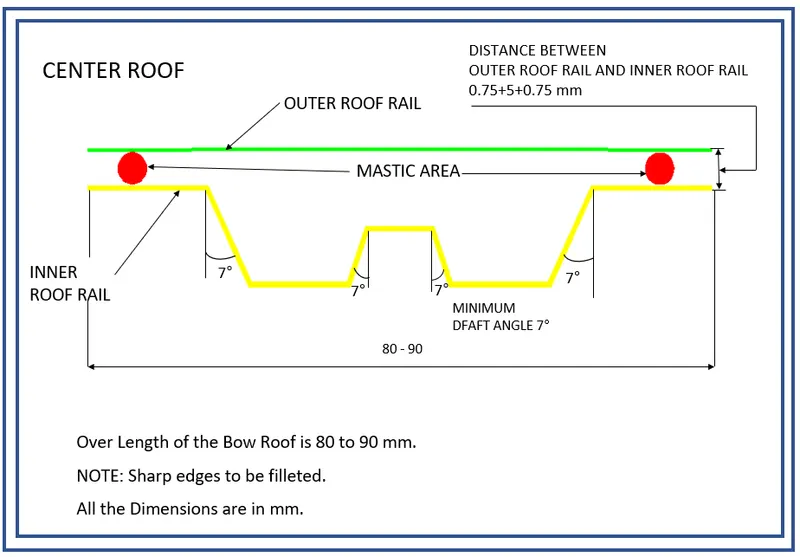
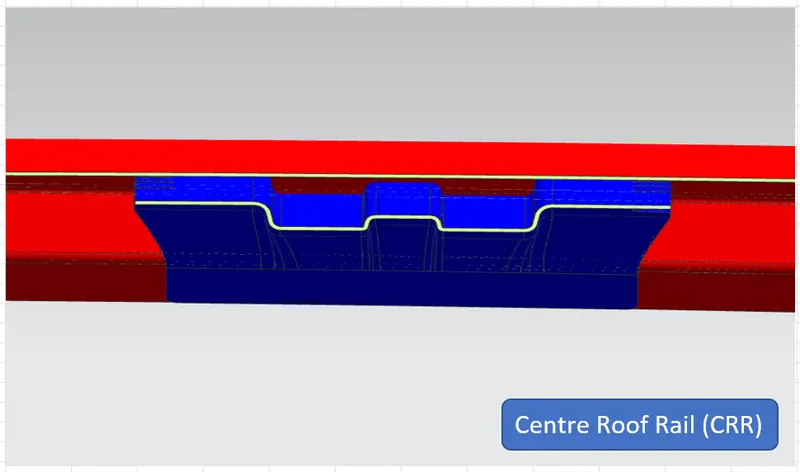
Centre roof rail or reinforcement centre is present in the centre of roof. it enhance the strength at the centre region of roof top. its provide support to the roof outer panel at middle of roof.
- Joining Mechanism : Centre roof rail is joined with the roof outer with the help of mastic sealent along the span. where, both the outer end of rail is spot welded to roof extension.
- Design Consideration : Design should pass the draft analysis at an angle more than 7° and contibute to snow load criteria.
Master section of Centre Roof Rail (CRR) :
Design of Centre Roof Rail (CRR) :
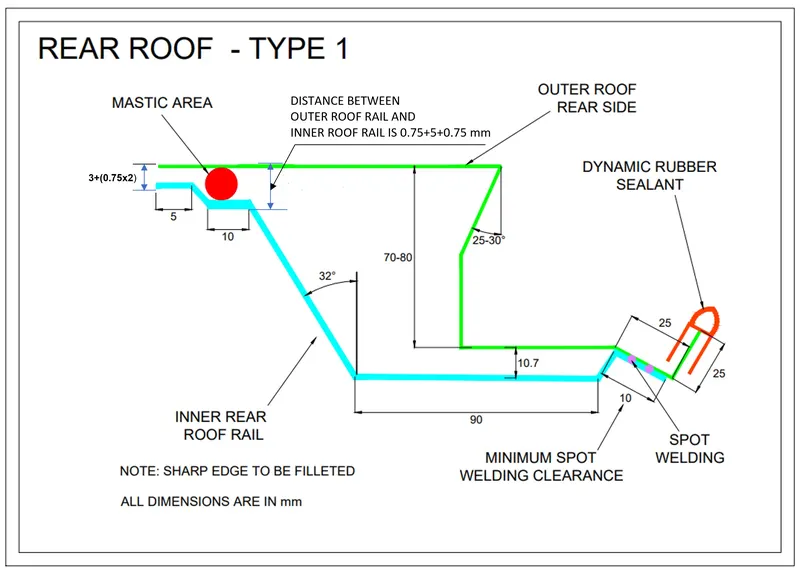
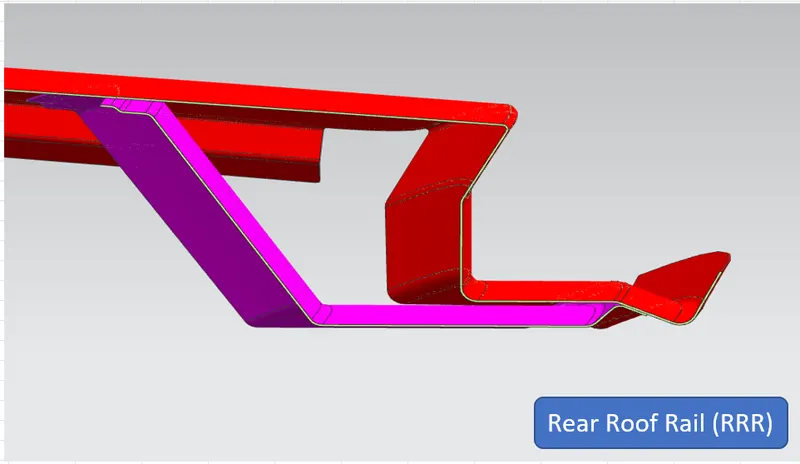
3. Rear Roof Rail
Rear roof rail is joined with the roof outer panel at rear end of the roof top. it provide strength and support to the rear section of roof outer. it also allow the joining of back door to roof.
- Joining Mechanism : Rear extended part of rear roof rail is spot welded with rear extended flange of roof outer. where, the front part of rear roof rail is joint with roof top with mastic sealent.
- Design consideration : Input of back door is consider for the design of rear roof rail. it also pass the draft analysis requirement of angle more than 7° from tooling axis.
Master section of Rear Roof Rail (RRR) :
Design of Rear Roof Rail (RRR) :
4. Bow Roof Rail
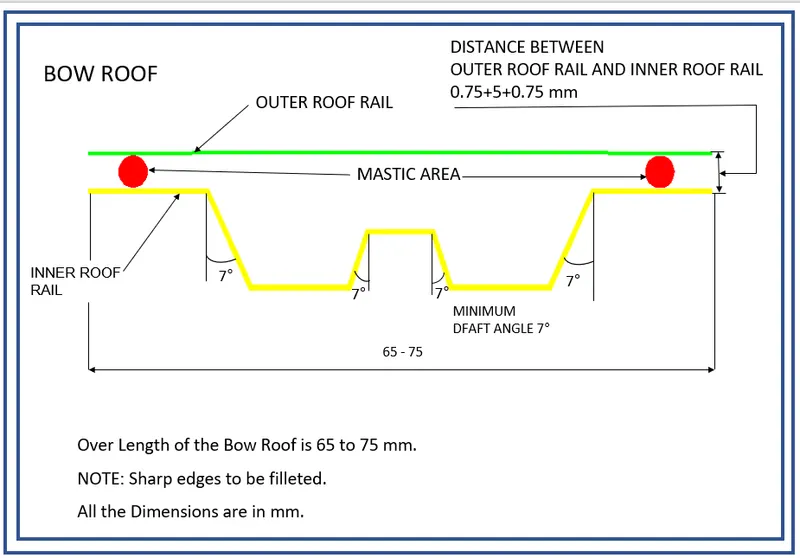
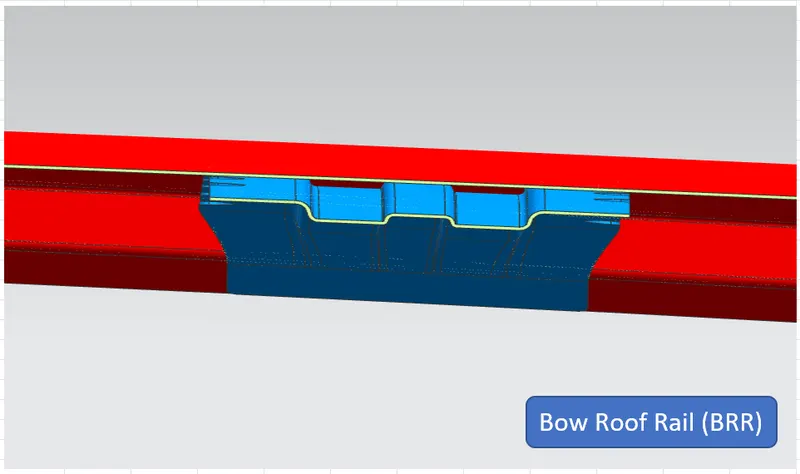
Bow roof rail are assembled in the middle region of roof outer. it provide strength to roof outer panel and enhance load bearing capacity of roof top. Number and position of bow joint to roof outer panel is depend upon the length of roof span.
- Joining Mechanisms : Bow roof rail is joint to roof top with mastic sealent along rail span. and, the outer extended part of roof rail is joint with roof outer through spot welding.
- Design Considerartion : Draft angle will be more than 7° from tooling axis. It also pass heat distortion, bow roof prediction and snow load criteria.
Master section of Bow Roof Rail (BRR) :
Design of Bow Roof Rail (BRR) :
Design of Roof Assembly
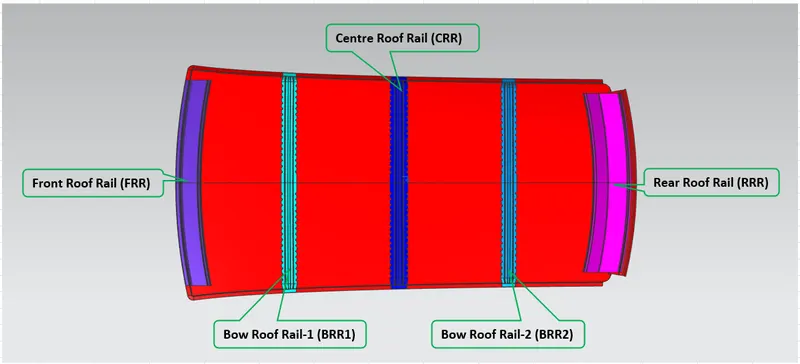
Design Consideration of Roof Assembly :
- Visibility Criteria
- Head Clearance of passenger
- Curavature study
- Heat Distortion Study
- Snow Load Criteria
- Draft Analysi
- Back door input
- Wind shield input
Analysis of Roof Assembly
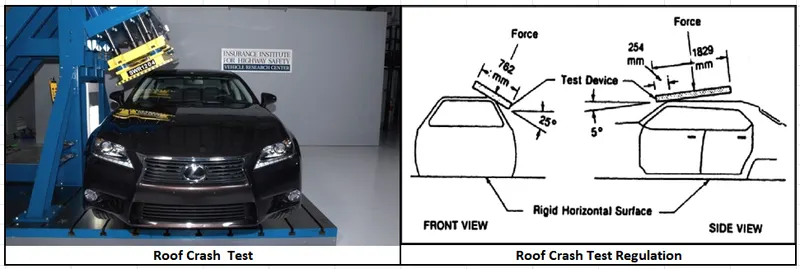
1. Roof Crush Test
Roof crush test is one of the test used in occupant safety analysis. It used to evaluate how car will deform during rollover accident. Safer car does not deform as much and providing occupant larger survival space during this kind of accident. During this test, plate shaped impactor is pushed down on one side of the roof at constant speed. This load case challenges the solver due to large deformations, complex contact situations and local buckling.
Purpose : To control injury and death of occupant due to crushing of vehicle roof into passenger compartment in rollover crashes.
Procedure : Vehicle or body-in-white (BIW) is mounted on the rig bedplate, supported along the sills and chassis frame. The loading plate, held at the regulation requirement angles, is lowered onto the roof structure. Then, loaded to the specified force based on the unloaded mass of the vehicle.
Video recordings taken from inside and outside of the vehicle during the roof crush test, for post-test analysis of the roof structure performance. Post-test investigation of the vehicle structural performance is conducted with, or on behalf of, the customer.
Condition While performing test : All window should be close, all door must be closed and locked. While fix the body sill and chassis frame on a hard lever surface horizontally.
Point consider for Rating : How fast car can regain to its original shape after roll over and How deep is protrusion after roll over.
Curvature study :
Heat distortion study and Snow load criteria is used to analyze the bow roof assembly design using curvature study.
2. Heat Distortion Study
Heat distortion study is used to predict the heat distortion temprature at which material soften on applying the fixed load at elevated temprature in order to prevent bending and damaging of roof. Based on heat distortion temprature , study will predict the bow roof rail position which strengthen the roof assembly.
Heat Distortion Temprature : Temprature at which material start soften and cannot be used for structural application above it.
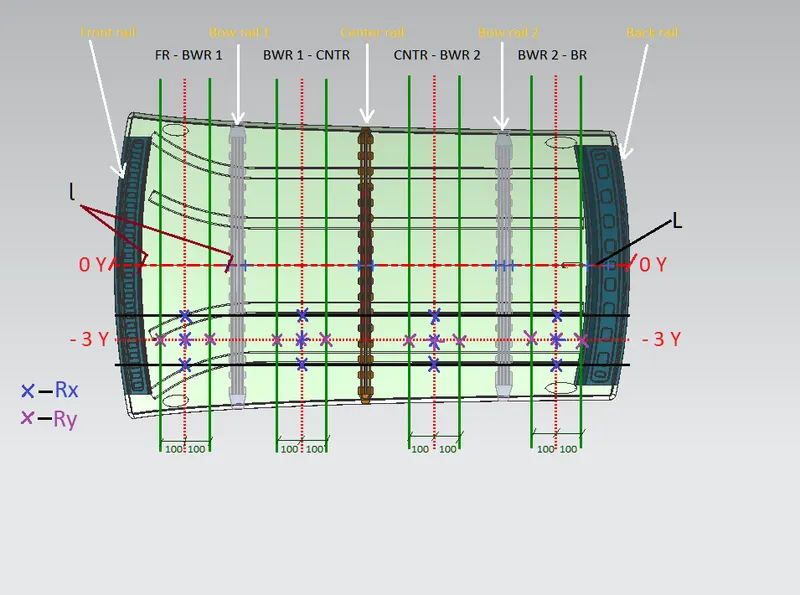
Bow–Roof Prediction Formula :
W = [1.73 x 10^(-3) x L] + [1.85 x 10^(-8) x (R^2)/t] + [ 1.10x10^(-3) x l] - 2.68
Where,
L = Roof Length in X-Direction (in mm) (Roof dimension in 0-Y)
R = Roof curvature = 2(Rx*Ry)/(Rx+Ry) ; Rx = X curvature, Ry = Y curvature
t = Roof plate thickness (in mm)
l = Bow Roof Span (in mm])
Judgment Condition : If W< 2.7, then Bow Roof assembly 'PASS' the result as per Bow-Roof prediction Criteria.

Result : Designed Bow Roof Assembly PASS the Bow-Roof Prediction Criteria.
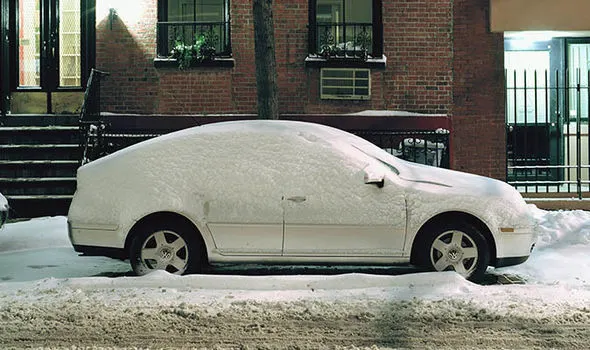
3. SNOW LOAD CRITERIA
Snow Load test is done to know how the roof is behaving when roof is overd with snow and load exerted by it. Due to the snow weight the dent will happen on the roof. But the roof should be designed in such a way that when snow is removed the roof should regain its original shape. This is the basic requirements for snow load criteria.
Snow Load : Pressure and force applied on vehicle roof by pile-up of snow and ice on it.
Snow Load Prediction Formula :
Qr = [Iy x t2] / [α x s x [(Rx + Ry)/2]2 x 10-8]
Where,
α = My x Lx2 x 10-12 , My = Y(Ly-Y)
t = Roof plate thickness (in mm)
Ly = Distance between the front and rear roof Rails on the Vehicle along 0Y (in mm)
Length of Roof panel with the center point between Roof rail Front/Rear as the front and rear reference point.
Lx = Distance between the Left and Right end of the roof on the Roof BOW (in mm)
The width of the roof panel is exposed on the surface.
Y = Distance from Front Roof Rail to Roof BOW (in mm)
s = Distance for which Roof BOW bears divided load (in mm)= L1/2 + L2/2 , 250 ≤ s ≤ 380
Iy = Geometrical moment of inertia of Roof BOW (Y cross-section ) (in mm^4)
Rx = Lateral direction curvature radius of roof panel Y cross-section on Roof BOW (in mm)
Roof panel curvature Radius of the Length Lx in Front view
Ry = Longitudinal Direction curvature radius of the Roof panel X cross-section on Roof BOW (in mm)
Roof panel X curvature radius of length s in Side view
Judgment condition : If Qr ≥ 3.1 , then Bow-Roof assembly will 'PASS' the result as per Snow Load Criteria.

Result : Designed Bow Roof Assembly FAIL the Snow Load Criteria.
Note : As bow roof assembly not passed the snow load criteria, following process can be used to improve strength of roof.
- Increase the depth of bow roof rail.
- Increase the thickness of roof rail upto 1.5 mm maximum.
- Creating emboss on roof.
- Adding bow roof rail.
- Reposition the bow roof to pass the curavature study under snow load criteria and bow roof prediction.
Embossed Roof
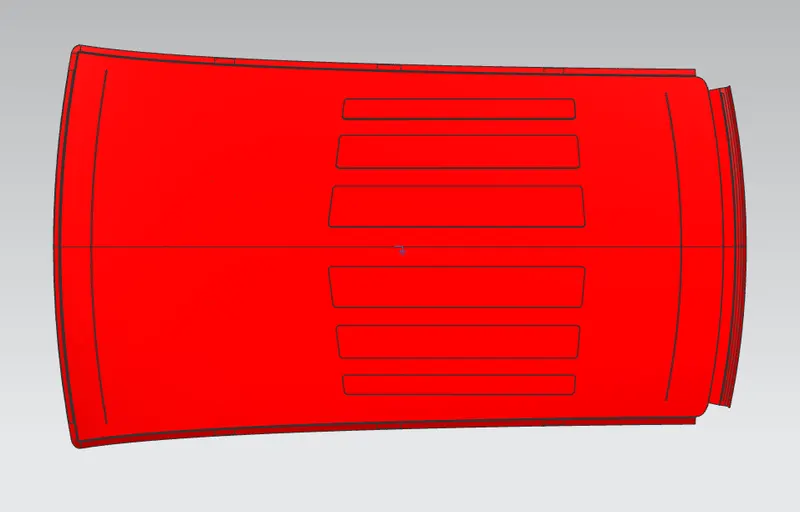
Curvature study Reference Image
Section Inertia Analysis 'Iy'
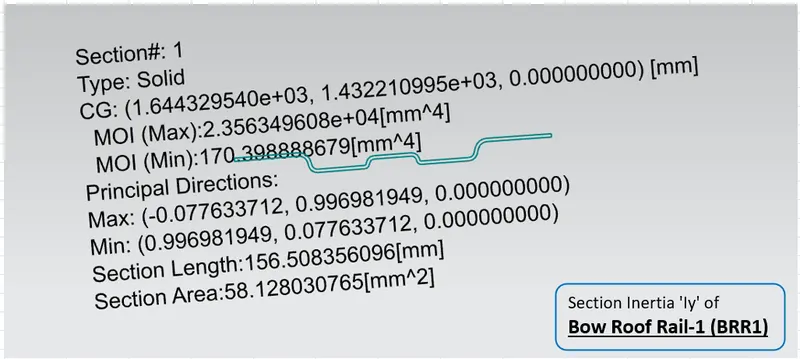
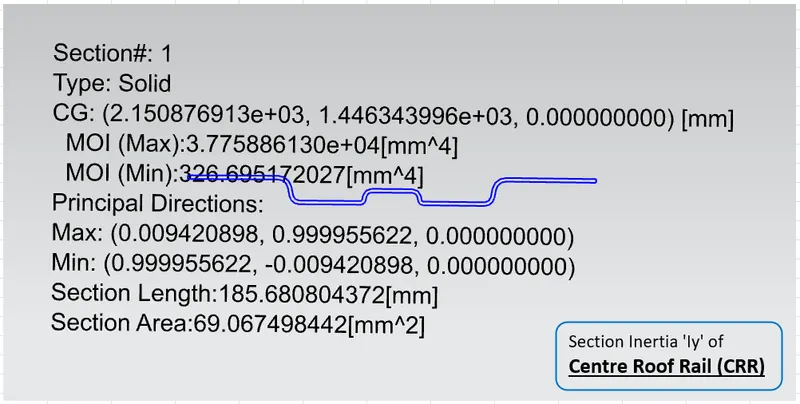
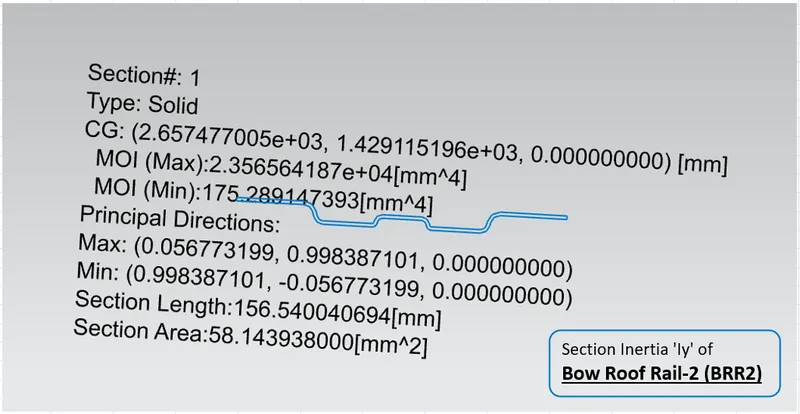
Moment of Inertia : Second moment of area also known as the moment of inertia 'I' of a cross section is a indication of structural member's ability to resist bending.
1. 'Iy' Section Inertia of Bow Roof Rail-1 (BRR1) : 170.398 mm^4 , MOI (Min) in attached image.
2. 'Iy' Section Inertia of Centre Roof Rail (CRR) : 326.695 mm^4 , MOI (Min) in attached image.
3. 'Iy' Section Inertia of Bow Roof Rail-2 (BRR2) : 175.289 mm^4 , MOI (Min) in attached image.
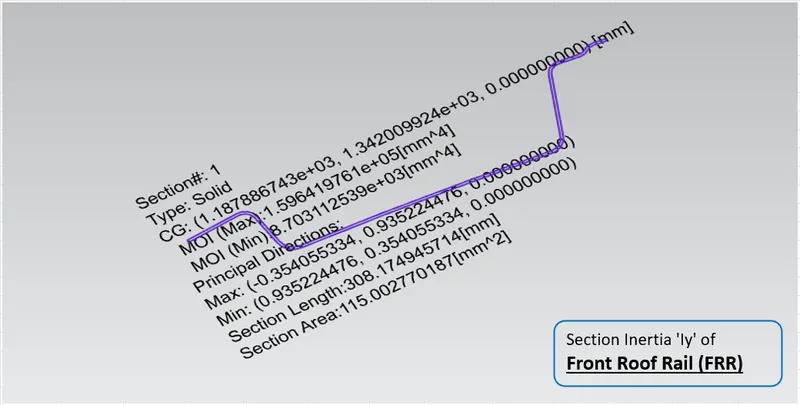
4. 'Iy' Section Inertia of Front Roof Rail (FRR) : 8703.112 mm^4 , MOI (Min) in attached image.
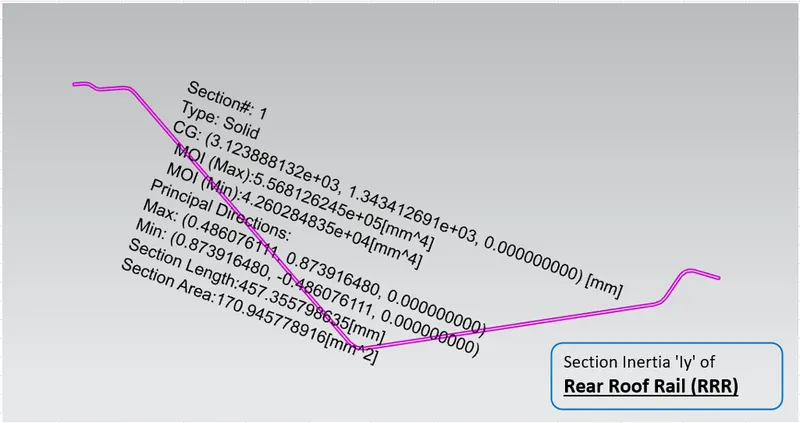
5. 'Iy' Section Inertia of Rear Roof Rail (RRR) : 42602.848 mm^4 , MOI (Min) in attached image.
Draft Analysis
Draft : It is the amount of taper given in manufacturing or machining part to the tool axis.
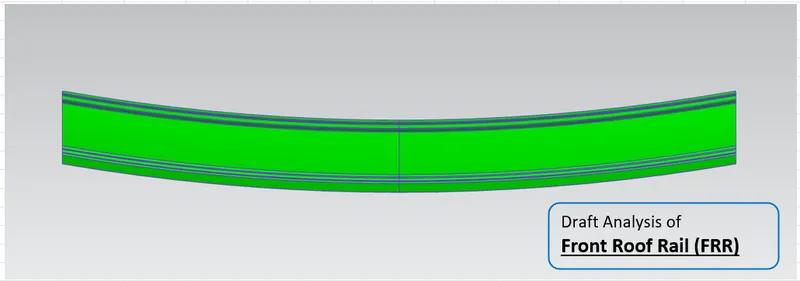
1. Draft Analyis of Front Roof Rail (FRR)
Result : Draft angle is more than 7° from Tool Axis
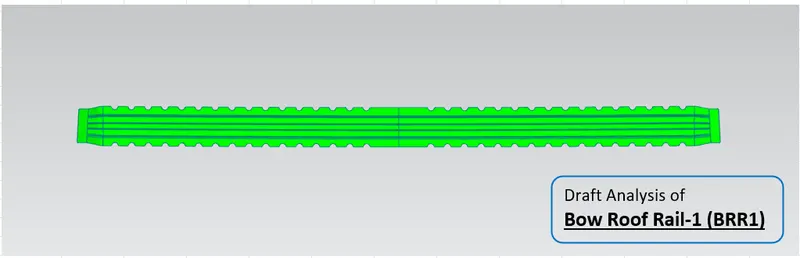
2. Draft Analyis of Bow Roof Rail-1 (BRR-1)
Result : Draft angle is more than 7° from Tool Axis
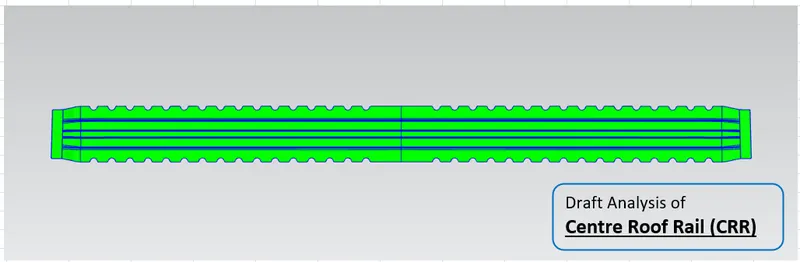
3. Draft Analyis of Centre Roof Rail (CRR)
Result : Draft angle is more than 7° from Tool Axis
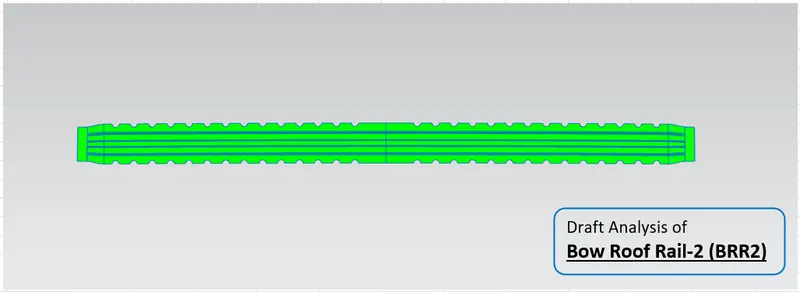
4. Draft Analyis of Bow Roof Rail-2 (BRR-2)
Result : Draft angle is more than 7° from Tool Axis
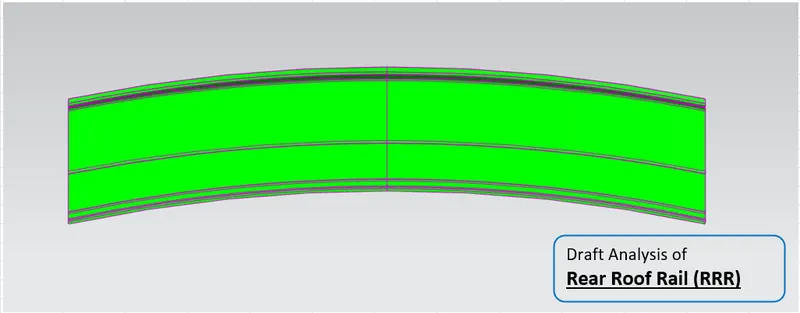
5. Draft Analyis of Rear Roof Rail (RRR)
Result : Draft angle is more than 7° from Tool Axis
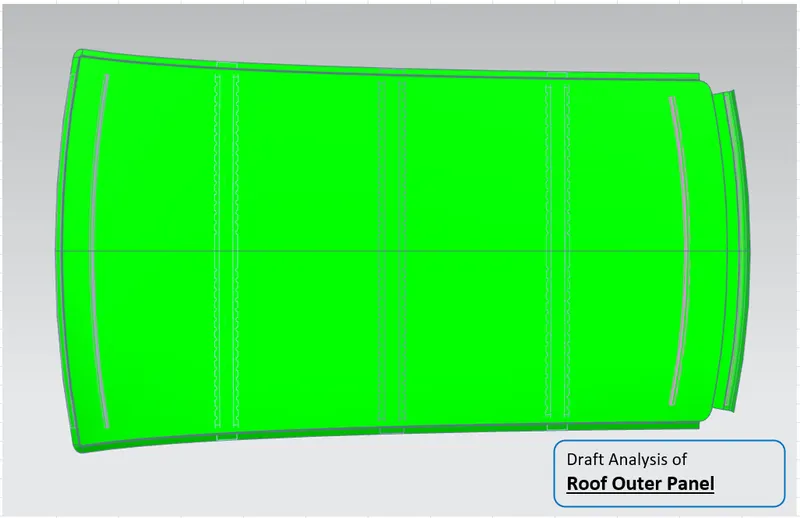
6. Draft Analyis of Roof Outer Panel :
Result : Draft angle is more than 7° from Tool Axis
Manufacturing Process
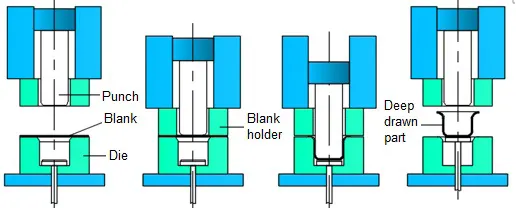
- Deep drawing : Deep drawing is a sheet metal forming process in which blank of sheet metal rapidly drawn into a forming die through the mechanical action of punch. Thus, it is a shape transformation process with material retention. After the process material take the shape of the punch. it consists of sheet metal blank holder, punch and die. Mainly used for the manufacturing of automobile parts.
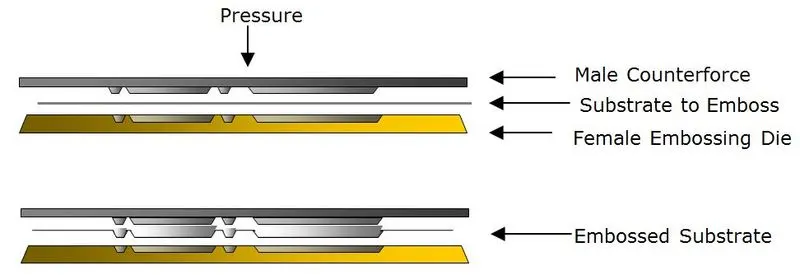
- Embossing : Embossing is a metal forming process used to create a raised surface on a material by applying a pressure on the material. Machine press the material against the die to impart a raised surface onto the material. Embossing add dimension to the surafce and enhance its look. it also protect material from wear and tear.
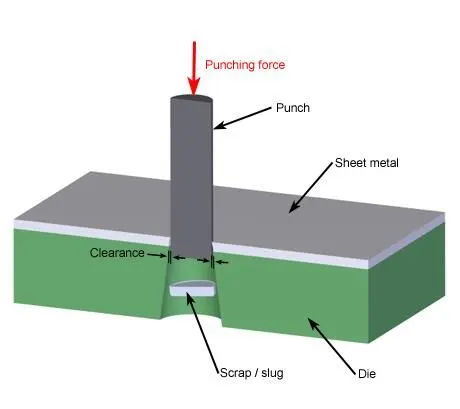
- Blanking or Piercing : Blanking or piercing is a shearing process in which punch and die used to produce a parts from coil or sheet stock. Blanking creates the outside feature of the component, while piercing also know as 'punching' make a internal holes or shapes.
Different Views of Roof
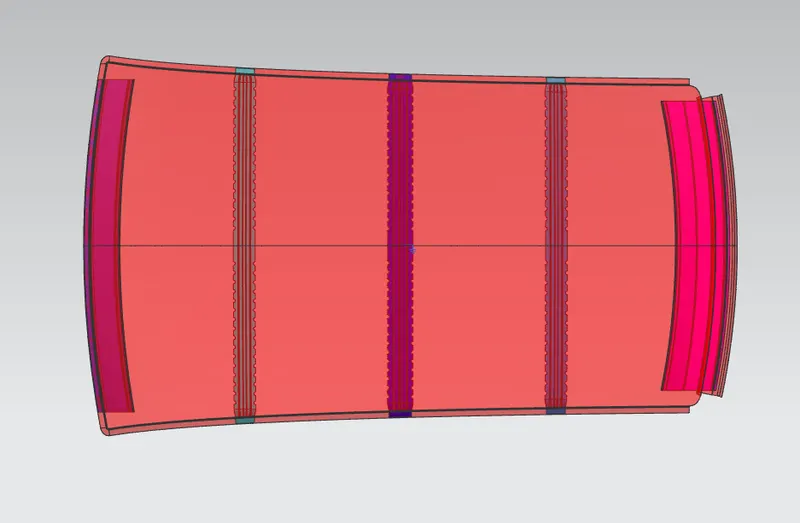
1. Top View
2. Bottom View
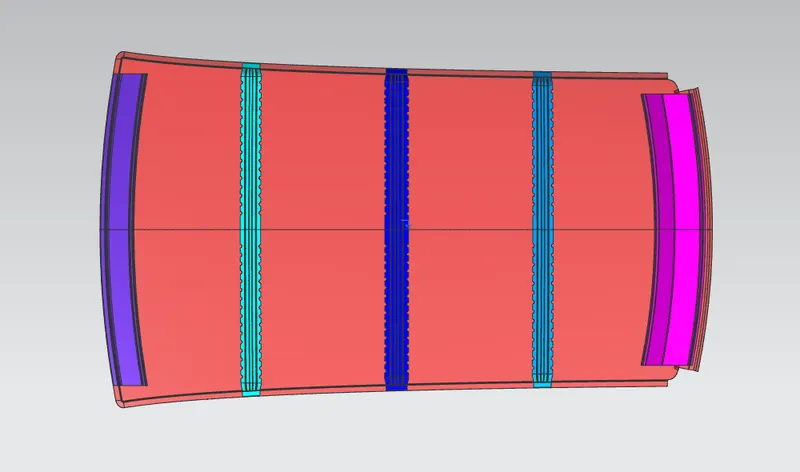
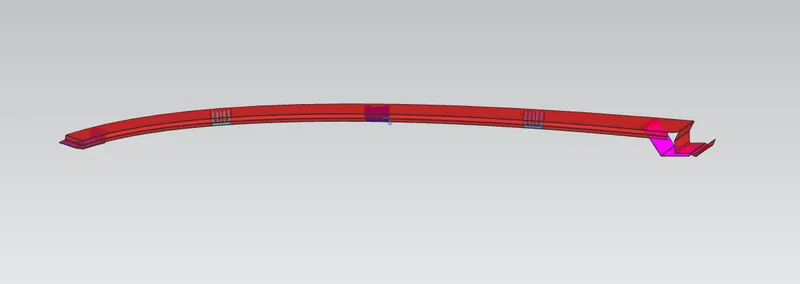
3. Side View
4. Isometric View
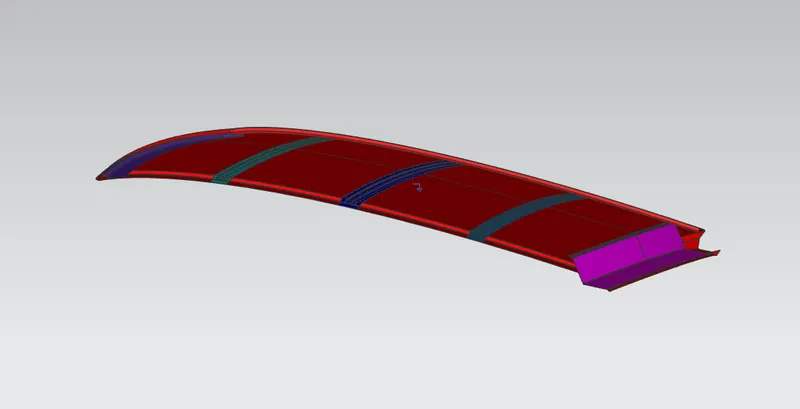
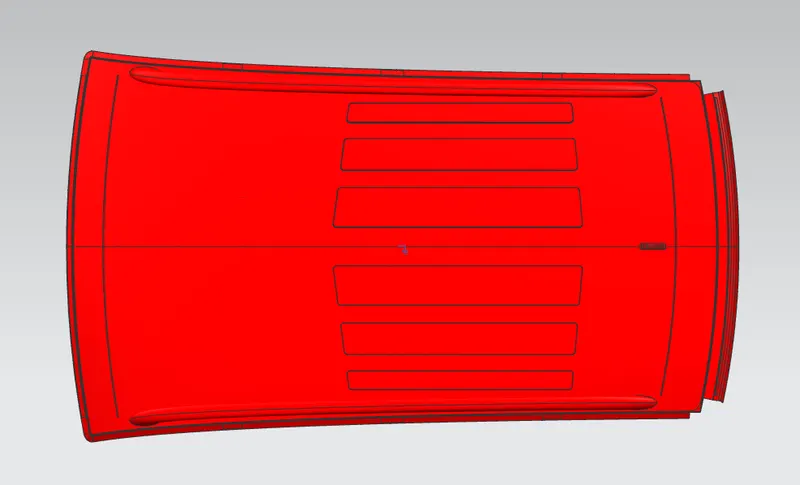
Improved roof design with Embossed surafce on roof top