Section Modulus calculation and optimization
Section Modulus
Section Modulus is a cross-sectional geometric property of structural element such as beam, coloumn, slab, shaft etc. It is measure directly the strength of shaft or beam section. Higher the section modulus of section, more the resistance it is given to bending.
It also said that greater the dimension of cross-section under given load, greater the section modulus and smaller the bending stress.
Type of section modulus
There are two type of section modulus :
- Elastic Section Modulus
- Plastic Section Modulus
Elastic Section Modulus
Elastic section modulus (S) is the ratio of moment of inertia about a neutral axis (I) and the maximum distance (y) between the neutral axis and outermost fibre of beam section.
Formula : S=I/y
Units : S=I/y=m^4/m=m^3
where,
S = Section Modulus (m^3)
I = Moment of inertia (m^4)
y = Distance between Neutral axis and outermost fibre of beam section (m)
Elastic section modulus is applicable upto the yield point of material.
How to calculate elastic section modulus (S) :
- Step 1 : Find the location of centroid of given cross-section.
- Step 2 : Find moment of inertia about neutral axis (I).
- Step 3 : Find the distance (y) of outermostfibre from neutral axis.
- Step 4 : Find elastic section modulus (S) using above formula.
Plastic Section Modulus
Plastic section modulus (Zp) is the summation of moment of area of area under compression about plastic neutral axis and the moment of area of area under the tensile stress.
Formula : Zp = Ac.Yc+At.Yt
Units : Zp = Ac.Yc+At.Yt = m^2.m+m^2.m=m^3
Where,
Zp = Plastic section modulus (m^3)
Ac = Area of cross-section under compression (m^2)
Yc = Distance of CG of area under compression from plastic neutral axis (m)
At = Area of cross-section under tension (m^2)
Yt = Distance of CG of area under tension from plastic neutral axis (m)
Plastic section modulus used for material in which plastic behaviour is observed.
How to calculate elastic section modulus (S) :
- Step 1 : Locate plastic neutral axis (PNA). At neutral axis, area under compression equal to area under tension.
- Step 2 : Find the summation of product of area of section undergoing compression and distance of its CG from PNA.
- Step 3 : Find the summation of product of area of section undergoing tension and distance of its CG from PNA.
- Step 4 : Find Plastic section modulus (Zp) using above formula.
Section Modulus of Hood Section
1. Hood Section Before Optimization
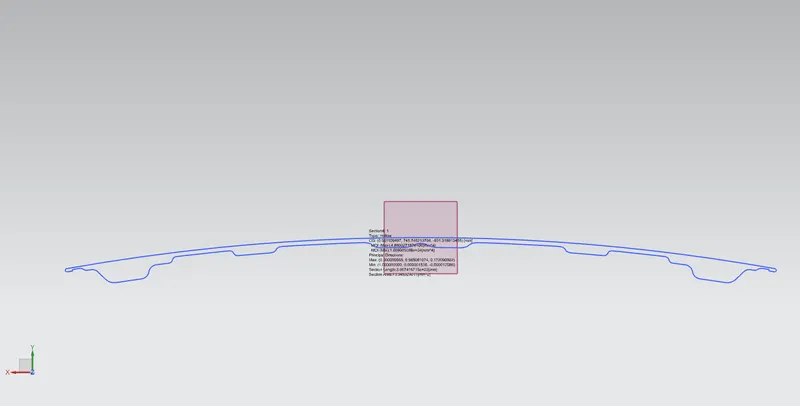
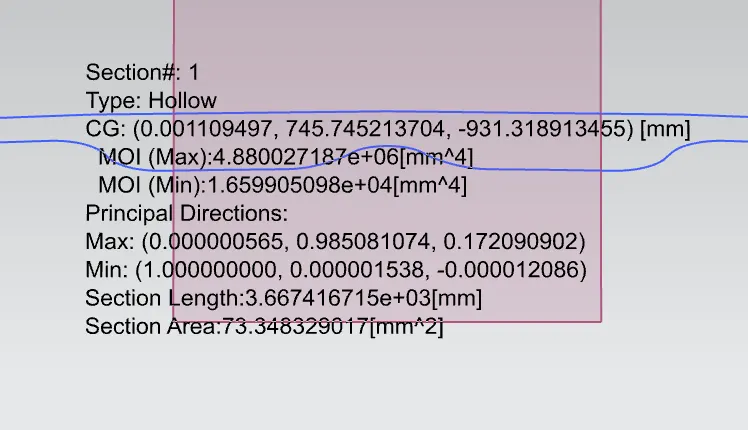
Imax (Max. Moment of inertia) = 4.880027187e+06 mm^4
Imin (Min. Moment of inertia) = 1.659905098e+04 mm^4
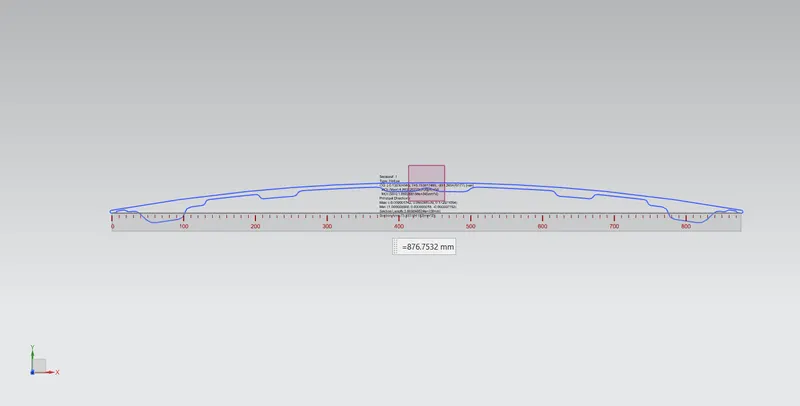
L = Total length of hood section = 876.7532 mm
Y = Total length of section (L)/2 = 876.7532 = 438.3766 mm
Using section modulus equation : Section modulus before optimization is
Section Modulus : S = Imin/Y = 1.6599*10^4/438.3766 = 37.8647 mm^3
Thus, section modulus before optimization is 37.8647 mm^3.
2. Hood Section After Optimization
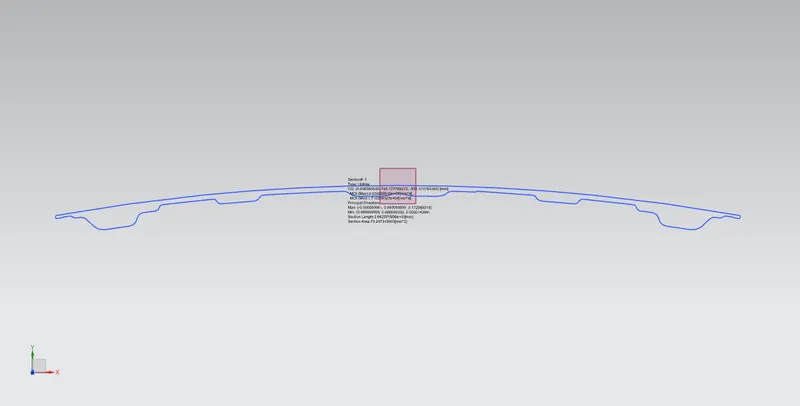
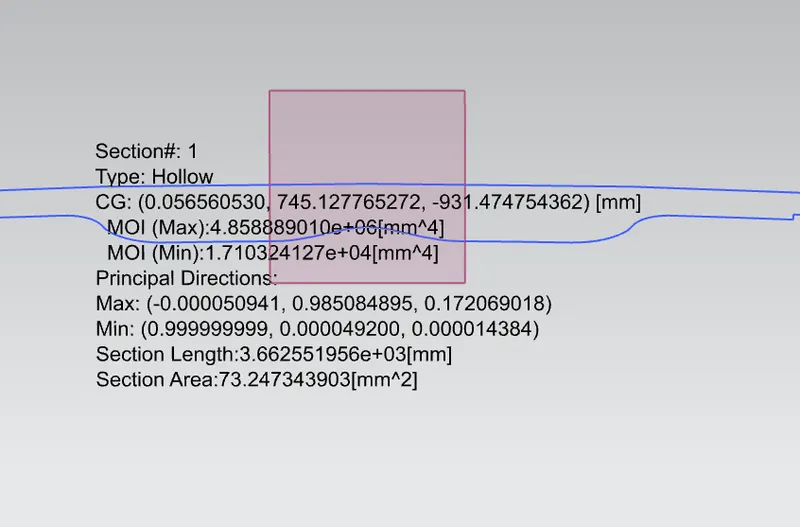
Hood section optimize by offseting the inner panel by 0.5 mm from outer panel.
Imax (Max. Moment of inertia) = 4.858889010e+06 mm^4
Imin (Min. Moment of inertia) = 1.710324127e+04 mm^4
L = Total length of hood section = 876.7532 mm
Y = Total length of section (L)/2 = 876.7532 = 438.3766 mm
Using section modulus equation : Section modulus after optimization is
Section Modulus : S = Imin/Y = 1.7103*10^4/438.3766 = 39.0143 mm^3
Thus, section modulus after optimization is 39.0143 mm^3.
Comparing Hood section before and after optimization :
1. Imin (Min. Moment of inertia)
- Before optimization : Imin = 1.659905098e+04 mm^4
- After optimization : Imin = 1.710324127e+04 mm^4
Result : Moment of inertia increase by offseting the inner panel of hood in downward direction by 0.5 mm from outer panel, as cross-section of hood increase.
2. S (Section Modulus)
- Before optimization : S = 37.8647 mm^3
- After optimization : S = 39.0143 mm^3
% increase in section modulus = (39.0143-37.8647)/37.8647 = 3.03 %
Result : Section modulus of hood increase by 3.03 % by offseting the inner panel of hood in downward direction by 0.5 mm from outer panel, as moment of inertia and cross-section of hood increase.
Conclusion :
- Cross-section of hood incease by offseting inner panel by 0.5 mm in downward direction from outer panel.
- As cross-section incease, moment of inertia of optimize hood section also increase.
- Section modulus of optimize hood section is increase by 3.03 % as it is directly proportion to moment of inertia.
- As section modulus of optimize hood increase which mean it give better strength and more resistance to bending stress.