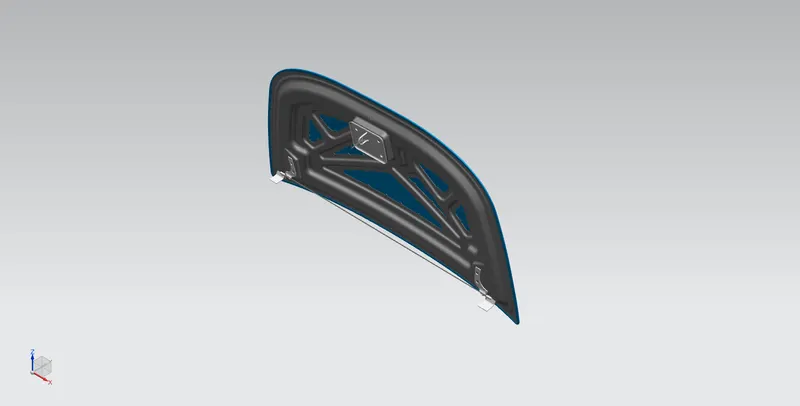
Hood design-Week 2
Hood and its component
Hood
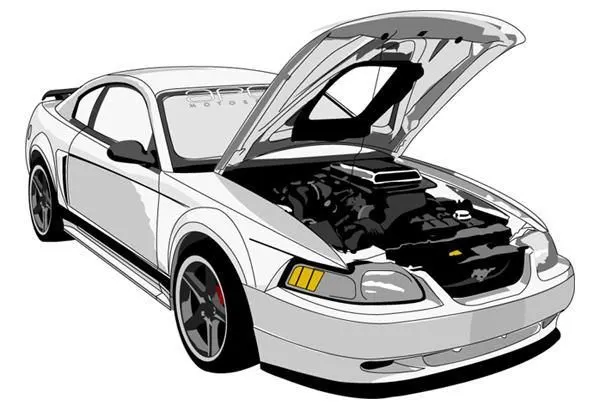
Car hood also know as 'Bonnet' is a metal part that cover engine of automobile. it is hinged cover over the car engine that allow access to enigne compartment for maintenance and repair.
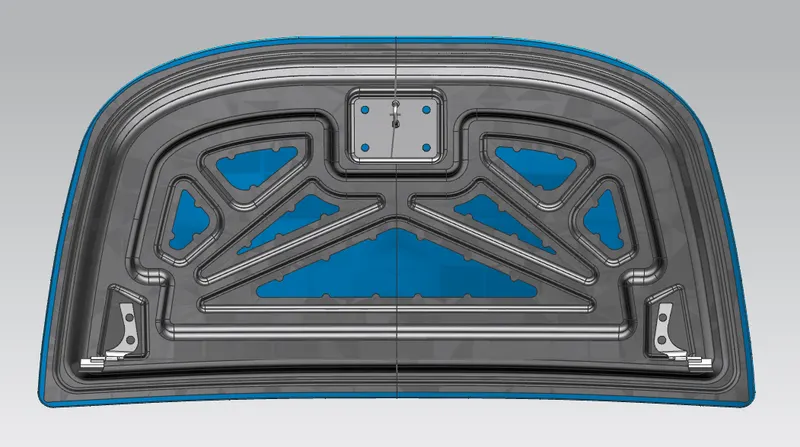
Car hood consists of inner and outer panel. Inner panel provide strength to the hood, where outer panel is a metal cover that contribute to aesthetic look of automobile. In passenger car, hood is held down by a latch and striker.
Hood usually made up of steel or aluminum although some manufacturer also made hood of carbonfibre, drycarbon or fibreglass.
Component of Hood
1. Hood Outer Panel
Hood outer panel is the metal cover that contribute to the asethetic look of automobile. In other term it is the outer skin of hood.
2. Hood Inner Panel
Hood inner panel provide strength and rigidity to the hood. It also support outer panel, also hinged and striker attached to inner panel. And, direct the force of collision outwards instead of passing into passenger compartment.
3. Hinges
Hinge is the pivoting point that allow the hood to rotate around the fixed axis for opening and closing movement of hood. One part of hinge assembled to the hood, while other is attached to engine compartment.
4. Latch and Striker
Hood is held down by a latch and striker in automobile. It is a mechanism that lock the hood with engine compartment, in order to prevent accidental opening of hood during driving. The latch is present on engine compartement ,where striker attached to inner panel of hood. Striker is U-shaped bend attaches to latch that lock the hood to engine compartement.

5. Support Rod
Support rod is a device that support the hood in open position. Also called as hood balancer rod.
6. Reinforcement
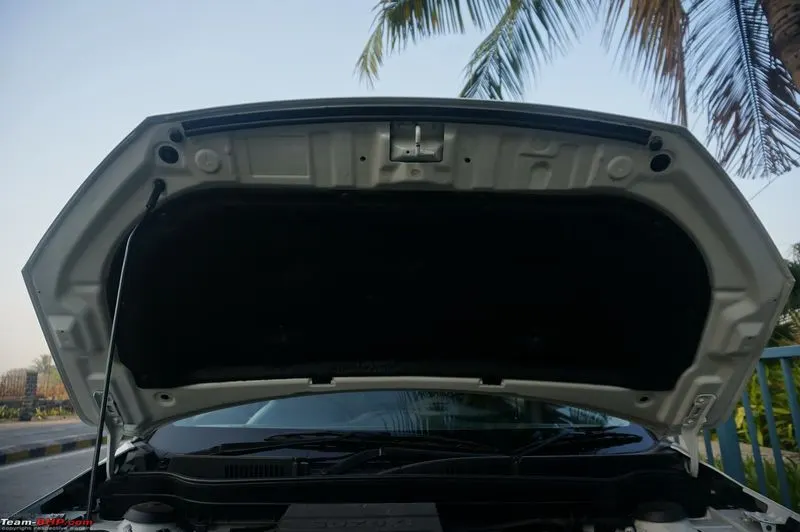
Reinforcement are provided to add material to inner panel of hood for providing extra stength to hood to compensate the loss of strength near component installation region.
Latch Trajectory
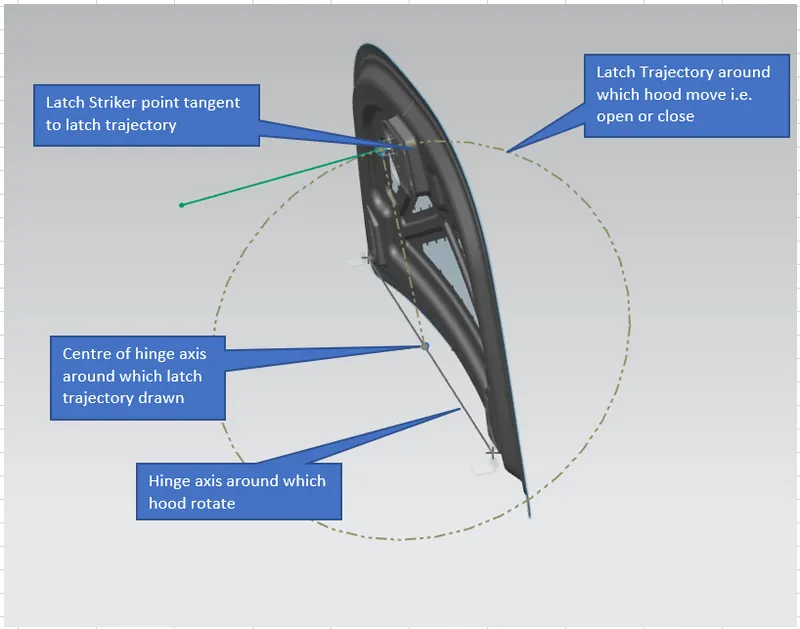
Latch trajectory is a path on which striker of hood is rotate so that it locked by latch present on enigne compartment on closing the hood. it is drawn by a circle from the centre of hinge axis around which hood rotate. For engagement of striker to the latch striker axis is tangent to the circle drawn from centre of hinge axis.
Mastic Data
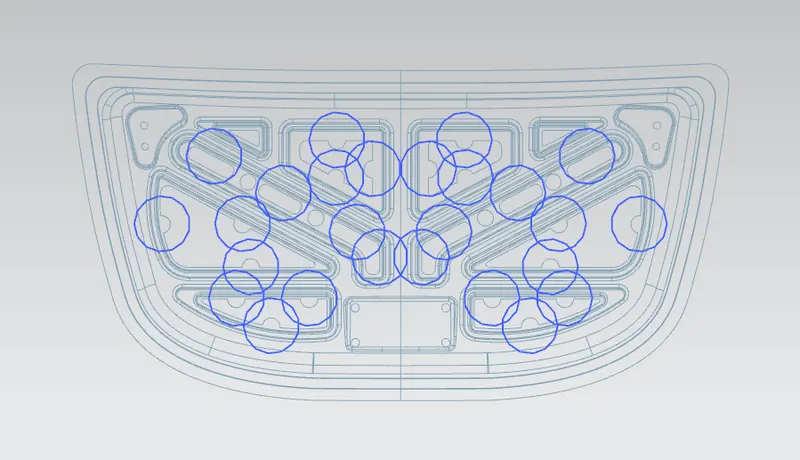
Mastic seal are used for joining of inner and outer panel. it stick the inner surface of outer panel to inner panel of hood. Mastic seals are elastic compound that behave like rubber, that is applied between inner and outer panel at specified spot. Each spot provide strength around circular region of 80mm, and its purpose is to minimize the Vibration produced by engine.
Emboss
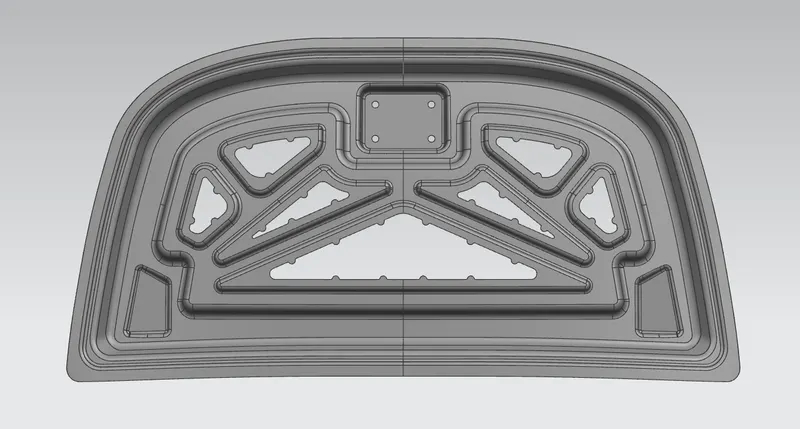
Emboss is the process of creating a raised surface in material. Emboss provided in inner panel of hood to provide strength and stiffnes to the hood. it also control the collision force and directed away from the passenger compartment.
Main aim of provinding emboss in inner panel:
- Pedestrian safety during frontal crash.
- Reducing weight of inner panel.
- Provide strength and stiffnes to hood.
- Direct the collisioon force away from passenger.
- Provide a sufrace for mastic seal application between inner and outer panel.
Manufacturing Process
A. Deep drawing
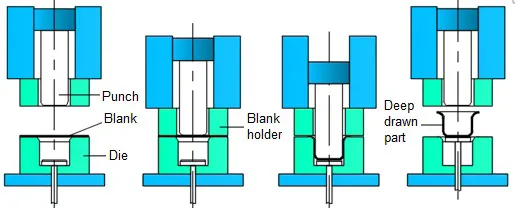
Deep drawing is a sheet metal forming process in which blank of sheet metal rapidly drawn into a forming die through the mechanical action of punch. Thus, it is a shape transformation process with material retention. After the process material take the shape of the punch.
it consists of sheet metal blank holder, punch and die. Mainly used for the manufacturing of automobile parts.
B. Hemming
Hemming is the sheet metal forming operation in which edge of the sheet are folded over another part in order to join the two parts. Sheet metal usually bending around 180 dgeree to join the parts. Hemming used in automobile to join the inner hood panel with outer panel of hood. Typically parts assembly are hood, door and fender.
The accuracy of hemming is very important as its affect the apperance and quality of surface. Typical hemming defects are splits or wrinkles in the flanges, material overlap in the corner area. That is why it is important to provie relief at corner.
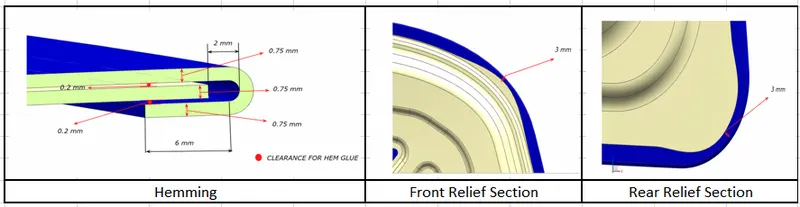
Type of hemming:
1. Conventional die hemming
In conventional die hemming, flange is folded over the entire length with hemming tool.

2. Roller Hemming
In Roll hemming, hemming roller is guided by industrial robot over the flange to make a fold.
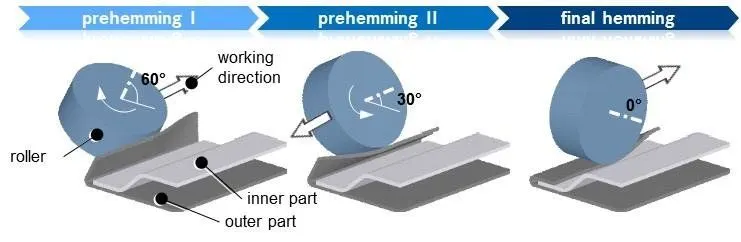
Parameter for Design of Hood
1. Hood Head Zone Criteria: Hood head zone selected on the basis of region where the car going to be used that depend upon average height of the humas. It should be such that striker should not hit the head of human in open position there will be some clearence between the head of human and the end striker.
2. Opening Angle Condition: it is the important parameter consider for design of hood, it is selected on region where the car going to be used. it should be such that when the hood is in open condition the striker should not hit the head of human.
3. Hood Stay Criteria: Appartus that is available in engine room used to keep the hood in open condition. Also known as hood balancer. Typicaly there are two type of hood stay one is support rod, other is gas stay.
Support Rod: It is a device supporting a engine hood in its open position by mean of rod. Design Requirement for support Rod:
- Inner opening angle condition of hood.
- Layout of suuport rod such that it support hood in open condition.
- Rod installation position is opposite to the battery installed position to prevent interference between battery and rod.
Gas Stay: A device used to keep the engine hood in open position by mean of actuator activated by gas.
4. NVH (Noise, Vibration and harness) Criteria: Stiffner pad, mastic data and reinforcement are used in hood is such a way that it minimize the noise and vibration produced by engine.
5. Master section data: Provoiding all the necessary dimension for designing of hood with refernce to outer panel.
- Thickness of outer panel: 0.75mm
- Thickness of inner panel: 0.75mm
- Reinforcement thickess: 1.50mm
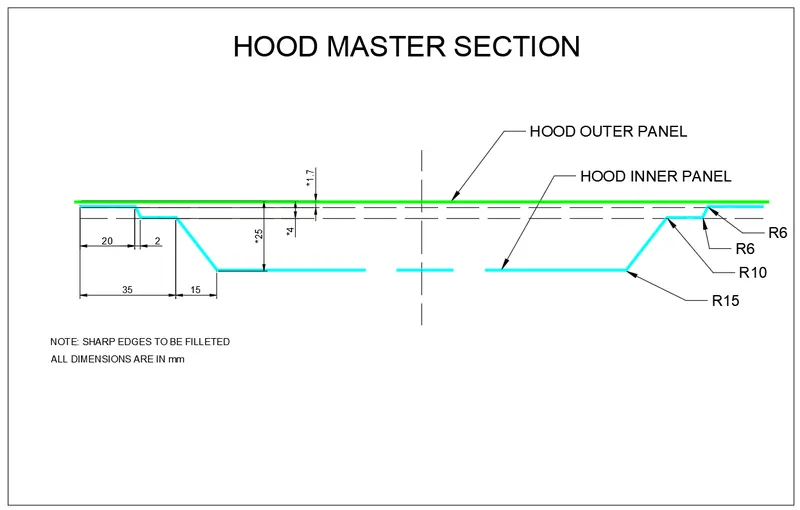
6. Collision Force Disipation Criteria: Embosses are provided on inner panel in such a way that it direct the collision force away from the passenger. So that in case of collision the hood get crumbled.
7. Hinge Axis Criteria: Both the hinge assembly passes to the hinge axis around which the hood rotate. both the hinge assembly must be lies on single axis that is called hinge axis.
8. Latch Trajectory Condition: Tracjectory around which hood open or close. Striker attached to the hood is such a way that striker point must be perpendicular to the circle drawn from centre of hinges aixs that keep the hood in closed condition.
9. Joining Process Criteria: Hemming is used to join the inner panel to the outer panel of hood around the entire edges. And mastic region used to join the inner panel to inner surface of outer panel without affecting aesthatic look of hood.
Hemming data :
- Gap between inner surface of outer panel and inner panel : 0.2mm for sealent application
- Gap between fold and inner panel edge face : 2mm to prevent interferenec
Mastic data:
- Distance between emboss of inner hood and outer panel inner surafce : less than 5mm for mastic sealent application
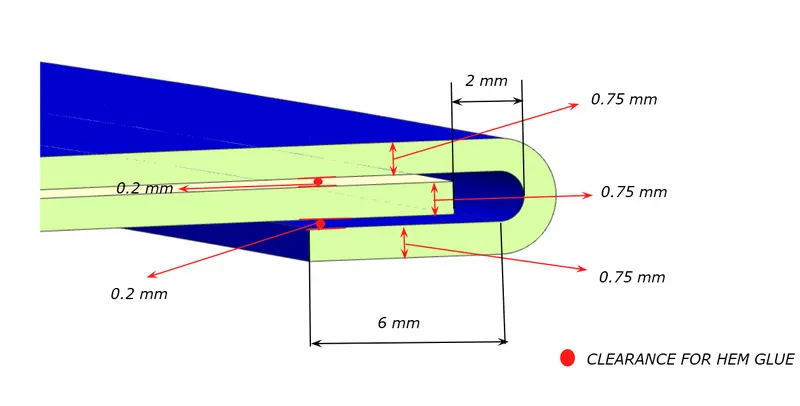
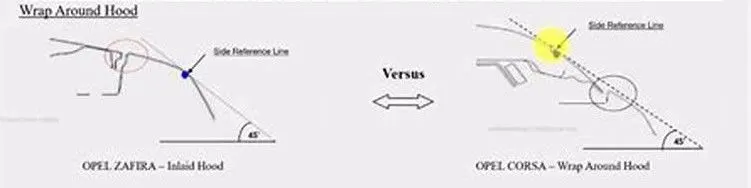
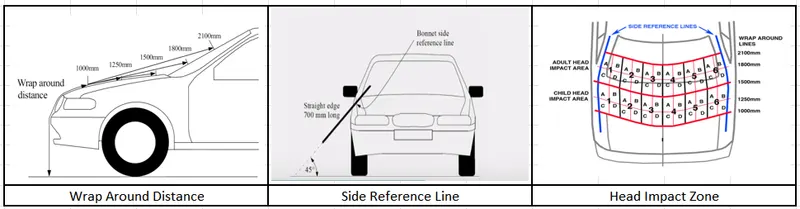
9. Pedestrian Head Impact Zone: Zone at which pedestrian head hit on the bonnet when collision with car. it deteermine by Wrap Around Distance (WAD) and Side Refernce Line (SRL).
There are two type of hood :
- Wrap around hood : if end point of car body lies on side refernce line passes throught the hood is called wrap around hood.
- Inlaid Hood : If end point of car body lies on side refernce line passes through the fender it is called inlaid hood.
Wrap Around Distance (WAD):
When car crashes the pedestrian the front body of car impact the pedestrian and the whole body of pedestrian wrap around the front shape of the car. it influence the head impact on vehicle. Meanwhile, windscreen is the major impact point and test under the NCAP condition.
Side Reference Line (SRL):
It is the trace of highest contact point between straight edge inclined at 45 degree and side of vehicle.
Head Impact Zone (HIZ):
- Child Head Zone : 1000 to 1500 WAD
- Adult Head Zone : 1500 to 2100 WAD
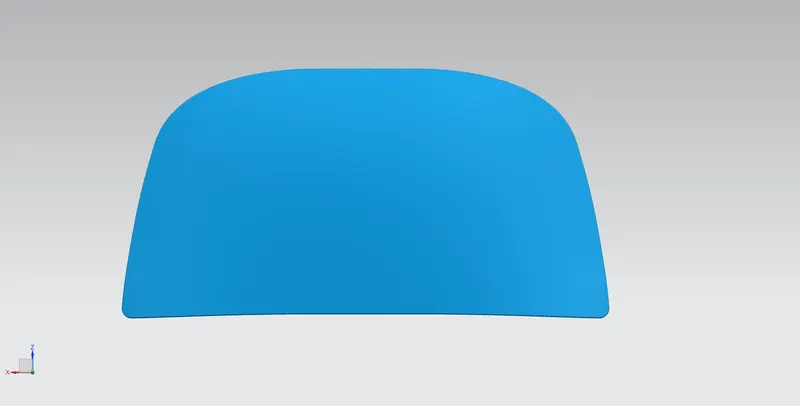
Design of Hood Assembly
1. Hood Top View
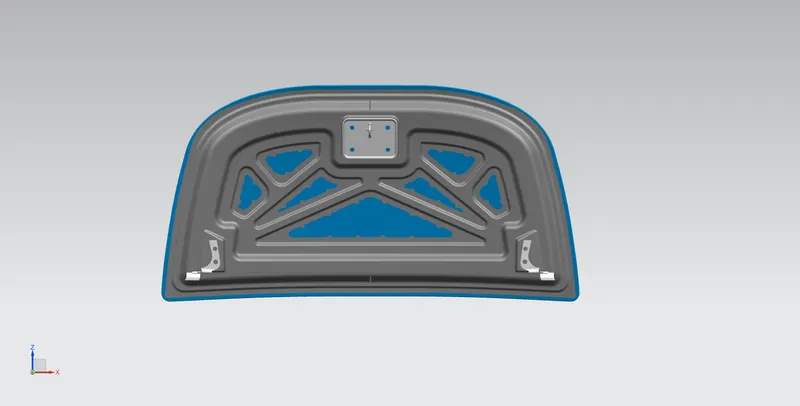
2. Hood Front View
3. Hood Side View
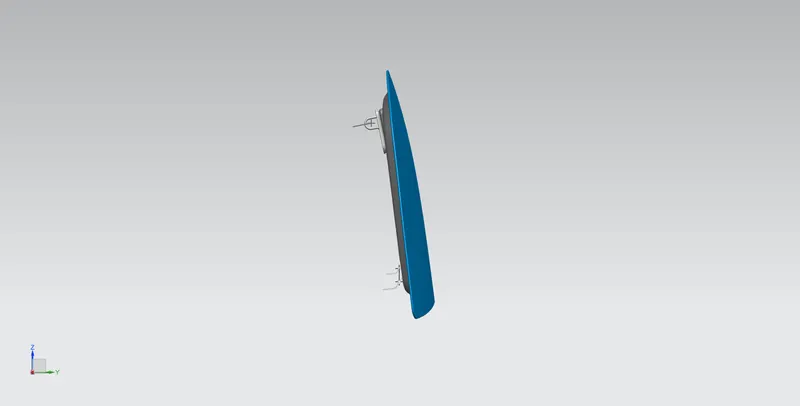
4. Hood Isometric View