Roof Design
*) When people take a wake around of a car, some would say that the facelift is amazing, some would say the rear end looks stylish and the remaining would talk about the sides and interior. Here the only view that is not observed is the top where the roof is located. It happens that no one talks about the roof because of the least visibility but it is one of the most important component of the car which completes the full structure. Roof is a component of car which is located on the top of it and gives strength to the overall structure. It also saves the occupant inside from all the harsh environmental conditions like rain, snow or sunlight etc. It also gives strength to A-B-C pillars.
*) When people take a wake around of a car, some would say that the facelift is amazing, some would say the rear end looks stylish and the remaining would talk about the sides and interior. Here the only view that is not observed is the top where the roof is located. It happens that no one talks about the roof because of the least visibility but it is one of the most important component of the car which completes the full structure. Roof is a component of car which is located on the top of it and gives strength to the overall structure. It also saves the occupant inside from all the harsh environmental conditions like rain, snow or sunlight etc. It also gives strength to A-B-C pillars.
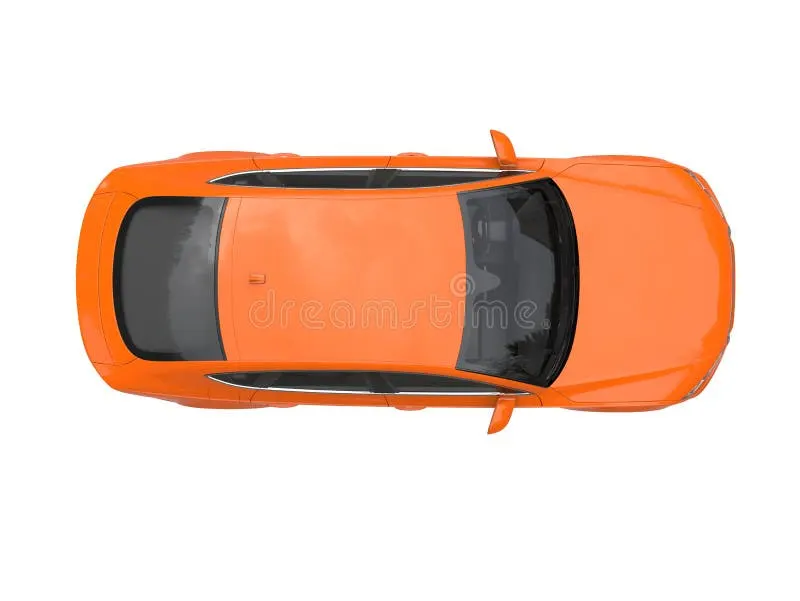
*) The roofs can be of different types with hard roof to soft roof. They are as follows:-
Convertible roof cars
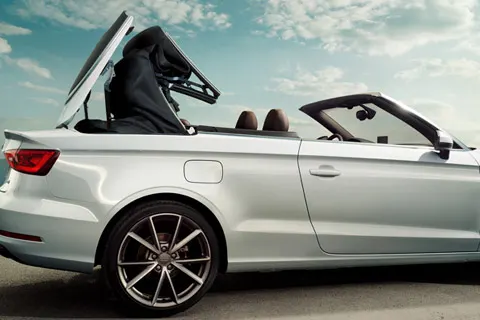
A car which can driven with or without a roof. The roof can be retracted and stored behind the passenger cab with an automatic system that could be activated by just a push of a button located on the dashboard. This type is manufactured for the buyers who want to enjoy the drive and also want to stay connected with the environment.
Sun roof cars
This type of car has a hard roof but with a window that can be opened and closed according to the occupant's will with a push of a button on the dashboard. This is done in order to let some fresh air or sun light to enter the car from the top.
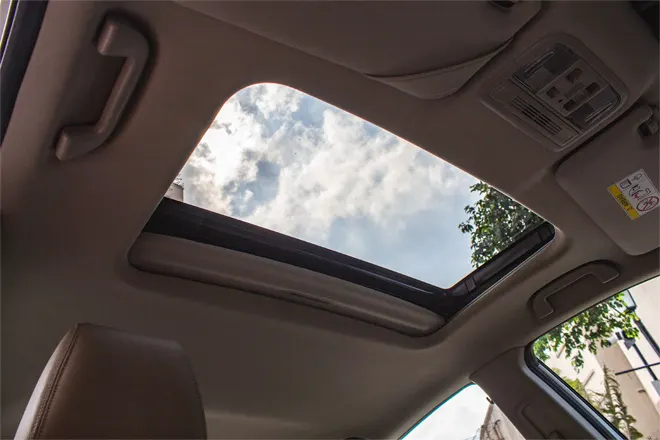
This feature is available in top end models and luxury cars.
T-top cars
A car with removable roof panel on each side of a center beam that runs from the main structure from the rear to the front. The T-top is usually made of auto grade safety glass.
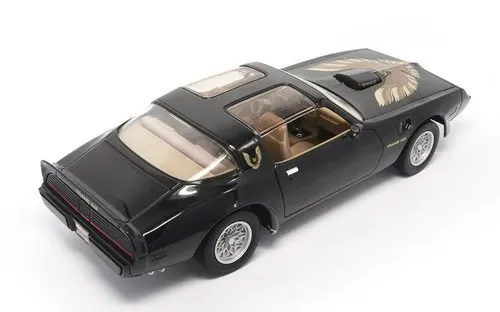
Of course the car which have compromised roof tops don't pass the roof safety test and only serve the purpose of giving it looks and not safety.
Targa top cars
This is again a styling component and purely based on looks and not safety. It has a semi-convertible car body with removable roof section and full width roof bar behind the passenger seats.
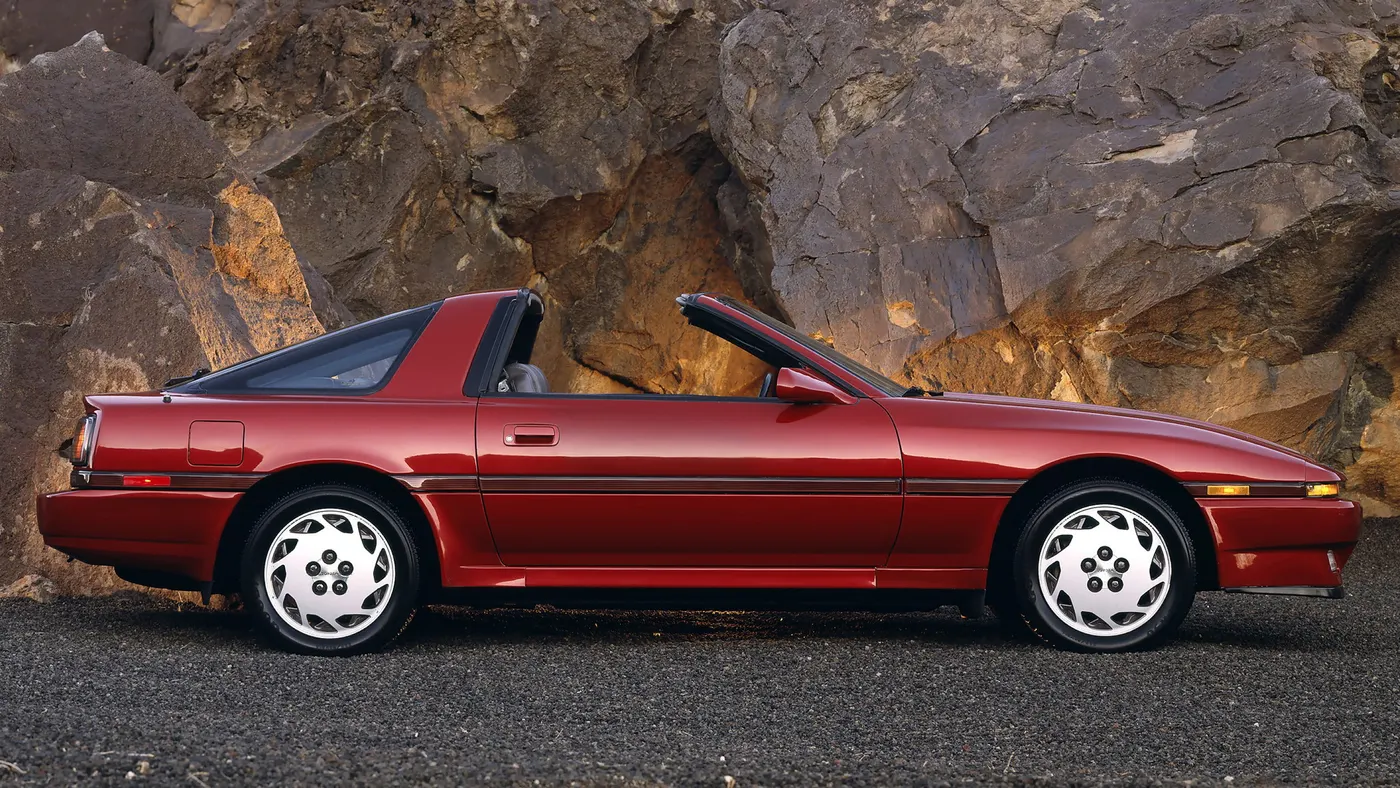
Vinyl roof cars
The car has a roof cover with vinyl coating on it. This is done in order to give a convetible look to the car with hard roof making this completely a styling component.
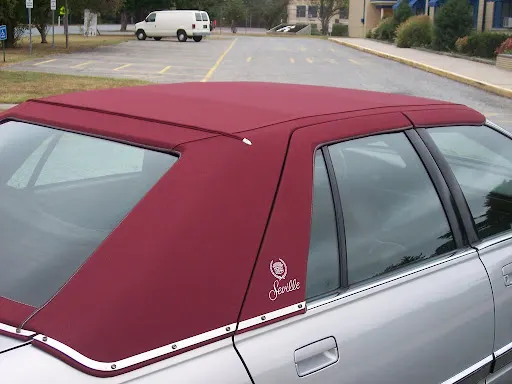
It is mostly famous in United States Of America.
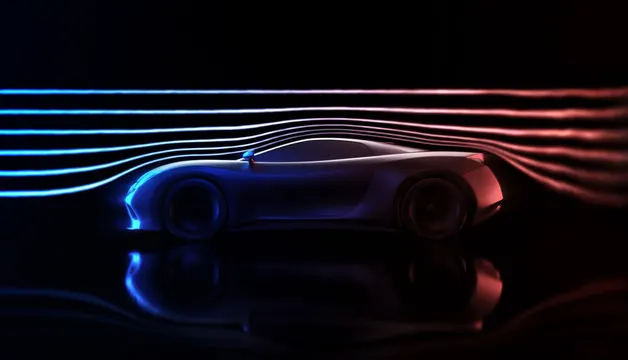
*) When the roof is designed, it has to maintain the continuity of the aerodynamic shape or line that begins with the hood. If the hood is designed with almost a new line which doesn't complete the path taken by the wind when the car is running. This roof would act as a obstacle for the wind and this car would face greater drag and hence low performance. Greater drag not only affects the performance but also induce more NVH issues. The colliding air particles with the car surface gives rise to greater NVH issues.
*) The design should be such that it gives an uninteruppted path for the water and dust to slide down and do not remain on the roof which may lead to corrosion of the panel.
*) It should be designed in a way to give sufficient room for driver's visibility both on rear and front ends.
Structure of the roof is made out of is the same material that is used to build the remaining BIW parts. Roof is made of outer roof panel which is approximately of 0.75mm and the inner reinforcements to give it more strength. The set of reinforcement comprises of front roof rail, center roof rail, rear roof rail, several bow roofs in the region between the roof rails. The number of bow roofs can increase with the car with longer roof like SUVs, MVPs etc.
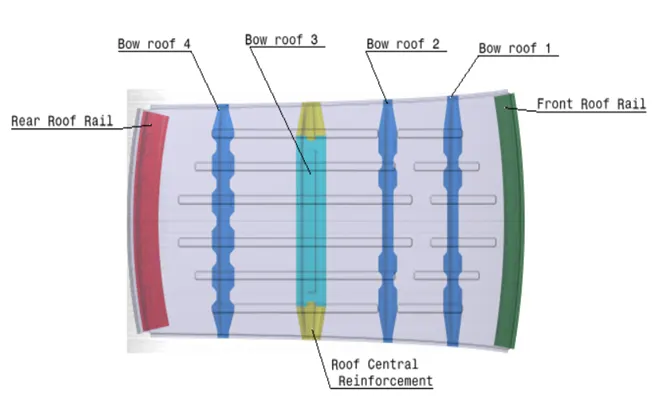
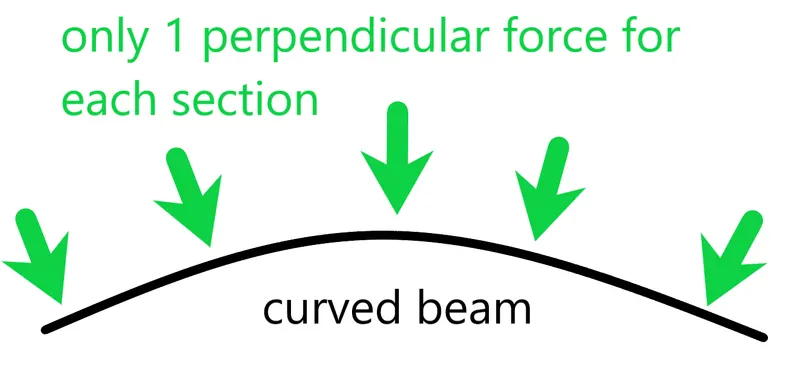
*) The roof is actually given the curvature to improve the strength. A roof with enough curvature would not even need a bow roof sometimes but most automakers don't feel shy of giving one even if it is not required. Bow roofs are necessary for those regions with flatter surface because the chances of this region to get damaged is the most. Impact of any force is the strongest if the surface on which it is acting is almost perpendicular to it. For a curved surface, only the force that is perpendicular to the surface would affect a small region perpendicular to it and not the other region of the same surface.
1)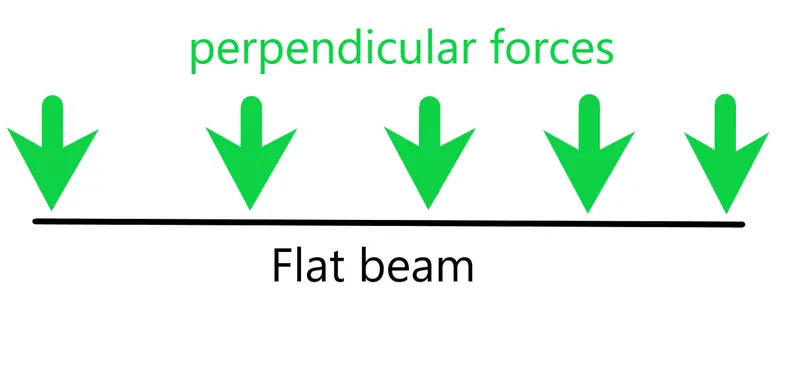 2)
2) 
Bow roofs give strength to these flat surfaces. the inner roof panels or the reinforcements are made of the scrap material that is removed while creating the outer roof panel. The shape and dimensions of the roof rails are determined keeping the visiblilty, head room, sealant and other plastic paste that would be used to join the two surfaces. To join the surfaces, mastic sealant is used which also improves the strength of the structure.
Roof crush test
Roof crush test is the design given by the IIHS or insurance institute of highway safety. After carrying out many safety tests and also with so many accidents making the headlines, it has come up with a test that involves some basic steps, regulations.
IIHS gives a car a certain rating which is based on the performance in this test.
Initial conditions before the test begins are
1) keep all the doors and windows closed and locked.
2) fix the car body(chassis frame) on a stationary and hard horizontal surface.
The load is applied in a way that it is 5 degree tilted from the front end to the rear end and the load is 1800mm*750mm in dimension. The load is applied is applied on the roof at an angle of 25 degrees from the flatness of the roof. The load is applied for 120 secs maintaining the crush speed to 13mm/sec or less.
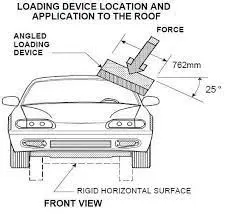
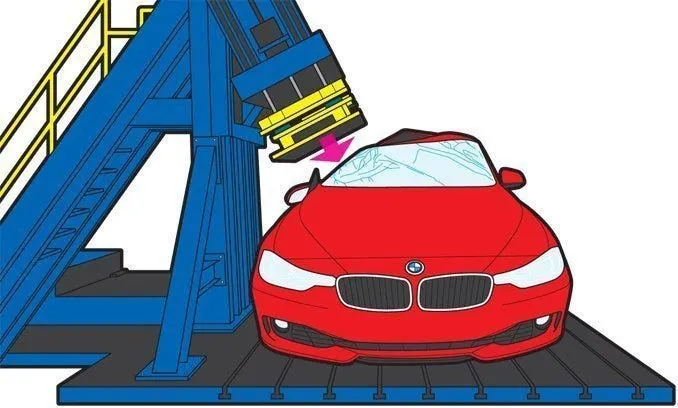
Results must show that the protrusion of passenger cab should be minimum so that the seat belts and air bags have enough room to perform there tasks to protect the occupants inside. The roof is also observed for it's returning back to the closest to the original position. On the basis of how deep the damage is, rating is given. If the displacement exceeds the pre-set safety value spectrum then the thickness of the bow roofs has to be increased. Also, there would be a need of more mastics points to improve the strength of the car and save the occupants in situations like roll over crashes.
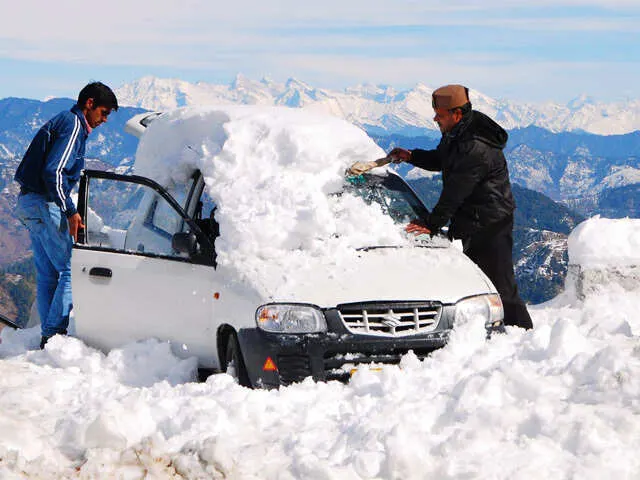
In European countries, snowfall is a common problem. If a car is left in snow overnight, it gets accumulated and this exerts force on the roof. The car is also tested for this load by hanging dead weights from the roof inside the car. The force is of the same value that a normal cars faces in real life situation.
Design procedure
*) The skin data was already provided so taking the reference of that the extracted body was taken out and then removed the unwanted roofrail holes and trimmed it.
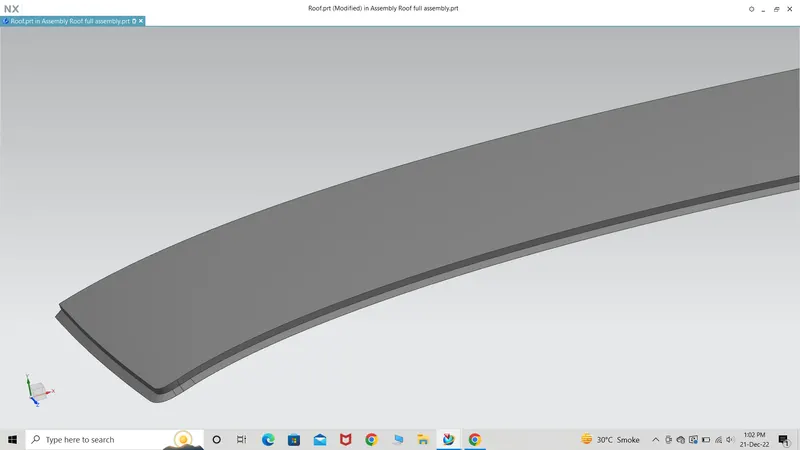
The side flanges were created as per the master section. For each of the part that is created, a seperate part file has been created to form a full assembly and make the overall design, a flexible one.
*) The outer skin was also worked on as the shark fin was incomplete and the color was also changed in order to identify any operation done on that specific part observable. The roof skin was worked on by making embossing to make the part strong and rigid and hence improving the overall strength. It has to be noticed that the skin data should not be worked upon at all.
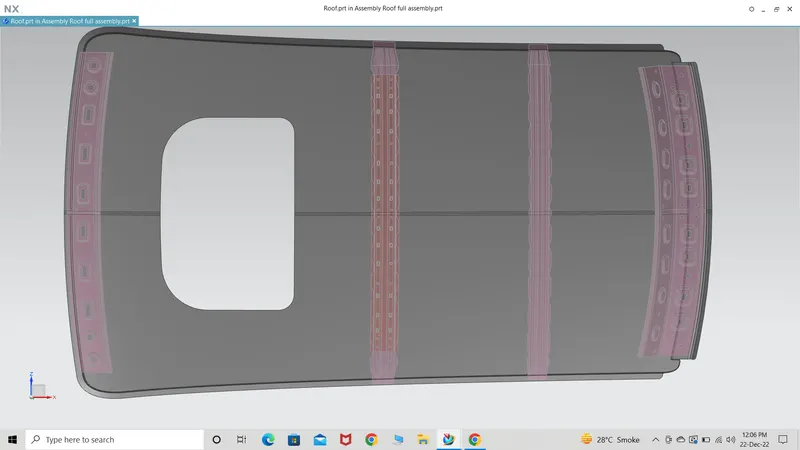
The roof is given a sun roof glass to make the part look like a one that would fit a top end version of a car or a part of a luxury brand. It was observed that the roof was not a linear in design but had a curvature. This is done in order to give the part some strength as explained in the earlier section. The front end was having greater curvature then the rear one so it was decided to create a sun roof in this region and give extra reinforcement at the rear end of the roof. Due to the presence of a sun roof section, the region over here has to be kept open which makes this region a weaker section. So the reinforcement that was to be given here has been shifted to the center region to keep the roof strong with this design adaptation.
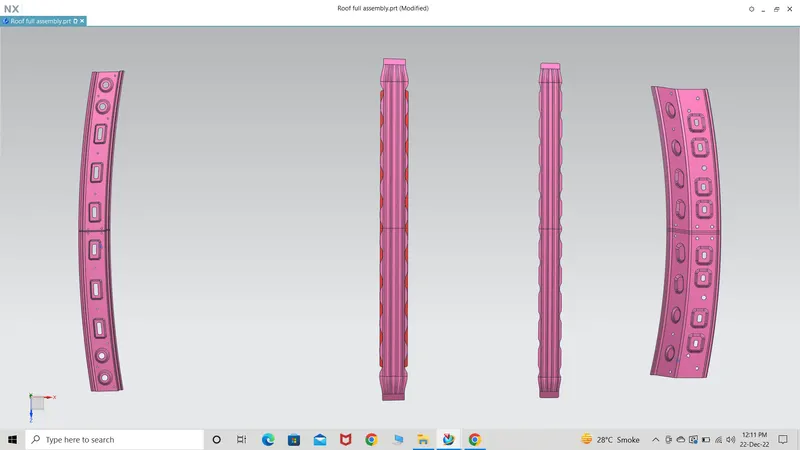
The components that make a roof strong are a set of reinforcements and bow roofs.
The front end of the roof is attached with a front roof rail which is a reinforcement to improve the strength of the same region. The design is adapted to give room for the front wind screen, plastic paste and the sealant that would attach the these all together. Roof rail and the upper roof are attached together by spot welding.
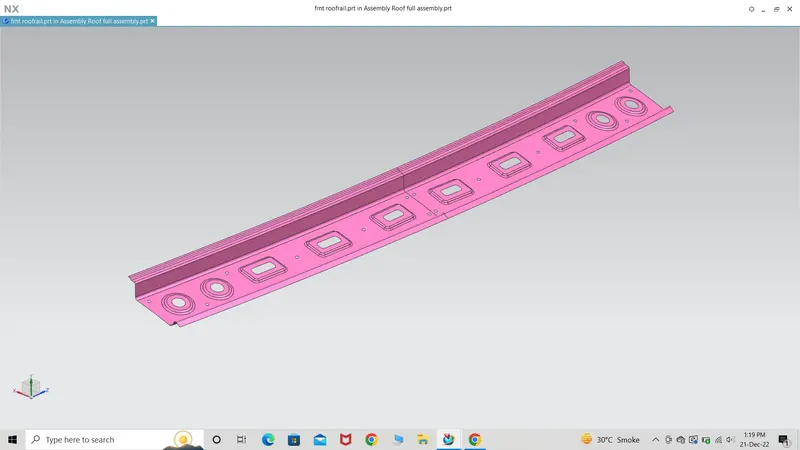
Front roof rail was created as a seperate part and was designed keeping the master section in mind. Additional cut outs and embossing was given to improve the strength but at the same time reduce the cost and weight of the part. the part was created as a half part and later after completion, the mirror geometry tool was used to form the remaining side of the same part.
*) The part is sewed after mirroring and in this assembly the front and rear roof rail was having gaps. The gaps were filled and the region was recreated where ever it was necessary.
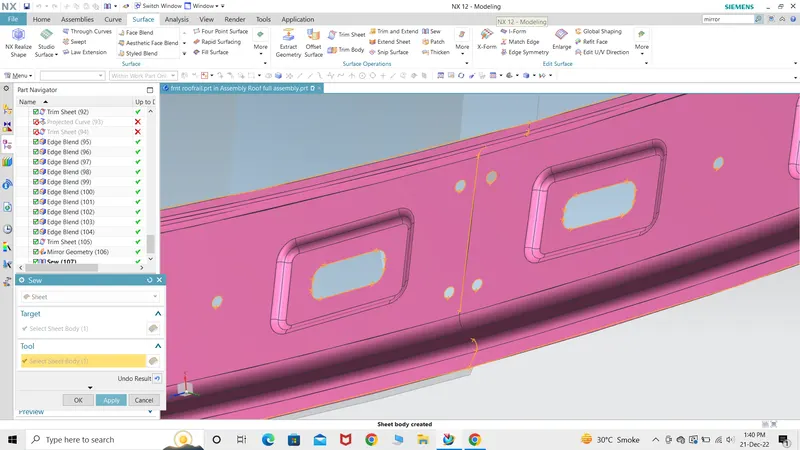
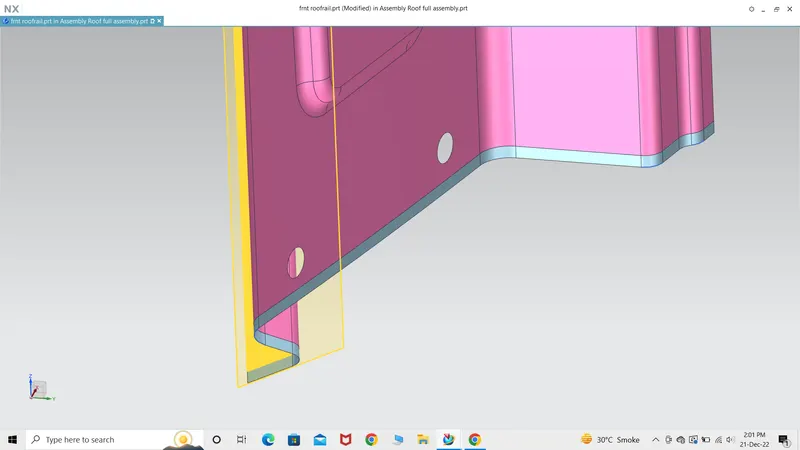
*) The center roof rail was created according to the master section. The location is exactly the center of the roof.
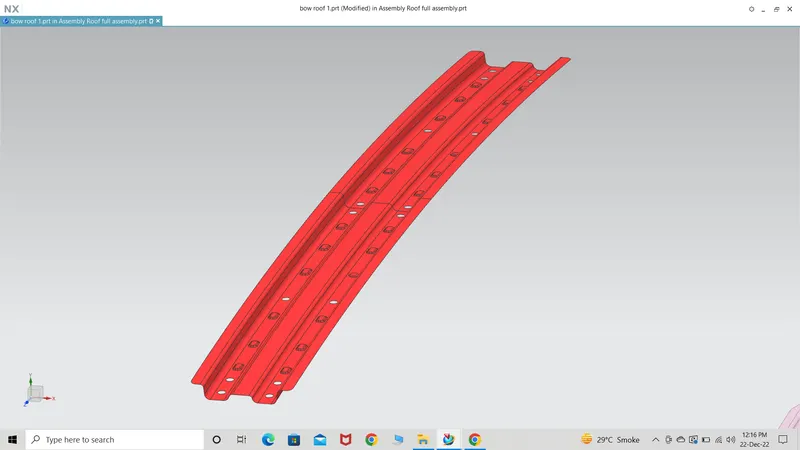
Center roof rail is given some cut-outs and emboss to improve the strenght and reduce a bit of cost with lowering the weight also.
*) Bow roof 1 are the rails which usually have a different design than roof rail due to the method by which these are joined to the roof. Bow roof is extra strengthening part that needs to be given in the region between the roof rails. Generally there is 1 bow roof in between front and center roof rail. The number of bow roofs in between center and rear roof rail depends on the curvature and length of the roof. In this particular design, there is a sun roof so the location of the bow roof gets shifted at the exact location of the center roof rail.
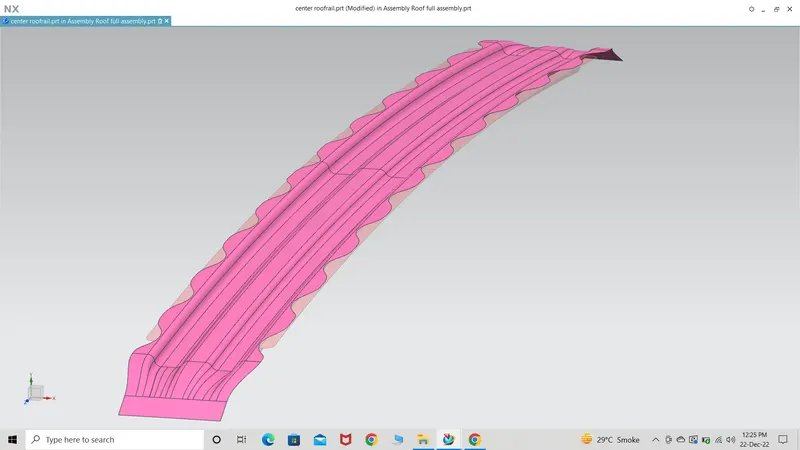
The end of the bow roof was created using guide curves and studio curves. The quality of the surface depends on only one factor i.e. whether nx 12 is executing thicken option or not.
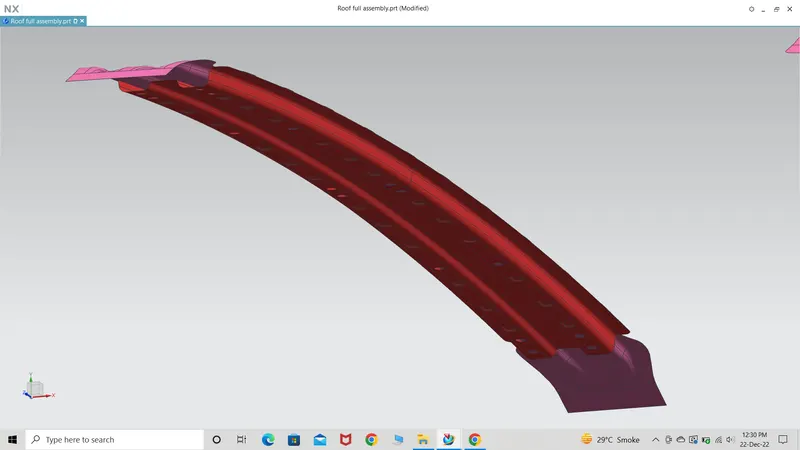
The s.s above shows center roof rail and bow roof 1 of a car with sun roof.
*) Bow roof 2 is created in the same manner and later mirror and sew option were used to complete the other half of the bow roof 2.
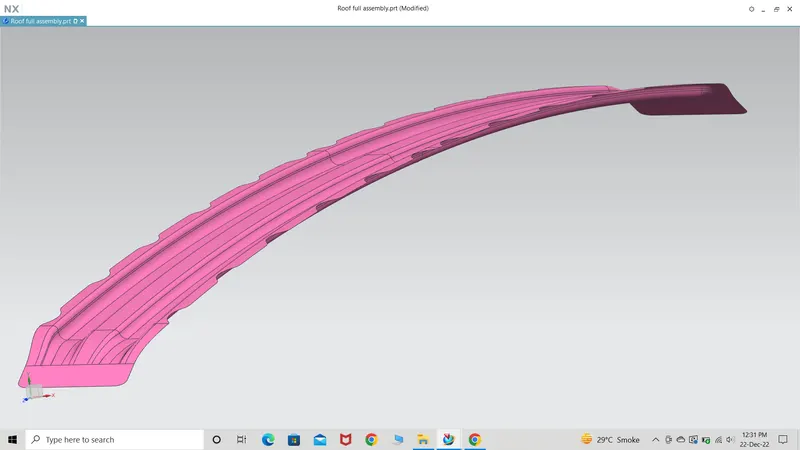
The dimensions of a bow roof and roof is different and also the method used to join them with roof. Spot welding is used where the surface area is min 15mm and pitch of 20-25mm. Mastic sealant requires a region of 80mm to spread and usually mastic sealant is put at area of 5mm.
*) Rear roof rail is located at the rear end of the roof as the name says it all. The design is adapted keeping the rear door mounting and sealant and plastic paste, and hinges that would mount the rear door on the roof.
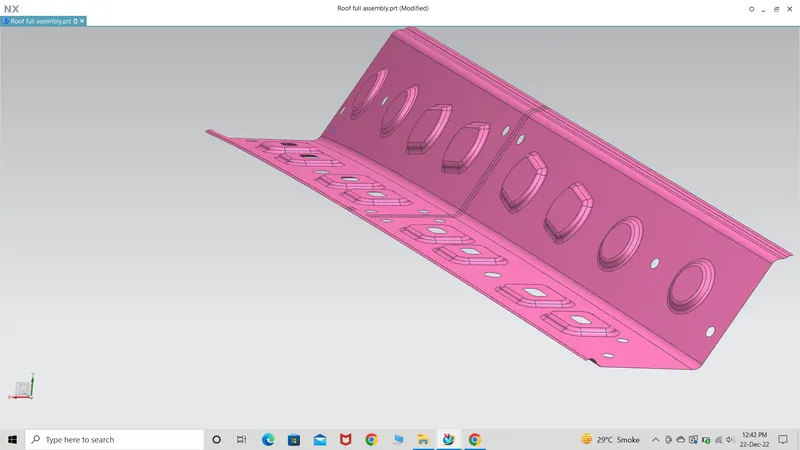
Additional embossing and cut-outs improve the strength of rear roof rail.
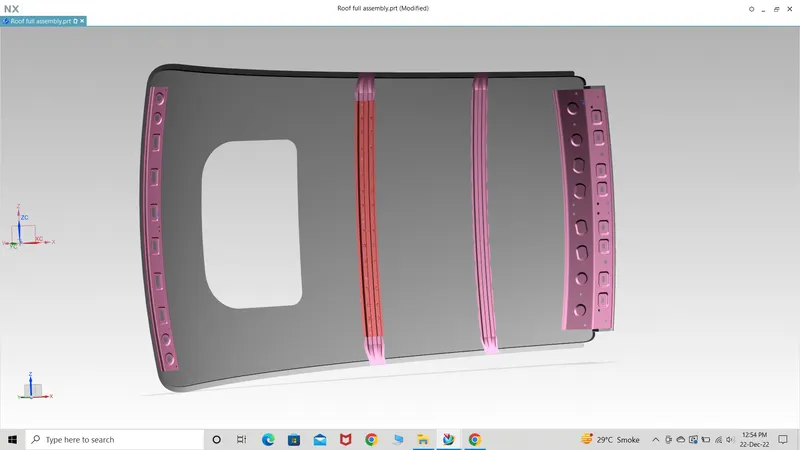
All design was completed and next was to test the designed roof for heat distortion and snow load test.
HEAT DISTORTION TEST
This test is based on the nature of metal which expands or deforms with change in the temperature. This test will test the roof based on the location of the reinforcements. The change in dimensions is under the influence of temperature change with load considered.
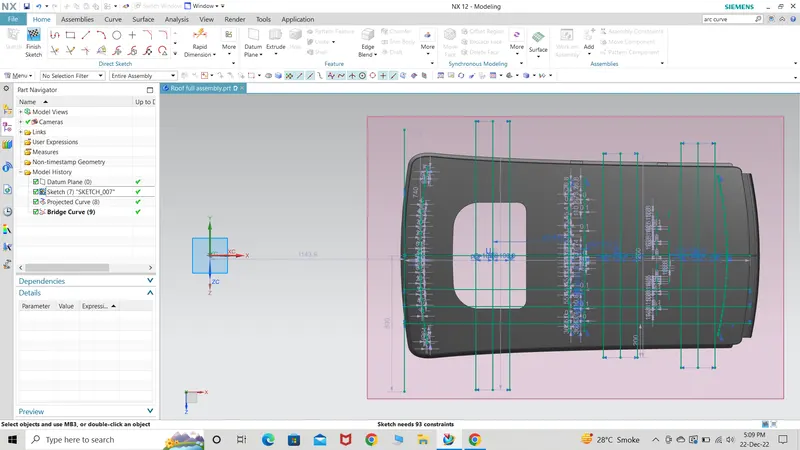
The necessary curves and points were created and the required arc and locations were measured to form the table.
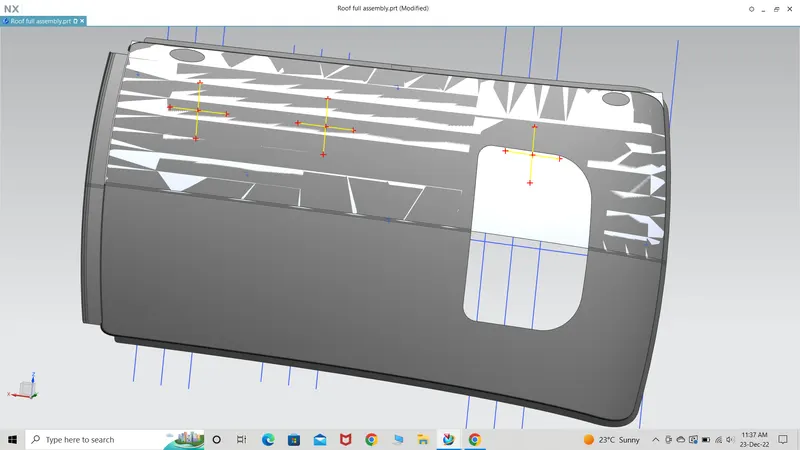
->) heat distortion table
| sr.no | Roofs | Rx | Ry | R | t | l | L | R^2/t | W |
| 1 | FRR to BR1 | 5441.28 | 4266.510 | 4782.81 | 0.75 | 2033.2 | 876.96 | 30500361.99 | 1.62 |
| 2 | BR1 to BR2 | 3979.39 | 10571.38 | 5782.188 | 0.75 | 2033.2 | 424.95 | 44578264 | 1.11 |
| 3 | BR2 to RRR | 3288.83 | 14531.3 | 5363.7 | 0.75 | 2033.2 | 339.85 | 38359036.92 | 0.843 |
The result show that the values are less than 2.7 and hence the design is ok for heat distortion test. There is no seperate bow roof in between the front rool rail and center roof rail because of the sun roof glass. The location however is not going to weaken the structure as the radius of curvature in this particular section is good enough to bear the load. In such a design with sun roof glass, bow roof and center roof rail share the same location. The calculation cannot be done for first case.
DRAFT ANALYSIS
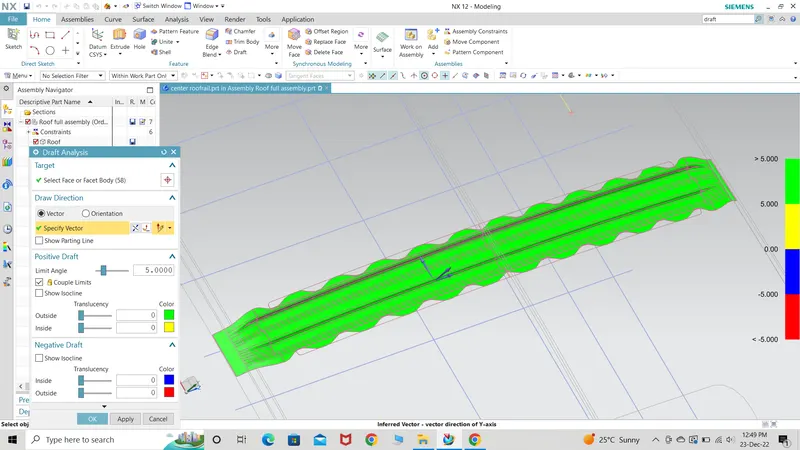
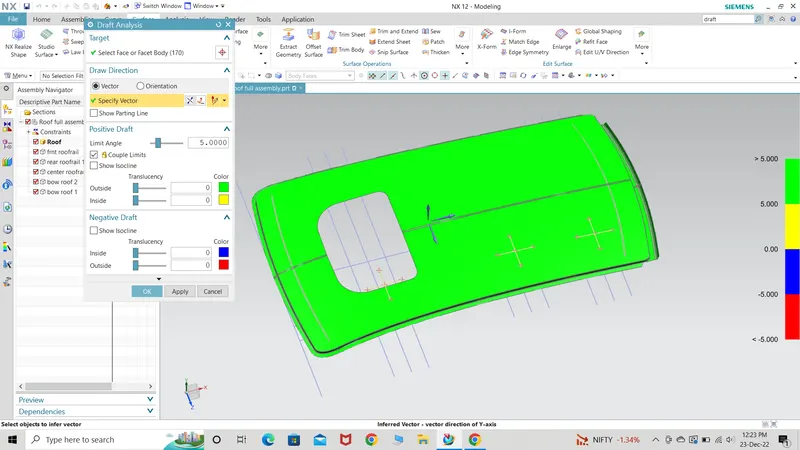
Draft analysis is an analysis that has to be carried out in order to get a good manufactureable surfaces. The angle is set to 7 degree which allows the stamp pressing manufaturing process to occur smoothly without causing any damage to the part which removing the sheet metal from the die. In other cases, the part won't manufacture without any damage.
Draft analysis of front roof rail.
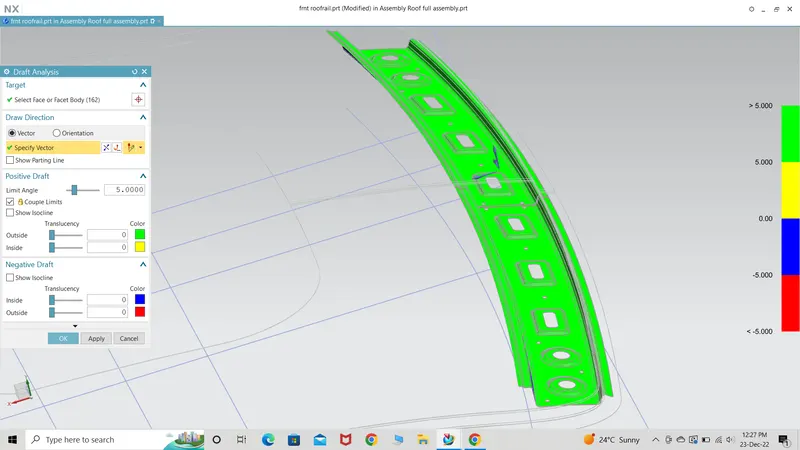
Draft anaylsis of bow roof 1
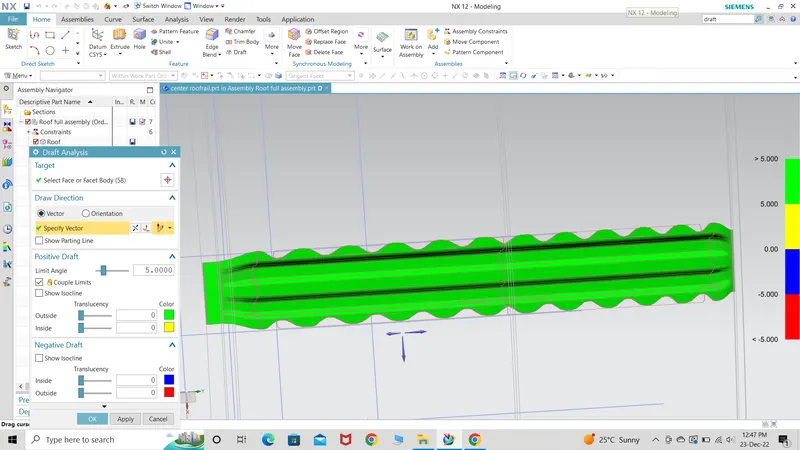
Draft analysis of center roof rail
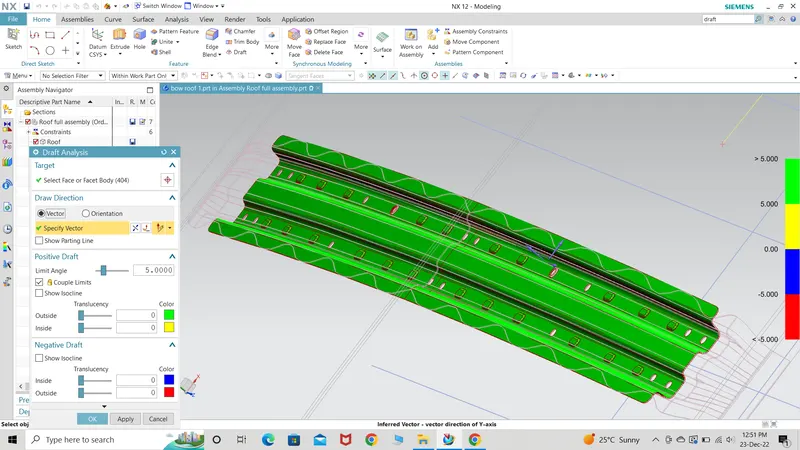
Draft analysis of bow roof 2
Draft analysis of roof
Draft analysis of rear roof rail
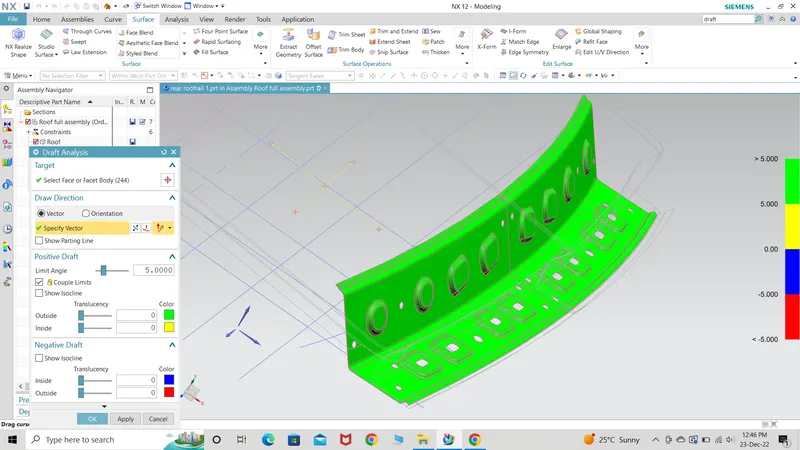
However, there were some regions in some of the aforementioned parts with blue and yellow regions which could be corrected by giving an angle greater than 5 for any flanges created.
*) Snow load criteria
Section inertia analysis was carried out for all the roofs to find the value of moment of inertia that would be used in snow load formula.
M.O.I of front roof rail
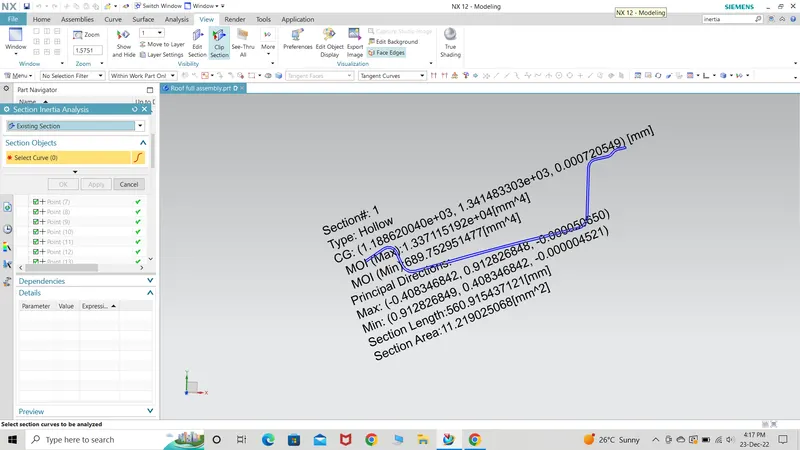
M.O.I of centre bow roof 1
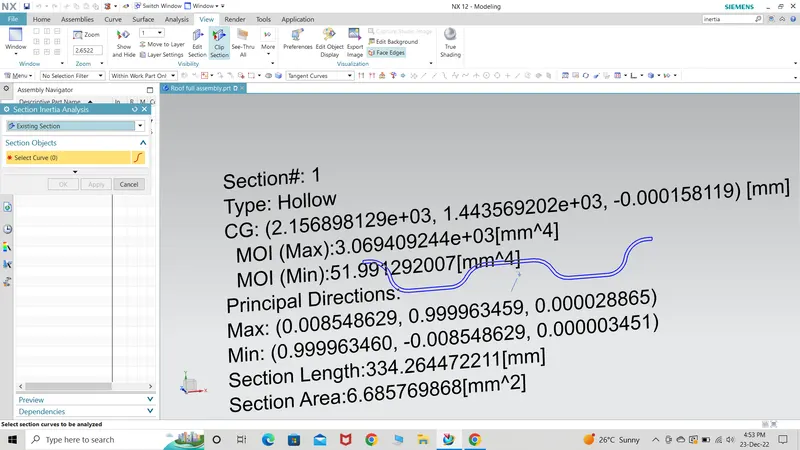
Center roof rail, bow roof 1 and 2 were having a very small moment of inertia which made the snow load test to fail. SO the embossing was increased in all these panels to get increment in the m.o.i values and which was observed clearly.
*) The panels with increased embossing are as follows:-
M.O.I of bow roof 1
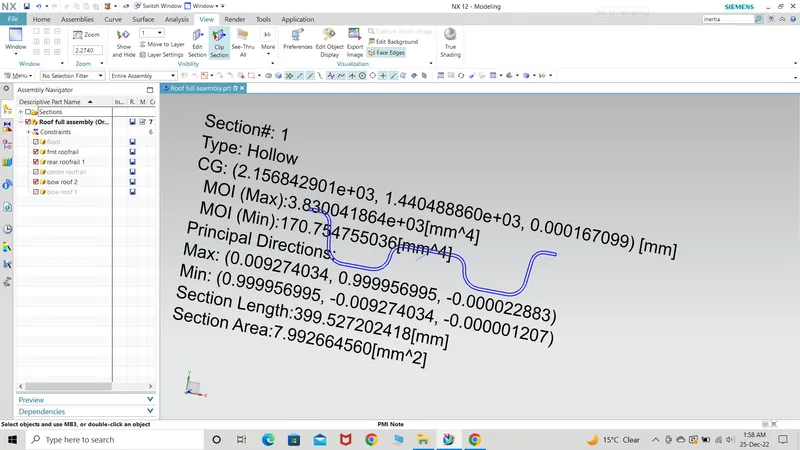
M.O.I of center roof rail
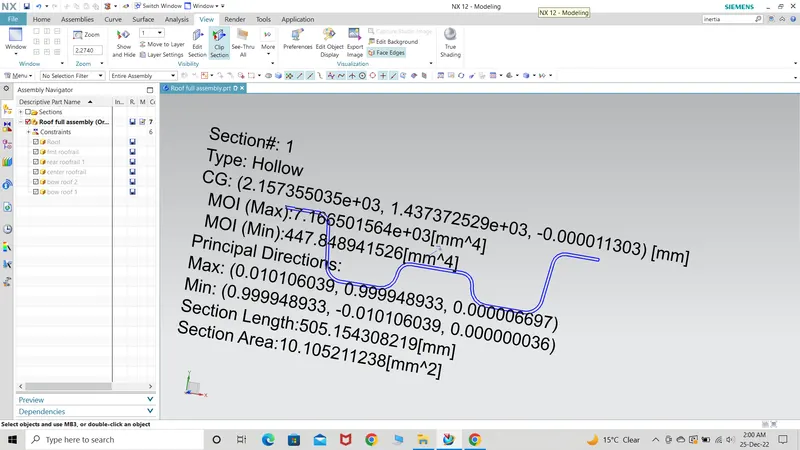
M.O.I of bow roof 2
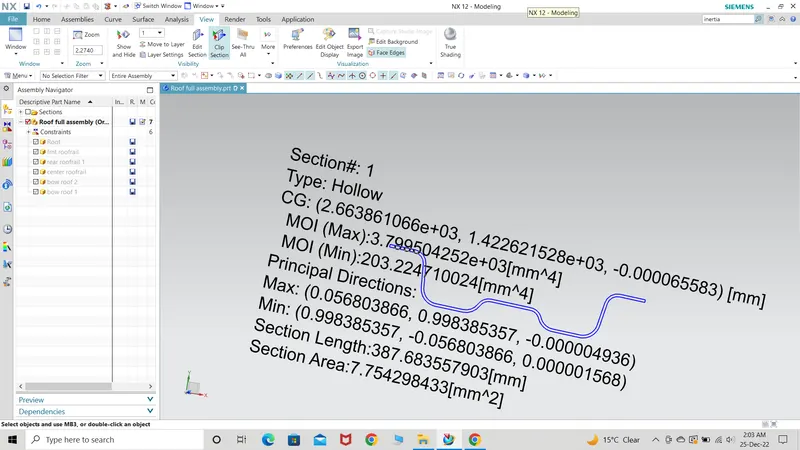
M.O.I of rear roof rail
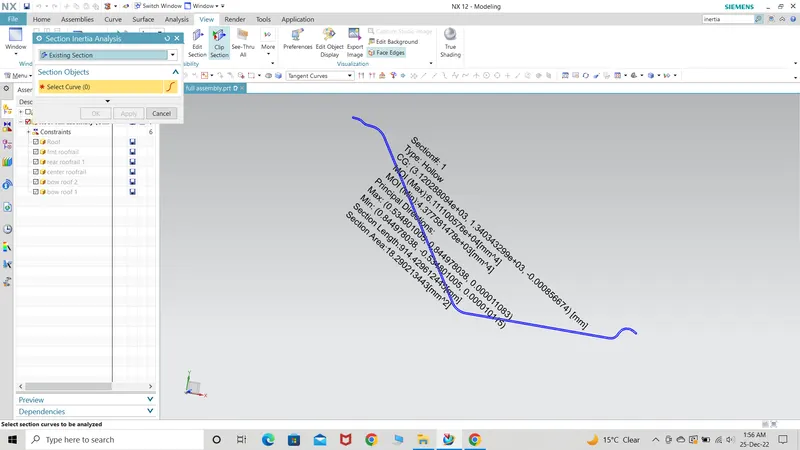
| Name | ly | alpha | Lx | Ly | Y | s | Rx | Ry | t |
| FRR to BR1 | 689.75 | 1.4 | 1198.56 | 2033.7 | 967.72 | 255.31 | 5441.28 | 4266.51 | 0.75 |
| CRR-BR2 | 447.84 | 0.2 | 1052.97 | 2033.7 | 506.82 | 251.1 | 3979.31 | 10571.38 | 0.75 |
| BR2-RRR | 170.74 | 0 | - | 2033.7 | 444.79 | 222.39 | - | - | 0.75 |
Qr1=4.6 .OK
Qr2=3.2 .OK
Qr3=not OK
Result- Roof with all the reinforcements was created and the tests were carried out. The observations were recorded.