Roof challenge
Aim :
To Design and Assemble the Roof and the necessary reinforcements by following the Master section.
Introduction :
An automobile roof or car top is the portion of an automobile that sits above the passenger compartment, protecting the vehicle occupants from sun, wind, rain, and other external elements. Because the earliest automobiles were designed in an era of horse-drawn carriages, early automobile roofs used similar materials and designs.
Types of roof :
- Convertible roofs is a passenger car that can be driven with or without a roof in place. The methods of retracting and storing the roof vary between models. A convertible allows an open-air driving experience, with the ability to provide a roof when required. Potential drawbacks of convertibles are reduced structural rigidity and cargo space.
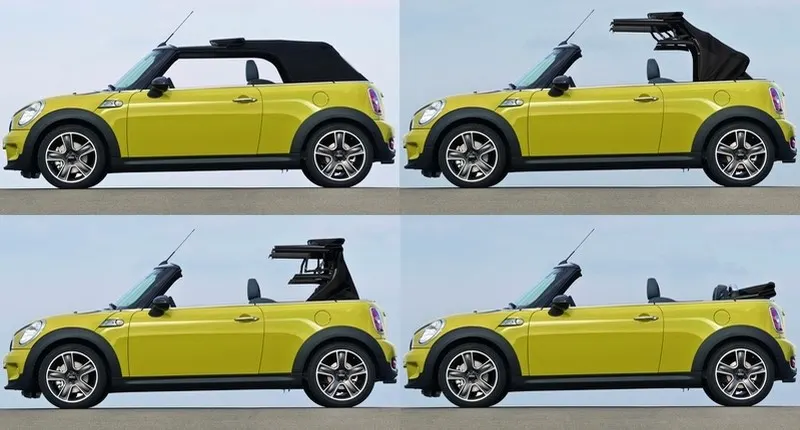
- hardtop is a rigid form of automobile roof, which for modern cars is typically constructed from metal. A hardtop roof can be either fixed, detachable for separate storing or retractable within the vehicle itself.
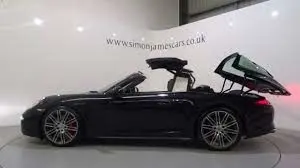
- Targa top is a semi-body style with a removable roof section and a full width roll bar behind the seats. The term was first used on the 1966 Porsche 911 Targa,and it remains a registered trademark of Porsche. The rear window is normally fixed, but on some targa models, it is a removable plastic foldable window, making it a convertible-type vehicle. Any piece of normally fixed metal or trim which rises up from one side, over the roof and down the other side is sometimes called a targa band, targa bar, or a wrapover band.Targa tops are different from T-tops which have a solid, non-removable bar running between the top of the windscreen and the rear roll-bar, and generally have two separate roof panels above the seats that fit between the window and central t-bar.
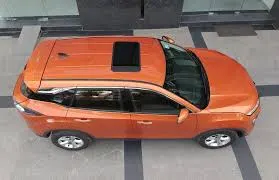
- Sunroof is a movable panel that opens to uncover a window in an automobile roof, allowing light and fresh air to enter the passenger compartment. Sunroofs can be manually operated or motor driven, and are available in many shapes, sizes and styles. While the term sunroof is now used generically to describe any glass panel in the roof, the term "moonroof" was historically used to describe stationary glass panes rigidly mounted in the roof panel over the passenger compartment. A moonroof has a glass panel that is transparent and usually tinted. Previous terms include Sunshine Roof, Sliding Head and Sliding Roof.
Manufacturing methods of Roof :
Spot welding: Spot welding is a resistance welding process. This welding process is used primarily for welding two or more metal sheets together by applying pressure and heat from an electric current to the weld area.
Blanking: Blanking is a metal production process, during which a metal workpiece is removed from the primary metal strip or sheet when it is punched. The material that is removed is the new metal workpiece or blank.
Deep Drawing: The deep drawing process is a forming process which occurs under a combination of tensile and compressive conditions. A flat sheet metal blank is formed into a hollow body open on one side or a hollow body is formed into a hollow body with a smaller cross-section.
Deburring: Deburring is the process of removing the small imperfections known as burrs from machined metal products.
Design of roof :
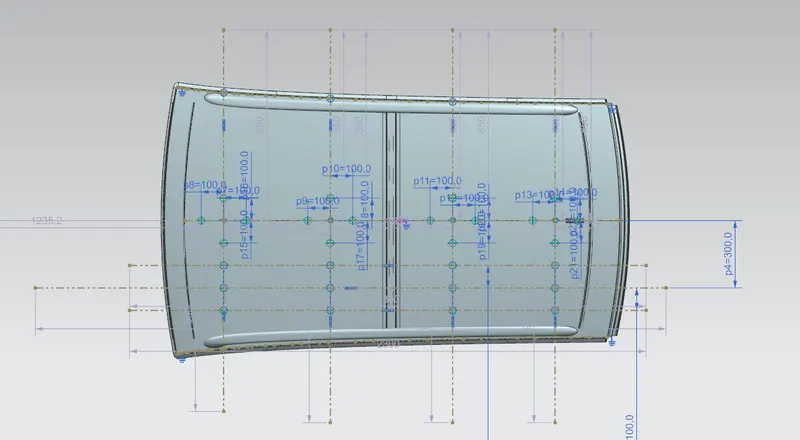
Given Input
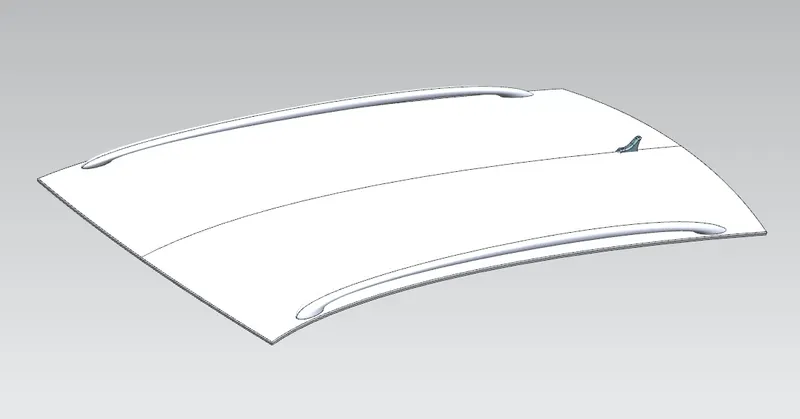
Components of roof we designed
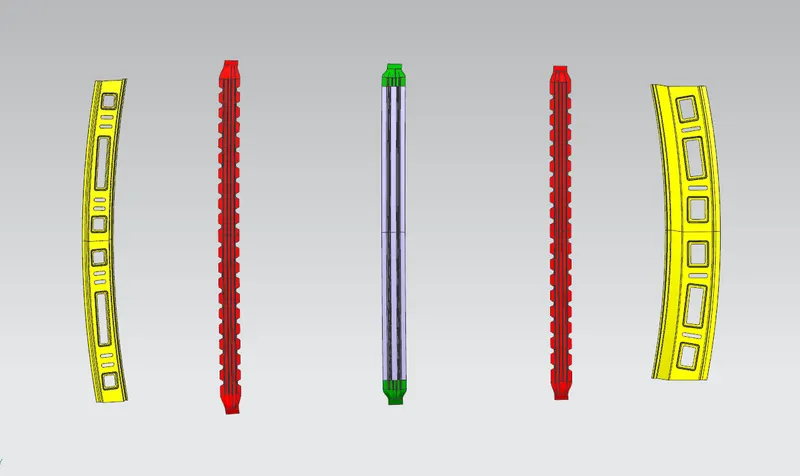
Front roof rail
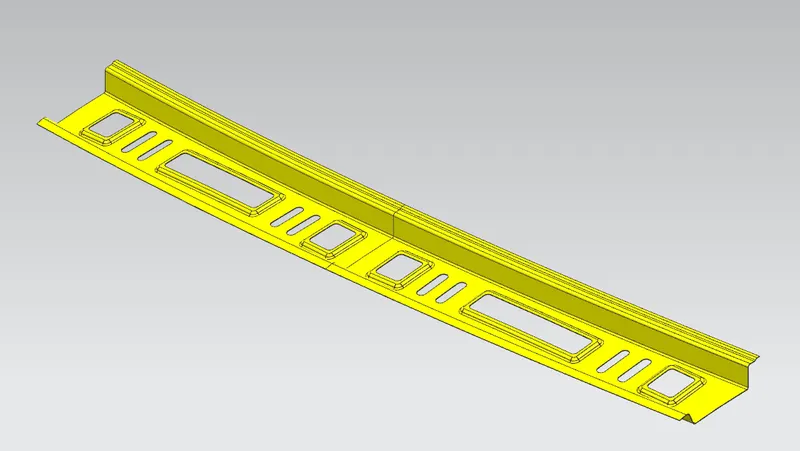
Front roof rail is used to provide strength to the roof panel front and it also acts as link between windshield glass, roof panel and headliner. Spot welds are applied at wind shield end of the rail and the other end is joined with roof using mastic sealent which also increases the strength.
Bow roof rail
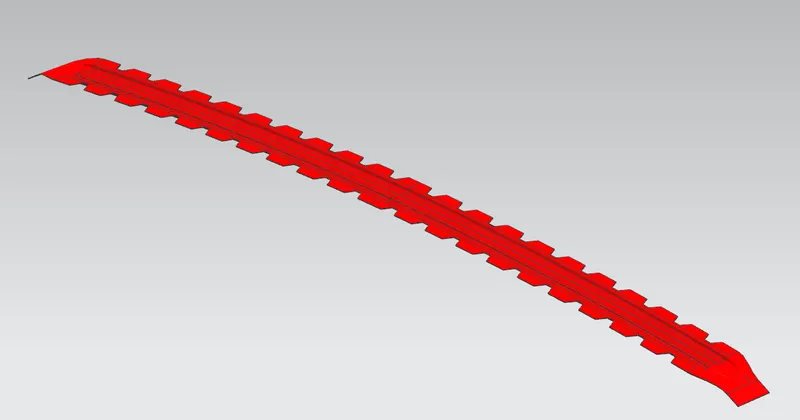
The bow roofs gives torsional stiffness and load bearing capacity of the roof structure. The bow roof is positioned based on the curvature of the roof panel. The heat distortion and snow load criteria are checked to analyze the position of the bows.
central roof rail
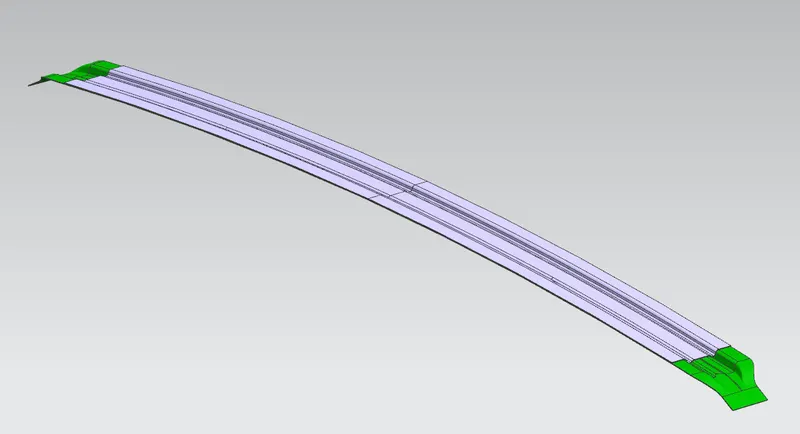
This is a roof rail that will be at the centre of the roof to provide strength and stability to the roof.
Rear roof rail 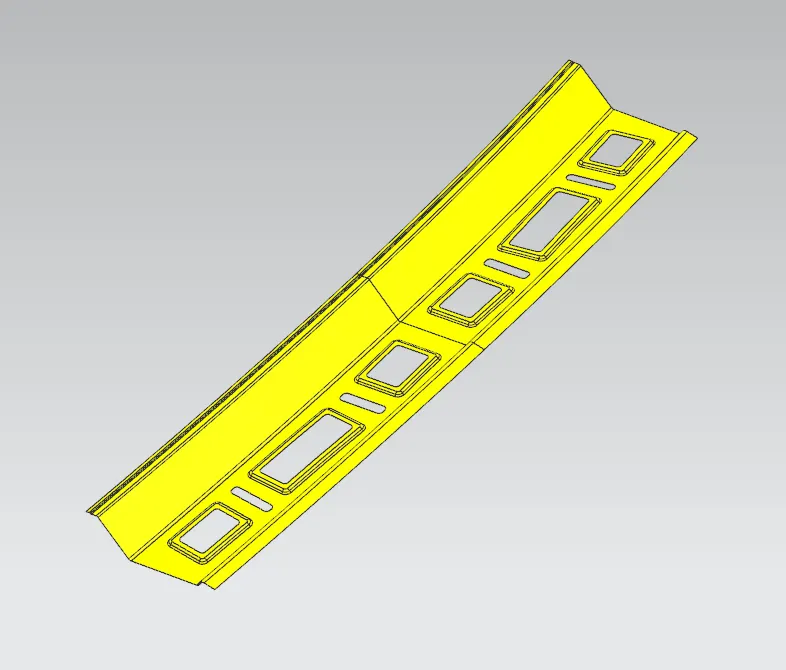
Rear roof rail is again used to strengthen the roof and it acts as a link between back glass and roof which connected to the backdoor of the car.Spot welds are applied at back doorend of the rail and the other end is joined with roof using mastic sealent.
Assembly images :
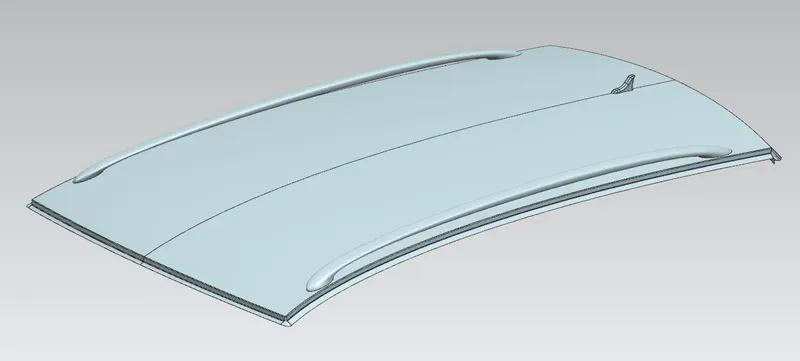
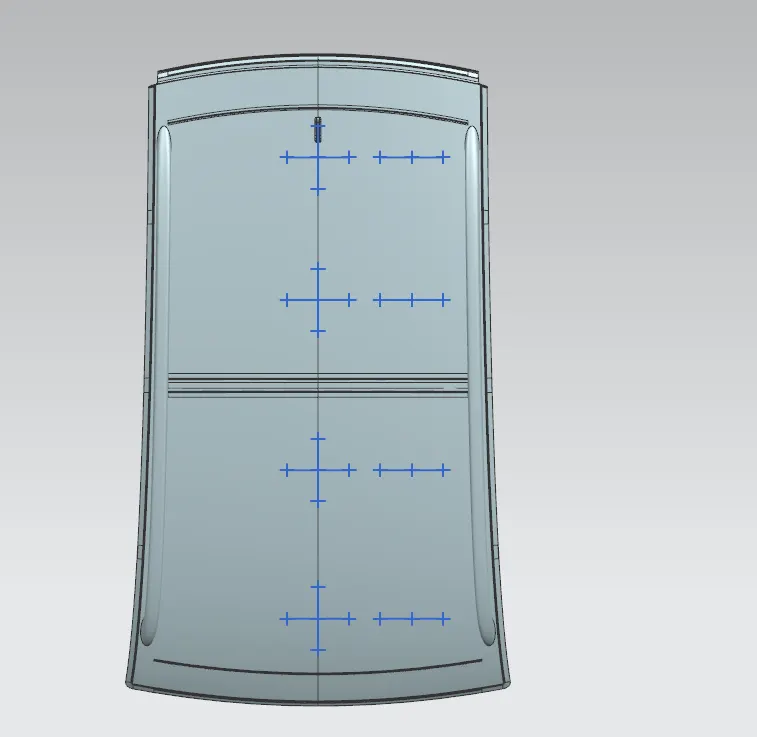
Isometric view
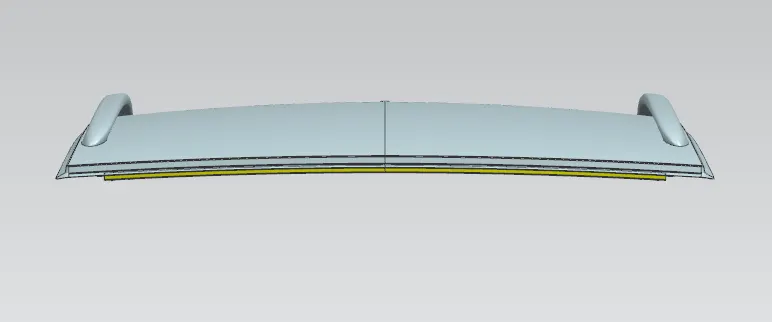
Front view
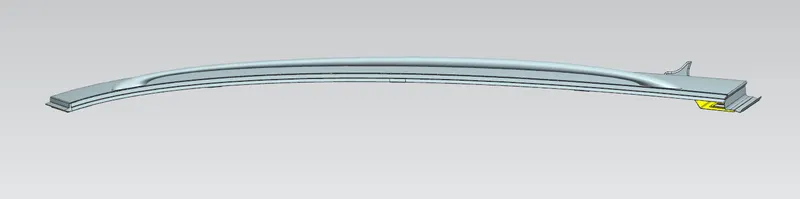
side view
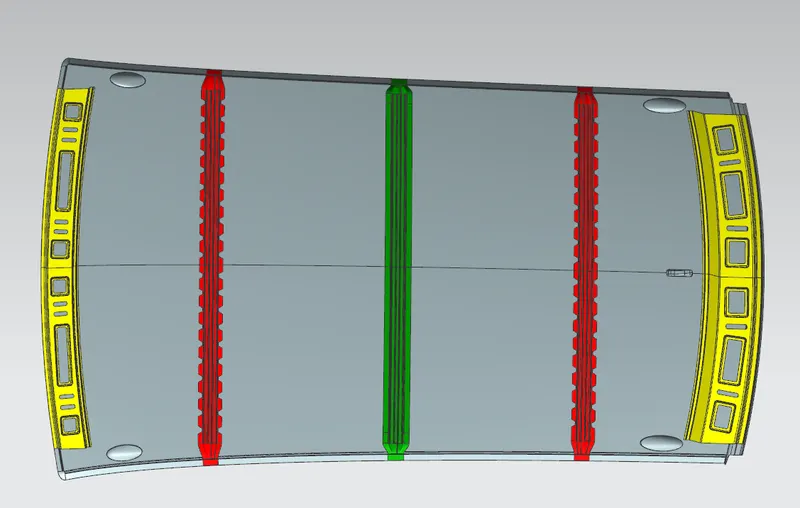
Bottom view
Analysis :
Heat distortion criteria:
Heat distortion temperature is a temperature at which the metal softens and deform under a specific load.This study is done to check the ability of the roof to withstand high temperature with respect to the position of the reinforcement which contribute to the increase strength.
Prediction formula:W=[1.73×10 ×L] + [1.85× 10 ×R /t]+[1.10×10 ×l]-2.68
Judgemental condition:Ok<2.7>3.1
Where
L=Roof length in X-direction in mm (Roof dimension in O-Y)
R=Roof curvature
R=2(R ×R )/(R +R )
Rx =X Curvature
Ry =Y Curvature
T =Roof plate thickness in mm
L =Bow roof span in mm
Calculation table of Heat Distortion Criteria
|
S.no |
section |
Rx |
Ry |
R |
I |
L |
t |
W |
OK/NG |
|
1 |
FR & BR1 |
4004.86 |
3841.04 |
3921.23 |
351.79 |
2026.86 |
0.75 |
1.59 |
OK |
|
2 |
BR1 & CR |
2864.54 |
4118.99 |
3379.09 |
467.30 |
2026.86 |
0.75 |
1.108 |
OK |
|
3 |
CR & BR2 |
5612.35 |
70050.49 |
10392.09 |
471.07 |
2026.86 |
0.75 |
4.008 |
NG |
|
4 |
BR2 & RR |
4326.06 |
411.317 |
751.20 |
306.37 |
2026.86 |
0.75 |
1.177 |
OK |
Snow Load criteria :
Snow load criteria study is done to check the ability of the to withstand snowfall and bounce back to its orginal shape without any permenant deformation once the load is removed.
prediction formula :Q =[(I × t )/(α × s×(R +R /2) × 10 )]
Where
α = M × L × 10 ,M =Y(L -Y)
Judgement Condition:Q ≥3.1
t=Roof plate thicness in mm
L =Distance between Front and rear roof rail on vehicle O-Y in mm i.e length of the roof panel with the centre point between roof rail FR/RR as the
referance point of the front and rear
Y=Distance from front roof rail centre to bow roof in mm
S - Distance for which BOW bears divided load in mm
S= L /2+L /2
I =Geometrical moment of inertia of roof BOW (Cross-section)mm
Ry= Lateral direction curvature radius of roof panel Y cross section on Roof ROW in mm
Rx=Longitudinal direction of the curvature radius of roof panel X cross section on BOW roof (mm)
|
S.no |
section |
Rx |
Ry |
Lx |
Ly |
Y |
t |
Iy |
L1 |
L2 |
α |
S |
Qr |
OK/NG |
|
1 |
FR & BR1 |
7145.17 |
3841.04 |
1140.29 |
2026.86 |
351.79 |
0.75 |
37.87 |
351.79 |
467.30 |
0.76 |
409.54 |
2.25 |
NG |
|
2 |
BR1 & CR |
2932.40 |
4118.99 |
1087.19 |
2026.86 |
467.30 |
0.75 |
113.32 |
467.30 |
471.07 |
0.86 |
469.18 |
1.266 |
NG |
|
3 |
CR & BR2 |
3242.71 |
70050.49 |
1056.81 |
2026.86 |
471.07 |
0.75 |
37.79 |
471.07 |
306.37 |
0.81 |
388.72 |
5.02 |
OK |
Draft analysis :
The Draft Analysis command enables you to detect if the part you drafted will be easily removed. This type of analysis is performed based on color ranges identifying zones on the analyzed element where the deviation from the draft direction at any point, corresponds to specified values.Here the draft angle is given as 5 degree.
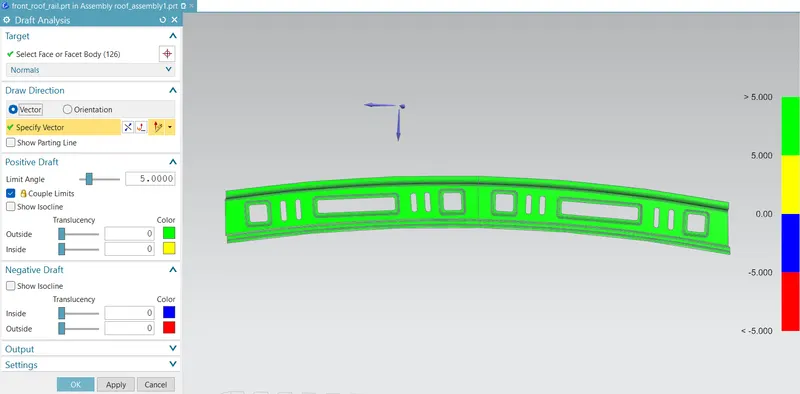
Front rail roof
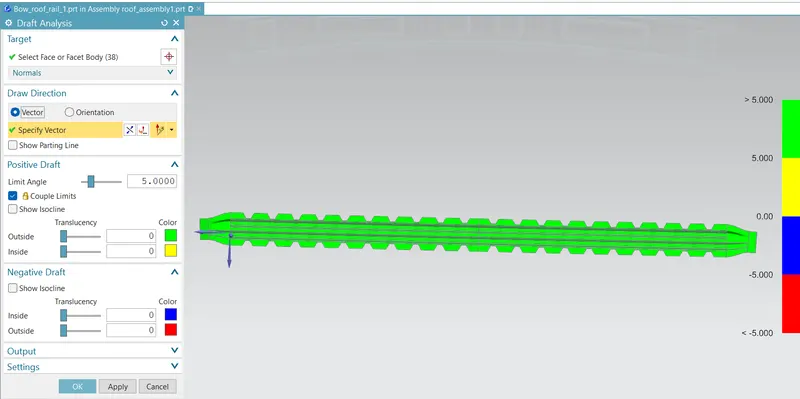
Bow rail roof 1
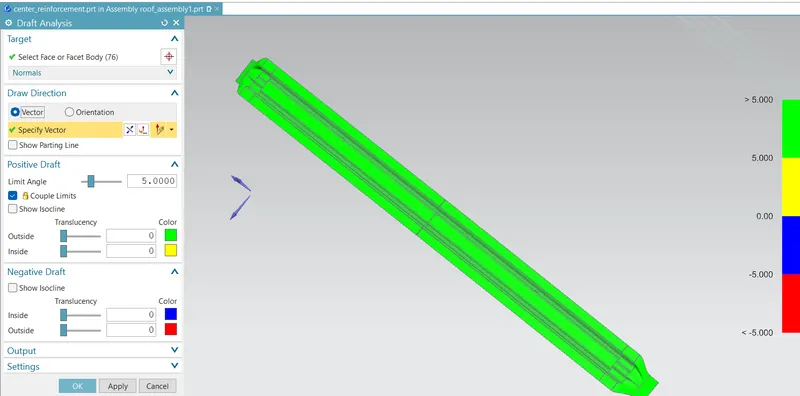
central rail roof
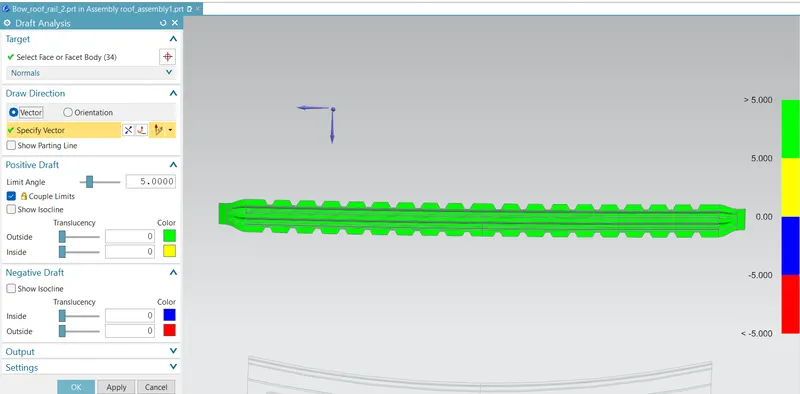
Bow rail roof 2
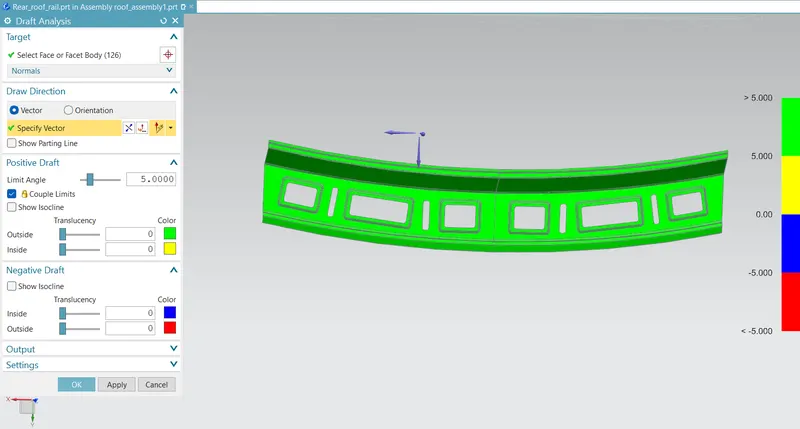
Rear rail roof
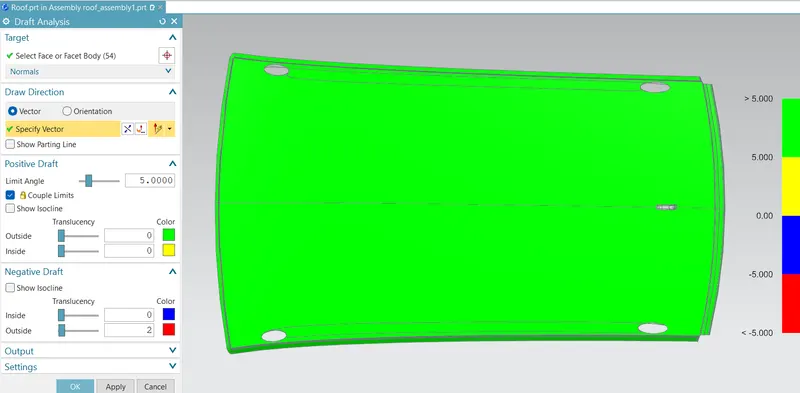
Outer roof
The outer roof have some negative values so we need to use another tooling direction
Conclusion :
The roof was created with all required parameters with a certain rails, and calculation has done for heat distortion, snow load and performed Draft analysis.