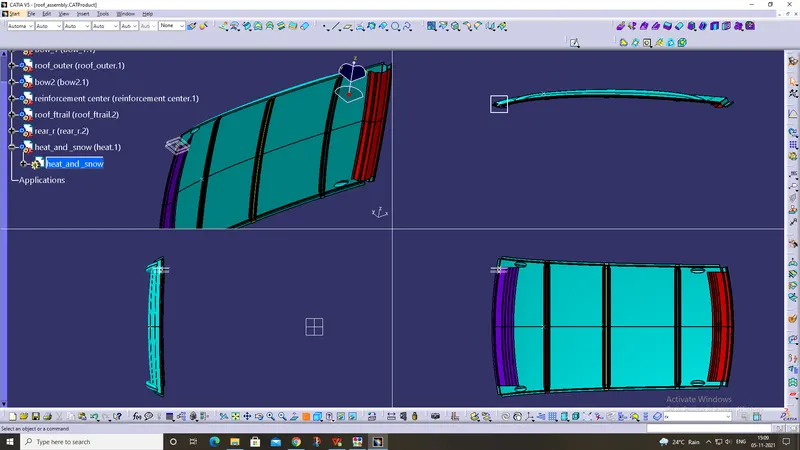
Roof challenge
Roof:-
An automobile roof or car top is the portion of an automobile that sits above the passenger compartment, protecting the vehicle occupants from sun, wind, rain, and other external elements.
Types of roofs:-
1. Hardtop:-
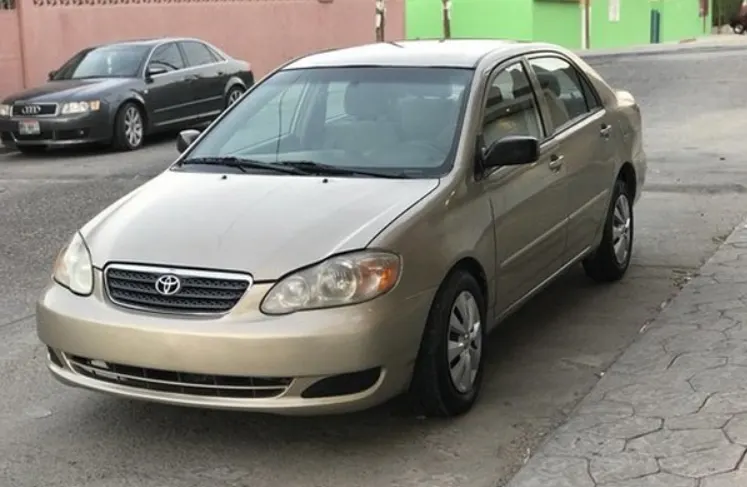
When we talk about hardtops, we are referring to the common rigid forms of automobile roofs which we see around. In modern-day cars, this type of roof is made from metal or plastic.
2. Sunroof:-
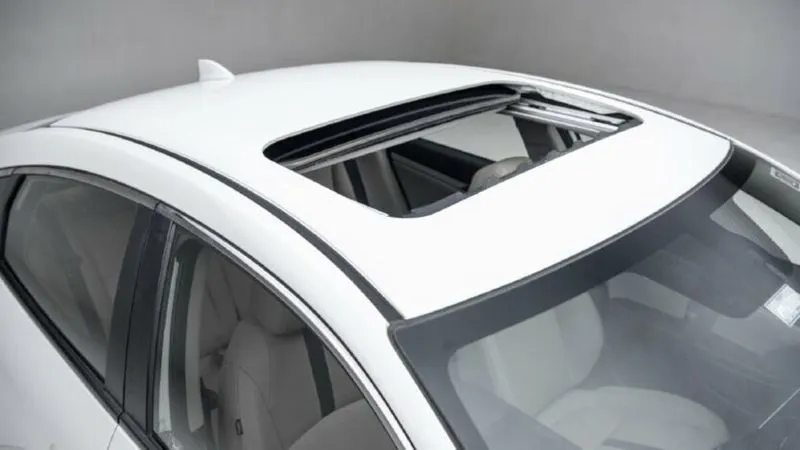
This type of roof is also quite popular. You might have been seeing it around. A sunroof is an operable type of roof that allows for an opening in the roof of an automobile; say a window in a roof. It can allow either light or air or both to enter the vehicle. They are either operated manually or automatically.
3. Convertible roofs -
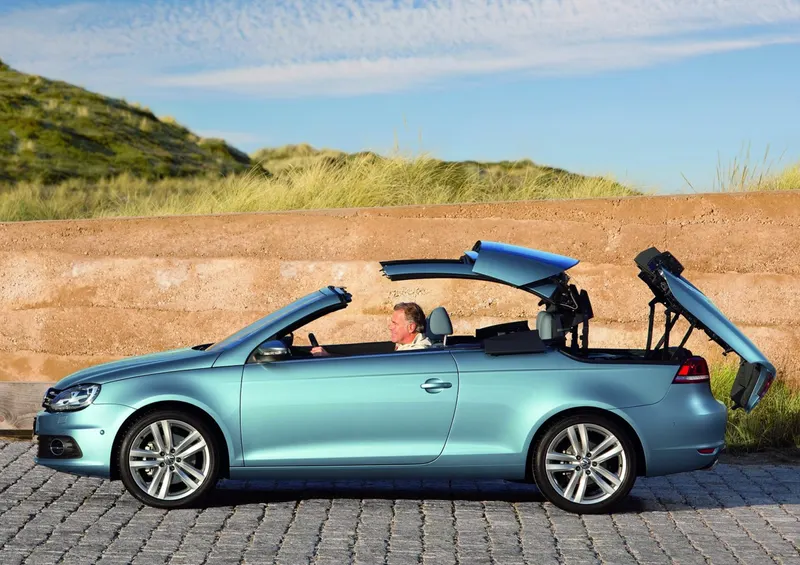
A convertible or cabriolet is a passenger car that can be driven with or without a roof in place. The methods of retracting and storing the roof vary between models. A convertible allows an open-air driving experience, with the ability to provide a roof when required. Potential drawbacks of convertibles are reduced structural rigidity (requiring significant engineering and modification to counteract the effects of removing a car's roof) and cargo space

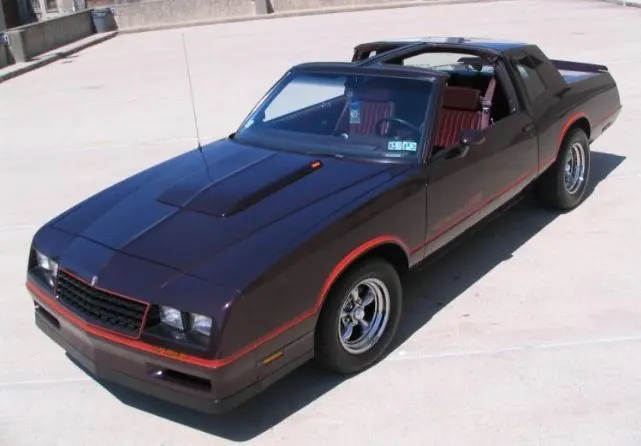
4. T-tops
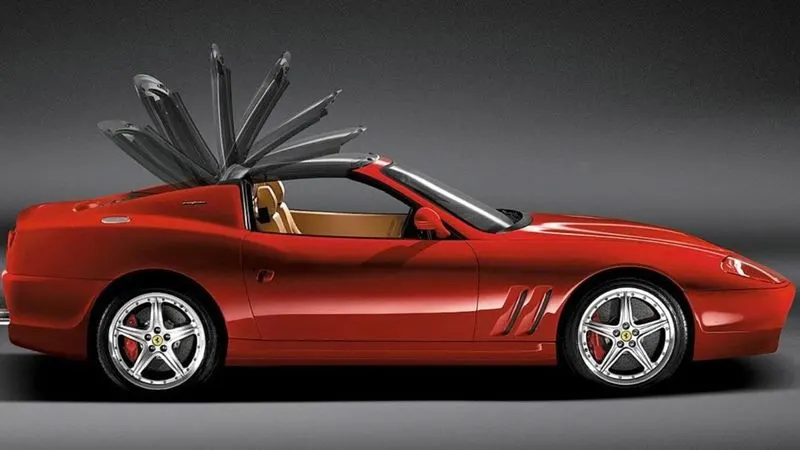
5. Targa tops
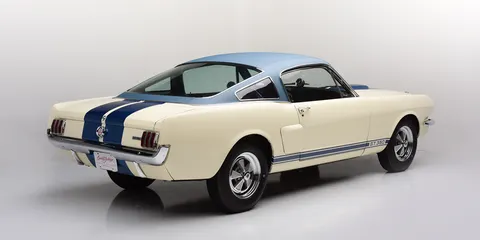
6. Vinyl roofs
Roof Crush Test:
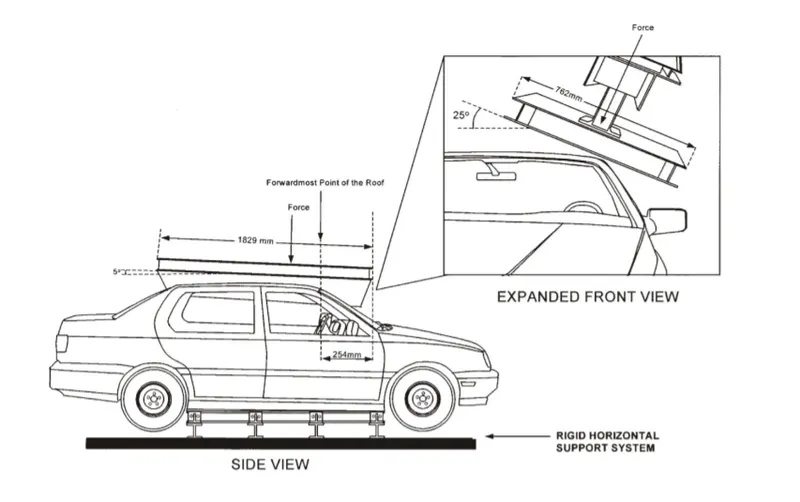
The strength of the roof structure to occupant the protection in real-world crashes, requiring the maximum moving distance of the roof structure should be less than 127mm when the induced load is 1.5 times the vehicle weight.
For the test, the passenger car shall be rigidly placed or positioned on a horizontal surface with the doors locked and the window closed.
This test can be conducted on either side of the roof structure, the front left or front right side but not on both sides in one single test and still meet the requirements of the test. The rigid plate shall not move faster than 0.5 inches/second and the force applied on the plate shall not exceed the lesser of 1.5 times the unloaded vehicle weight (UVW) expressed in kilograms multiplied by 9.8 or 5000lbs
Also, the direction of the forces shall be downward and perpendicular to the lower surface of the rigid plate and such that moves in a straight line without rotation. The duration of the test shall not exceed 120 seconds. The longitudinal axis of the plate is pitched forward at a 5° angle as viewed from the side of the passenger
The roof is designed by following some criteria:-
1. Visibility criteria as safety and functionality
2. Head clearance for ease and comfort
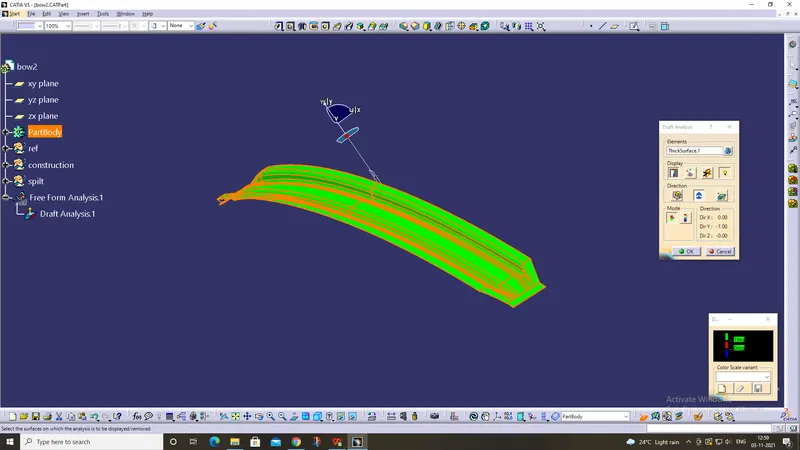
3. Draft analysis for easy manufacturing and tooling
4. Safety parameters for users
5. Heat distortion
6. snow load criteria
To create the Roof Given data is:-
Roof Skin:-
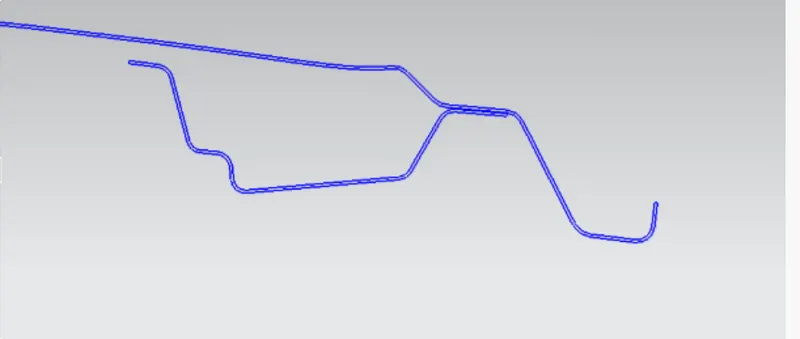
Master section of the rear roof rail:-
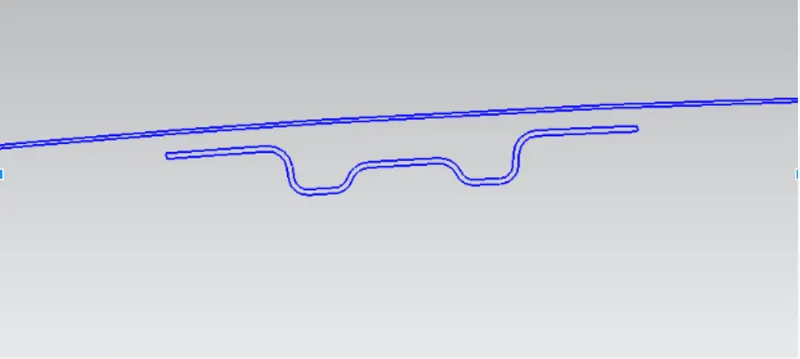
Master section of bow roof:-
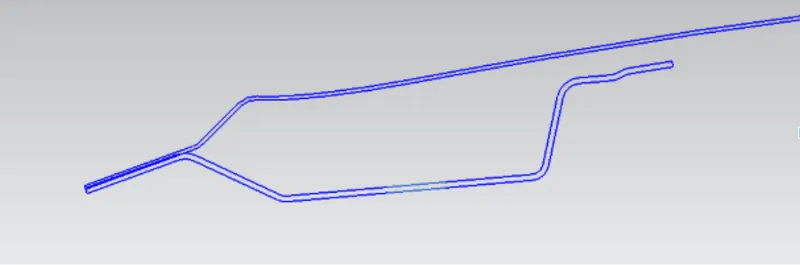
Master section of the front roof rail:-
Front roof Rail master section reference:-
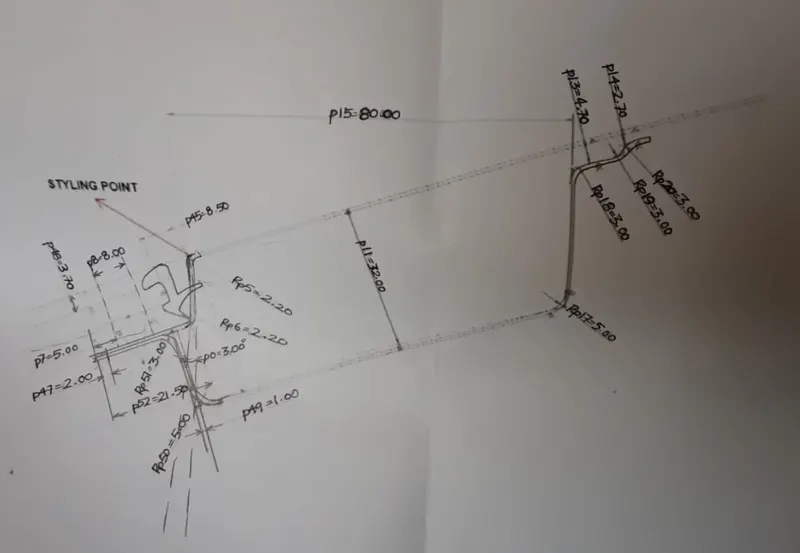
Rear roof rail Master section reference:-
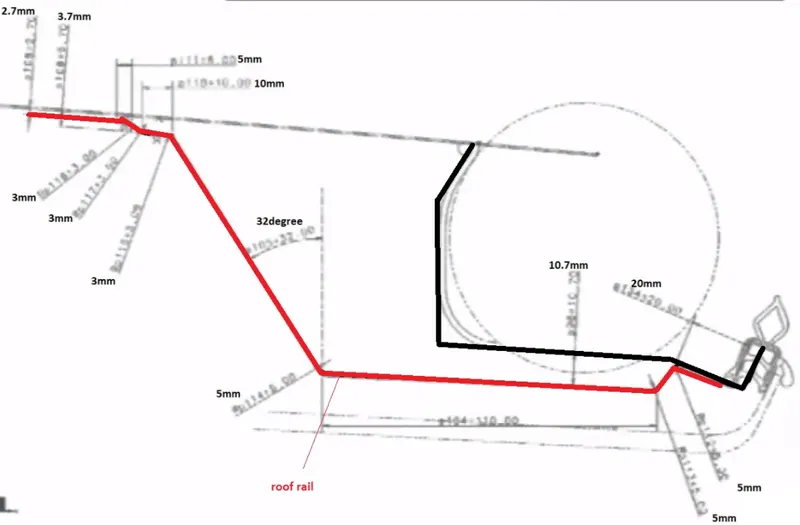
Front Roof Rail:-
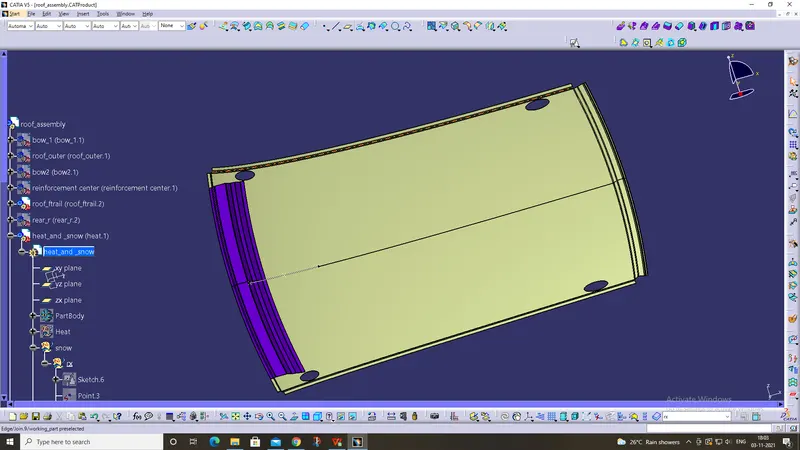
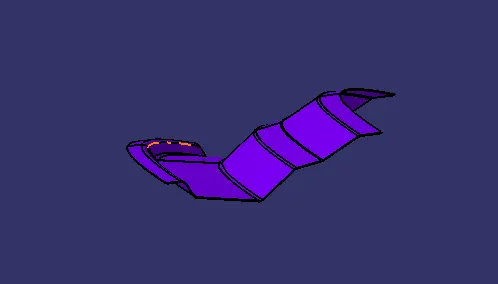
Rear Roof Rail
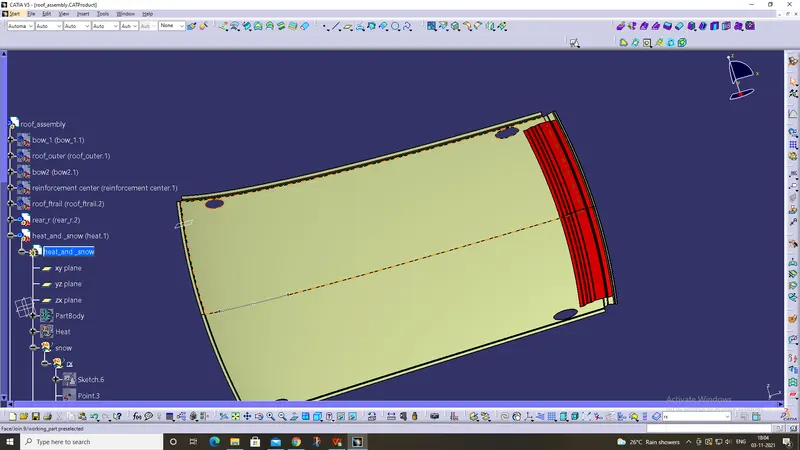
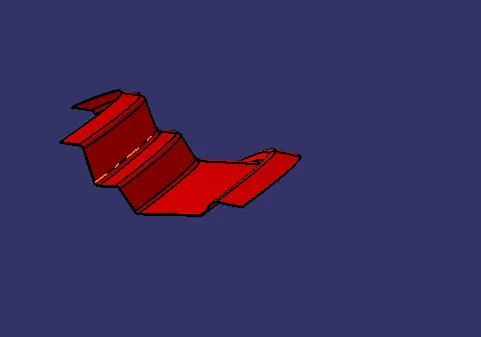
Reinforcement Roof Rail
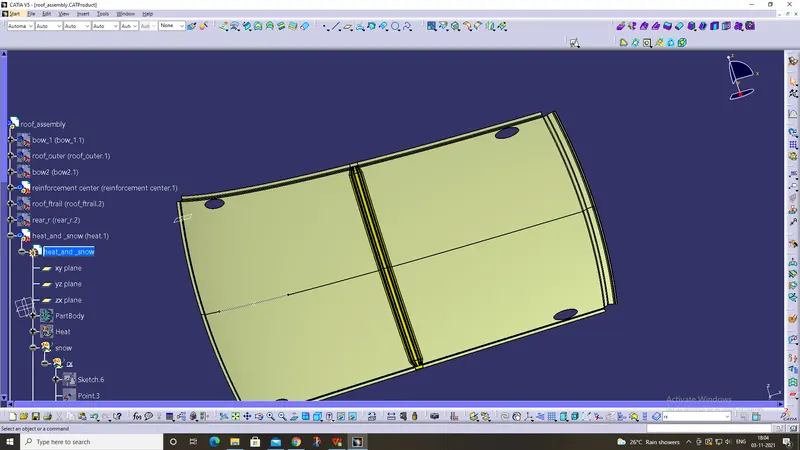
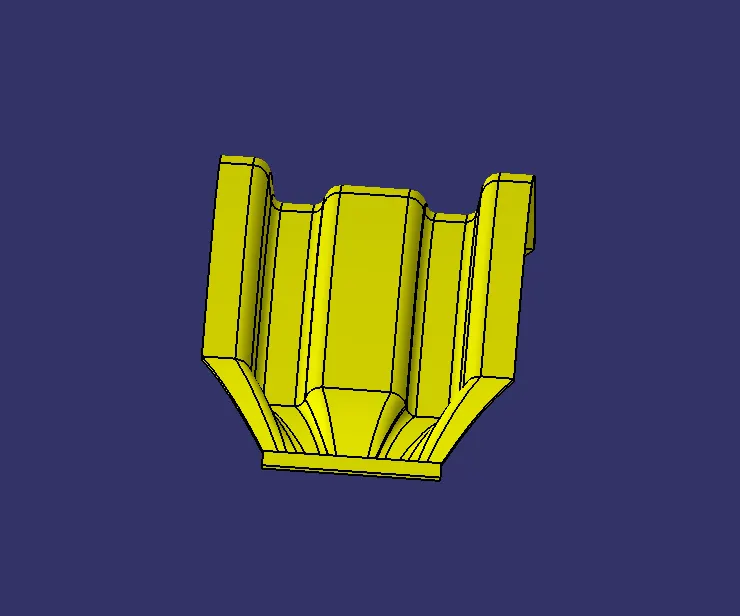
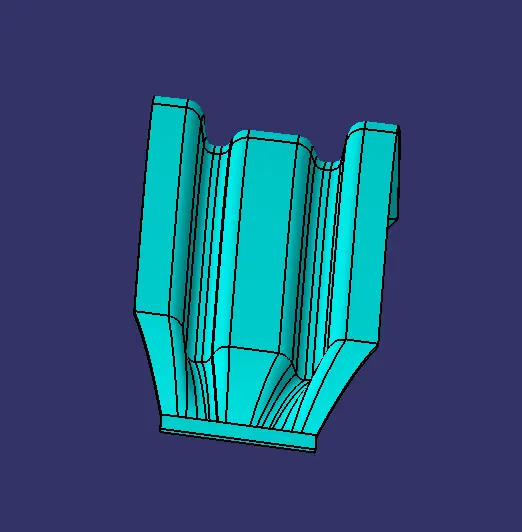
Bow Roof 1
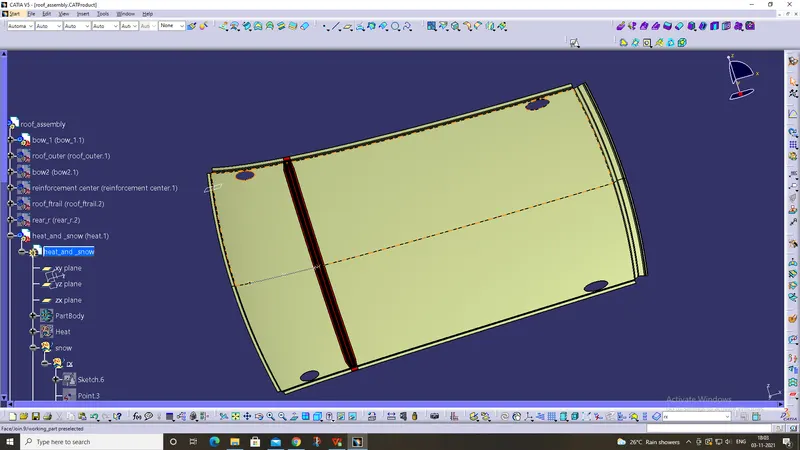
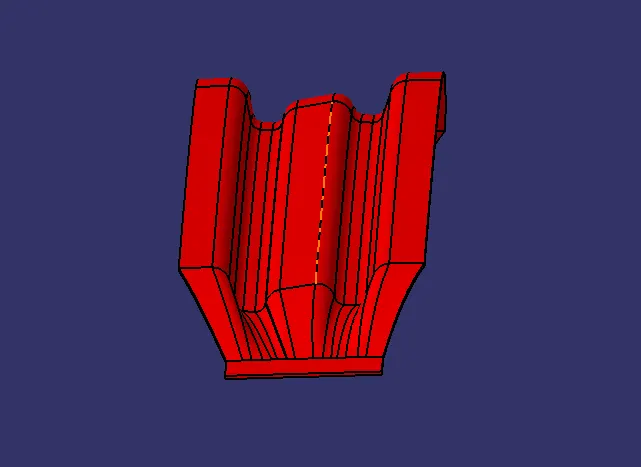
Bow Roof 2
Draft Analysis of bow 1:-
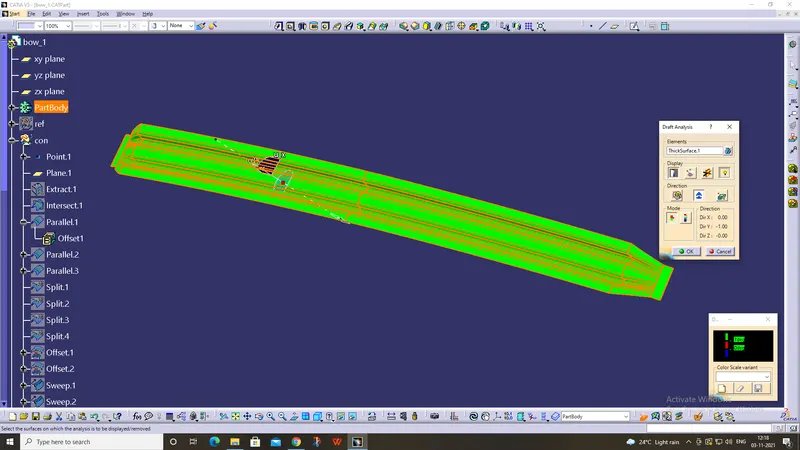
Draft Analysis of bow 2:-
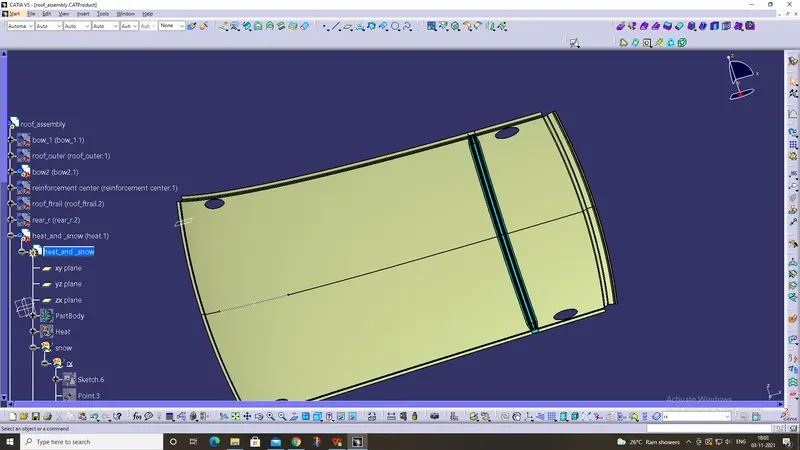
Heat Distortion Calculations:
We have a data to calculate
W = [1.73 x 10^(-3) x L] + [1.85 x 10^(-8) x (R^2)/t] + [ 1.10x10^(-3) x l] - 2.68
udgement Condition : OK< 2.7> 3.5
Where
L = Roof Length in X-Direction[mm](Roof dimension in 0-Y)
R = Roof curvature
R = 2(Rx*Ry)/(Rx+Ry)
Rx = X curvature
Ry = Y curvature
t = Roof plate thickness [mm]
l = Bow Roof Span [mm]
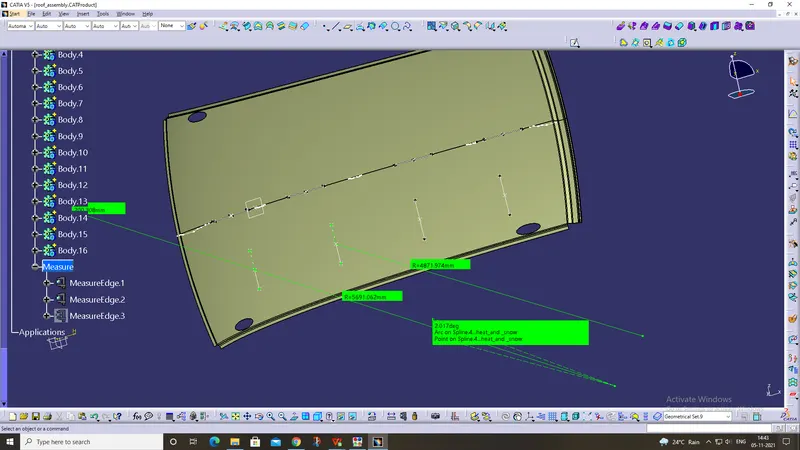
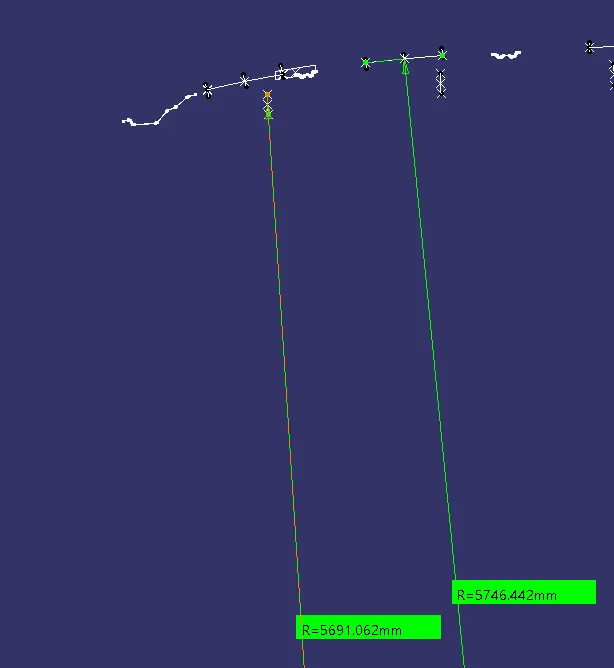

value of w is below 3.5.
Snow Load Calculation
During Winter Season the snow gets clogged over the top surface/roof of the car and the snow has some mass on it. Due to this, the roof can fail if the snow
load exceeds the capacity of the roof that was designed to sustain.
Snow load Prediction formula
Qr = [Iy x t^2 ] / [α x s x [(Rx + Ry)/2]^2 x 10^-8
Where
α = My x Lx x 10 , My = Y(Ly-Y)
Judgement condition = Qr ≥ 3.1
250 ≤ s ≤ 380
t = Roof plate thickness [mm]
Ly = Distance between the front and rear roof Rails on the Vehicle along with 0Y[mm]
Length of Roof panel with the center point between Roof rail Front /Rear as the front and rear reference point.
Lx = Distance between the Left and Right end of the roof on the Roof BOW [mm]
The width of the roof panel is exposed on the surface.
Y = Distance front Front Roof Rail to Roof BOW[mm]
s = Distance for which Roof BOW bears divided load [mm]
s = L1/2 + L2/2
Iy = Geometrical moment of inertia of Roof BOW (Y cross-section )[mm4]
Rx = Lateral direction curvature radius of roof panel Y cross-section on Roof BOW [mm]
Roof panel curvature Radius of the Length Lx in Front view
Ry = Longitudinal Direction curvature radius of the Roof panel X cross-section on Roof BOW [mm]
Roof panel X curvature radius of length s in Side view

Qr and S are in acceptable range.