Roof challenge
A roof is the portion of an automobile that sits above the passenger compartment, protecting the vehicle occupants from the sun, wind, rain and other external elements.
The roof assembly consist mainly of roof, front roof rail, bow roof rails and rear roof rail.
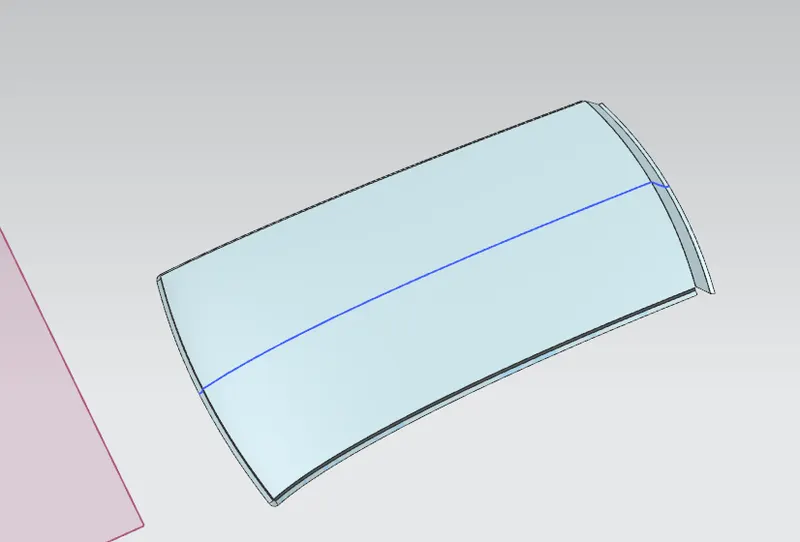
1. Roof :
Roof is the main part of the roof assembly. The roof surface shouldn't be flat, but should be curved instead beacause flat sheet metal surfaces are more weaker than the curved surface. Hence the roof surface is provided a small amount of curvature by the designer to have better strength.
The ditch area of the roof has tool opening angle of 3 degrees to satisfy the visibilty criteria and the flange is provided with a sufficient distance to occupy windshield glass and rubber sealants above it. The front roof rail is welded below the ditch area on its flange.
The side flanges of the roof must have draft angle of 7degrees or more and these 2 flanges are welded with the bow roof rails below it. The rear portion of the roof is associated with the back door and has rear roof rail welded below it.
The thickness of my roof design is 0.75mm.
2. Front roof rail :
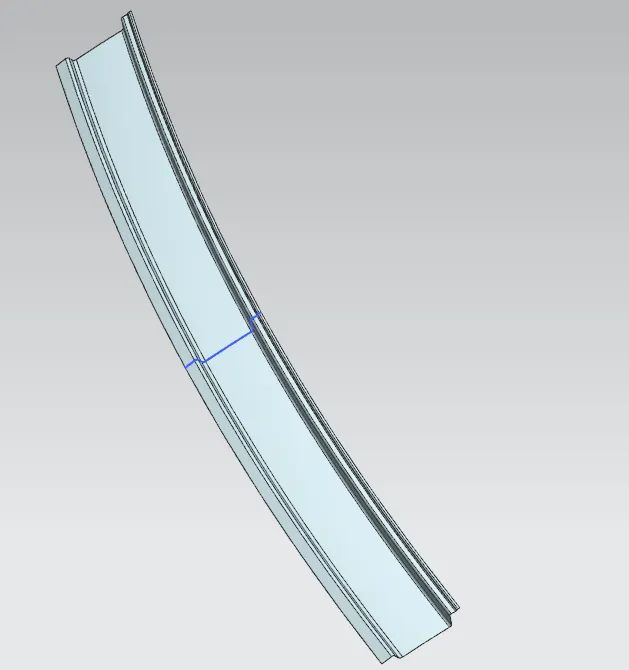
Front roof rail is made from body side outer scrap.
Front roof rail acts like a reinforcement for the front roof portion.
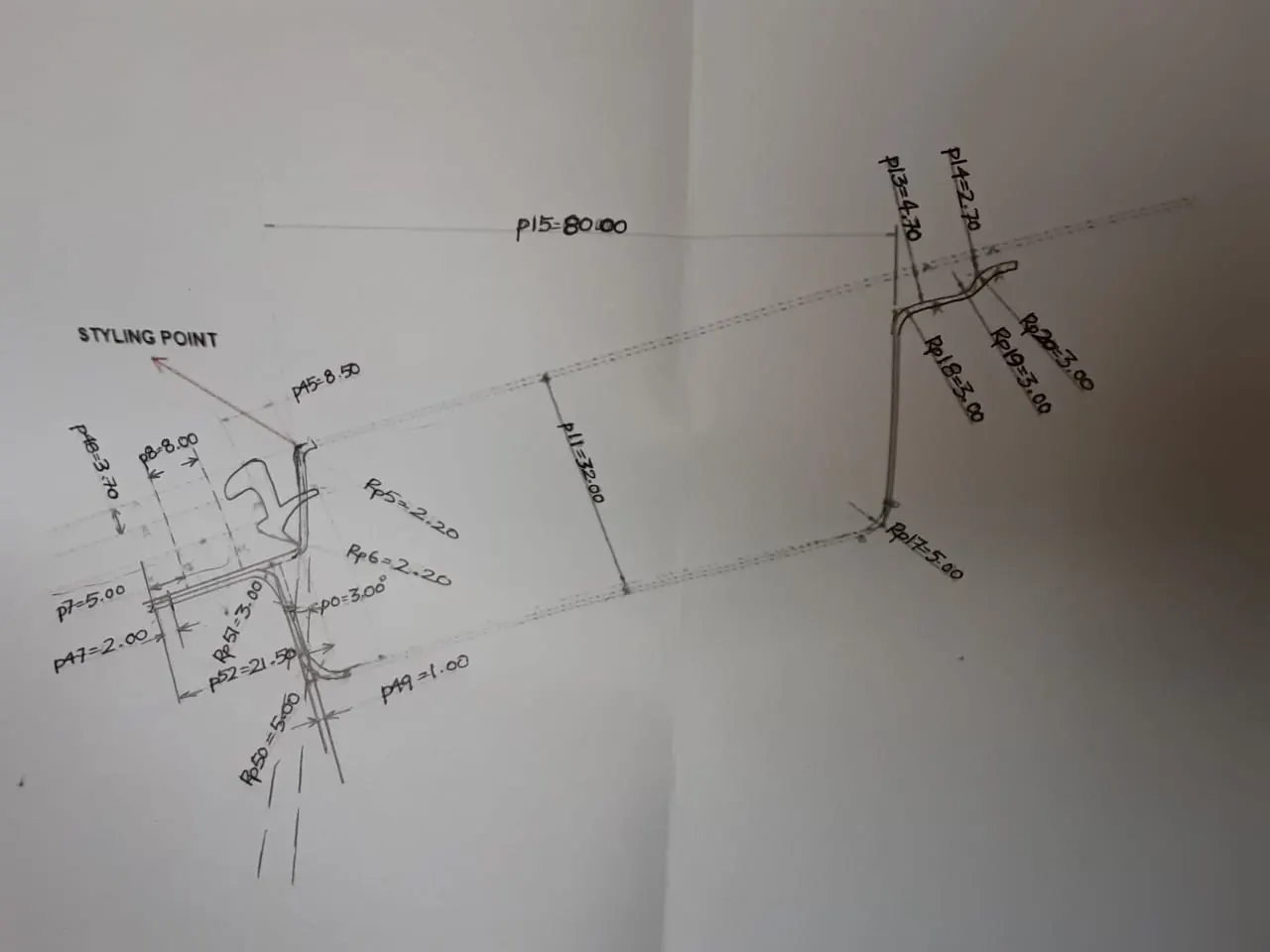
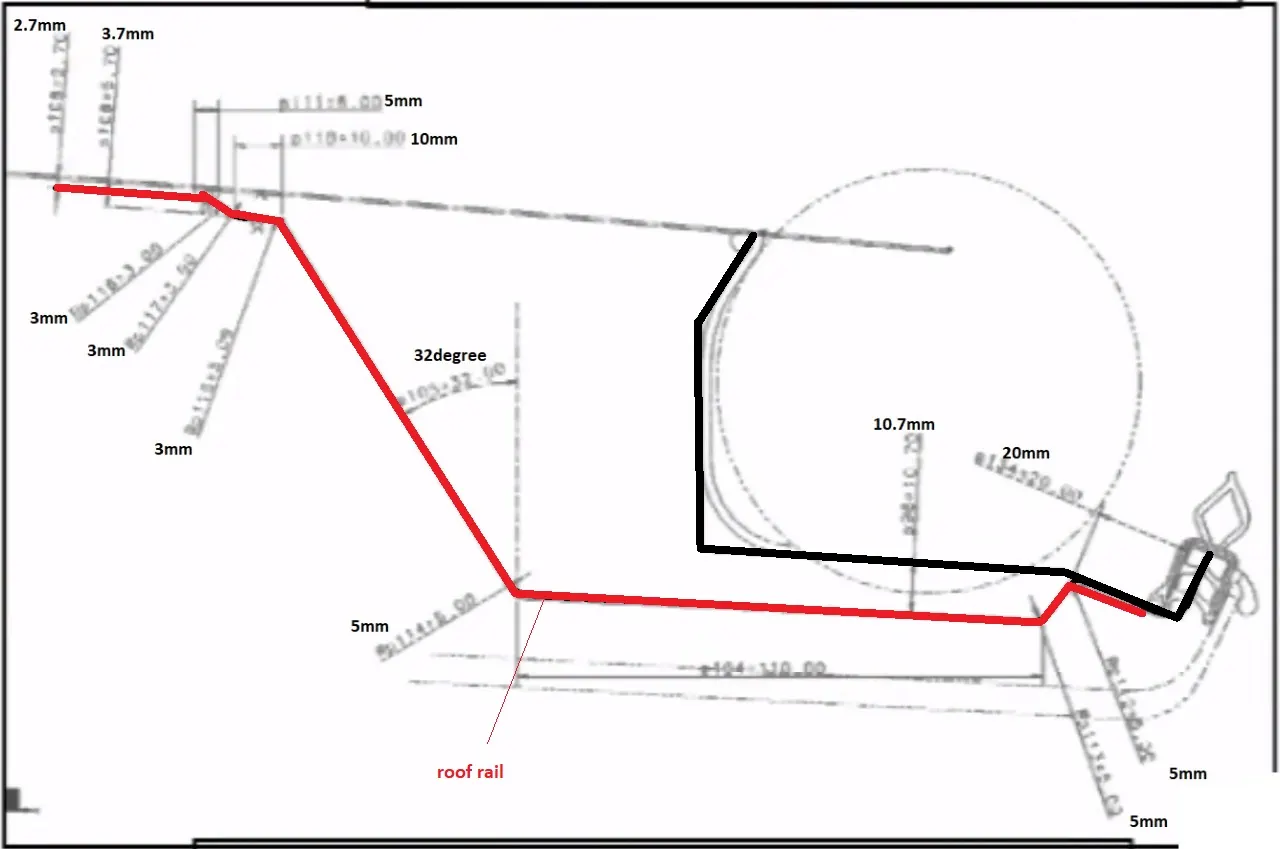
The offset distance (in this case 32mm) of the front roof rail surface from the roof top surface should be maintained below the specified distance to meet the visibilty criteria for the driver.
Also the width of the front roof rail (in this case 80mm) should be maintained below the specified distance in order to maintain the head clearance criteria i.e. 80mm minimum.
The front end of front roof rail is welded with roof, but the back end of front roof rail is joined to the roof with mastic sealant as it is not covered with head liner which otherwise gives a bad appearance.
Front roof rail is the reinforcement upon which the windshield glass rests.
Master section of front roof rail
3. Bow roof rails :
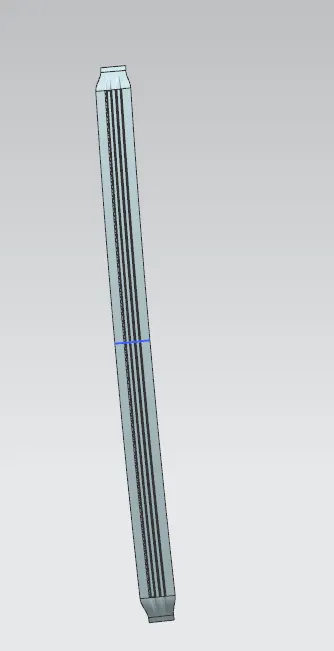
Bow roof rails are the reinforcements used to increase the load bearing capacity of the roof.
Bow roof rails can be 1, 2 or more depending on the length of the roof.
Bow roof rails is attached to the roof by welding it with the side flanges of roof.
The centre portion of the bow roof rails is attached with the roof through the mastic sealants. The mastics increases the strength of the roofs and has an influence of about 80mm around it.
The bow roof rails positioning is done through the curvature study analysis of the roof.
4. Rear roof rails :
Rear roof rail is made from body side outer scrap.
Rear roof rail acts like a reinforcement for the rear roof portion.
Similar to the front roof rail the rear roof rail should also fulfil minimum head clearance criteria and visibilty criteria.
The rear end of rear roof rail is welded with roof, but the front end of rear roof rail is joined to the roof with mastic sealant as it is not covered with head liner which otherwise gives a bad appearance.
Rear roof rail is the reinforcement upon which the back door rests.
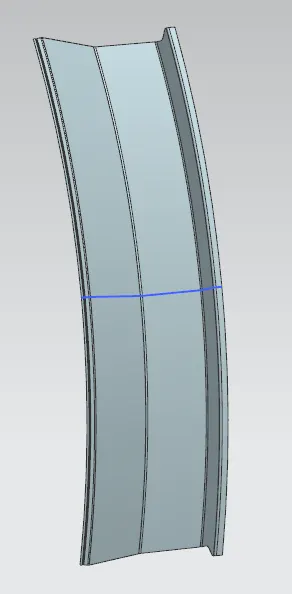
Master section of rear roof rail
Draft analysis of parts
Draft analysis is performed to check whether if the sheet metal part is provided with the sufficient amount of draft angle as required, so that the part is easily manufacturable in the real world scenario.
Below are the images of draft analysis performed on NX cad for the roof assembly parts which I have designed. The green colour indicates that the part is provided with the sufficient amount of draft angles.
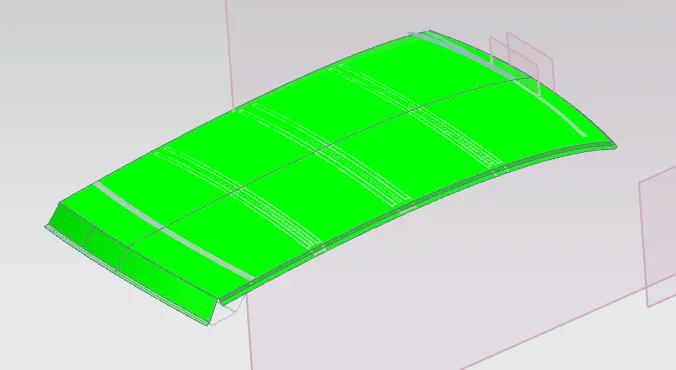
Image of Roof draft analysis
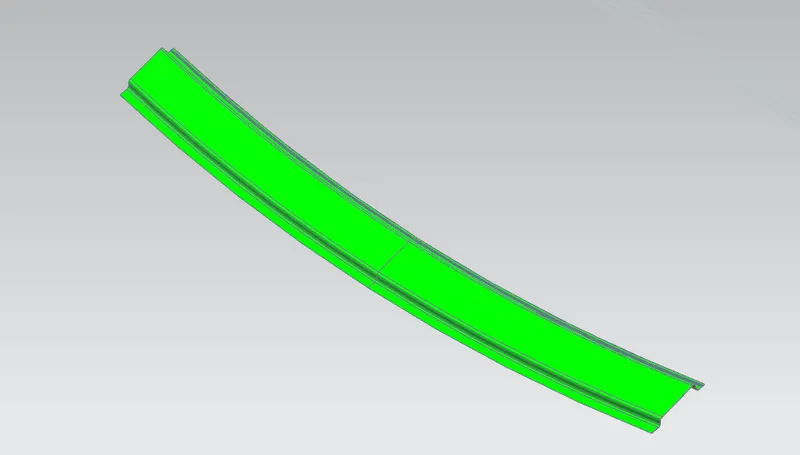
Image of Front roof rail draft analysis
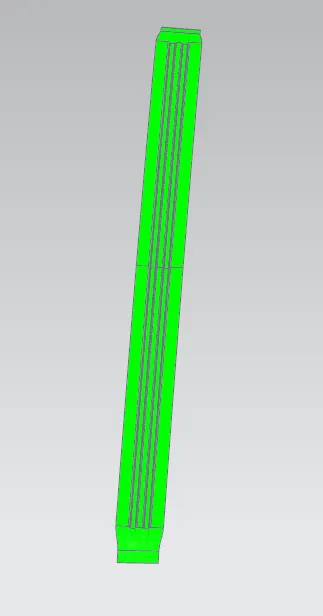
Images of Bow roof rail 1,2 and 3 draft analysis
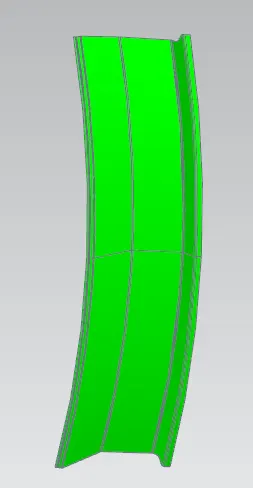
Image of rear roof rail draft analysis
Section Modulus :
Section modulus is often used to determine yield moment(My) such that My = S x σy where σy is the yield strength of the material. It is a direct measure of the strength of the beam and a beam that has a larger section modulus than another will be stronger and capable of supporting greater loads.
Section modulus (S) is given by formula, S =I/y where I is the moment of inertia and y is the distance from the neutral axis to the most extreme fiber.
Section modulus of roof
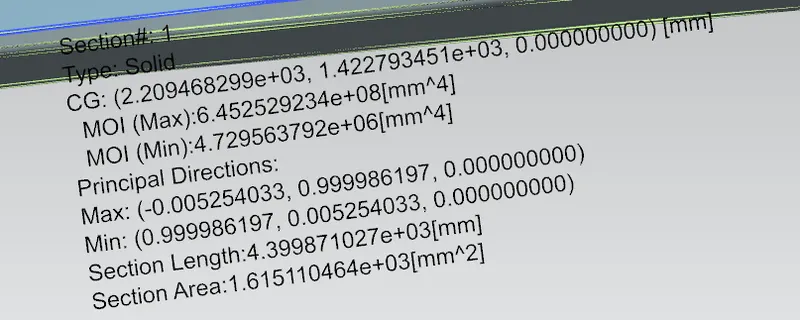
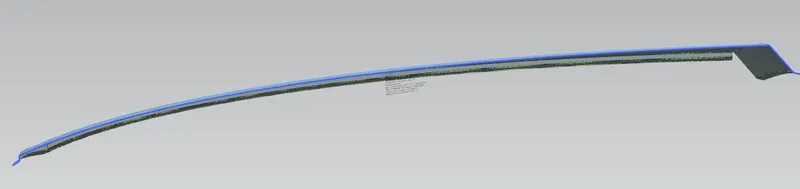
Section modulus S = I/y
Here Imin= 4.72x10^6 mm^4
y=c/2 = 2128.98/2 = 1064.49 mm
therefore S= 4434.04 mm^3
Section modulus of front roof rail
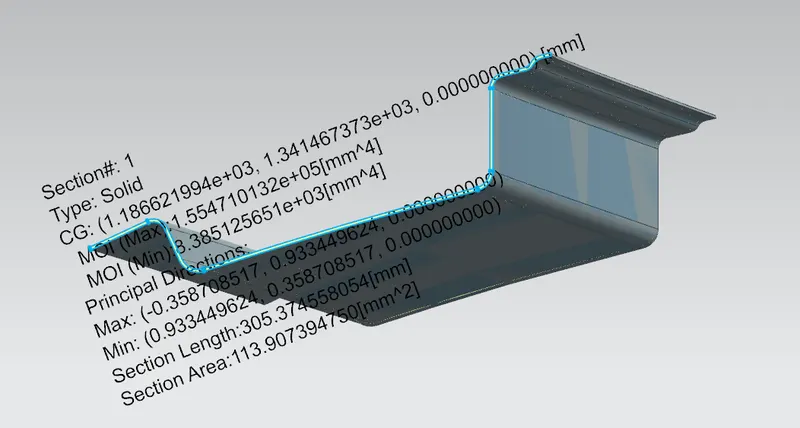
Section modulus S = I/y
Here Imin= 8.38x10^3 mm^4
y=c/2 = 123.95/2 = 61.975 mm
therefore S= 135.21 mm^3
Section modulus of bow roof rail 1
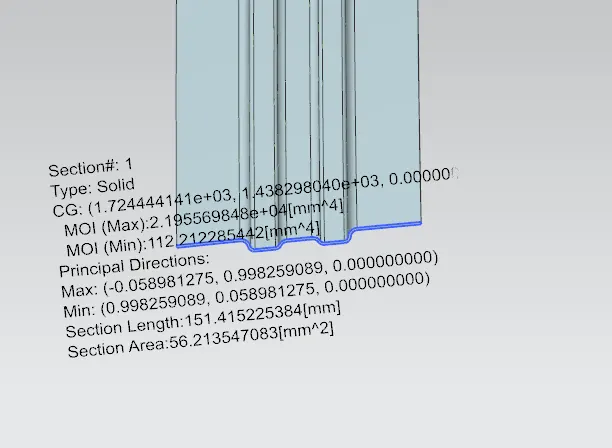
Section modulus S = I/y
Here Imin= 112.21 mm^4
y=c/2 = 70/2 = 35 mm
therefore S= 3.206 mm^3
Section modulus of bow roof rail 2
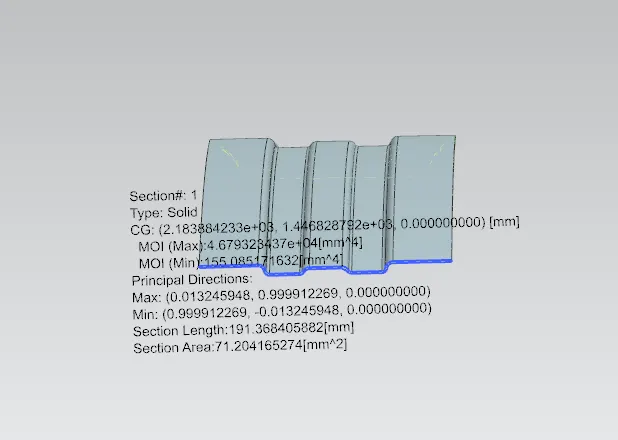
Section modulus S = I/y
Here Imin= 155.08 mm^4
y=c/2 = 90/2 = 45 mm
therefore S= 3.44 mm^3
Section modulus of bow roof rail 3
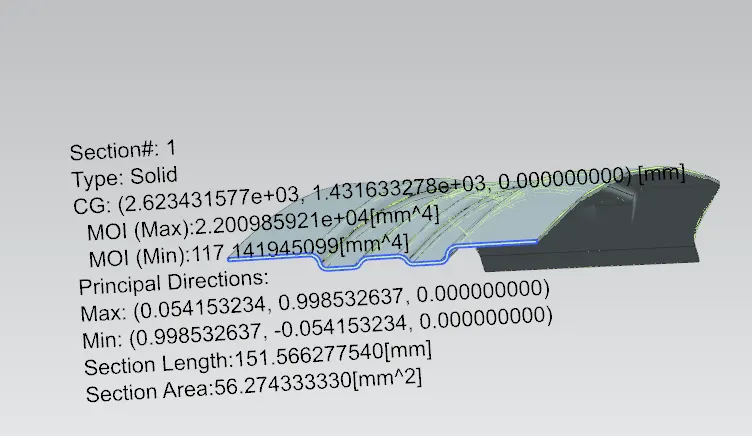
Section modulus S = I/y
Here Imin= 117.14 mm^4
y=c/2 = 70/2 = 35 mm
therefore S= 3.34 mm^3
Section modulus of rear roof rail
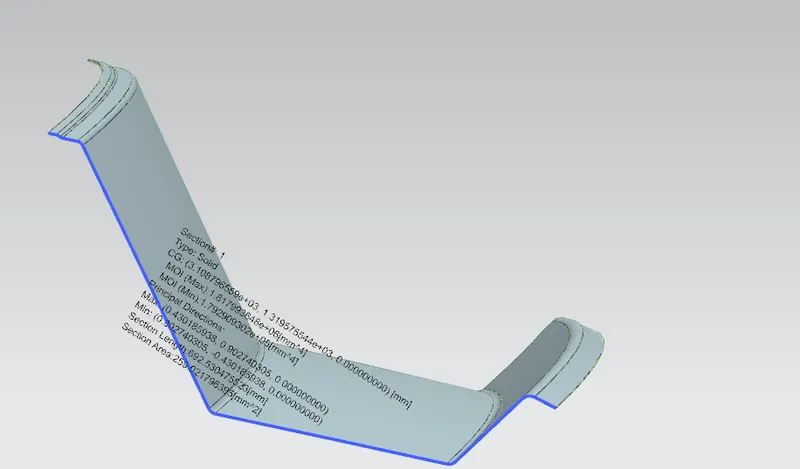
Section modulus S = I/y
Here Imin= 1.79x10^5 mm^4
y=c/2 = 278.67/2 = 139.335 mm
therefore S= 1284.67 mm^3
Curvature study analysis
1. Heat distortion criteria :
Prediction formula : W = (1.73x10^-3 xL) + (1.85x10^-8 x R^2/t )+ (1.1 x 10^-3 x l)-2.68
Judgement condition : OK<2.7mm<=NG
However if the value is in the range of 2.7<=W<3.5, provide outer panel reinforcement in the planning stage, and determine whether the reinforcement is needed or not needed through tests.
L : Roof length in X direction (mm) ( Roof dimension with 0y )
R : Roof curvature R = 2(Rx xRy)/(Rx+Ry)
Rx : X curvature
Ry : Y curvature
t : Roof plate thickness (mm)
l : Bow roof span(mm)
| Sl. no. | Bows | Rx | Ry | R | l | L | t | R^2/t | W | OK/NG |
| 1 | FR & 1st | 2821.62 | 5712 | 3777.31 | 455.258 | 2030.868 | 0.75 | 19024094.45 | 1.235 | OK |
| 2 | 1st & 2nd | 6595.74 | 4873.28 | 4442.99 | 379.746 | 2030.868 | 0.75 | 26320213.52 | 1.738 | OK |
| 3 | 2nd & 3rd | 10513.47 | 3990.35 | 5785.01 | 359.935 | 2030.868 | 0.75 | 44621787.6 | 2.054 | OK |
| 4 | 3rd & RR | 14028.29 | 3366.39 | 5429.78 | 330.804 | 2030.868 | 0.75 | 39310014.46 | 1.92 | OK |
Obtained values are less than 2.7mm. Hence the heat distortion condition is satisfied.
2. Snow load Distortion criteria :
Qr = (Iy x t^2)/(α x s x ((Rx+Ry)/2)^2 x 10^-8)
where α = My x Lx^2 x10^-12, My = Y(Ly-Y)
Judgement condition : Qr >= 3.1
250<= s <=380
t : roof plate thickness (mm)
Ly : Distance between the front and rear roof rails on vehicle 0Y (mm)
length of roof panel with centre point between roof rail FR/RR as the refrence point of the front/rear.
Lx : Distance between the left and right end of the roof on the roof bow
Width of roof panel exposed on the surface
Y : Distance from FR roof rail centre to roof bow (mm)
s : Distance for which roof bow bears divided load (mm)
s = L1/L2 + L2/2
Iy : Geometrical moment of inertia of roof bow (Y cross section) (mm^4)
Rx : Lateral direction curvature radius of roof panel Y cross section on roof bow (mm)
Roof panel curvature radius of the length Lx in FR/view
Ry : Longitudnal direction curvature radius of roof panel X cross section on roof bow (mm)
Roof panel curvature radius of the length s in side view
| Sl.no | Bows | Iy | α | Lx | Ly | y | s | Rx | Ry | t | Qr | Determination(Qr) |
| 1 | FR & 1st | 112.21 | 1.04 | 1134.59 | 2030.868 | 543.10 | 230.76 | 2730.54 | 4443.19 | 0.75 | 2.04 | NG |
| 2 | 1st & 2nd | 155.08 | 0.84 | 1083.26 | 2030.868 | 459.16 | 220.62 | 6561.19 | 3791.1 | 0.75 | 1.75 | NG |
| 3 | 2nd & 3rd | 117.14 | 0.78 | 1058.97 | 2030.868 | 439.19 | 248.37 | 10953.52 | 4265.87 | 0.75 | 0.58 | NG |
| 3 | 3rd & 4th | 0.82 | 1044.40 | 2030.868 | 494.97 | 16313.27 | 4020.36 | 0.75 | #DIV/0! | #DIV/0! |
The obtained value of Qr is less than 3.1 which is not satisfying the snowed condition.
Therefore I increased the bow roof thickness to meet the required criteria as shown below and also a certain amount of increase ocurrs in the value of Iy as shown below for the bow roof rails.
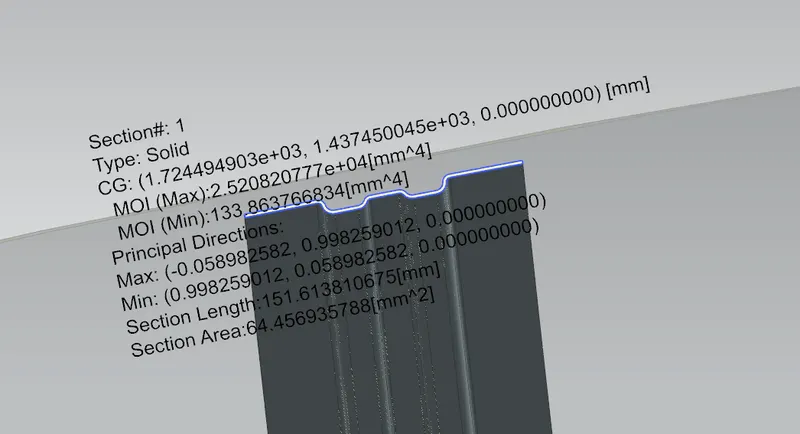
image of bow roof rail 1
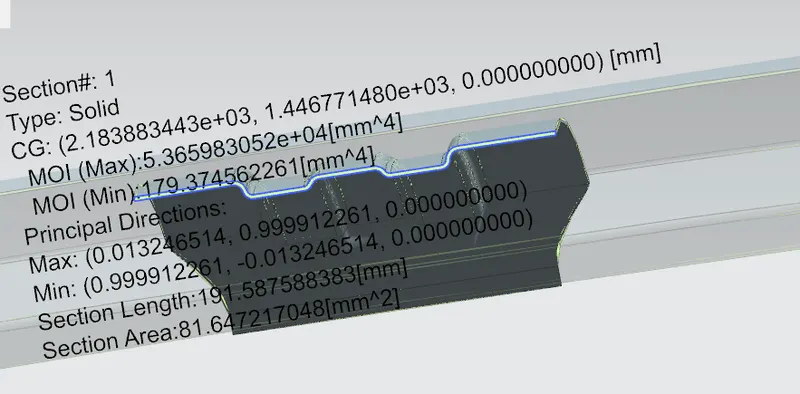
image of bow roof rail 2
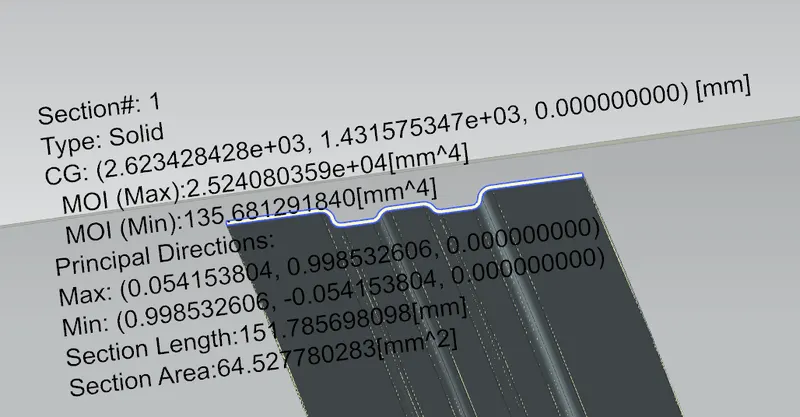
image of bow roof rail 3
| Sl.no | Bows | Iy | α | Lx | Ly | y | s | Rx | Ry | t | Qr | Determination(Qr) |
| 1 | FR & 1st | 133.86 | 1.04 | 1134.59 | 2030.868 | 543.10 | 230.76 | 2730.54 | 4443.19 | 0.86 | 3.206 | OK |
| 2 | 1st & 2nd | 179.73 | 0.84 | 1083.26 | 2030.868 | 459.16 | 220.62 | 6561.19 | 3791.1 | 0.86 | 4.305 | OK |
| 3 | 2nd & 3rd | 135.68 | 0.78 | 1058.97 | 2030.868 | 439.19 | 248.37 | 10953.52 | 4265.87 | 0.86 | 2,250 | OK |
| 3 | 3rd & 4th | 0.82 | 1044.40 | 2030.868 | 494.97 | 16313.27 | 4020.36 | 0.86 | #DIV/0! | #DIV/0! |
Hence now the given condition of Qr is satisfied as shown in the above table.