Roof challenge
AIM: To create a roof and to do the curvature to study heat resist distortion and snow load condition of the same and also Roof styling, Develop the essential flanges and reinforcements, Provide appropriate dimension and check for Draft analysis .
Tools Required
1 Surface Workbench Tools
2 part Workbench Tools
Sequence of operation
- creating Ditch Area
INTRODUCTION:
An automobile roof or car top is the portion of an automobile that sits above the passenger compartment, protecting the vehicle occupants from sun, wind, rain, and other external elements.
Most cars have roofs, and sometimes those roofs can be retracted, thus exposing the occupants to the glory of the out-doors with it's sunlight and fresh air.The first car roofs were not the sturdy versions we have today, not even by comparison to the convertible versions. By the 1930s, though, the car roof became a standard in automotive design. Compared to the windshield, the roof has to be the most valuable luxury-item-cum-standard in the history of automobiles.
There are different types of car roofs:
- Convertible roofs. Roof modules. Roof modules.
- Hardtops.
- Sunroofs.
- T-tops.
- Targa tops.
- Vinyl roofs.
1. Hardtops
When we talk about hardtops, we are referring to the common rigid forms of automobile roofs which we see around. In modern-day cars, this type of roof is made from metal or plastic.
So, the common Toyota Corolla, Camry, and many of the cars in Nigeria are all Hardtops. However, we should say that there are different types. The one we just described is the fixed hardtop. Other types include:
- The detachable hardtops
- The retractable hardtops

2. Sunroof:
This type of roof is also quite popular. You might have been seeing it around. A sunroof is an operable type of roof that allows for an opening in the roof of an automobile; say a window in a roof. It can allow either light or air or both to enter the vehicle. They are either operated manually or automatically.
The keyword here is Opening in the roof. It is not the entire roof that is removed – that is a different type of roof.
Shey you get it?
There are 3 popular types of sunroofs. They include:
a. Pop-up:
The pop-up sunroof usually tilts when you open it. It is the most basic and relatively cheaper type of sunroof. Some can even be removed so that they are kept properly, maybe in the trunk whenever you want to go ‘sunroof mode.’
A pop-up sunroof pops up!
b. Spoiler:
Wait, this is not spoiling anything o. It just means that it can slide. So, the spoiler is a pop-up that would slide, instead of tilting upwards. The advantage of this is that it can easily be restored to its original position by sliding.
Spoiler sunroofs are easy to slide
c. Panoramic sunroof:
Please take the pronunciation easy. Panoramic sunroofs are distinct. While other sunroofs basically allow air and light or both into the front seats, the panoramic sunroof would allow for both the front and rear. Of course, this means the aperture would be larger than the spoiler or pop-up, bit hey, what is the purpose of the window in the roof if it is not big enough?
Think about it!
How the panoramic sunroof appears inside
Some brands also refer to them as moonroofs and they are automatically operated with the push of a button or turning of a knob.
The sunroof allows car users to enjoy light and air without having to remove the entire roof. It also adds to the sleek design of the car and the automatically operated types just add to the awesome features of the car.
Difffernt components of a car are as follows :
- ROOF
- FRONT ROOF RAIL
- CENTER BOW ROOF
- BOW ROOF 1
- BOW ROOF 2
- REAR ROOF
GIVEN ROOF
SOLID ROOF
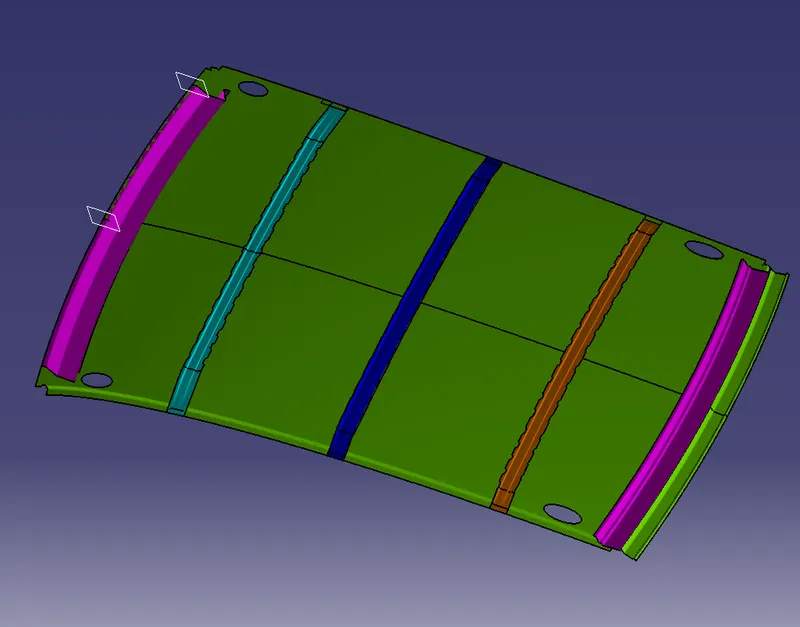
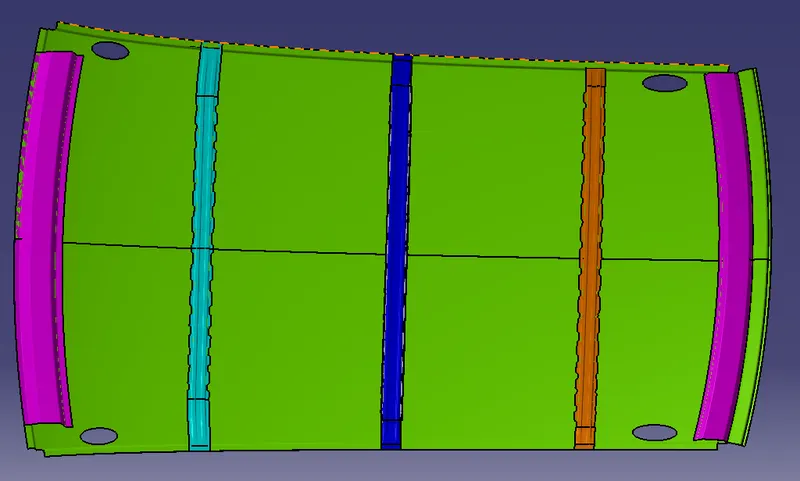
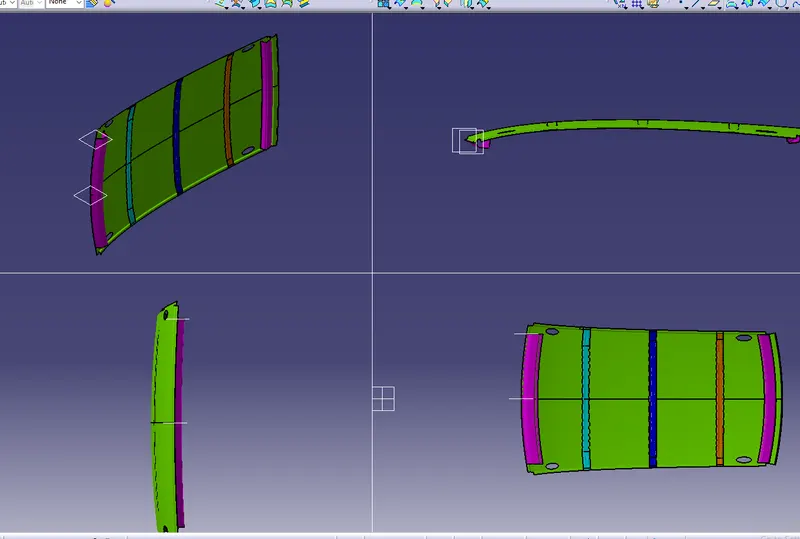
TYPES OF ORIENTATIONS
MASTER SECTION OF REAR ROOF RAIL
REAR ROOF RAIL
It is the support that is
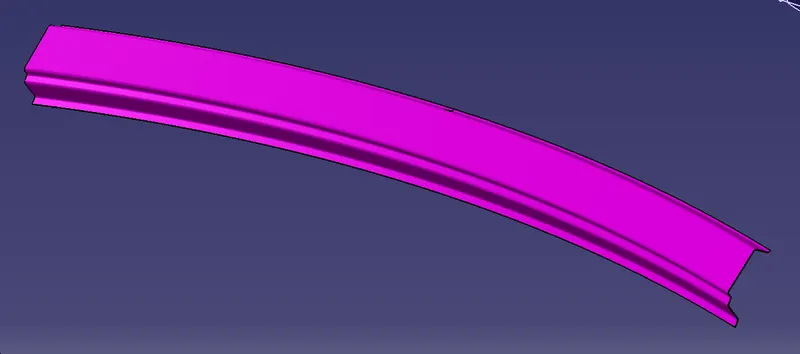
MASTER SECTION OFF BOW ROOF
BOW 1
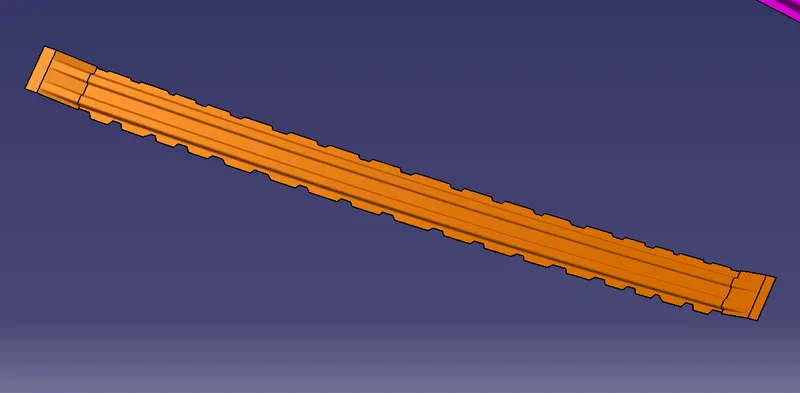
MASTER SECTION OF CENTER ROOF RAIL
CENTER BOW ROOF
Similar to other Rails
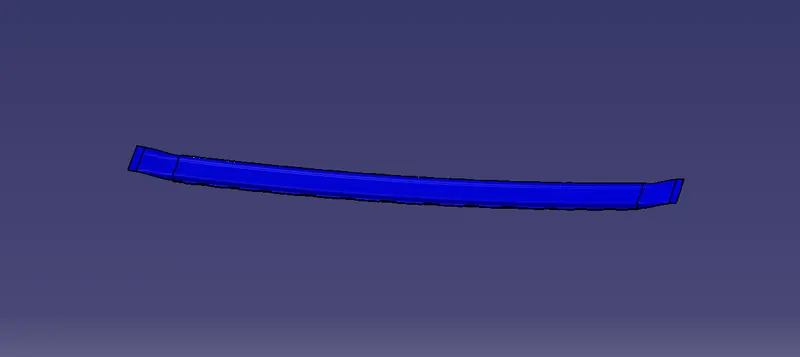
BOW 2 ROOF
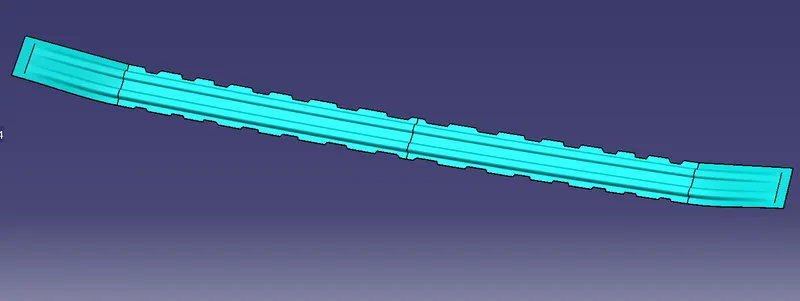
MASTER SECTION OF FRONT ROOF RAIL
FRONT ROOF
It is the support that is
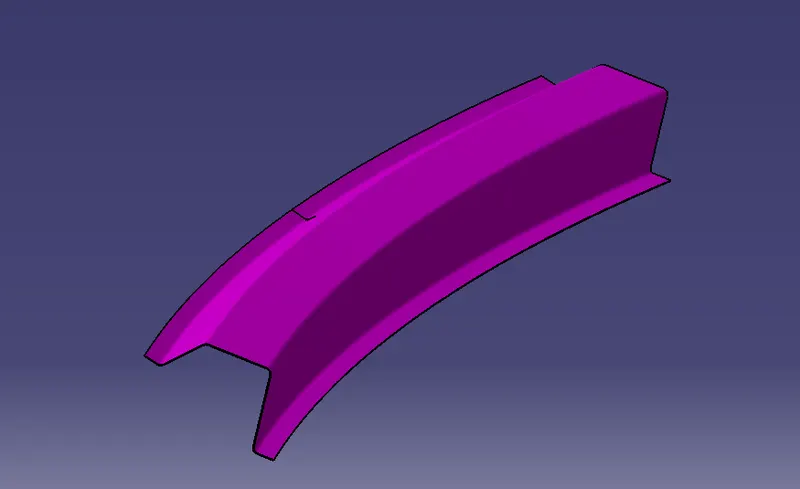
Calculating Heat Distortion criteria
Heat Distortion temp is the temp at which the metal gets softens and deform under a specific load. this study is down to check the ability of the roof to withstand high temp with respect to the positioning of the reinforcement which contributes to increased strength.
prediction Formula
W = [1.73 x 10^(-3) x L] + [1.85 x 10^(-8) x (R^2)/t] + [ 1.10x10^(-3) x l] - 2.68
Judgement Condition : OK< 2.7> 3.1
Where
L = Roof Length in X-Direction[mm](Roof dimension in 0-Y)
R = Roof curvature
R = 2(Rx*Ry)/(Rx+Ry)
Rx = X curvature
Ry = Y curvature
t = Roof plate thickness [mm]
l = Bow Roof Span [mm]
F.R - B.R_1
W = [1.73 x 10^(-3) x L] + [1.85 x 10^(-8) x (R^2)/t] + [ 1.10x10^(-3) x l] - 2.68
R = 2(Rx*Ry)/(Rx+Ry)
= 2(3,265.692*14,797.354)/(3,
= 5,350.54
(R^2)/t = 5,350.54^2/0.75
= 38,171,037.722
w = [1.73 x 10^(-3) x 2033.705] + [1.85 x 10^(-8) x 38,171,037.722] + [ 1.10x10^(-3) x 308.791] - 2.68
= 1.881mm
B.R_1 - C.R
W = [1.73 x 10^(-3) x L] + [1.85 x 10^(-8) x (R^2)/t] + [ 1.10x10^(-3) x l] - 2.68
R = 2(Rx*Ry)/(Rx+Ry)
= 2(3,992.478*10,534.659)/(3,
= 5790.458
(R^2)/t = 5790.458^2/0.75
= 44,705,871.799
w = [1.73 x 10^(-3) x 2033.705] + [1.85 x 10^(-8) x 44,705,871.799] + [ 1.10x10^(-3) x 309.176] - 2.68
= 2.005mm
C.R - B.R_2
W = [1.73 x 10^(-3) x L] + [1.85 x 10^(-8) x (R^2)/t] + [ 1.10x10^(-3) x l] - 2.68
R = 2(Rx*Ry)/(Rx+Ry)
= 2(4,971.948*6,199.832)/(4,971.
= 5518.411
(R^2)/t = 5518.411^2/0.75
= 40,603,813.286
w = [1.73 x 10^(-3) x 2033.705] + [1.85 x 10^(-8) x 40,603,813.286] + [ 1.10x10^(-3) x 309.005] - 2.68
= 1.929mm
B.R_2 - R.R
W = [1.73 x 10^(-3) x L] + [1.85 x 10^(-8) x (R^2)/t] + [ 1.10x10^(-3) x l] - 2.68
R = 2(Rx*Ry)/(Rx+Ry)
= 2(5,797.291*2,450.796)/(5,797.
= 3445.157
(R^2)/t = 3445.157^2/0.75
= 15,825,476.254
w = [1.73 x 10^(-3) x 2033.705] + [1.85 x 10^(-8) x 15,825,476.254] + [ 1.10x10^(-3) x 295.811] - 2.68
= 1.456mm
| S.No | positioning | RX |
RY |
R | l | L | t | R^2/t | W | Status |
| 1 | F.R. - B.R_1 | 3,265.692 | 14,797.354 | 5,350.54 | 308.791 | 2,033.705 | 0.75 | 38,171,037.722 | 1.881 | OK |
| 2 | B.R_1 - C.R | 3,992.478 | 10,534.659 | 5790.458 | 309.176 | 2,033.705 | 0.75 | 44,705,871.799 | 2.005 | OK |
| 3 | C.R - B.R_2 | 4,971.948 | 6,199.832 | 5518.411 | 309.005 | 2,033.705 | 0.75 | 40,603,813.286 | 1.929 | OK |
| 4 | B.R_2 - R.R | 5,797.291 | 2,450.796 | 3445.157 | 295.811 | 2,033.705 | 0.75 | 15,825,476.254 | 1.456 | OK |
Note F.R - FRONT ROOF RAIL
B.R_1 - BOW ROOF_1
C.R - CENTRAL ROOF RAIL
B.R_2 - BOW ROOF_2
R.R - REAR ROOF RAIL
calculating Snow load criteria
The snow load criteria study is down to check the ability of the roof to withstand the snowfall and bounce back to its original shapes without any permanent deformation once the load is removed.
Prediction formula
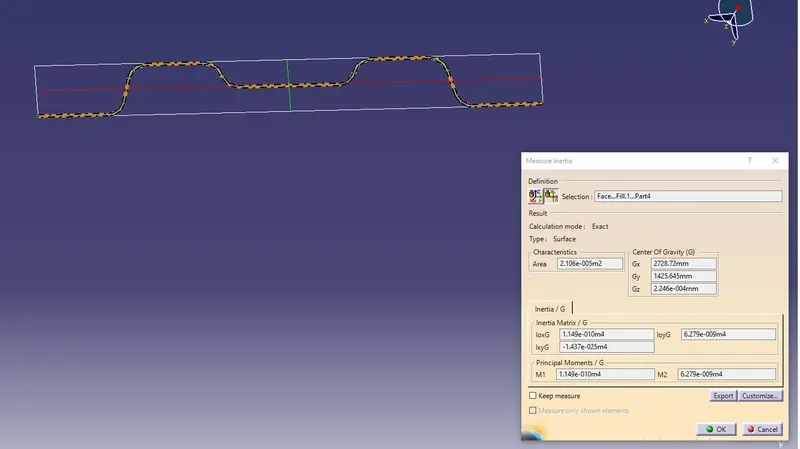
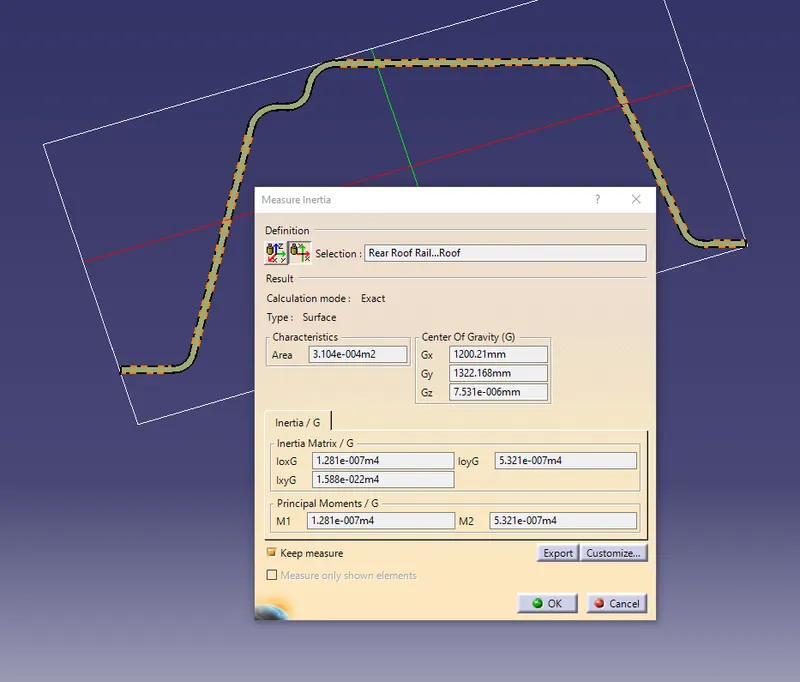
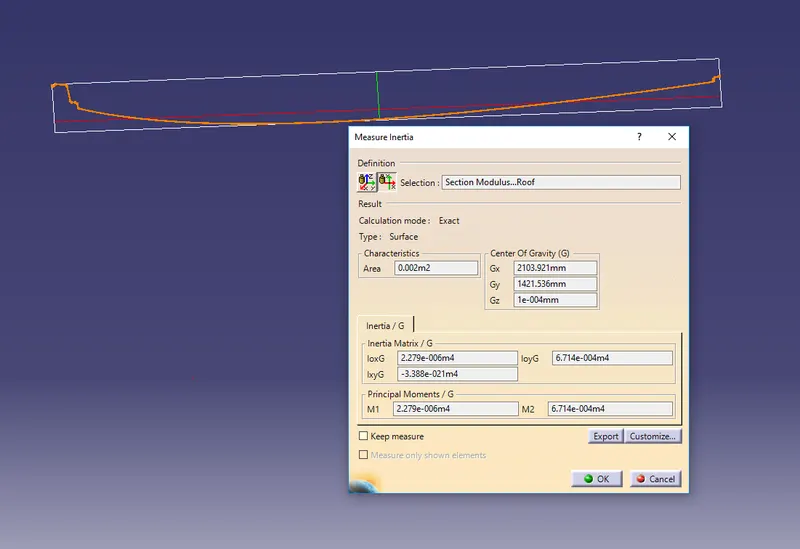
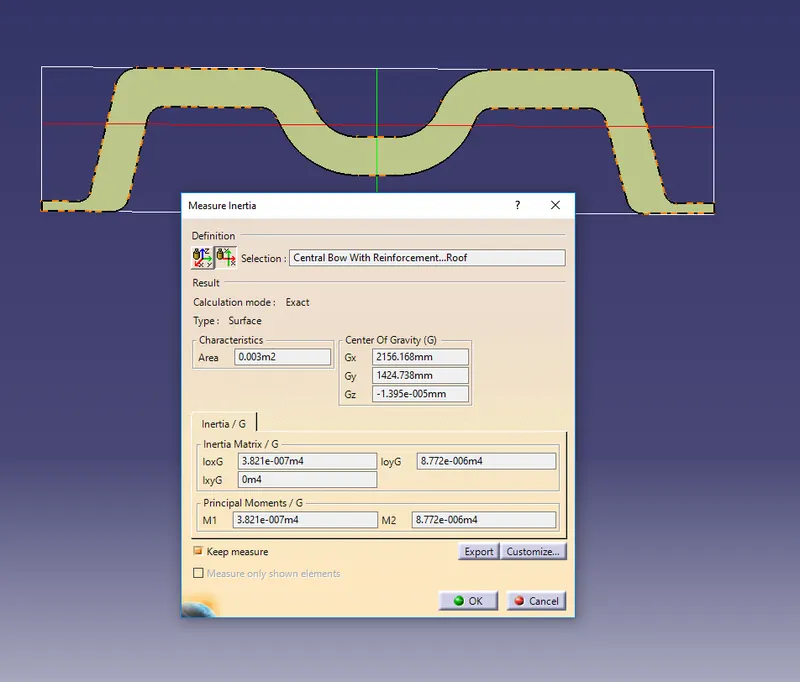
Qr = [Iy x t2] / [α x s x [(Rx + Ry)/2]2 x 10-8]
Note: The Qr value given over here is correct. There was a typo error in the formula given in the video.
Where
α = My x Lx2 x 10-12 , My = Y(Ly-Y)
Judgement condition = Qr ≥ 3.1
250 ≤ s ≤ 380
t = Roof plate thickness [mm]
Ly = Distance between the front and rear roof Rails on the Vehicle along with 0Y[mm]
Length of Roof panel with the center point between Roof rail Front /Rear as the reference point of the front and the rear.
Lx = Distance between the Left and Right end of the roof on the Roof BOW [mm]
Width of the roof panel exposed on the surface.
Y = Distance front Front Roof Rail to Roof BOW[mm]
s = Distance for which Roof BOW bears divided load [mm]
s = L1/2 + L2/2
Iy = Geometrical moment of inertia of Roof BOW (Y cross-section )[mm4]
Rx = Lateral direction curvature radius of roof panel Y cross-section on Roof BOW [mm]
Roof panel curvature Radius of the Length Lx in Front view
Ry = Longitudinal Direction curvature radius of the Roof panel X cross-section on Roof BOW [mm]
Roof panel X curvature radius of length s in Side view
| S.No | positioning | LY | Y | My = Y(Ly-Y) |
| 1 | F.R. - B.R_1 | 2,033.705 | 472.791 | 737,986.090 |
| 2 | B.R_1 - C.R | 2,033.705 | 509.226 | 776,304.343 |
| 3 | C.R - B.R_2 | 2,033.705 | 509.117 | 776,193.668 |
| 4 | B.R_2 - R.R | 2,033.705 | 463.533 | 727,826.537 |
| S.No | positioning | MY | LX | α = My x Lx2 x 10-12 |
| 1 | F.R. - B.R_1 | 737,986.090 | 1,046.886 | 0.808 |
| 2 | B.R_1 - C.R | 776,304.343 | 1,061.934 | 0.875 |
| 3 | C.R - B.R_2 | 776,193.668 | 1,090.266 | 0.922 |
| 4 | B.R_2 - R.R | 727,826.537 | 1,142.898 | 0.950 |
| S.No | positioning | L1 | L1/2 | L2 | L2/2 | S=L1/2+L2/2 |
| 1 | F.R. - B.R_1 | 472.791 | 236.395 | 509.226 | 254.613 | 491.008 |
| 2 | B.R_1 - C.R | 509.226 | 254.613 | 509.117 | 254.555 | 509.168 |
| 3 | C.R - B.R_2 | 509.117 | 254.558 | 463.533 | 231.766 | 486.324 |
| 4 | B.R_2 - R.R | 463.533 | 231.766 | - | - | - |
| S.No | positioning | IY | α | s | RX | RY | [(Rx + Ry)/2]2 | t | Qr | Status |
| 1 | F.R. - B.R_1 | 7.3*10^4 | 0.808 | 491.008 | 3,965.851 | 16,683.193 | 106,595,754.528 | 0.75 | 97.096 | OK |
| 2 | B.R_1 - C.R | 3.8*10^5 | 0.875 | 509.168 | 4,274.277 | 11,025.477 | 58,520,618.115 | 0.75 | 819.838 | OK |
| 3 | C.R - B.R_2 | 7.6*10^4 | 0.922 | 486.324 | 3,765.675 | 6,106.665 | 24,365,774.268 | 0.75 | 391.290 | OK |
| 4 | B.R_2 - R.R | - | 0.950 | - | 4,648.145 | 2,508.346 | 12,803,840.858 | 0.75 | - |
Note F.R - FRONT ROOF RAIL
B.R_1 - BOW ROOF_1
C.R - CENTRAL ROOF RAIL
B.R_2 - BOW ROOF_2
R.R - REAR ROOF RAIL
SECTION MODULUS