Project - Vehicular Crash safety Systems
VEHICULAR CRASH SAFETY SYSTEM IN TESLA CAR
Tesla car
Tesla is an electric vehicle (EV) maker located in Palo Alto, California. Its goal is to produce electric cars that are either premium or affordable for everyday consumers. The company is run by CEO and founder Elon Musk.
Outside of EVs, Tesla is also exploring a wider ecosystem, offering a number of other solutions that leverage its experience in battery power, such as solar panels and power storage.
Evolution of Tesla car
- Tesla, Inc., formerly (2003–17) Tesla Motors, American manufacturer of electric automobiles, solar panels, and batteries for cars and home power storage. It was founded in 2003 by American entrepreneurs Martin Eberhard and Marc Tarpenning and was named after Serbian American inventor Nikola Tesla.
- The U.S. car market is saturated with established automakers like Ford (F), Honda (HMC), and Chevrolet (GM). But one company stands out from the mix: electric car maker Tesla Motors (TSLA). Tesla and its CEO Elon Musk gained notoriety in 2012 when it released its flagship car, the Model S.1
- Tesla’s release positioned it as one of the few successful independent automakers and a pioneer in the electric car market. Notably, it also proved to be a hit with auto buyers. The Model S, a sleek luxury sedan that starts at $89,490, is ranked best in class in every category for electric sedans. When the Model S premiered in 2013, Tesla made headlines when the trade press gave it laurels. The electric plug-in car received a near-perfect score of 99 out of 100 from Consumer Reports, which also named it “the best car ever tested.
- By September 2014, the car hit all-time sales records in the U.S. with 2,500 sold in just one month, and in Q1 2015, sales reached a new high at 10,030 sold. It is now considered a staple within the electric car stratosphere. As of March 4, 2022, the company’s market capitalization was $909.6 billion.
Business strategy
- At the time of Tesla's founding in 2003, electric vehicles were very expensive. In 2006, Elon Musk stated that Tesla's strategy was to first produce high-price, low-volume vehicles, such as sports cars, for which customers are less sensitive to price. This would allow them to progressively bring down the cost of batteries, which in turn would allow them to offer cheaper and higher volume cars. Tesla's first vehicle, the Roadster, was low-volume (fewer than 2,500 were produced) and priced at over $100,000. The next models, the Model S and Model X, are more affordable but still luxury vehicles.
- The most recent models, the Model 3 and the Model Y, are priced still lower, and aimed at a higher volume market, selling over 100,000 vehicles each quarter. Tesla continuously updates the hardware of its cars rather than waiting for a new model year, as opposed to nearly every other car manufacturer.
- Unlike other automakers, Tesla does not rely on franchised auto dealerships to sell vehicles. Instead, the company directly sells vehicles through its website and a network of company-owned stores. The company is the first automaker in the United States to sell cars directly to consumers. Some jurisdictions, particularly in the United States, prohibit auto manufacturers from directly selling vehicles to consumers. In these areas, Tesla has locations that it calls galleries that the company says "educate and inform customers about our products, but such locations do not actually transact in the sale of vehicles." In total, Tesla operates nearly 400 stores and galleries in more than 35 countries. These locations are typically located in retail shopping districts, inside shopping malls, or other high-traffic areas, instead of near other auto dealerships. As of January 2022, Tesla does not pay for direct advertisement.
- Tesla has a high degree of vertical integration, estimated at 80% in 2016. The company produces vehicle components as well as builds proprietary stations where customers can charge their vehicles. Vertical integration is rare in the automotive industry, where companies typically outsource 80% of components to suppliers and focus on engine manufacturing and final assembly. Tesla used low-cost strategy as a business approach, with which they can expand their business into a broader market by offering standard technology items.
- Tesla generally allows its competitors to license its technology, stating that it wants to help its competitors accelerate the world's use of sustainable energy. Licensing agreements include provisions whereby the recipient agrees not to file patent suits against Tesla, or to copy its designs directly. Tesla retains control of its other intellectual property, such as trademarks and trade secrets to prevent direct copying of its technology.
Tesla-Vehicle batteries
- Tesla was the first automaker to use batteries containing thousands of small, cylindrical, lithium-ion commodity cells like those used in consumer electronics. Tesla uses a version of these cells that is designed to be cheaper to manufacture and lighter than standard cells by removing some safety features; according to Tesla, these features are redundant because of the advanced thermal management system and an intumescent chemical in the battery to prevent fires.
- The batteries are placed under the vehicle floor. This saves interior and trunk (boot) space but increases the risk of battery damage by debris or impact. After two vehicle fires in 2013 due to road debris, the Model S was retrofitted with a multi-part aluminium and titanium protection system to reduce the possibility of damage.
- In 2016, former Tesla CTO J.B. Straubel expected batteries to last 10–15 years, and discounted using electric cars to charge the grid with vehicle-to-grid because the related battery wear outweighs economic benefit. He also preferred recycling over re-use for grid once they reach the end of their useful life for vehicles. Tesla launched its battery recycling operation at Giga Nevada in 2019.
- Panasonic is Tesla's supplier of cells in the United States and cooperates with Tesla in producing cylindrical 2170 batteries at Giga Nevada. As of January 2021, Panasonic has the capacity to produce 39 GWh per year of batteries at Giga Nevada. Tesla's battery cells used in Giga Shanghai are supplied by Panasonic and Contemporary Amperex Technology (CATL), and are the more traditional prismatic (rectangular) cells used by other automakers.
Tesla-Battery research
- Tesla invests in lithium-ion battery research. Starting in 2016, the company established a 5-year battery research and development partnership at Dalhousie University in Nova Scotia, Canada, with lead researcher Jeff Dahn. Tesla acquired two battery companies: Maxwell Technologies, acquired for over $200 million– but sold in 2021 and Hibar Systems.
- During Tesla's Battery Day event on September 22, 2020, Tesla announced the next generation of batteries, featuring a tab-less battery design to increase the range and decrease the price of Tesla vehicles. The new battery is named the "4680" in reference to its dimensions: 46 millimetres (1.8 in) wide by 80 millimetres (3.1 in) tall. Two weeks before Battery Day, Tesla paid a total of $3 to buy several battery manufacturing patent applications from Spring power International, a small Canadian battery company.
- Tesla predicted the new batteries could be up to 56% cheaper and allow the cars to have a 54% longer range. The company said this would be achieved by a more efficient production process, new battery design, cheaper resources for the anode and cathode, and better integration into the vehicle. Business analysis company Bloomberg NEF estimated Tesla's battery pack price in 2021 at $112 per kWh, versus an industry average of $132 per kWh. As of December 2021, Bloomberg NEF estimates the industry as a whole will reach $100 per kWh in 2024. The United States Department of Energy estimated in 2020 that with battery prices at $100 per kWh, electric cars would be the same cost to purchase as comparable gasoline-powered cars, which would accelerate the sales of electric cars.
Tesla-Motors
- Tesla makes two kinds of electric motors. Its oldest design in production is a three-phase four-pole alternating current induction motor with a copper rotor (which inspired the Tesla logo), which is used as the rear motor in the Model S and Model X. Newer, higher-efficiency permanent magnet motors are used in the Model 3, Model Y, the front motor of 2019-onward versions of the Model S and X, and are expected to be used in the Tesla Semi. The permanent magnet motors increase efficiency, especially in stop-start driving.
Tesla-Autopilot
- Autopilot is an advanced driver-assistance system developed by Tesla. The system requires active driver supervision at all times.
- Since September 2014, all Tesla cars are shipped with sensors (initially hardware version 1 or "HW1") and software to support Autopilot. Tesla upgraded its sensors and software in October 2016 ("HW2") to support full self-driving in the future. HW2 includes eight cameras, twelve ultrasonic sensors, and forward-facing radar. HW2.5 was released in mid-2017, and it upgraded HW2 with a second graphics processing unit (GPU) and, for the Model 3 only, a driver-facing camera. HW3 was released in early 2019 with an updated and more powerful computer, employing a custom Tesla-designed system on a chip.
- In April 2019, Tesla announced that all of its cars will include Autopilot software (defined as just Traffic-Aware Cruise Control and Autosteer (Beta)) as a standard feature moving forward. Full self-driving software (Auto park, Navigate on Autopilot (Beta), Auto Lane Change (Beta), Summon (Beta), Smart Summon (Beta) and future abilities) is an extra cost option.
- In 2020, Tesla released software updates where its cars recognize and automatically stop at stop signs and traffic lights. In May 2021, Tesla removed the radar sensor and radar features from its Model 3 and Model Y vehicles, opting instead to rely on camera vision alone. The New York Times reported in December 2021 that Musk "repeatedly told members of the Autopilot team that humans could drive with only two eyes and that this meant cars should be able to drive with cameras alone," an analogy some experts and former Tesla engineers described as "deeply flawed." Similarly, a statistical analysis conducted in A Methodology for Normalizing Safety Statistics of Partially Automated Vehicles debunked a common Tesla claim that Autopilot reduced crash rates by 40 percent by accounting for the relative safety of the given operating domain when using active safety measures.
Tesla-Full Self-Driving
- Full Self-Driving (FSD) is an optional extension of Autopilot promoted as eventually being able to perform fully autonomous driving. At the end of 2016, Tesla expected to demonstrate full autonomy by the end of 2017, which as of July 2022 has not occurred. The first beta version of the software was released on October 22, 2020, to a small group of testers The release of the beta has renewed concern regarding whether the technology is ready for testing on public roads. The National Transportation Safety Board (NTSB) has called for "tougher requirements" for any testing of Autopilot on public roads.
- Tesla's approach to achieve full autonomy is different from that of other companies. Whereas Waymo, Cruise, and other companies are relying on highly detailed (centimetres-scale) three-dimensional maps, lidar, and cameras, as well as radar and ultrasonic sensors in their autonomous vehicles, Tesla's approach is to use coarse-grained two-dimensional maps and cameras (no lidar) as well as radar and ultrasonic sensors. Tesla claims that although its approach is much more difficult, it will ultimately be more useful, because its vehicles will be able to self-drive without geofencing concerns. Tesla's self-driving software has been trained on over 20 billion miles driven by Tesla vehicles as of January 2021.[290] Tesla also designed a self-driving computer chip that has been installed in its cars since March 2019.
- Most experts believe that Tesla's approach of trying to achieve full self-driving by eschewing lidar and high-definition maps is not feasible. In March 2021, according to a letter that Tesla sent to the California Department of Motor Vehicles about FSD's capability – acquired by Plain Site via a public records request – Tesla stated that FSD is not capable of autonomous driving and is only at Society of Automotive Engineers Level 2 automation. In a May 2021 study by Guide house Insights, Tesla was ranked last for both strategy and execution in the autonomous driving sector. In October 2021, the National Transportation Safety Board (NTSB) called on Tesla to change the design of its Autopilot to ensure it cannot be misused by drivers, according to a letter sent to Musk.
- In September 2022, Tesla revealed prototypes of its proposed humanoid robot Optimus, which Musk has stated uses the same core software as FSD.During the presentations at Tesla's AI Day 2022, Musk suggested that, among other use cases, the finalized version of Optimus could be used in Tesla's car factories to help with repetitive tasks and relieve labour shortages.
TESLA Vehicle safety report
- Experts in Tesla think that technology can aid in the improvement of safety. That's why Tesla automobiles are designed to be the safest vehicles on the road. Designers believe that the unique combination of passive safety, active safety, and automated driving assistance is critical for keeping all drivers on the road safe, not only Tesla drivers and passengers but also pedestrians.
- Every decision, designers make is based on this principle, from the design of the cars to the software designers implement to the benefits they provide to every Tesla owner.
- The Model S, Model X, and Model 3 have the lowest overall chance of injury of any vehicle ever tested by the New Car Assessment Program of the United States government. Much of this is due to the robust, reinforced structure of the battery pack affixed to the car's floor, which gives the vehicle tremendous strength, wide crumple zones, and a low centre of gravity. In the exceedingly unlikely case of a fire, the state-of-the-art architecture of our battery packs guarantees that the safety system functions as intended, isolating a fire to specific locations within the battery while simultaneously venting heat away from the passenger compartment and the vehicle.
- While no car can avoid every collision, designers strive to make them substantially less likely every day. For an added layer of safety beyond the physical structure of each car, active safety measures are standard on all Tesla vehicles built after September 2014. Designers can leverage the billions of miles of real-world data from our worldwide fleet – of which more than 1 billion have been driven with Autopilot activated – to study the numerous ways accidents happen since every Tesla is connected. Then designers create tools that can assist Tesla drivers in avoiding or minimising accidents. Manufacturers can add safety features and advancements long after a car has been delivered, as well as distribute new versions of software, using over-the-air software updates.
Tesla-Vehicle sales
- In 2021, Tesla ranked as the world's bestselling plug-in and battery electric passenger car manufacturer, with a market share of 14% of the plug-in segment and 21% of the battery electric segment sales. Tesla reported 2021 vehicle deliveries of 936,222 units, up 87% from 2020. At the end of 2021, Tesla's global sales since 2012 totalled 2.3 million units.
- Tesla deliveries vary significantly by month due to regional issues such as availability of car carriers and registration. On March 9, 2020, the company produced its 1 millionth electric car, becoming the first auto manufacturer to achieve such a milestone. In the third quarter of 2021, Tesla sold its 2 millionth electric car, becoming the first auto manufacturer to achieve such a milestone.
THE PREMISE OF THE CASE STUDY
TESLA VEHICLE SAFETY REPORT
- Experts in Tesla think that technology can aid in the improvement of safety. That's why Tesla automobiles are designed to be the safest vehicles on the road. Designers believe that the unique combination of passive safety, active safety, and automated driving assistance is critical for keeping all drivers on the road safe, not only Tesla drivers and passengers but also pedestrians. Every decision, designers make is based on this principle, from the design of the cars to the software designers implement to the benefits they provide to every Tesla owner.
- The Model S, Model X, and Model 3 have the lowest overall chance of injury of any vehicle ever tested by the New Car Assessment Program of the United States government. Much of this is due to the robust, reinforced structure of the battery pack affixed to the car's floor, which gives the vehicle tremendous strength, wide crumple zones, and a low centre of gravity. In the exceedingly unlikely case of a fire, the state-of-the-art architecture of our battery packs guarantees that the safety system functions as intended, isolating a fire to specific locations within the battery while simultaneously venting heat away from the passenger compartment and the vehicle.
- While no car can avoid every collision, designers strive to make them substantially less likely every day. For an added layer of safety beyond the physical structure of each car, active safety measures are standard on all Tesla vehicles built after September 2014. Designers can leverage the billions of miles of real-world data from our worldwide fleet – of which more than 1 billion have been driven with Autopilot activated – to study the numerous ways accidents happen since every Tesla is connected. Then designers create tools that can assist Tesla drivers in avoiding or minimising accidents. Manufacturers can add safety features and advancements long after a car has been delivered, as well as distribute new versions of software, using over-the-air software updates.
ACCIDENTS DATA
(4th Quater 2021)
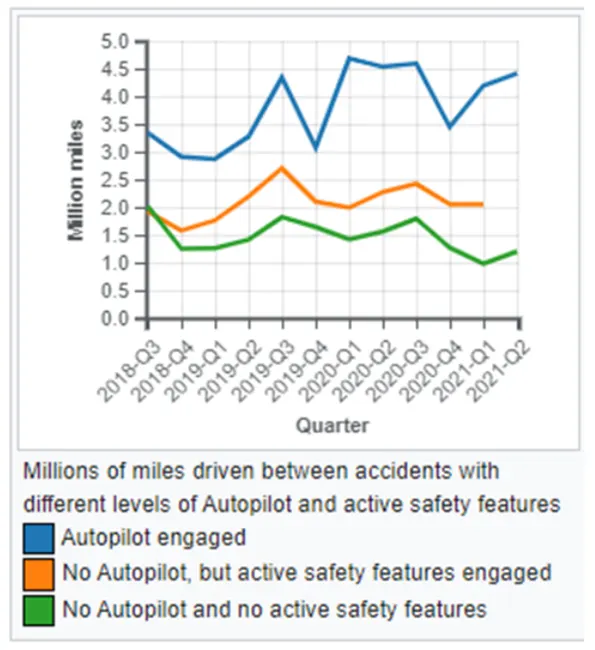
Researchers recorded one crash for every 4.31 million kilometres driven in the fourth quarter in which drivers were utilising Autopilot technology (Autosteer and active safety features). Researchers found one crash for every 1.59 million miles driven by drivers who did not use Autopilot technology (no Autosteer or active safety features). According to the most recent data from the National Highway Traffic Safety Administration, a vehicle crash occurs every 484,000 miles in the United States.
(3rd Quater 2021)
Researchers recorded one crash for every 4.97 million kilometres driven in the third quarter in which drivers were utilising Autopilot technology (Autosteer and active safety features). Researchers found one crash for every 1.6 million miles driven by drivers who did not use Autopilot technology (no Autosteer or active safety features). According to the most recent data from the National Highway Traffic Safety Administration, a vehicle crash occurs every 484,000 miles in the United States.
(2nd Quater 2021)
Researchers recorded one crash for every 4.41 million miles driven in the second quarter in which drivers were using Autopilot technology (Autosteer and active safety features). Researchers found one crash for every 1.2 million miles driven by drivers who did not use Autopilot technology (no Autosteer or active safety features). According to the most recent data from the National Highway Traffic Safety Administration, a vehicle crash occurs every 484,000 miles in the United States.
(1st Quater 2021)
Researchers recorded one collision for every 4.19 million kilometres driven in the first quarter, with drivers using Autopilot. Researchers recorded one collision for every 2.05 million miles driven by individuals driving without Autopilot but with our active safety measures. Researchers recorded one collision for every 978 thousand kilometres driven by people driving without Autopilot and our active safety systems. According to the most recent data from the National Highway Traffic Safety Administration, a vehicle crash occurs every 484,000 miles in the United States.
VEHICLE FIRE DATA
- Between 2012 and 2020, about one Tesla vehicle caught fire for every 205 million miles driven. According to data from the National Fire Protection Association (NFPA) and the United States Department of Transportation, one vehicle fire occurs per 19 million miles driven in the United States.
- Between 2012 and 2019, about one Tesla vehicle caught fire for every 175 million miles driven. According to data from the National Fire Protection Association (NFPA) and the United States Department of Transportation, one vehicle fire occurs per 19 million miles driven in the United States.
- Between 2012 and 2018, about one Tesla vehicle caught fire for every 170 million miles driven. According to data from the National Fire Protection Association (NFPA) and the United States Department of Transportation, there is a car fire per 19 million miles driven in the United States.
METHODOLOGY USED
- Based on available data from the fleet, researchers collect the number of miles driven by each car with Autopilot turned on or in manual mode, and they do so without identifying specific vehicles to safeguard privacy. Every time the fleet reports an incident, researchers receive a crash alert, which may contain information about whether Autopilot was enabled at the time of impact. They count every event in which Autopilot was deactivated within 5 seconds of contact and also count any crashes in which the incident alert showed an airbag or other active restraint deployed to ensure their safety. (All crash statistics aren't based on estimates or sample data sets.
- In actuality, depending on the collision forces generated, this corresponds to practically any crash at roughly 12 mph (20 kph) or higher. On the other hand, police-reported crashes in government databases are notoriously under-reported, by as much as 50% according to some estimates, in large part because most small crashes (such as "fender benders") are not investigated. They also don't make any distinctions based on the sort of crash or failure. (For example, the Tesla vehicle is rear-ended by another vehicle in more than 35% of all Autopilot crashes.)
SAFETY SYSTEM IN TESLA CAR
Battery pack---The position and weight reduce rollover risk and improve emergency avoidance handling.
Impact Protection---A patented side sill structure supports the chassis to absorb impact energy and protect occupants and battery
Structural Integrity---The rigid body and fortified battery help to reduce and prevent cabin intrusion
Crumple Zones---Large empty spaces in the front and rear soften the impact, reducing the risk of occupant injury
Advanced Airbags---Less cabin intrusion helps preserve space for airbags to fully inflate and protect passengers
Exception hardware components---Eight cameras provide 360 degrees of visibility while twelve ultrasonic sensors can detect both hard and soft objects, including surrounding vehicles.
Forward Collision Warning---Provides visual and audible warnings of impending collisions with vehicles or obstacles.
Blind Spot Collision Warning---Warns when a possible collision is detected with a vehicle or obstacle in your blind spot.
Lane Departure Avoidance---Applies corrective lane-centring steering if a potential collision or unintended lane departure is detected
Software Safer overtime---Every mile a user drives, it can help researched and others drivers to stay safer. We can analyse real-world scenarios from our worldwide fleet of over a million Tesla vehicles and billions of kilometres driven on Autopilot to learn how crashes happen and how to help lessen or prevent them in the future. The most recent additions and enhancements are available immediately via over-the-air software updates.
Fire Safety protection---Tesla battery packs are engineered to disperse heat away from the occupant cabin and battery in the event of damage, helping to prevent fires and protect occupants. Tesla vehicles were nearly 10 times less likely to catch fire per mile driven in the United States from 2012 to 2020 than average gas vehicles.
SAFETY CONCERNS
- Tesla was criticized by the National Transportation Safety Board (NTSB) for failing to foresee and prevent "predictable abuse" of Autopilot in a fatal 2018 Autopilot crash in California. An autopilot and Tesla's marketing of the technology, according to the Centre for Auto Safety and Consumer Watchdog, is "dangerously misleading and deceptive," giving buyers the mistaken impression that their vehicles are self-driving or autonomous. Tesla's Autopilot, according to UK safety experts, is "particularly misleading. In comparison to a similar level, 2 driver-assistance systems from other automobile manufacturers, a 2019 IIHS study found that the word "Autopilot" causes more drivers to misperceive behaviours like texting or napping to be safe.
Driver monitoring
- With Autopilot turned on, drivers have been caught dozing at the wheel, driving under the influence of alcohol, and performing other inappropriate behaviours. Tesla initially decided against employing driver monitoring features to curb such behaviour. It wasn't until late May 2021 that a new version of the OTA software-enabled inside cameras to monitor drivers using Autopilot in new Model 3 and Model Y cars (i.e. the first cars as part of the changeover to Tesla Vision). Model S and Model X vehicles built before 2021 lack an interior camera and hence are unable to provide such capabilities, while the upgraded models are planned to include one.
Detecting stationary vehicles at speed
- The manual warns that Autopilot may not identify stationary vehicles "Congestion-aware’ ‘When driver drives at 50 mph (80 km/h) and a vehicle you're following moves out of your driving path and a stationary vehicle or item is in front of you instead, Cruise Control may not identify all objects and may not stop or decelerate for stationary cars." This has resulted in several collisions with emergency vehicles that have come to a halt. Any automobile with only adaptive cruise control or automated emergency braking suffers from the same issue (for example, Volvo Pilot Assist)
Dangerous and unexpected behaviour
- Hundreds of Tesla customers reported unsafe behaviours with Autopilot in a 2019 Bloomberg survey, including phantom braking, drifting out of lane, and failing to stop for road hazards. Users have also reported the software crashing and turning off unexpectedly, off-ramp barrier collisions, radar failures, unexpected swerving, tailgating, and uneven speed adjustments. The brake mechanism tends to activate later than some drivers expect
Court cases
- In 2017, a class-action lawsuit was filed against Tesla, alleging that the second-generation Enhanced Autopilot technology was "dangerously flawed." Owners who paid US$5,000 (equivalent to $5,392 in 2020) to equip their cars with the updated Autopilot software in 2016 and 2017 were rewarded between $20 and $280 for the delay in activating Autopilot 2.0 in 2018. A German court found in July 2020 that Tesla made misleading promises about its Autopilot system and that the word "Autopilot" gave the idea that the car could drive itself. The US auto safety regulators started an official safety examination against Tesla's driver on August 16, 2021, after reports of 17 injuries and one death in car incidents involving emergency vehicles.
Safety statistics
- In 2016, data collected after 47 million miles of driving in Autopilot mode revealed that the risk of an accident was reduced by at least half when using Autopilot. During the investigation into the tragic crash in Williston, Florida in May 2016, the National Highway Traffic Safety Administration (NHTSA) released a preliminary report in January 2017 claiming that "the Tesla vehicles' crash rate fell by nearly 40% after Autosteer installation. In 2019, Quality Control Systems, a private company, produced a report evaluating the same data, claiming the NHTSA conclusion was "not well-founded. After the installation of Autosteer, the crash rate (measured in the rate of airbag deployments per million miles of travel) increased from 0.76 to 1.21, according to Quality Control Systems' examination of the data.
NHTSA investigations
- According to a document issued in June 2021, the NHTSA has launched at least 30 investigations into Tesla collisions employing Autopilot, some of which have resulted in fatalities. The National Highway Traffic Safety Administration's Office of Defects Investigation (ODI) opened a preliminary evaluation (PE 21-020) in August 2021 and released a list of eleven crashes involving Tesla vehicles colliding with emergency vehicles in each case, NHTSA confirmed that Autopilot or Traffic-Aware Aware Cruise Control was active during the approach to the crashes. Seven of the eleven collisions resulted in seventeen injuries, including one fatality. The National Highway Traffic Safety Administration (NHTSA) planned to assess the Autopilot system, specifically the systems that monitor and enforce driver engagement. The National Highway Traffic Safety Administration (NHTSA) added the twelfth accident to its inquiry list in September.
- National Highway Traffic Safety Administration (NHTSA) has given TESLA car models as 5-Star Safety Rating overall and in every category.
CONCLUSION ARRIVED
- Tesla Autopilot is a set of advanced driver-assistance system (ADAS) technologies that amounts to Level 2 vehicle automation and is supplied by Tesla. Lane centring, traffic-aware cruise control, automatic lane changes, semi-autonomous navigation on limited-access highways, self-parking, and the option to summon the car from a garage or parking spot are some of its features. In all of these aspects, the driver is in charge, and the vehicle must be constantly monitored. The features, according to the business, decrease accidents caused by driver error and exhaustion from long-distance driving. Although it was placed #1 in the "Capabilities and Performance".
- The company's stated plan is to offer SAE Level 5 (complete autonomous driving) as an update to the standard Autopilot features at a later date, noting that regulatory and technical challenges must be overcome to achieve this goal. Most experts estimate that Tesla vehicles would lack the requisite hardware for fully autonomous driving by April 2020. Tesla launched and commissioned consumers for a Full Self-Driving beta programme in the United States in October 202 It is now being tested by a few thousand Tesla employees and owners as of May 2021.
PERSONAL THOUGHTS ON THIS CONTENT
- The design, lack of a dealership, fuel savings, low depreciation, supercharger stations, vehicle safety, self-driving technology, superior entertainment systems, and software are all advantages of Tesla cars.
- The pricing, high maintenance costs, lengthier repair times, lack of service centres, construction quality, dull interior, limited towing capabilities, and battery deterioration are all disadvantages of Tesla cars.
- But gradually TESLA will dominate the automotive industries in the 21st-century replacing conventional IC engines.
- The future of Tesla looks promising as the company continues to be a leader in the electric vehicle market. Tesla has a strong brand reputation and a loyal customer base, which has helped the company to continue to grow and expand its offerings.
- In the near future, Tesla plans to release several new vehicles, including the Model Y SUV and the Cybertruck. The company is also working on developing new battery technology and expanding its Supercharger network to make charging more convenient for its customers.
- Additionally, Tesla is investing in future projects like how to safeguard the pedestrian during complete rollover with a definite linear & angular velocities of the car as well as the windshields resistance and removal during the emergency situations.