Project - Position control of mass spring damper system
Project Title
''Position control of mass spring damper system''
Aim:-The aim of this project is to determined the transfer function of the simple Mass Spring Damper System and then implement the same in simulink with PID controller to adjust the force on mass so that it's position follows a reference signal.
The simple Spring Mass Damper System or Mass Spring Damper system is as shown below:-
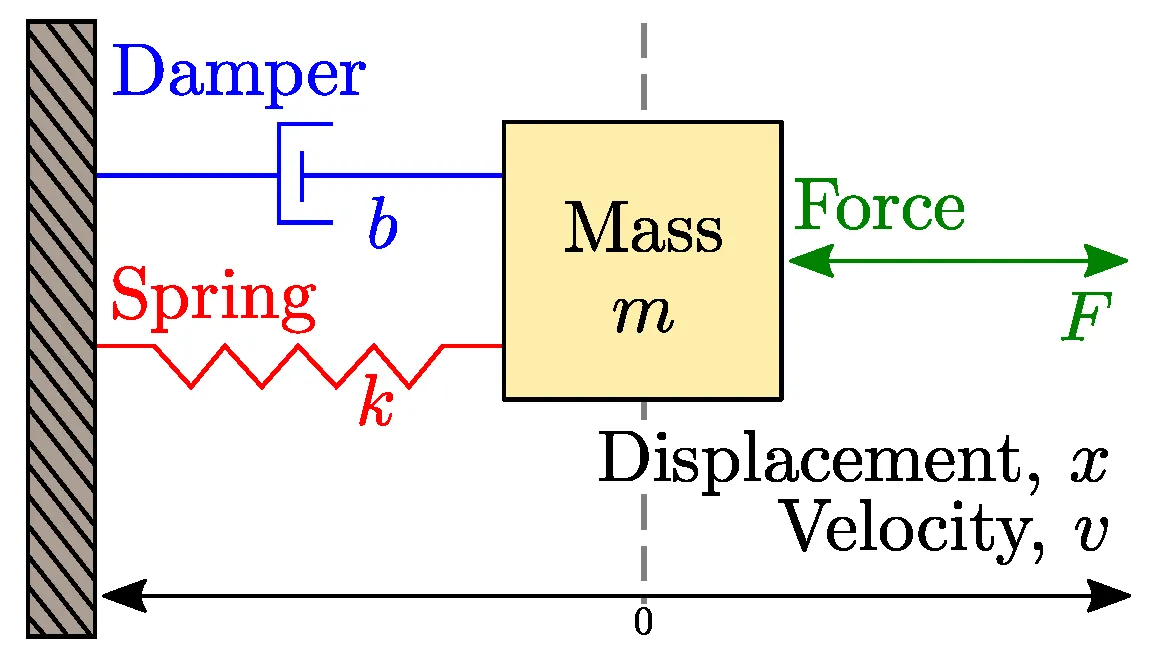 Figure(1)
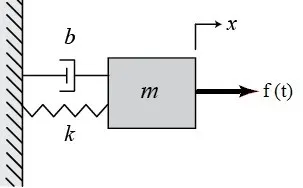 Figure(2)
Here,B=C=stiffness cofficient or friction constant.
K= Damping cofficient constant.
f(t) is forcing function and x(t) is Displacement or position
both f(t) and x(t) are the function of time
>Due to the applied force f(t), mass(M) will displace by an amount of x(t) in the direction of the force applied (i.e f(t)) as shown in Figure(2)
>According to Newton's low of motion , applied force will cause displacement x(t) in spring , acceleration to mass(M) against frictional force having constant 'B' or 'C'.
Therefore,
f(t)= M*a + C*v + Kx(t)-------(i)
where, a= acceleration, v= velocity
Therefore, equation (i) can be written in differential euation form as,
f(t)= M*(d^2x(t)/dt^2) + C* (dx(t)/dt) + Kx(t)--------(ii)
Taking laplace transform we get,
F(s)=Ms^2X(s) + CsX(s) + BX(s)---------(iii)
on sloving equation (iii) to get transfer function we get
X(s)/F(s) = 1/(Ms^2 + Cs + K)---------(iv)
Hence the equation (iv) is the required transfer function for the Mass Spring Damper System.
The constant value is give as: Mass(M)=3.6 kg,
Stiffness or Spring Constant(K)=400 N/m,
Damping cofficient or Friction Constant(C)=100 Ns/m.
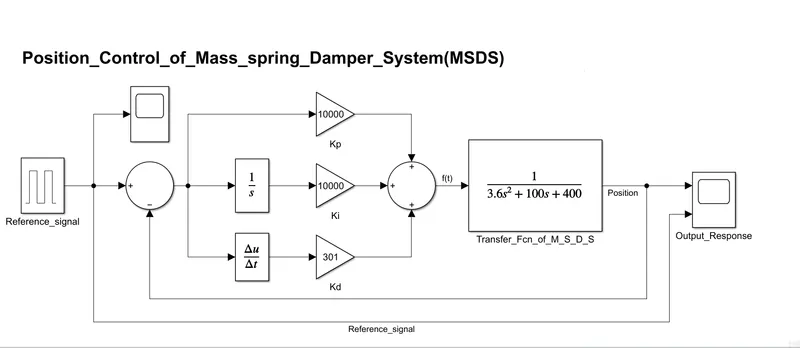
The Equation (iv) is implemented in the simulink with PID controller as shown in figure below:-
Here, the perfect or correctly tuned values of Kp, Ki and Kd are shown.
>>PID controller:- A proportional-Integral-Derivative(PID) controller is a control loop mechanism employing feedback that is widely used in industrial control system and varity of other application which required continuously modulated control.The composite controller including the combination of the proportional , Integral and Derivative control mode is called PID control mode and the controller is called three mode controller. It is very much complex to design but very powerful in action.
Mathematically such control mode can be expressed as, P(t)= Kp*e(t) + Ki*∫e(t)dt + Kd*(de(t)/dt) + p(0)
where, p(0)= initial value of the output
>This mode has advantage of all three modes. The integral mode eliminates the offset error of the proportional mode and response is also very fast due to derivative mode. The sudden respone is produced due to derivative mode. Thus it can be used for any process condition.
>With the PID control action, there is no offset , no oscillations with least settling time. so there is improvement in both transient as well as steady state reponse. With PID control, there is no offset and system achieves the steady state with less settling time. Thus PID is ultimate process composite controller.
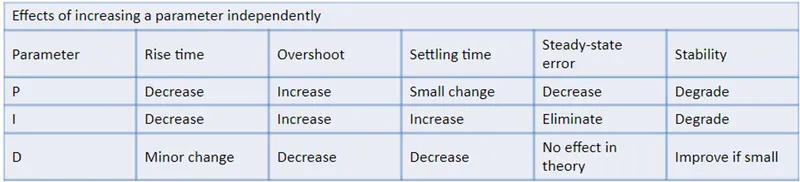
The table below shows the effect of P,I and D on the verious parameter of the output response.
>There is a set of steps through which we can find and fixed the value of Kp, Ki and Kd.
The steps are listed below:-PID Tuning steps
i.set Kp, Ki, and Kd to zero.
ii. Increse the Kp until we get close to setpoint.
iii.Stop if behaviour is good enough.
iv. Increase the Ki to reach the set point quickly.
v. Increase the Kd to reduce the oscillatioms.
>In the simulink model feedback from the transfer function block, output is feedback or given as input to the PID controller and the processed error is minimized to get the desired output respone if tuning of the Kp, Ki and Kd is done correctly and perfectly.
>In the simulink model shown above the best or perfectely suited Kp, Ki and Kd values are 10000, 10000 and 301 as shown in simulink model.
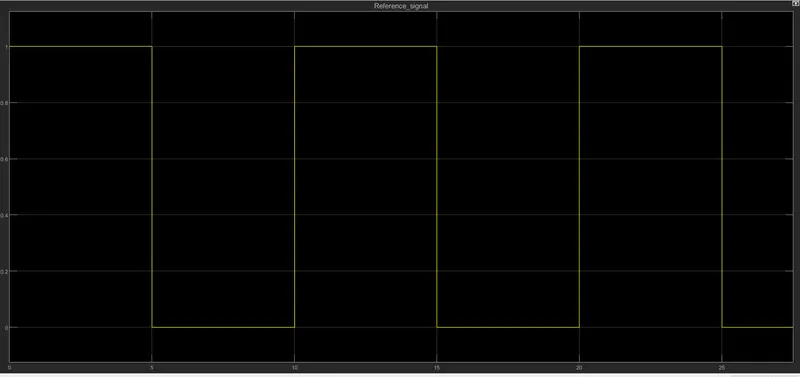
#)The input signal or reference signal applied to the system is shown below:-
#)The output respone or controlled output v/s reference input signal is shown below:-
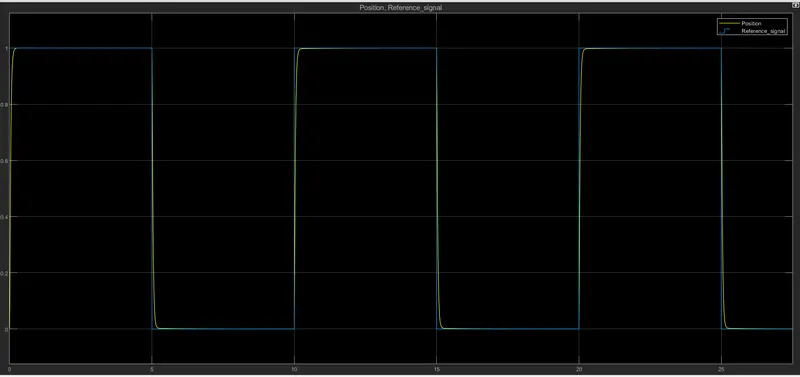
From this output we can conclude that the position control of Mass Spring Damper System is achieved using PID (Kp, Ki and Kd tuning) controller by adjusting the force on mass so that it's position follows a reference signal.