Project on Concrete Mix Design for various grades of Concrete
AIM: To calculate the concrete mix design for M35 grade concrete with fly ash.
INTRODUCTION :
- The Process of selecting suitable ingredients of concrete (cement, fine aggregates and course arrgegate mixed with water ) and determining the relative quantities with an objective of producing a concrete of required strenght , durability and workability as economical a possible is termed as concrete mix design.
- Concrete is used in the construction of load bearing structure, beams,columns,foundation, slabs and other concrete structure.
- In General concrete mix are 3 types.
- 1: Nominal mix
- 2: Standard mix
- 3: Design mix
- Nominal mix : Nominal mix is a process in which the prescribed ingredients are as per their standard specification and their proportions are specified in the ratio of cement to aggregate to attain the required strength.
- Nominal mix is preferred for simpler ,and unimportant work and smaller work.
Grade of concrete Table IS 456:2000 Nominal mix proportion cement:sand:aggregate
M5 1:5:10 M7.5 1:4:8 M10 1:3:6 M15 1:2:4 M20 1:1.5:3 - Grade of concrete define the compressive strength after 28 days curing of concrete. In Mix design the M35, M represent the mix ratio of ingredients and 35 represent the compressive strength after 28 day of concrete expressed in N/mm*2.
- Standard mix.
- The nominal mix of fixed cement aggregate ratio vary widely in strength and in over rich mixes
- IN IS 456:2000 Grade mix are M10,M15,M20,M25,M30,M35 and M40
- Design mix.
- These mix are design by the structural engineer.
- Used for high strength of concrete structure.
Requirment of concrete mix design
- minimun compressive strength required for structural considerations.
- Adequate workability .
- max water cement ratio to attain adequate durability .
- max cement content to avoid shrinkage .
- Workability: The degree of workability deponds on size of section,amount of reinforcement and method of compaction.The concrete should have high workability so that can be achived by full compaction.The desired workability deponds on the compaction equipment available at the site.
- Durability: The durability of concrete is the resistance to the aggressive environmental conditions. High strength concrete generally have more durable than low strength concrete.
Guidelines for concrete mix design
IS method 10262-2009 and Recommended guidlines for concrete mix design,IS 10262-1982, British standard method - BSEN-1 and its complementary standard BS8500 part 1 & 2.
PROCEDURE :
Step 1: Data collection for concrete mix design
- Grade of concrete = M35
- Type of cement = OPC 43 grade conforming to IS 8112
- Type of mineral admixture = Fly ash conforming to IS 3812 part 1
- Maximum nominal size of aggragate =20mm
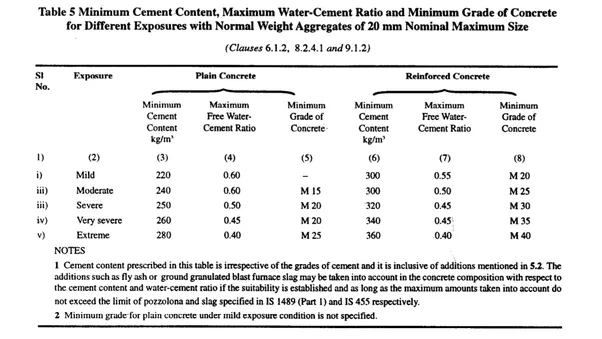
- min cement content =320kg/m*3 ( Table 5 of IS 456-2000 Expose condition)
- max water cement ratio =0.45 (Table 5 IS 456-2000)
- Workability =100mm (slump value for pumping concrete )
- Expose condition = severe (for bars )
- Method of concrete placing = pumping
- degree of supervision = Good
- Type of aggregate = Crushed Granular
- max cement content= 450kg/m*3
- Chemical admixture = Superplasticizer
Fly Ash : Fy Ash is a by product from coal fired power plant that is frequently used as a admixture in concrete to replace a portion of portland cement.
Using flyash in concrete it is environmentally benefical because it reduce the portland cement required.
Step 2 : Test data for material.
- Cement used = Opc 43 grade conforming to IS 8112
- Specific Gravity of cement = 3.15
- Flyash=Conforming to IS 3812 part 1
- Specific Gravity of flyash = 2.2
- Chemical admixture =Superplasticizer conforming to IS 9103
- Specific Gravity of
- Course aggregate =2.74
- Fine aggregate =2.65
- Chemicl admixture=Superplasticizer conforming to IS 9103
- Water absorption:
- Coure aggregate =0.5%
- Fine aggragate =1.0%
- Free Surface moisture
- Course aggregate =nil
- fine aggregate =nil
- Seive analysis
- Course aggregate =confroming table 2 of IS 383
- Fine aggregate=grading zone 1 of table 4 of IS 383
Step 3 : Target strength for mix proportioning.
ft =fck+1.65 S
Where ft = Target average compressive strength at 28 days
fck = Characteritic compressive strength at 28 days
S= Standard deviation
from Table 1 of IS 10262:2009, standard devition S = 5 N/mm*2
Therefore,Target strength ft= 35+(1.65*5)=43.25N/mm*2
Step 4: selection of water-cement ratio:
- From Table 5 of IS 456:2000 maximum water cement rartio for severe exposure (Reinforced concrete )=0.45
- Also water cement ratio as per the following graph from IS 10262:2019
- IS 10262:2019
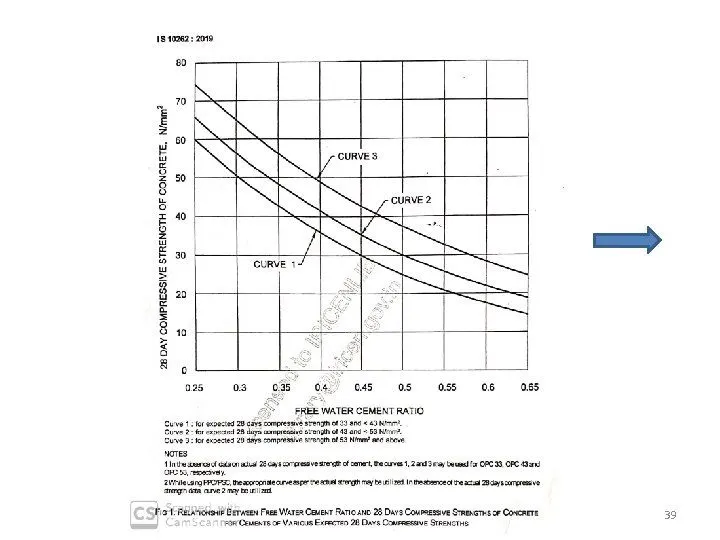
The water cment ratio corresponding to target strength can be assumed as 0.39
Hence 0.39<0.45 hence ok
The water cement ratio is 0.39
Step 5: Selection of water content
- From table 4 of IS 10262:2019,max water content for 20mm aggregate = 186kg (for 25mm to 50mm slump range)
- Estimated water content for 75mm slump=186+3/100*186=191.58kg(for every 25mm increase in slump value 3% is increase in water )
- As superplasticizer is used the water content can be reduced up to 30% and above. Based on the trail water content reduction of 29% is achieved with plasticizer.
- Hence the arrived water content =191.58*0.71=136 liters
Step 6: Calculation of cement content.
water cement ratio =0.39
cement content = 136/0.39 = 349kg\m*3
now to proportion a mix containing fly ash the following steps are suggeted.
- Percentage of fly ash need to be decied based on the project requirment and quality of material
- In some cases increase of cementitious material can be warranted.
Cementitious material content = 349 X 1.10 = 348 Kg/m*3
water content =136 Kg/m*3
Hence water cement ratio =136/384 =0.354 Kg/m*3
Flyash at 30% total cementitious material content = 384 x 30%= 115 Kg/m*3
cement opc =384-115=289Kg/m*3
fly ash being utilized =115Kg/m*3
from Table 5 of IS 456:2000 minimum cementitous content for severe exposure condition = 320 Kg /m*3
Hence 384kg/m*3 > 320 Kg /m*3
Step 7: Proportion of course aggregate & fine aggregate content
from Table 3 of IS 10262:2009 volume of coarse aggregate corrospnding to 20mm size aggregate and fine aggregate for water cement ratio =0.6
here water cement ratio is 0.354
Therefore the volume of course aggregate need to be increase to decrease the fine aggregate content.
Therefore the corrected volume of aggragate for the water cement ratio of 0.354=0.629=0.63m*3
Volume of fine aggregate content =1-0.63=0.37m*3
Step 8: mix calculation
The mix calculation per unit volume of concrete shall be as follows
- Volume of concrete = 1m*3
- volume of cement = (mass of cement /specific gravity of cement)*(1/1000).
= (269/3.15) x (1/1000)= 0.085m*3 - Volume of fly ash = (mass of flyash /specific gravity of flyash)*(1/1000).
= (115/2.2) x (1/1000)= 0.052m*3 - volume of water = (mass ofwater /specific gravity of water)*(1/1000). =(136/1) x ( 1/1000) =0.316 m*3
- Volume of chemical admixture 2% by mass of cementitious material
=(mass of admixture /specific gravity of admixture)*(1/1000).
=(7.68/1.145) x (1/1000) = 0.007m*3
- volume of aggregate = a-(b+c+d+e) =1-(0.085+0.052+0.316+0.007)= 0.72m*3
- Mass of course aggregate = f*(mass of course aggregate /specific gravity of course aggregate)*(1000). = 0.72 x 0.63 x 2.74 x 1000=1242.86 = 1243Kg/m*3
- Mass of fine aggregate = f*(mass of fine aggregate /specific gravity offine aggregate)*(1000)
=0.72 x 0.37x 2.65 x 1000 = 705.5 =706 Kg/m*3.
Step 9: mix proportion for trai number
cement : 269 Kg/m*3.
fly ash : 115 Kg/m*3.
water : 136 Kg/m*3.
chemical admixture : 7.68 Kg/m*3.
water cement ratio : 0.354
course aggregate : 1243 Kg/m*3.
fine aggregate : 706 Kg/m*3.
Trail mix ratio = 1:2.62:4.62
AIM: To calculate the concrete mix design for M50 grade concrete without fly ash.
INTRODUCTION :
- The Process of selecting suitable ingredients of concrete (cement, fine aggregates and course arrgegate mixed with water ) and determining the relative quantities with an objective of producing a concrete of required strenght , durability and workability as economical a possible is termed as concrete mix design.
- Concrete is used in the construction of load bearing structure, beams,columns,foundation, slabs and other concrete structure.
- In General concrete mix are 3 types.
- 1: Nominal mix
- 2: Standard mix
- 3: Design mix
- Nominal mix : Nominal mix is a process in which the prescribed ingredients are as per their standard specification and their proportions are specified in the ratio of cement to aggregate to attain the required strength.
- Nominal mix is preferred for simpler ,and unimportant work and smaller work.
Grade of concrete Table IS 456:2000 Nominal mix proportion cement:sand:aggregate
M5 1:5:10 M7.5 1:4:8 M10 1:3:6 M15 1:2:4 M20 1:1.5:3 - Grade of concrete define the compressive strength after 28 days curing of concrete. In Mix design the M50, M represent the mix ratio of ingredients and 50 represent the compressive strength after 28 day of concrete expressed in N/mm*2
- Standard mix.
- The nominal mix of fixed cement aggregate ratio vary widely in strength and in over rich mixes
- IN IS 456:2000 Grade mix are M10,M15,M20,M25,M30,M35 and M40
- Design mix.
- These mix are design by the structural engineer.
- Used for high strength of concrete structure.
Requirment of concrete mix design
- minimun compressive strength required for structural considerations.
- Adequate workability .
- max water cement ratio to attain adequate durability .
- max cement content to avoid shrinkage .
- Workability: The degree of workability deponds on size of section,amount of reinforcement and method of compaction.The concrete should have high workability so that can be achived by full compaction.The desired workability deponds on the compaction equipment available at the site.
- Durability: The durability of concrete is the resistance to the aggressive environmental conditions. High strength concrete generally have more durable than low strength concrete.
Guidelines for concrete mix design
IS method 10262-2009 and Recommended guidlines for concrete mix design,IS 10262-1982, British standard method - BSEN-1 and its complementary standard BS8500 part 1 & 2.
PROCEDURE :
Step 1: Data collection for concrete mix design
- Grade of concrete = M50
- Type of cement = OPC 43 grade conforming to IS 269
- Maximum nominal size of aggragate =20mm
- min cement content =320kg/m*3 ( Table 5 of IS 456-2000 Expose condition)
- max water cement ratio =0.45 (Table 5 IS 456-2000 Expose condition)
- Workability =75mm (slump value)
- Expose condition = severe (for reinforced concrete )
- Method of concrete placing = Chute
- degree of supervision = Good
- Type of aggregate = Crushed Angular Granular
- max cement content= 450kg/m*3
Step 2 : Test data for material.
- Cement used = Opc 43 grade conforming to IS 269
- Specific Gravity of cement = 3.15
- Chemical admixture =Superplasticizer conforming to IS 9103
- Specific Gravity of
- Course aggregate =2.74
- Fine aggregate =2.65
- Chemicl admixture=1.145
- Water absorption:
- Coure aggregate =0.5%
- Fine aggragate =1.0%
- Free Surface moisture
- Course aggregate =nil
- fine aggregate =nil
- Seive analysis
- Course aggregate =confroming table 2 of IS 383
- Fine aggregate=grading zone 1 of table 4 of IS 383
Step 3 : Target strength for mix proportioning.
ft =fck+1.65 S
Where ft = Target average compressive strength at 28 days
fck = Characteritic compressive strength at 28 days
S= Standard deviation
from Table 1 of IS 10262:2009, standard devition S = 5 N/mm*2
Therefore,Target strength ft= 50+(1.65*5)=58.25 N/mm*2
Step 4: selection of water-cement ratio:
- From Table 5 of IS 456:2000 maximum water cement rartio for severe exposure (Reinforced concrete )=0.45
- Also water cement ratio as per the following graph from IS 10262:2019
- IS 10262:2019
The water cment ratio corresponding to target strength can be assumed as 0.34
Hence 0.34<0.45 hence ok
The water cement ratio is 0.34
Step 5: Selection of water content
- From table 4 of IS 10262:2019,max water content for 20mm aggregate = 186kg (for 25mm to 50mm slump range)
- Estimated water content for 75mm slump=186+3/100*186=191.58kg (for every 25mm increase in slump value 3% is increase in water )
- As superplasticizer is used the water content can be reduced up to 20% and above. Based on the trail water content reduction of 29% is achieved with plasticizer.
- Hence the arrived water content =191.58*0.71=136 liters
Step 6: Calculation of cement content.
water cement ratio =0.34
cement content = 136/0.34 = 400kg\m*3
from Table 5 of IS 456:2000 minimum cementitous content for severe exposure condition = 320 Kg /m*3
Hence 400 kg/m*3 > 320 Kg /m*3
Step 7: Proportion of course aggregate & fine aggregate content
from Table 3 of IS 10262:2009 volume of coarse aggregate corrospnding to 20mm size aggregate and fine aggregate for water cement ratio =0.6
Here water cement ratio is 0.354
Therefore the volume of course aggregate need to be increase to decrease the fine aggregate content.
As water cement ratio is lower by 0.16the proportion of volume of coarse aggregate is increased by 0.032 (for every +or - 0.001 or + or - 0.005 change in water cement ratio)
The corrected volume of course aggregate for the water cement ratio of 0.34=0.62
The volume of fine aggregate content =1-0.63 =0.37m*3
Step 8: mix calculation
The mix calculation per unit volume of concrete shall be as follows
- Volume of concrete = 1m*3
- volume of cement = (mass of cement /specific gravity of cement)*(1/1000).
= (400/3.15) x (1/1000)= 0.126m*3
- volume of water = (mass ofwater /specific gravity of water)*(1/1000). =(136/1) x ( 1/1000) =0.316 m*3
- Volume of chemical admixture 1% by mass of cementitious material
=(mass of admixture /specific gravity of admixture)*(1/1000).
=(4/1.145) x (1/1000) = 0.003m*3
- volume of aggregate = a-(b+c+d) =1-(0.126+0.136+0.003)= 0.735m*3
- Mass of course aggregate = e*(mass of course aggregate /specific gravity of course aggregate)*(1000). = 0.735 x 0.63 x 2.74 x 1000=1269 Kg/m*3
- Mass of fine aggregate = e*(mass of fine aggregate /specific gravity offine aggregate)*(1000)
=0.735 x 0.37x 2.65 x 1000 = 720 Kg/m*3.
Step 9: mix proportion for trai number
cement : 400 Kg/m*3
water : 136 Kg/m*3.
chemical admixture : 4 Kg/m*3.
water cement ratio : 0.34
course aggregate : 1269 Kg/m*3.
fine aggregate : 720 Kg/m*3.
Trail mix ratio = 1:1.8:3.17