Project on Concrete Mix Design for various grades of Concrete
Aim : To determine the mix design for M35 grade concrete with flyash and M50 grade concrete without flyash.
Introduction :
The main aim of the concrete mix design is to find out the desired proportion of each ingredients which are cement, coarse aggregate, fine aggregates, water, etc., to obtain the required properties such as strength, desired workability and durability as economically.
This project contains two types of concrete mix design
1. Concrete Mix Design of M35
To determine the concrete mix design for M35 grade concrete with flyash as per IS method.
2. Concrete Mix Design of M50
To determine the concrete mix design for M50 grade concrete without flyash as per IS method.
Codes Used : IS 10262:2009, IS 456:2000
PART 1 : To calculate the Mix Design for M35 grade concrete with flyash
Stipulations for concrete Design Mix
- Grade Designation: M35
- Type of cement: OPC 43 grade conforming to IS 8112
- Type of chemical admixture: Flyash ( conforming to IS 3812 Part- 1)
- Maximum nominal size of aggregate: 20mm
- Maximum water-cement ratio: 0.45 (from table 5 of IS 456:2000 - exposure condition)
- Workability:125mm slump
- Exposure condition: Moderate (for reinforced concrete)
- Method of concrete placing: Pumping
- Degree of supervision: Good
- Type of aggregate: Crushed angular aggregate
- Maximum cement content: 360 kg/cum
- Chemical admixture type: Superplasticizer
Test data for materials
- Cement used: OPC 43 grade conforming to IS 8112
- Specific gravity of cement: 3.15
- Specific gravity of flyash: 2.2 (conforming to IS 3812 part-1)
- Chemical admixture: Superplasticizer
- Specific gravity of CA: 2.74
- Specific gravity of FA: 2.74
- Water absorption of CA: 0.5%
- Water absorption of FA: 1%
- Free surface moisture of CA & FA: Nil
- Sieve analysis for CA: As per Table 2 of IS 383
- Sieve analysis for FA: As per Grading zone I of Table 4 of IS 383
Procedure
a. Target mean strength of concrete
f'ck = fck + 1.65*s
where f'ck = compressive strength of concrete
fck = characteristic strength of concrete
s = standard deviation
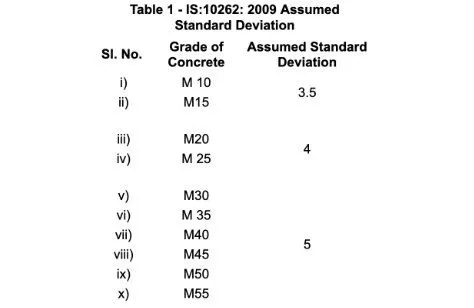
f'ck = 35 + 1.65*5 = 43.25 N/sq.mm
b. Selection of water-cement ratio
From table 5 IS: 456-2000 for moderate exposure condition, maximum water-cement ratio = 0.45
Based on experience, we can consider maximum water-cement ratio = 0.4
c. Selection of water content
Maximum water content for 20mm aggregate is 186 litres for 25mm to 50mm slump range (from table 2 of IS 10262:2009).
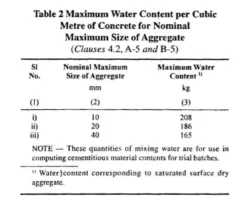
Estimated water content for 125mm slump = `186 + (9/100)*186 = 202.74 = 203`litres
As superplasticizer is used, the water content can be reduced upto 20% to 30%.
Based on trails water content reduction of 29% is achieved with plasticizer.
Thus water content is obtained = 203*0.71 = 144.13
Adopt 150 litres
d. Calculation of cement content
Adopted water-cement ratio = 0.4
Cement content = 150/0.4 = 375 kg/cum
From table 5 of IS 456:2000 minimum cement content for moderate exposure condition = 300 kg/cum
Therefore, 375 kg/cum > 300 kg/cum.
Hence O.K.
e. Calculation of flyash content
Considering 10% increase in cementious material.
Thus, cementious content = 375 * 1.10 = 412.5
Adopt 415 kg/cum.
Water content = 150 kg/cum
So, water-cement ratio = 150/415 = 0.361
Flyash = 30% of total cementious content
= 415*0.3 = 124.5 = 125 kg/cum
Cement (OPC) = 415-125 = 290 kg/cum
Saving of cement while using flyash = 375-290 = 85 kg/cum
Flyash being utilized = 125 kg/cum
f. Proportion of volume of CA & FA content
Volume of CA corresponding to 20mm size aggregate and FA (zone 1) for water-cement ratio is 0.5 = 0.6
In this case w/c ratio is 0.4. Therefore volume of CA needs to be increased to decrease FA content.
As the w/c ratio is lower by 0.10, the proportion of volume of CA is increased by 0.02 (at the rate of -/+ 0.01 for every +/- 0.05 change in water-cement ratio.
Corrected volume of CA for the water-cement ratio is 0.4 = 0.62
(Note : If the CA is not of angular type, then also volume of CA may be required to increased,suitably based on experience).
For pumpable concrete, these values are reduced by 10%
Volume of CA = 0.62*0.9 = 0.56
Volume of FA = 1-0.56 = 0.44
g. Mix Calculations
The mix calculation per unit volume of concrete shall be as following
i. Volume of concrete = 1 cum
ii. Volume of cement = (mass of cement/specific gravity of cement) * (1/1000)
= (290/3.15) * (1/1000) = 0.09 cum
iii. Volume of flyash = (mass of flyash/specific gravity of flyash) * (1/1000)
= (125/2.2) *(1/1000) = 0.05 cum
iv. Volume of water = (mass of water/specific gravity of water) * (1/1000)
= (150/1) * (1/1000) = 0.15 cum
v. Volume of chemical admixture = (mass of chemical admixture/specific gravity of admixture) * (1/1000)
= (7.6/1.145) * (1/1000) = 0.006 cum
vi. Volume of aggregate (CA & FA) = i - (ii + iii + iv + v)
= 1 - (0.09+0.05+0.15+0.006) = 0.704 cum
vii. Mass of CA = vi * volume of CA * specific gravity of CA *1000
= 0.704 * 0.56 * 2.74 * 1000 = 1080.21 kg/cum
viii. Mass of FA = vi * volume of FA * specific gravity of FA *1000
= 0.704 * 0.44 * 2.74 * 1000 = 848.74 kg/cum
Result
Mix proportion for M35 grade concrete with flyash is obtained as below :
- Cement = 290 kg/cum
- Flyash = 125 kg/cum
- Water = 150 kg/cum
- Coarse Aggregate = 1080.20 kg/cum
- Fine Aggregate = 848.74 kg/cum
- Chemical Admixture = 7 kg/cum
- Water-Cement ratio = 0.361
- Mix proportion ratio = 1:2.92:3.72
Note :
- The slump shall be measured and water content & dosage of admixture shall be adjusted for achieving required slump. The mix proportion shall be reworked for the actual water content and checked for the durability requirements.
PART 2 : To calculate the Mix Design for M50 grade concrete without flyash
Stipulations for concrete Design Mix
- Grade Designation: M50
- Type of cement: OPC 43 grade conforming to IS 8112
- Maximum nominal size of aggregate: 20mm
- Maximum water-cement ratio: 0.40 (from table 5 of IS 456:2000 - exposure condition)
- Workability:75mm slump
- Exposure condition: Very severe (for reinforced concrete)
- Method of concrete placing: Pumping
- Degree of supervision: Good
- Type of aggregate: Crushed angular aggregate
- Maximum cement content: 360 kg/cum
- Chemical admixture type: Superplasticizer
Test data for materials
- Cement used: OPC 43 grade conforming to IS 8112
- Specific gravity of cement: 3.15
- Specific gravity of chemical admixture: 1.145
- Specific gravity of CA: 2.74
- Specific gravity of FA: 2.74
- Water absorption of CA: 0.5%
- Water absorption of FA: 1%
- Free surface moisture of CA & FA: Nil
- Sieve analysis for CA: As per Table 2 of IS 383
- Sieve analysis for FA: As per Grading zone I of Table 4 of IS 383
Procedure
a. Target mean strength of concrete
f'ck = fck + 1.65*s
where f'ck = compressive strength of concrete
fck = characteristic strength of concrete
s = standard deviation
f'ck = 50 + 1.65*5 = 53.25 N/sq.mm
b. Selection of water-cement ratio
From table 5 IS: 456-2000 for moderate exposure condition, maximum water-cement ratio = 0.45
Based on experience, we can consider maximum water-cement ratio = 0.4
c. Selection of water content
Maximum water content for 20mm aggregate is 186 litres for 25mm to 50mm slump range (from table 2 of IS 10262:2009).
Estimated water content for 125mm slump = `186 + (3/100)*186 = 191.58 = 192`litres
As superplasticizer is used, the water content can be reduced upto 20% to 30%.
Based on trails water content reduction of 29% is achieved with plasticizer.
Thus water content is obtained = 192*0.71 = 136.2
Adopt 137 litres
d. Calculation of cement content
Adopted water-cement ratio = 0.4
Cement content = 137/0.4 = 343 kg/cum
From table 5 of IS 456:2000 minimum cement content for moderate exposure condition = 300 kg/cum
Therefore, 343 kg/cum > 340 kg/cum.
Hence O.K.
e. Proportion of volume of CA & FA content
Volume of CA corresponding to 20mm size aggregate and FA (zone 1) for water-cement ratio is 0.5 = 0.6
In this case w/c ratio is 0.4. Therefore volume of CA needs to be increased to decrease FA content.
As the w/c ratio is lower by 0.10, the proportion of volume of CA is increased by 0.02 (at the rate of -/+ 0.01 for every +/- 0.05 change in water-cement ratio.
Corrected volume of CA for the water-cement ratio is 0.4 = 0.62
(Note : If the CA is not of angular type, then also volume of CA may be required to increased,suitably based on experience).
For pumpable concrete, these values are reduced by 10%
Volume of CA = 0.62*0.9 = 0.56
Volume of FA = 1-0.56 = 0.44
f. Mix Calculations
The mix calculation per unit volume of concrete shall be as following
i. Volume of concrete = 1 cum
ii. Volume of cement = (mass of cement/specific gravity of cement) * (1/1000)
= (343/3.15) * (1/1000) = 0.10 cum
iii. Volume of water = (mass of water/specific gravity of water) * (1/1000)
= (137/1) * (1/1000) = 0.137 cum
iv. Volume of chemical admixture = (mass of chemical admixture/specific gravity of admixture) *(1/1000)
= (7.6/1.145) * (1/1000) = 0.006 cum
v. Volume of aggregate (CA & FA) = i - (ii + iii + iv )
= 1 - (0.10+0.137+0.006) = 0.764 cum
vi. Mass of CA = vi * volume of CA * specific gravity of CA *1000
= 0.764 * 0.56 * 2.74 * 1000 = 1172.28 kg/cum
vii. Mass of FA = vi * volume of FA * specific gravity of FA *1000
= 0.764 * 0.44 * 2.74 * 1000 = 921.07 kg/cum
Result
Mix proportion for M50 grade concrete without flyash is obtained as below :
- Cement = 343 kg/cum
- Water = 137 kg/cum
- Coarse Aggregate = 1172.28 kg/cum
- Fine Aggregate = 921.07 kg/cum
- Chemical Admixture = 7 kg/cum
- Water-Cement ratio = 0.4
- Mix proportion ratio = 1:2.68:3.41
Note :
- The slump shall be measured and water content & dosage of admixture shall be adjusted for achieving required slump. The mix proportion shall be reworked for the actual water content and checked for the durability requirements.
Result :
From both concrete mix designs, we know that all the concrete ingredients required to make concrete of required grade give desired properties as required in both plastic and hardend state of concrete. The concrete mix design ratios for M35 and M50 are as follows
- Mix proportion by weight of M35 Grade Concrete with Fly ash - 1:2.92:3.72
- Mix proportion by weight of M50 Grade Concrete without Fly ash - 1:2.68:3.41
Challenge Accomplished