Project on Concrete Mix Design for various grades of Concrete
AIM:- To Calculate the Concrete Mix Design for M35 grade concrete with fly ash & M50 grade concrete without Fly ash.
INTRODUCTION:- The process of selecting suitable ingredients of concrete and determining their relativeamounts with the objective of producing a concrete of the required, strength, durability, and workability as economically as possible, is termed the concrete mix design. In this project we are designing two conrete mixes , M35 grade concrete with fly ash and M50 without Fly ash.
Part 1:- To calculate M35 concrete with flyash.
Step 1:-
Stipulations for proportioning of M35 grade concrete.
- Garde of concrete = M35
- Type of cement = OPC 43
- Type of admixture = fly ash
- Maximum nominal size of coarse aggregate = 20 mm
- Minimum cement content = 340 kg/m^3 (table 5 of IS 456 exposure condition)
- Maximum cement content = 450 kg/m^3 (table 5 of IS 456 exposure condition)
- Type of aggregate = Crushed angular aggregates
- Workabilty = 100mm
- Method of concrete placing = Pumping
- Exposure condition = Very severe
- Maximum water cement content = 0.45 (table 5 of IS 456 exposure condition)
- Chemical admixture = Super plasticizer
1) Target strength for mix proportion
f'ck=fck+1.65S
where,
f'ck = target strength of concrete after 28 days
fck = characteristics strength of concrete or grade
S = standard deviation
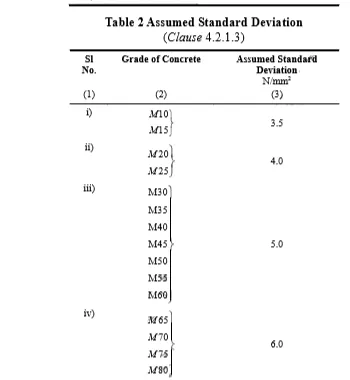
from table 1 of IS 10262:2009, standard deviation S=5 N/mm^2.
therefore,
f'ck= 35+1.65 (5)
f'ck= 43.25 n/mm^2
2) Selection of water cement ratio
According to table 5 of Is 456:2000 exposure condition is assumed very severe
therefore,
vere severe W/C=0.45
Minimum cement content = 340 kg/m^3
3) Selection of water content
Nominal size of aggregates assunmed are of 20 mm
therefore,
According to Table 2 of IS 10262:2009
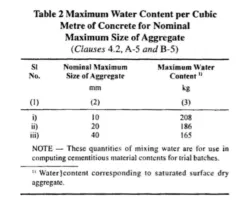
Minimum water content for 20 mm aggregates for slump range from 25mm to 50mm is = 186 litres
But our slump ranges till 100 mm therefore according to clause 4.2 3% water is to incresed for every 25 mm
186+(6/100)*186=197 litres
But, since we are using super plasticizer water content can be reduced by 20%
therefore, 197-(20/100*197)= 157 litres
Water content= 157 litres
4) Calculations of Cementious content
W/c ratio= 0.45
therefore, total cementious content = 157/0.45=348 kg/m^3
The cemnetious content is incresed by 10% to attain good strength and workabilty. this increment is done based on trial and previous experiences.
therefore total cemetious content = 348 * 1.10= 382 Kg/m^3
Water cement ratio = 157/382= 0.4
fly ash content is assumed 30%= 382*0.3 = 114 kg/m^3
cement required = 382-114= 268 Kg/m^3
quantity of cement saved by adding fly ash = 348-268 = 80 Kg/m^3
5) Volume of coarse aggregate and fine aggregate
From table 3 of IS 10262:2009
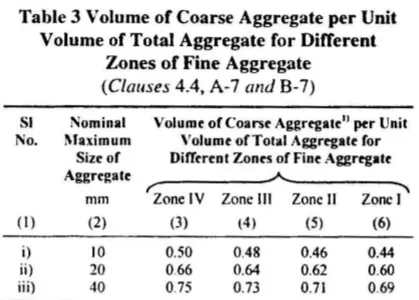
Volume of coarse aggregate for 20 mm size in zone 1 of water cement ratio is 0.60
the proportion of volume of coarse aggregate is changed at a rate of +/- 0.01 for every +/- 0.05 change in water cement ratio.
Water cement ratio= 0.45
As the method of concrete placing is pumping 10% is reduced = 0.60 * 0.9= 0.54
Volume of coarse aggregate =0.54
Volume of fine aggregate = 1 - 0.54= 0.46
6) Estimation of concrete mix calculation
- Volume of concrete = 1 m3
- Volume of cement = (Mass of cement / Specific gravity of cement) x (1/1000) = (268/3.15) x (1/1000) = 0.085 m3
- volume of fly ash = (mass of fly ash / specific gravity of fly ash ) x (1/1000) = (114/2.2)x (1/1000) = 0.051 m^3
- Volume of water = (Mass of water / Specific gravity of water) x (1/1000) = (157/1) x (1/1000) = 0.157 m3
- volume of chemical admixture = (mass of admix/ specific gravity of admix) x (1/1000) = (7.76/1.14) x (1/1000) = 0.006 m^3
- Total Volume of Aggregates = (a-(b+c+d+e)) =1- (0.085+0.51+0.157+0.006) = 0.701 m3
- Mass of coarse aggregates = f X Volume of Coarse Aggregate X Specific Gravity of Coarse Aggregate X 1000 = 0.701 X 0.54 X 2.70 X 1000 = 1022 kgs/m3
- Mass of fine aggregates = f X Volume of Fine Aggregate X Specific Gravity of fine Aggregate X 1000 = 0.701 X 0.46 X 2.70 X 1000 = 870 kgs/m3
7) Final mix proportions
| Cement | 268 Kg/m^3 |
| Fly ash | 114 kg/m^3 |
| Water content | 157 litres |
| Fine aggregate | 870 kgs/m3 |
| Coarse aggregate | 1022 kgs/m3 |
| Chemical admixture | 7.76 kg/m3 |
Trial Mix Ratio = 268:870:1022 = 1:3.24:3.81
- This trial mix ratio should be durable, have workability and minum strength for M35 concrete .
- Two more trial having a variation of 10% in water cement ratio and based on that appropriate trial mix is selected.
Part 2:- To calculate M50 concrete without flyash.
Step 1:-
Stipulations for proportioning of M50 grade concrete.
- Garde of concrete = M50
- Type of cement = OPC 53
- Type of admixture = Nil
- Maximum nominal size of coarse aggregate = 20 mm
- Minimum cement content = 340 kg/m^3 (table 5 of IS 456 exposure condition)
- Maximum cement content = 450 kg/m^3 (table 5 of IS 456 exposure condition)
- Type of aggregate = crushed angular aggregates
- Workabilty = 100mm
- Method of concrete placing = Pumping
- Exposure condition = very severe
- Maximum water cement content = 0.45 (table 5 of IS 456 exposure condition)
- chemical admixture = Super plasticizer
1) Target strength for mix proportion
f'ck=fck+1.65S
where,
f'ck = target strength of concrete after 28 days
fck = characteristics strength of concrete or grade
S = standard deviation
from table 1 of IS 10262:2009, standard deviation S=5 N/mm^2.
therefore,
f'ck= 50+1.65 (5)
f'ck= 58.25 n/mm^2
2) Selection of water cement ratio
according to table 5 of Is 456:2000 exposure condition is assumed very severe
therefore,
vere severe W/C=0.45
Minimum cement content = 340 kg/m^3
3) Selection of water content
Nominal size of aggregates assunmed are of 20 mm
therefore,
according to Table 2 of IS 10262:2009
Minimum water content for 20 mm aggregates for slump range from 25mm to 50mm is = 186 litres
but our slump ranges till 100 mm therefore according to clause 4.2 3% water is to incresed for every 25 mm
186+(6/100)*186=197 litres
But, since we are using super plasticizer water content can be reduced by 20%
therefore, 197-(20/100*197)= 157 litres
Water content= 157 litres
4) Calculations of Cement content
W/c ratio= 0.45
therefore, total cement content = 157/0.45=348 kg/m^3
Cement content = 348 kg/m^3
5) Volume of coarse aggregate and fine aggregate
from table 3 of IS 10262:2009
volume of coarse aggregate for 20 mm size in zone 1 of water cement ratio is 0.60
the proportion of volume of coarse aggregate is changed at a rate of +/- 0.01 for every +/- 0.05 change in water cement ratio.
water cement ratio= 0.45
as the method of concrete placing is pumping 10% is reduced = 0.60 * 0.9= 0.54
volume of coarse aggregate =0.54
volume of fine aggregate = 1 - 0.54= 0.46
6) Estimation of concrete mix calculation
- Volume of concrete = 1 m3
- Volume of cement = (Mass of cement / Specific gravity of cement) x (1/1000) = (348/3.15) x (1/1000) = 0.110 m3
- Volume of water = (Mass of water / Specific gravity of water) x (1/1000) = (157/1) x (1/1000) = 0.157 m3
- volume of chemical admixture = (mass of admix/ specific gravity of admix) x (1/1000) = (7.76/1.14) x (1/1000) = 0.006 m^3
- Total Volume of Aggregates = (a-(b+c+d)) =1- (0.110+0.157+0.006) = 0.727 m3
- Mass of coarse aggregates = e X Volume of Coarse Aggregate X Specific Gravity of Coarse Aggregate X 1000 = 0.727 X 0.54 X 2.70 X 1000 = 1060 kgs/m3
- Mass of fine aggregates = e X Volume of Fine Aggregate X Specific Gravity of fine Aggregate X 1000 = 0.727 X 0.46 X 2.70 X 1000 = 903 kgs/m3
7) Final mix proportions
| Cement | 348 Kg/m^3 |
| Water content | 157 litres |
| Fine aggregate | 903 kgs/m3 |
| Coarse aggregate | 1060 kgs/m3 |
| Chemical admixture | 7.76 kg/m3 |
Trial Mix Ratio = 348:903:1060 = 1:2.59:3.04
- This trial mix ratio should be durable, have workability and minum strength for M35 concrete .
- Two more trial having a variation of 10% in water cement ratio and based on that appropriate trial mix is selected.
RESULTS:-
For M35 grade of concrete with flyash A Mix proportion of 1:3.24:3.81 is to be used with a water cement ratio of 0.4.
For M50 grade of concrete without flyash A Mix proportion of 1:2.59:3.04 is to be used with a water cement ratio of 0.45.