Project - Analysis of a practical automotive wiring circuit
1. Identify each of the major elements in the above automotive wiring diagram.
- Generator
- Current and voltage regulator
- Battery
- Fuse
- Light Switch
- Ammeter
- Starter
- Ignition Coil
- Distibutor
2. Explain the purpose and working of any three elements briefly.
- Generator:
PURPOSE: This device converts mechanical energy to electrical energy and transfers the electrical energy to the desired electrical equipment, like bulbs, ammeter, indicators, horns, to charge the battery, etc.
WORKING: This includes 2 main components: Stator (Stationary part) -- which contains magnets or electromagnets to create a magnetic field when it rotates, Rotor( rotatory part) -- which contains Windings. Other components are the commutator, brushes, and bearings.
- If the IC engine starts to operate, then the generator rotor rotates on its axis, and then the magnets rotate. The stator armature winding senses the change in magnetic flux that passes throughout the winding, and then an electromotive force (EMF) is generated. Now, this EMF is transferred to an external circuit with the help of a Commutator, and brushes help to maintain contact with the commutator to conduct current.
- This generated voltage is first rectified (converted to DC) and then sent to every electrical equipment.
- Battery:
PURPOSE: to store the electricity in the form of chemical energy, and during the electricity demand battery can provide power to various electrical equipment.
WORKING: This is a collection of cells. The battery has 2 terminals anode (positive) and a cathode (negative). Which is immersed in electrolyte, and electrolyte is a medium which facilitates the transfer of ions between the anode and the cathode. The anode releases electrons and gets oxidised during the chemical reaction. The cathode gains electrons from the external circuit and gets reduced during the electrochemical reaction.
During the discharging of a battery, the electron moves from the anode to the cathode, as a result, we get electricity.
- Fuse:
PURPOSE: To protect the electrical equipment from short circuit or undesired electric power supply in the electric circuit, which can destroy the electrical equipment.
WORKING: This safety device contains a thin wire of metal which will conduct the current in normal conditions of power supply, but it melts when an excessive current flows through it. It depends on the diameter, length and metal (copper, tin or silver) properties. The wire melts due to excessive heat, according to H = i2Rt. i =current , R = resistance, t = time interval.
3. If the total load is 10A from battery, what should be the fuse rating?
Fuse Rating = Normal load x safety factor (let's take a 25% margin for small fluctuation)
Fuse Rating = 10x1.25 = 12.5 Ampere.
4. If 500W is the load, what is the voltage and capacity of battery you recommend?
Solution: We know Load = Voltage x current (unit volt-ampere or watt) -------(i)
Capacity of battery = current x hour (ampere-hour) -------(ii)
Energy stored in battery = load x hour (watt-hour) -------(iii)
Let us consider a 12-volt battery for a load under 600 watts.
From equation (i)
500 = 12 * current
Current = 41.67 amperes.
From equation (ii)
Capacity of battery = 41.67 * 1 = 41.67 Ah
If the backup is for 2 hours, then
Capacity of battery = 41.67 * 2 = 83.34 Ah
5. Identify any two elements which are connected in parallel to each other. Why are they connected in parallel? 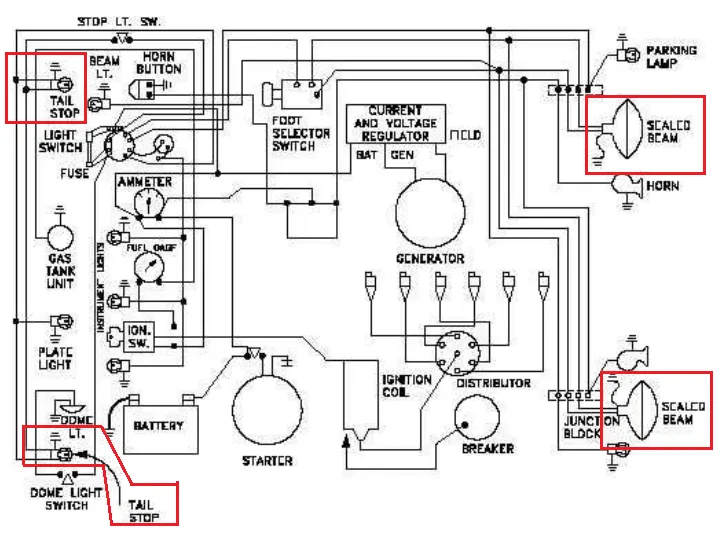
REASON: Tail stop lamps are connected in parallel so that both lamps can get the full voltage of the battery for equal glowing. Similarly, for the scaled beam also. Parallel connection reduced the equivalent resistance of the overall circuit.
6. Identify any two elements which are connected in series. Why are they connected in series?
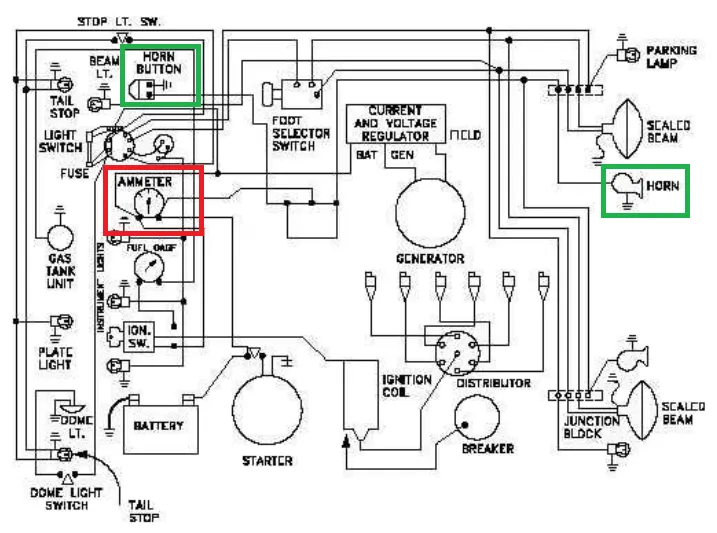
REASON: An Ammeter is always connected in series with an electric circuit because it measures the current flowing through the line. An ammeter will create a short circuit if we add it to a parallel series circuit.
The horn button and horn will always connect in series in the electronic circuit. The horn button will act like a circuit breaker and circuit connector, so that on the traffic road, we push the horn button and complete the circuit, then the horn will blow; otherwise horn will be silent.