Project - Analysis of a practical automotive wiring circuit
Q1. Identify each of the major elements in the above automotive wiring diagram.
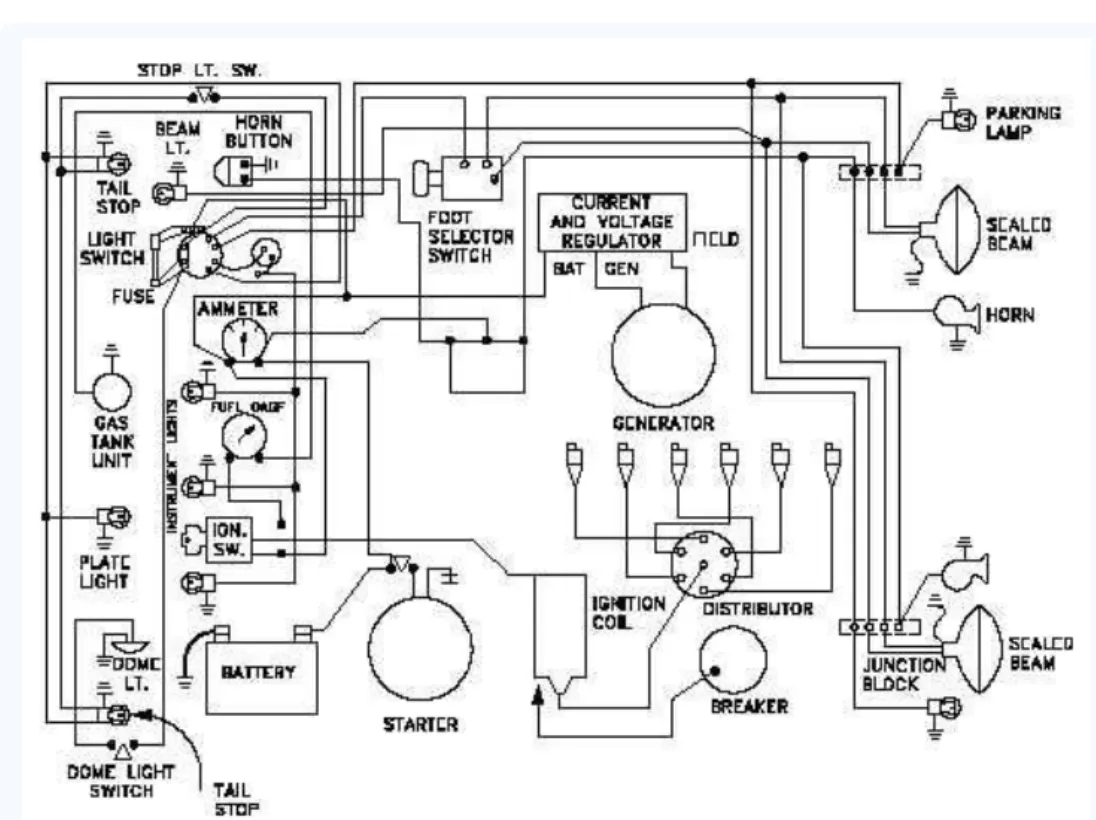
Major components of the wire harness circuit (of a four wheeler automobile) are as follows:
Battery, Starter, Current
and Voltage Regulator, Gas Tank Unit, Ignition Coil
Q2
. Explain the purpose and working of any three elements briefly.
Major components of the wire harness circuit (of a four wheeler automobile) are as follows:
a. Battery: The battery in an automotive wire harness system is fundamental for starting the vehicle, providing continuous power for electrical systems, and ensuring stable operation of various electronic components throughout the vehicle's operation.
Purpose: The purpose of a battery in an automotive wiring harness is fundamental to the operation of the vehicle. Here are the key roles a battery plays:
- Power Supply: The battery provides electrical energy to start the engine. When you turn the ignition key, the battery sends a large current to the starter motor, which initiates the engine's combustion process.
- Electrical System Power: Beyond starting the engine, the battery supplies power to all electrical systems in the vehicle when the engine is not running or when the alternator cannot meet the demand. This includes powering lights, dashboard instruments, radio, power windows, and other accessories.
- Voltage Stabilization: The battery helps stabilize the voltage in the electrical system. It acts as a buffer against voltage fluctuations that occur due to various factors such as alternator output variations or sudden changes in electrical load.
- Backup Power: In case the alternator fails or when the engine is off, the battery acts as a backup power source for critical systems, ensuring that essential functions like headlights and emergency signals remain operational.
- Starting Aid in Hybrid and Electric Vehicles: In hybrid and electric vehicles, the battery serves as the primary energy source for electric motors, either solely or in combination with an internal combustion engine.
b. Starter: The battery in an automotive wire harness system is fundamental for starting the vehicle, providing continuous power for electrical systems, and ensuring stable operation of various electronic components throughout the vehicle's operation.
Purpose:
Engine Cranking: As the starter motor rotates, it turns the engine's crankshaft via the flywheel or flexplate. This action initiates the process of engine cranking, which means the crankshaft and pistons start moving in a controlled manner.
c.
Current and Voltage Regulator: The voltage regulator and current regulator
contribute to the overall reliability, safety, and efficiency of the vehicle's
electrical system. They work in tandem to provide stable voltage to electrical
components while safeguarding against excessive current flow that could lead to
damage or safety hazards.
Purpose:
Maintaining Stable Voltage: The voltage regulator controls the output voltage of the alternator to maintain a stable voltage within the vehicle's electrical system.
- Protecting Electronics: A stable voltage 1is crucial for the proper operation of electronic components, such as sensors, engine control units (ECUs), and entertainment systems. Fluctuations in voltage can cause malfunctions or even permanent damage to these components.
- Battery Charging: The regulator ensures the alternator supplies sufficient voltage to charge the battery effectively without overcharging it. It adjusts 1the alternator output voltage based on the SOC of the battery and the electrical load, ensuring optimal charging conditions.
- Load Compensation: Modern voltage regulators may also incorporate features to compensate for variations in electrical load, ensuring that voltage remains stable even as the vehicle's electrical demands change.
Q3. If the total load is 10A from battery, what should be the fuse rating?
Fuses are a vital component which protect electrical circuits from overcurrent conditions. It ensures both electrical safety and reliable operation of equipment and wiring in automotive and other electrical systems.
The fuse rating refers to the current-carrying capacity of the fuse and is specified in amperes (A). It resembles the maximum current that the fuse can safely conduct without blowing or melting under normal operating conditions
If load current is 10 amperes hence it specifies that maximum current that can flow in the circuit is 10 A. So, Fuse rating must be slightly greater than 10 Ampere.
To protect the circuit from overcurrent, let us assume a fuse rating of 11 Ampere.
Q4. If 500W is the load, what is the voltage and capacity of battery you recommend?
Given:
Power rating of load, P=500 Watt
Let Voltage capacity of battery, V=12 Volts (This is typical for many automotive applications and smaller electrical devices)
Also let us assume time duration, t=1 hour
We know,
Capacity of battery, C=(Power/Voltage)*Time
C=(500W/12 V)*(1 hr)
C=(41.66 A)*(1 hr)
C=41.66 Ah
Answer:
Capacity of battery=41.66 Ah Ampere hour
Q5. Identify any two elements which are connected parallel to each other. Why they are connected in parallel?
a. In the given automotive wire harness diagram, the two 'Scaled Beam' (front head lamps) elements are in parallel connection with each other.
b. Also the two 'Tail Stop' (rear end lights) elements are in parallel connection.
Reasons for Parallel Wiring of headlamps:
- Equal Voltage Distribution: When headlights are wired in parallel, each headlamp receives the same voltage directly from the power source (usually the vehicle’s battery or electrical system). This ensures that both headlights operate at their intended brightness levels.
- Independent Operation: Headlights wired in parallel can operate independently of each other. If one headlamp develops an issue (like a blown bulb), the other headlamp can continue to function normally because they are not dependent on each other for current flow.
- Simplicity in Wiring: Parallel wiring is straightforward and allows each headlamp to be controlled individually. This makes troubleshooting easier if there are any issues with one of the headlamps.
Q6. Identify any two elements which are connected in series. Why they are connected in series?
a. In the given automotive wire harness diagram, the 'Starter' and 'Ammeter' components are connected in series with each other.
b. Also, 'Ammeter' and 'Voltage' Regulator elements are connected in series with each other.
Considerations for Series Connections in Automotive Wiring:
- Current Handling: Series connections must be designed to handle the expected current without overheating or voltage drop issues. Automotive circuits often carry significant currents, so proper wire gauge and component ratings are crucial.
- Reliability and Safety: Series connections should be implemented with reliability and safety in mind. Automotive environments are harsh, with exposure to vibration, temperature variations, and moisture, so connections must be securely insulated and protected against these elements.
- Efficiency: While series connections can serve specific purposes, they can also introduce higher resistance compared to parallel connections, potentially affecting the overall efficiency of the electrical system.