Project - Analysis of a practical automotive wiring circuit
1.
- Battery
- Ignition Switch
- Current Voltage regulators
- Distributter
- Breakers
- Fuses
- Switches
- Juntion Box
- Accesories such as Tail Lamp, Head lamp, Indicators, wipers, A/c, Sterios etc.
2.
Battery
Batteries are widely employed in order to power small electric devices such as mobile phones, remotes, and flashlights. Historically, the ‘term’ battery has always been used in order to refer to the combination of two or more electrochemical cells
A battery is a device that stores chemical energy and converts it to electrical energy. The chemical reactions in a battery involve the flow of electrons from one material (electrode) to another, through an external circuit. The flow of electrons provides an electric current that can be used to do work.
Batteries can be broadly divided into two major types.
- Primary Cell / Primary battery
- Secondary Cell / Secondary battery
Based on the application of the battery, they can be classified again. They are:
-
Household Batteries
These are the types of batteries which are more likely to be known to the common man. They find uses in a wide range of household appliances (such as torches, clocks, and cameras). These batteries can be further classified into two subcategories:
- Rechargeable batteries Nickel
Examples: Cadmium batteries, Lithium-Ion - Non-rechargeable batteries
Examples: Silver oxide, Alkaline & carbon zinc
- Rechargeable batteries Nickel
-
Industrial Batteries
These batteries are built to serve heavy-duty requirements. Some of their applications include railroad, backup power and more for big companies. Some examples are:
Nickel Iron
Wet Nickel Cadmium (NiCd) -
Vehicle Batteries
These are more user-friendly and a less complicated version of the industrial batteries. They are specifically designed to power cars, motorcycles, boats & other vehicles. An important example of a vehicle battery is the Lead Acid Battery.
Generator
Generators are useful devices that provide electrical power during a power cut-off and prevent discontinuity of day and night affairs and activities or disruption in operations in different conditions and places. All a generator does is to convert the mechanical energy provided from an external source, to electrical energy to provide enough energy for other appliances. It works based on the Faraday law of electromagnetic induction.
This law says that wherever a conductor is put among a varying magnetic field, the electromagnetic flux is induced. There are different electrical and physical configurations for Generators. This diversity in the configuration is for use in different applications. In the following sections, we will elaborate on how a generator works, what different types it has, and what parts a generator consists of. Read on to get more acquainted with the world of this amazing device.
he generators are divided into two different and basic classes or categories which are AC (Alternating Current) generator and DC (Direct Current) generator.
-
AC Generator
The AC generators or as they are also called the Alternator, are one of the most essential devices of providing electrical power in several conditions in our life. ACs work based on the principle of electromagnetic induction. AC generators are classified into two categories: induction generators and synchronous generators. As there are no brushes in this type of generators, maintenance is almost free. the size of ACs is smaller in comparison to DCs. So, they are more commonly used. And at last, what makes this type more popular is that the losses of ACs are less than DCs.
-
DC Generator
This type of generator is commonly found in off-grid applications. The DCs are classified into three main categories according to the way their magnetic field is developed in the stator: permanent-magnet generators, separately-excite generators, and self-excited generators. Some advantages of DCs are: they are designed plainly. They are usually used for operating large motors and electrical devices requiring direct control. DCs diminishes the fluctuations described by smoothing the output voltage through a regular set of coils around the armature for some steady state applications.
Fuses
Fuses are the protectors, these are the safety devices which are used to protect the Electrical Devices.The fuse is made up of thin strip or strand of metal, whenever the heavy amount of current or an excessive current flow is there in an electrical circuit, the fuse melts and it opens the circuit and disconnects it from the power supply. Also, it works as a circuit breaker or stabilizer which protects the device from damage.In the market, many types, features, and design of fuses are available nowadays. Their strips are made up of aluminum, copper, zinc & it is always connected in series with the circuit to protect from overcurrent in the running cables.
The fuses work on the principle of the heating effect of the current. It’s made up of thin strip or strand of metallic wire with noncombustible material. This is connected between the ends of the terminals. Fuse is always connected in series with the electrical circuit.
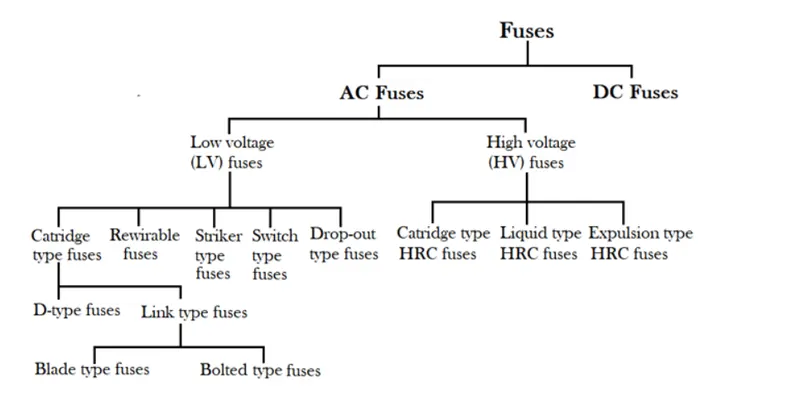
Classification of fuses
3.
Fuse rating = (watts/volts) x 1.25
If a 10A load is specified, most (American) technicians would use a 15A fuse. 10A is usually not a safe minimum, do to potential impulses or even small fluctuations, as a fuse is designed to not exceed the restrictions on the current, to prevent damage to the circuit. Grammarly helps ensure your writing is mistake-free.
4.
Backup time (in hours) = (battery capacity (in AH) * battery voltage) / load (in watts)
Load=500w(given)
Battery Voltage= 12V
Backup-Time =4hrs
Battery Capacity=(Backuptime*Load in Watts)/Battery Voltage
=(4hrs*500W)/12V=166.6AH
5.
Tail lamp,Horn are connected in parallel in order to atttain a constant Voltage across the circuit meet the required voltage of the Electrical elements.
6.
Switches , Fuses are connected in parallel because when When one system cut off the the whole circuit becomes open so that it is easy to attain safety of the circuit. In parallel connection constant voltage is maintaining acrosss the surface so that when there is a increase in current helps to burnd down the fuse.