Project - Analysis of a practical automotive wiring circuit
Project - Analysis of a practical automotive wiring circuit
Aim:-
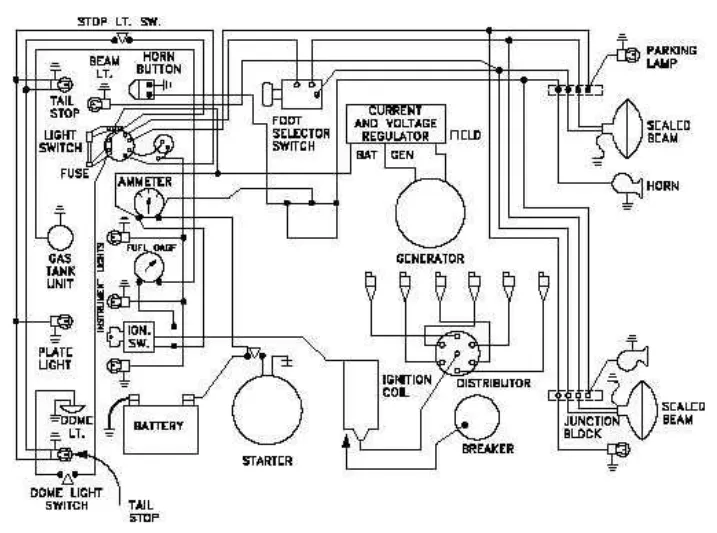
- Identify each of the major elements in the above automotive wiring diagram.
- Explain the purpose and working of any three elements briefly.
- If the total load is 10A from the battery, what should be the fuse rating?
- If 500W is the load, what is the voltage and capacity of the battery you recommend?
- Identify any two elements which are connected parallel to each other. Why they are connected in parallel?
- Identify any two elements which are connected in series. Why they are connected in series?
Hint- take battery voltage =12V
Solution:-
1. Identify each of the major elements in the above automotive wiring diagram.
Ans: Battery
Starter
Breaker
Distributor
Generator
Junction Block
Current and Voltage Regulator
Fuse
Ammeter
2. Explain the purpose and working of any three elements briefly.
Ans:
Battery
The small essential components that can operate many devices are the batteries. It has become one of the key components in our everyday lives. Some batteries can be recharged and are used in almost every sector. Some of the applications of the batteries are given below.
- House
- Health Instruments
- Medical
- Logistics and Construction
- Firefighting and Emergency
- Military
We depend on batteries for several gadgets that we use in our house. Devices like remote controls and torches are powered by disposable batteries. Mobile phones, handheld video game consoles, digital cameras, and many other devices use rechargeable batteries, such as alkaline batteries. Appliances that consume too much power, such as laptops and other devices, are powered by advanced batteries like lithium batteries.
Working
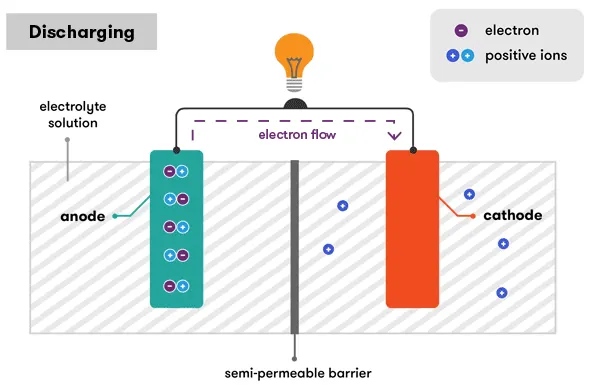
- A battery is a device that stores chemical energy and converts it to electrical energy.
- The chemical reactions in a battery involve the flow of electrons from one material (electrode) to another, through an external circuit.
- The flow of electrons provides an electric current that can be used to do work.
- To balance the flow of electrons, charged ions also flow through an electrolyte solution that is in contact with both electrodes.
- Different electrodes and electrolytes produce different chemical reactions that affect how the battery works, how much energy it can store, and its voltage.
Generator
An electric generator also called a dynamo, is any machine that converts mechanical energy to electricity for transmission and distribution over power lines to domestic, commercial, and industrial customers. Generators also produce the electrical power required for automobiles, aircraft, ships, and trains.
Working
First of all, keep in mind that a generator is not a device that creates electricity. A generator uses the provided mechanical energy and forces the flow of present electric charges inside the wire of its windings. This flow of electric charges makes the output electric current used for different purposes.
To understand what a generator produces, it is better to consider a water pump. A water pump makes the flow of water but does not create the water flowing through it. In simple words, generators generate electrical energy by capturing movement's power and turning it into electricity by forcing electrons from external sources through an electrical circuit. Generators are the same as electrical motors but they work in reverse.
As mentioned before, a generator works based on the principle of electromagnetic induction introduced by Michael Faraday in the 19th century. This law says that when a conductor moves inside a magnetic field, the electrical charges are created and can be led to make a flow. Again, in simple words, a generator is just a couple of rotating wires near or inside a magnet or magnetic field that causes the electrical current. The example of a water pump is the greatest to understand what a generator does.
Now that you know what a generator does and how it works, you are closer to the answer to the question “ what is a generator”. To complete the definition of the generator, let’s see how many types it has and how different they are. In the next section, we are going to talk about various types of generators. Stay with us.
Fuse
- The primary use of an electric fuse is to protect electrical equipment from excessive current and to prevent short circuits or mismatched loads.
- Electrical fuses play the role of miniature circuit breakers.
- Apart from protecting equipment, they are also used as safety measures to prevent any safety hazards to humans.
- The fuse wire in an electrical fuse is selected in such a way that it does not face any damage when the normally stipulated amount of current flows through the circuit.
- Under normal conditions, the fuse wire is a part of the circuitry, contributing to a complete loop for charges to flow through it.
- However, when an excessive amount of current flows through the fuse wire, the heating effect of the current causes the fuse wire to melt.
- This is because the fuse wire is chosen such that it has a low melting point.
- This causes the loop to break thereby stopping the flow of charges in the circuit.
Working
The Electric Fuse works based on the heating effect of the Electric Current. It is composed of a non-flammable thin metallic wire with a low melting point. If a high amount of Electricity is passed from the Electric Fuse, there is a production of heat which causes the Fuse to melt which leads to the opening of the Circuit and the blockage of the Current.
Once a Fuse melts, it can be changed or replaced with a new Fuse. A Fuse is normally made up of elements like zinc, copper, aluminum, and silver.
A Fuse acts as a circuit breaker and breaks the circuit in case any fault occurs in the circuit. It acts as a protector of Electric appliances and also as a safety measure for humans. The figure below represents a Fuse operation, Fuse barrel, and Fuse link.
3. If the total load is 10A from the battery, what should be the fuse rating?
Ans: To select the right amperage of the fuse, you first need to know the full-load steady-state current of the circuit at an ambient temperature of 25o C (68o F). Once the current value is determined, then a fuse rating should be selected as to be 135% of this value (taken to the next standard value).
For example, if the normal steady-state current is calculated to be 10 amps, then a 15A fuse rating should be selected [10 amps x 135% = 13.5 amps, the next larger standard size is 15A].
The basic rule of thumb is that the voltage rating of the fuse must always be higher than the voltage rating of the circuit that it is protecting.
4. If 500W is the load, what is the voltage and capacity of the battery you recommend?
Ans:
Given:
500W is the load
12V is the battery voltage (given in the hint)
The capacity of the Battery is Ah = I*t
Power is Wh = V*I*t
If (V*I*t)/V = I*t = Capacity of the Battery
therefore, the Capacity of the Battery = 500/12 = 41.6Ah
5. Identify any two elements which are connected parallel to each other. Why they are connected in parallel?
Ans: Tail Stop Light and Beam Light are connected in Parallel to each other.
They are connected in parallel to each other to get their rated voltage so that they function efficiently. They have their independent switch to control them. If one gets faulty, it doesn't affect the other.
6. Identify any two elements which are connected in series. Why they are connected in series?
Ans: Dome Light and Dome Light Switch are connected in series.
They are connected in series for the same current to flow through them. The current has only one path. If one gets faulty, the current doesn't flow further. On;y if the switch is close the current will flow to the light.