Project
Aim:
To carry out a system level simulation of an all terrain vehicle.
Objective:
To Prepare a technical report explaining the model properties of BAJA all terrain vehicle & comments on the results.
- Study on BAJA atv without dashboard.
- Study on BAJA atv with dashboard.
- Study on BAJA atv without lookup table.
- Study on BAJA atv with lookup table.
ATV Vehicle:
An all-terrain vehicle (ATV) is defined as a motorized off-highway vehicle designed to travel on four low-pressure or non-pneumatic tires, having a seat designed to be straddled by the operator and handlebars for steering control.
ATV are generally manufactured into two types by the operator . One type is only one person can sit and ride the atv i.e, the operator . Other type is for two passengers one is the operator and the other is a co-passenger.
Transmission:
A car transmission is one of the most important components of a vehicle. It’s what moves the power from the engine to the wheels.
There are a variety of car transmissions namely:
1) Manual transmission
2) Automatic transmission.
3) CVT transmission.
Manual Transmission:
Manual transmissions have a clutch pedal and a shifter the driver uses to manually change gears.With a manual transmission, the driver has to select the proper gear and engage or disengage the clutch. The transmission uses a flywheel, pressure plate and clutch to engage and disengage the engine from the transmission.
Automatic Transmission:
Automatic transmissions typically don’t use clutches. Instead, the automatic transmission relies on a torque converter to change gears.The main difference between the automatic and manual transmission is that with an automatic transmission, the process of the manual transmission happens within the transmission itself.Most large SUVs and trucks have traditional automatic transmissions
CVT Transmission:
CVT is abbreivated as Continuously variable transmission.It is a pulley based transmission.A CVT is similar to an automatic in that it doesn't use any input from the driver. A CVT doesn't have any gears. Instead, it has two pulleys. One pulley connects to the engine, and the other connects to the wheels. A flexible belt made of steel or alloy connects the two pulleys.The width of the pulleys changes depending on how much power the vehicle needs. When one pulley gets larger, the other one gets smaller. Since neither the pulleys or the belt are fixed, they can provide an infinite number of gear ratios.
STUDY 1.1:
SIMULINK MODEL FOR BAJA ATV WITHOUT DASHBOARD:
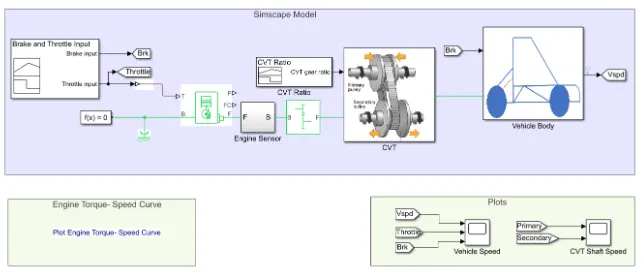
The simulink model for BAJA atv consist of a signal builder,generic engine,engine sensor, cvt, simple gear, vehicle body, solver configuration and references. The Generic Engine block represents a general internal combustion engine. This block is a suitable generic engine for spark-ignition and diesel. Connections F and B are mechanical rotational conserving ports associated with the engine crankshaft and engine block, respectively. Connections P and FC are physical signal output ports through which engine power and fuel consumption rate are reported.
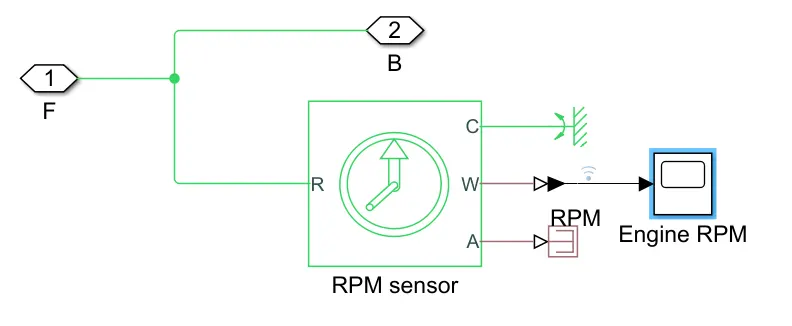
The engine sensor subsystem block consist of a RPM sensor, PS terminator, rotational reference and scope. The inputs are given from the F port of the engine block. To measure the power produced from the engine in terms of RPM.
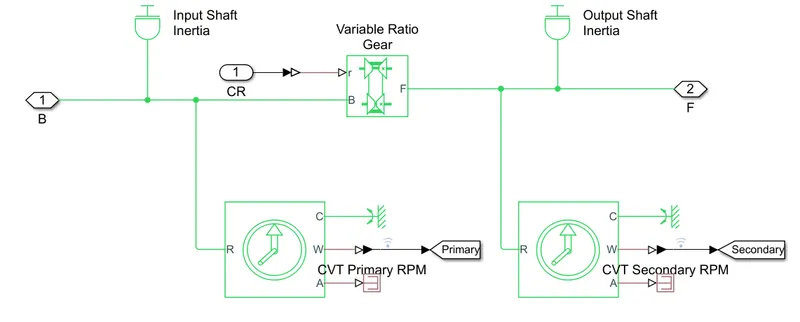
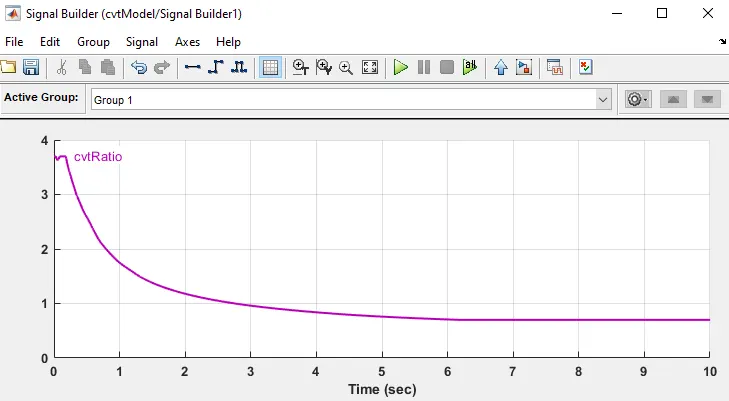
The CVT subsystem block consist of a variable gear ratio, ideal mechanical rotational inertia, rotational motion sensor, PS terminator etc. The gear ratio is given as the input from the siganl builder block. The Variable Ratio Transmission block dynamically transfers motion and torque between the base shaft and the follower shaft. The physical signal input r defines the ratio of input to output angular shaft velocities. Connections B (base) and F (follower) are mechanical rotational conserving ports. Specify the relation between base and follower rotation directions with the Output shaft rotates parameter.
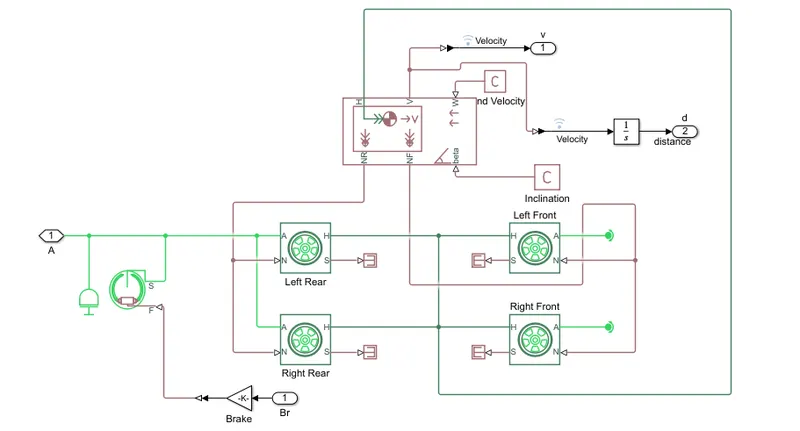
The vehicle body subsystem block consist of tyres, two axles, shoe brakes, integral block, inertia output shaft, vehicle body block, inclination block, PS terminator etc. The external forces which acts on the vehicle body are given as the inputs for the block. The parameters are shown below.
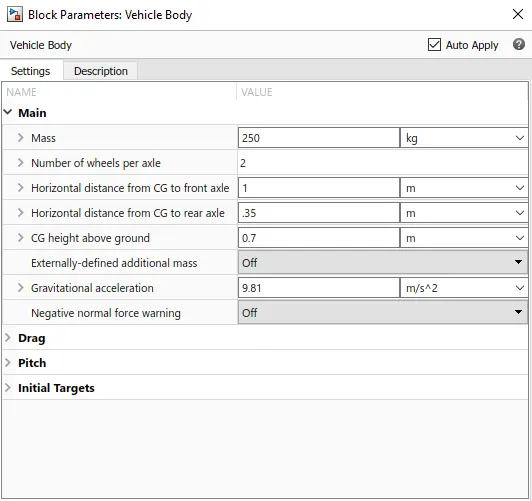
The Vehicle Body block represents a two-axle vehicle body in longitudinal motion. The vehicle can have the same or a different number of wheels on each axle. The vehicle wheels are assumed identical in size. The vehicle can also have a center of gravity (CG) that is at or below the plane of travel.
INPUT SIGNALS:
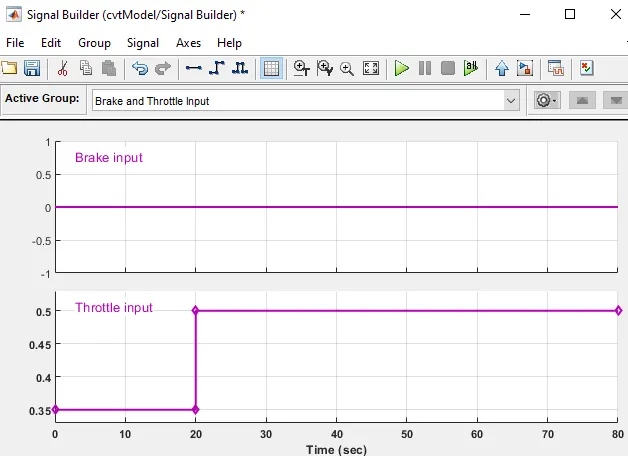
A Signal builder block is used to provide the input signals as brake and throttle input.
CVT Gear Ratio:
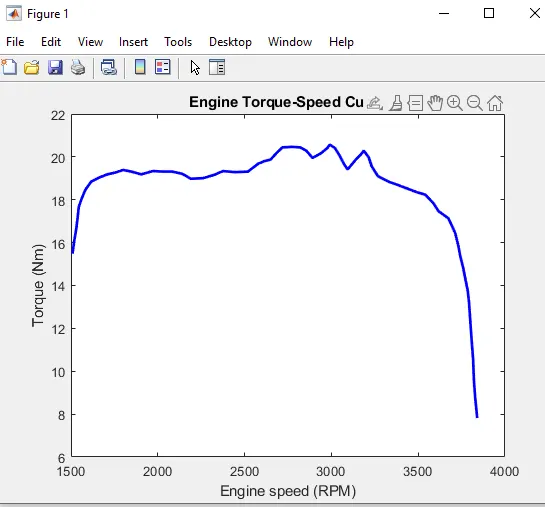
Torque vs Engine Speed:
OUTPUT:
Vehicle Speed:
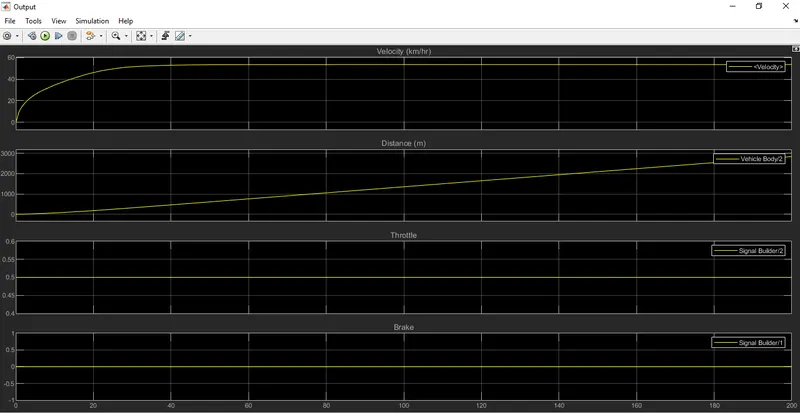
From the graph we get to know that at a constatnt throttle of 0.5 the vehicle reaches it's maximum speed of 53km/hr at 41 seconds. The value of the brake input is zero throughout the simulation.
CVT SHAFT RPM:
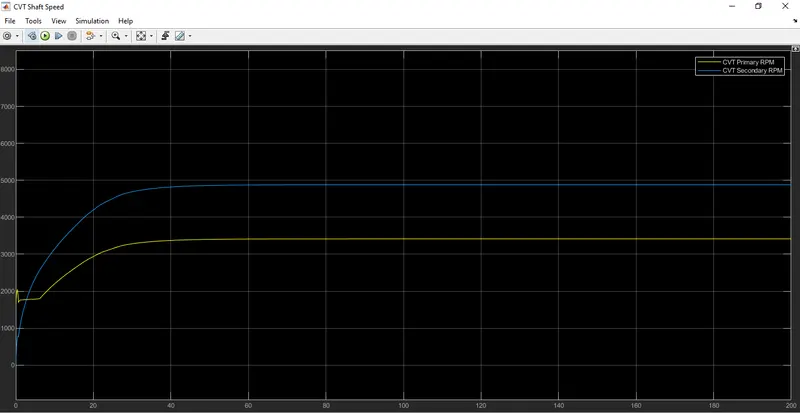
From the figure we know that the RPM of the secondary shaft is higher than the primary shaft. When radius decreases speed increases. So, speed in inversely propotional to the radius of the shaft. The vehicle is running at higher gear ratio.
STUDY 1.2:
SIMULINK MODEL FOR BAJA ATV WITH DASHBOARD:
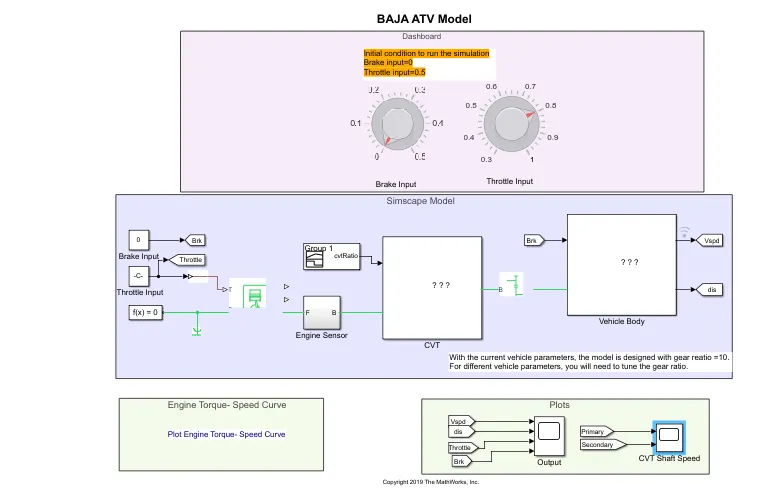
Above given is the Simulink model for BAJA atv with dashbord. In this model instead of a signal builder block we are using a knob to let the user control the input signal in real time. The inputs are Brake and Throttle and the values are 0 and 1.
OUTPUT:
VEHICLE SPEED:
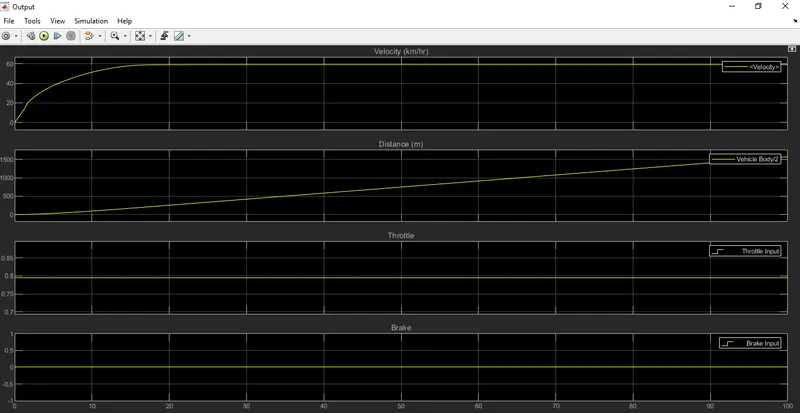
From this graph we see that when a throttle value 0.79 is given it takes about 18 sec to reach the top speed which is 59km/hr. The brake value remains 0 as a constant.
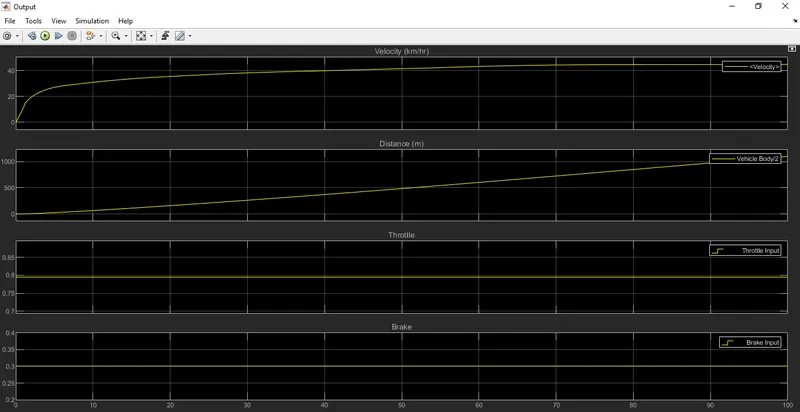
When a brake input of 0.3 is apllied the acceleration of the vehicle gets sloppy.
CVT SHAFT RPM:
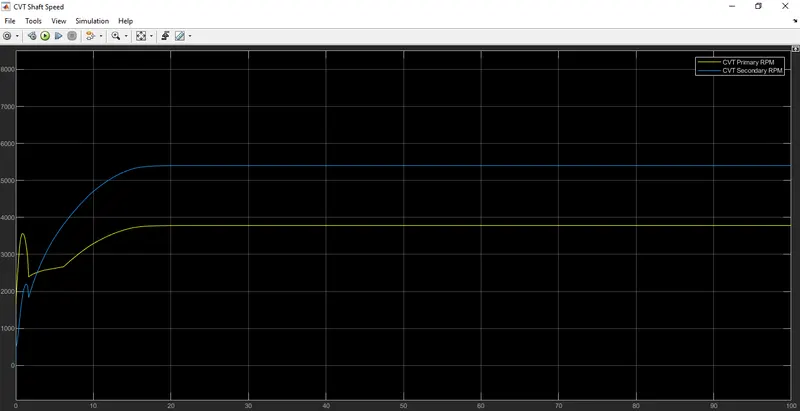
The output obtained from the graph. The RPM of the secondary shaft is higher than the primary shaft.
STUDY 2.1:
SIMULINK MODEL FOR BAJA ATV WITH LOOKUP TABLE:
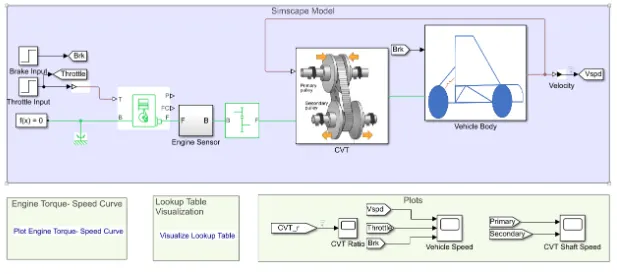
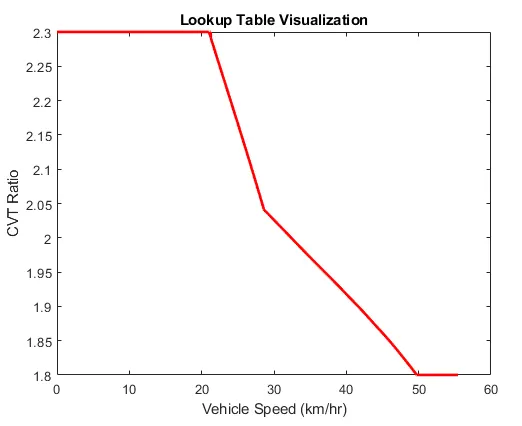
In this model the gear ratio input signal is given by a Lookup table instead of a signal builder block. These were the difference between this model and the previous models.
CVT BLOCK:
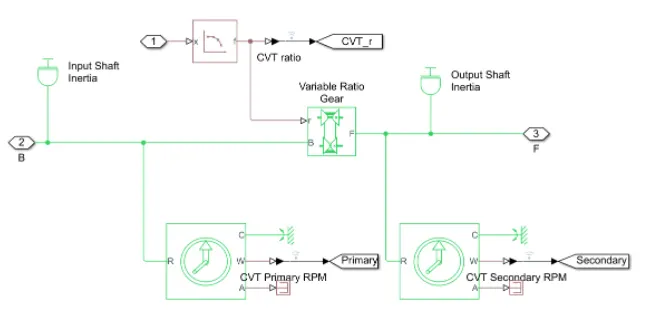
LOOKUP TABLE VISUALIZATION:
OUTPUT:
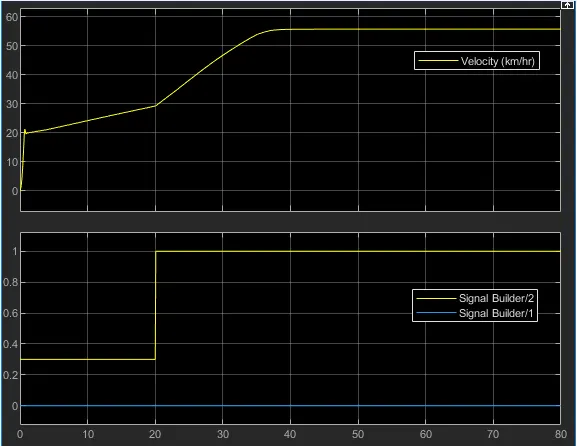
VEHICLE SPEED:
CVT SHAFT RPM:
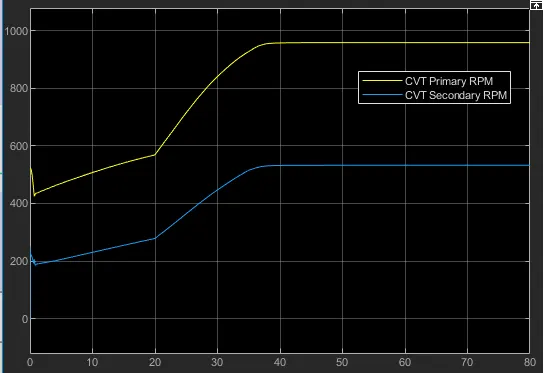
The input parameters for this model is same as the BAJA ATV WITHOUT DASHBOARD. Identical results were obtained.
STUDY 2.2:
SIMULINK MODEL FOR BAJA ATV WITH LOOKUP TABLE USING DASHBOARD:
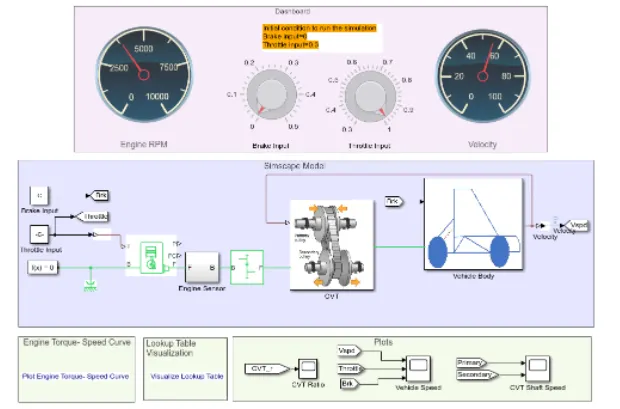
This model consist of a dashboard along with knobs which can be used to control the input values for the Brake and Throttle. The values of the gear ratio is given by the lookup table.
OUTPUT:
VEHICLE SPEED:
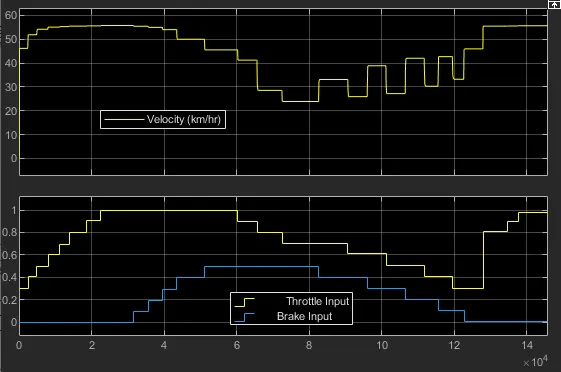
At initial stage the value of the brake input is 0 where as the throttle input increases reulting in higher velocity 56km/hr. When the value of the brake input rises the throttle is at it's peak resulting in maintaing the velocity of the vehicle. But when the throttle descends the speed of the vehicle also gets reduced. The brake input is inversely propotional to the speed of the vehicle.
CVT SHAFT RPM:
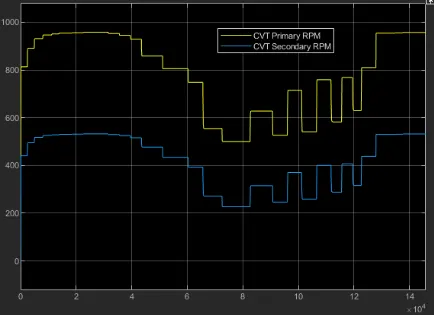
In this graph the rotation of the primary shaft is higher than that of the secondary shaft. There were continuous up's and down's in the gear ratio based on the input parameters. The radius of the primay shaft is less than that of the secondary shaft.
CONCLUSION:
Thus we have carried out a system level simulation of an all terrain vehicle and prepared a technical report explaining the model properties of all four BAJA all terrain vehicle and commented on the results.