Project
AIM: Carry out a system-level simulation of an all-terrain vehicle. Prepare a technical report explaining the model properties & comments on the results.
INTRODUCTION:
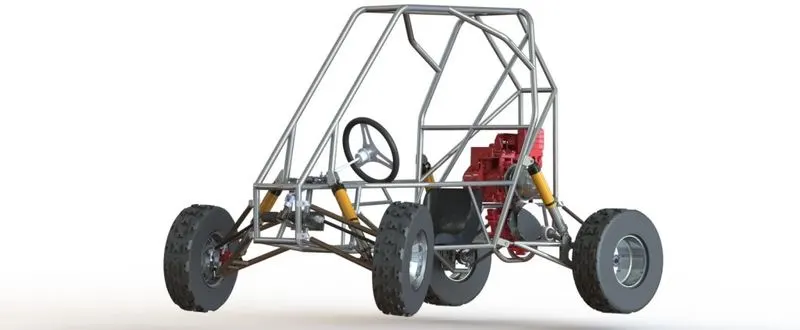
All terrain vehicle
An all-terrain vehicle (ATV), also known as a light utility vehicle (LUV),a quad bike, or simply a quad; is a vehicle that travels on low-pressure tires, with a seat that is straddled by the operator, along with handlebars for steering control. As the name implies, it is designed to handle a wider variety of terrain than most other vehicles.
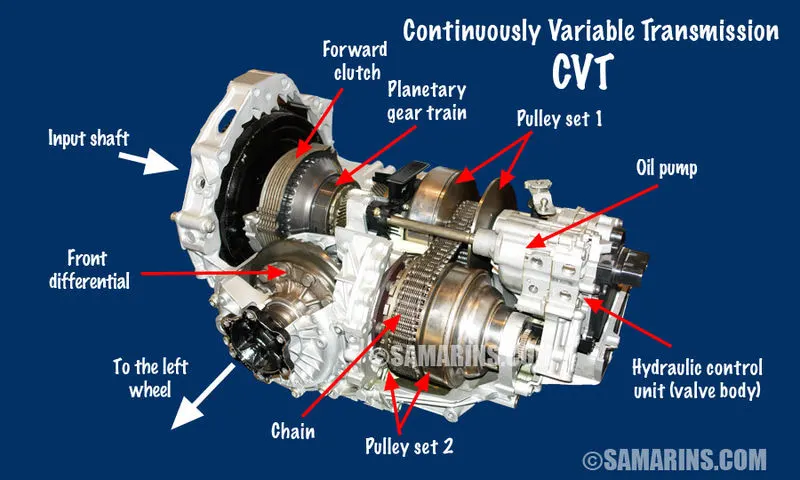
What is a CVT?
A CVT, or continuously variable transmission, seamlessly changes through an unending range of effective gear ratios while you drive, whereas other kinds of mechanical transmissions offer a fixed number of gear ratios and have hard shifts between each as explained by Certified Transmission Repair. CVT transmission systems are also known as single-speed, shiftless, and stepless transmissions.The shiftless nature of a CVT offers unparalleled flexibility that maintains constant angular velocity regardless of output speed. Additionally, a continuously variable transmission makes accelerating smooth and offers enhanced fuel economy.
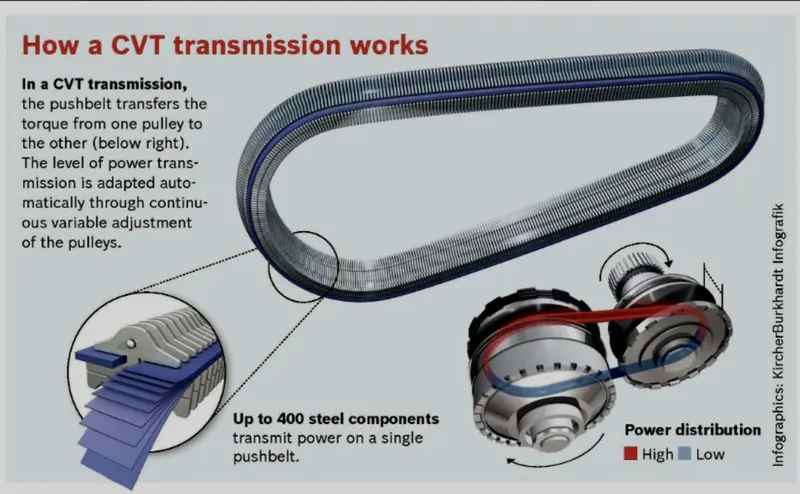
How does a CVT work?
Most CVT systems work through a pulley system.One pulley in the CVT is connected to the engine and the other directs power to the wheels. The width of these pulleys changes based on the needed power; as one gets larger, the other gets smaller. This allows a CVT to deliver strong and seamless acceleration.Though there are no gears in a CVT, some simulate a more traditional changing of gears. In these transmissions, the belt-and-pulley system is designed to move to preset points by using a traditional shift lever or paddle shifters on the steering wheel.
BAJA ATV MODEL
SIMULINK MODEL OF THE BAJA ATV MODEL
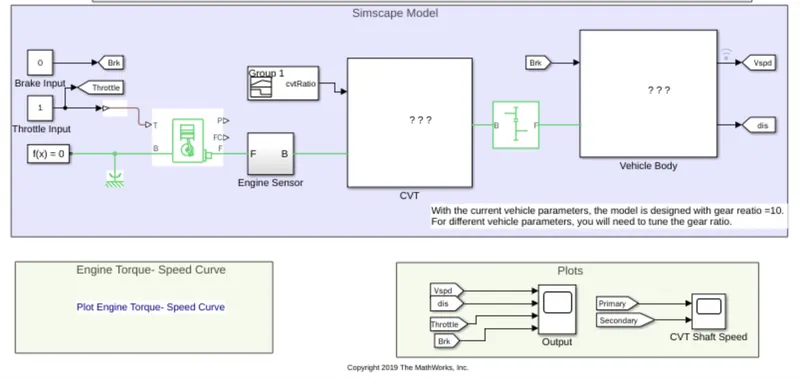
EXPLANATIONS OF ALL THE PARAMETERS:
- SIGNAL BUILDER BLOCK:
The signal builder block allows us to create interchangeable groups of signal sources and use them in a model.
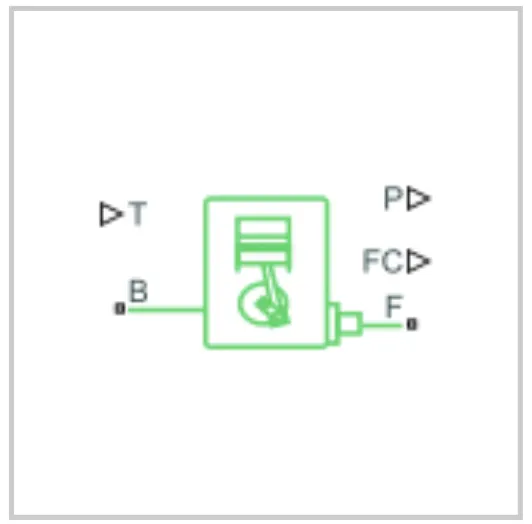
- GENERIC ENGINE:
The Generic Engine block represents a general internal combustion engine. This block is a suitable generic engine for spark-ignition and diesel. Speed-power and speed-torque parameterizations are provided. A throttle physical signal input specifies the normalized engine torque. Optional dynamic parameters include crankshaft inertia and response time lag. A physical signal port outputs the engine fuel consumption rate based on the fuel consumption model that you choose. Optional speed and redline controllers prevent engine stall and enable cruise control.
- ENGINE SENSOR:
the engine sensor consists of a subsystem. Inside the engine sensor we have:
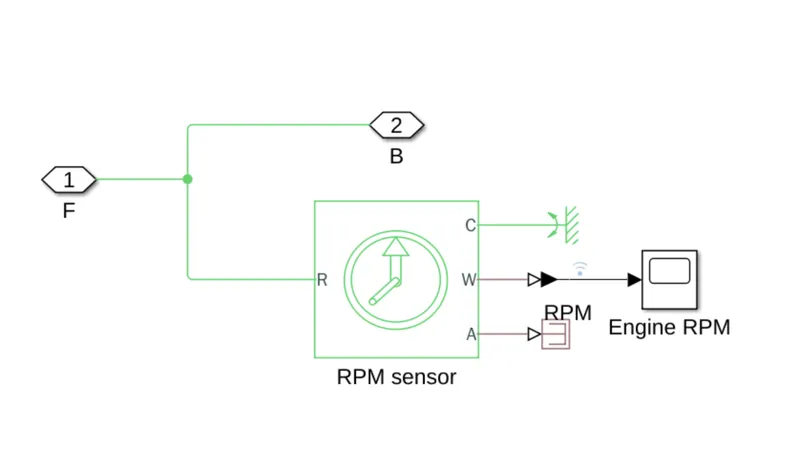
Ideal Rotational Motion Sensor
The Ideal Rotational Motion Sensor block represents an ideal mechanical rotational motion sensor, that is, a device that converts an across variable measured between two mechanical rotational nodes into a control signal proportional to angular velocity or angle. You can specify the initial angular position (offset) as a block parameter.
The sensor is ideal since it does not account for inertia, friction, delays, energy consumption, and so on.
Connections R and C are mechanical rotational conserving ports that connect the block to the nodes whose motion is being monitored. Connections W and A are physical signal output ports for velocity and angular displacement, respectively.
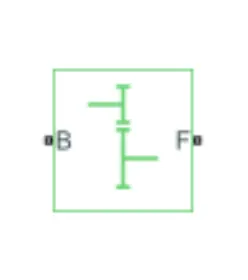
- SIMPLE GEAR
The Simple Gear block represents a gearbox that constrains the connected driveline axes of the base gear, B, and the follower gear, F, to corotate with a fixed ratio that you specify. You choose whether the follower axis rotates in the same or opposite direction as the base axis. If they rotate in the same direction, the angular velocity of the follower, ωF, and the angular velocity of the base, ωB, have the same sign. If they rotate in opposite directions, ωF and ωB have opposite signs.
- CVT SUBSYSTEM:
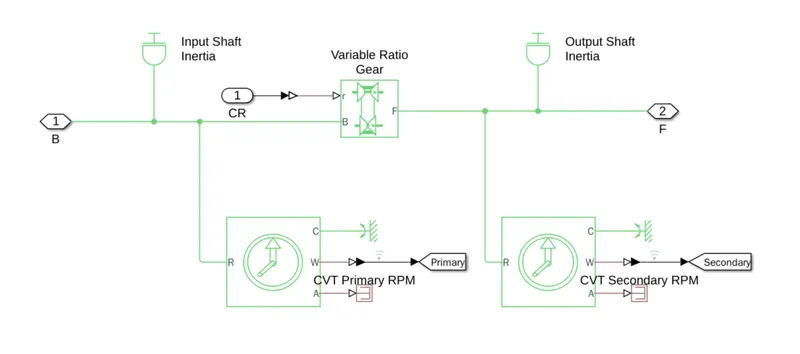
the CVT subsystem consists of the following parts:
INPUT SHAFT INERTIA:
The Inertia block represents an ideal mechanical translational inertia.This block consists of one or two mechanical rotational conservational points.The block positive direction is from its port to the reference point. This means that the inertia torque is positive if inertia is accelerated in the positive direction.
VARIABLE RATIO GEAR:
The Variable Ratio Transmission block represents a gearbox that dynamically transfers motion and torque between the two connected driveshaft axes, the base and the follower.
- VEHICLE BODY SUBSYSTEM:
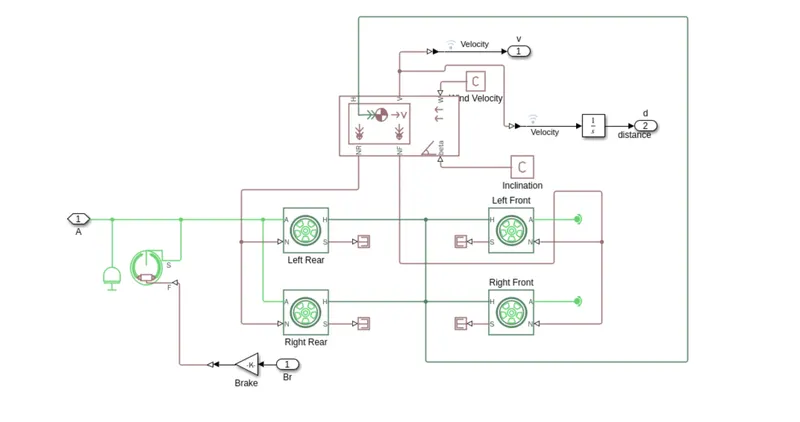
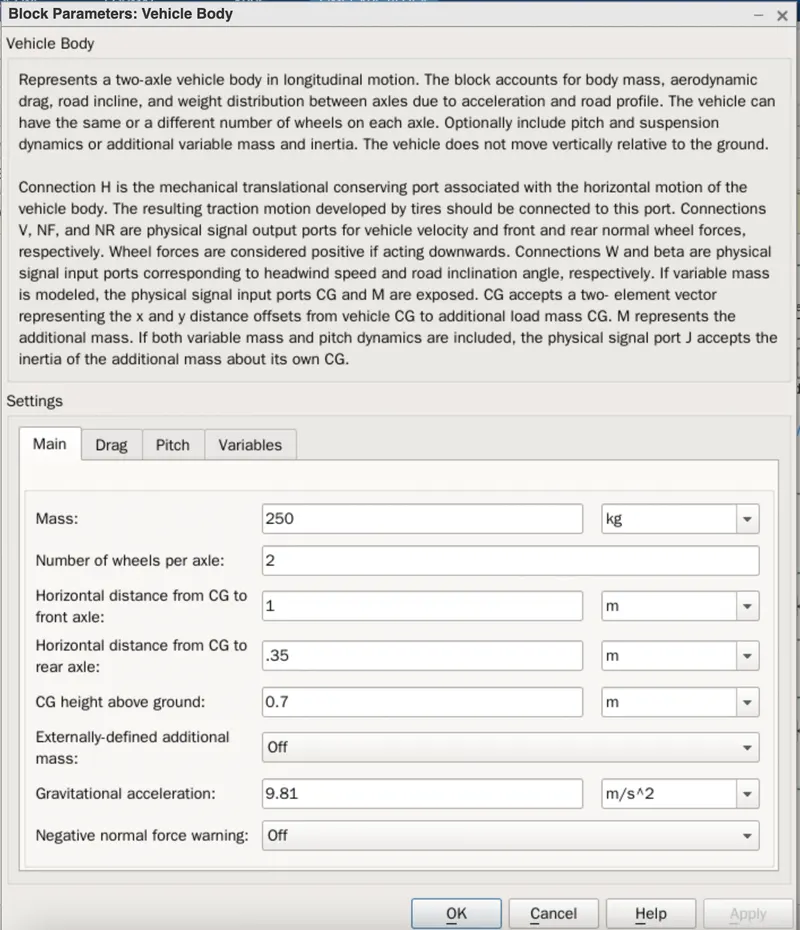
The Vehicle Body block represents a two-axle vehicle body in longitudinal motion. The vehicle can have the same or a different number of wheels on each axle. For example, two wheels on the front axle and one wheel on the rear axle. The vehicle wheels are assumed identical in size. The vehicle can also have a center of gravity (CG) that is at or below the plane of travel.
The block accounts for body mass, aerodynamic drag, road incline, and weight distribution between axles due to acceleration and road profile. Optionally include pitch and suspension dynamics. The vehicle does not move vertically relative to the ground.
The block has an option to include an externally-defined mass and an externally-defined inertia. The mass, inertia, and center of gravity of the vehicle body can vary over the course of simulation in response to system changes.
PARAMETRS FOR VEHICLE BODY
- TIRES:
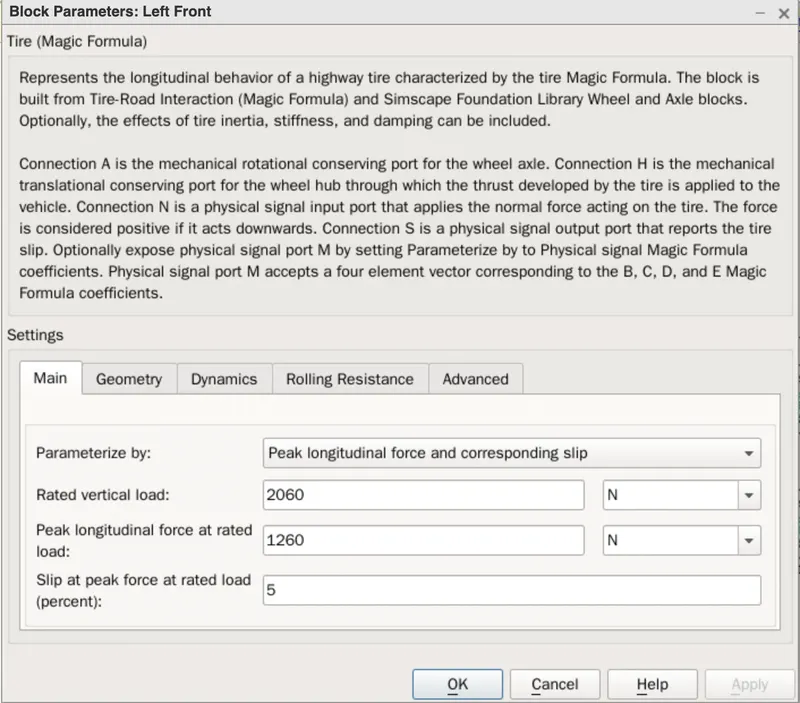
Represents the longitudinal behaviour of a highway tire characterised by magic tire formula. The block is built from Tire-Road interaction(Magic Formula) and Simscape Foundation Library Wheel and Axle Blocks.
Connection A is the mechanical rotational conservation port for the wheel ale.connection H is the mechanical translational conserving port for the wheel hub through which the thrust developed by the tire is applied to the vehicle.Connection N is a physical signal input port that applies the normal force acting on the tire. The force is considered positive if it acts downward. Connection S is a physical signal output port that reports the tire slip.Optionally expose physical signal port M by setting Parameretrize by to Physical signal Magic Formula coefficients. Physical signal M accepts a four element vector corresponding to the BBC,D and E Magic Formula coefficients.
- DOUBLE SHOE BRAKE:
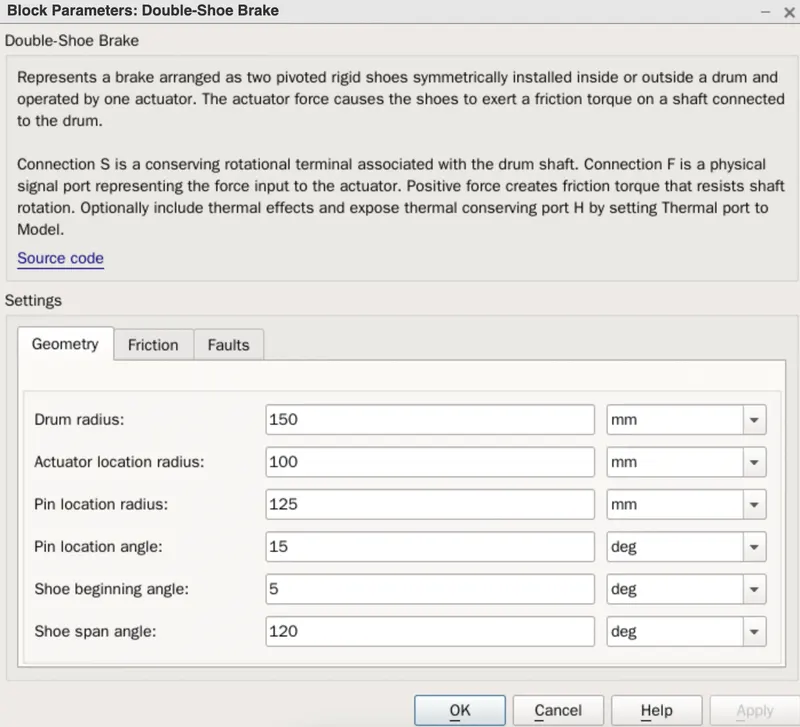
The Double-Shoe Brake block represents a frictional brake with two pivoted rigid shoes that press against a rotating drum to produce a braking action. The rigid shoes sit inside or outside the rotating drum in a diametrically opposed configuration. A positive actuating force causes the rigid shoes to press against the rotating drum. Viscous and contact friction between the drum and the rigid shoe surfaces cause the rotating drum to decelerate.
Double-shoe brakes provide high braking torque with small actuator deflections in applications that include motor vehicles and some heavy machinery. The model employs a simple parameterization with readily accessible brake geometry and friction parameters.
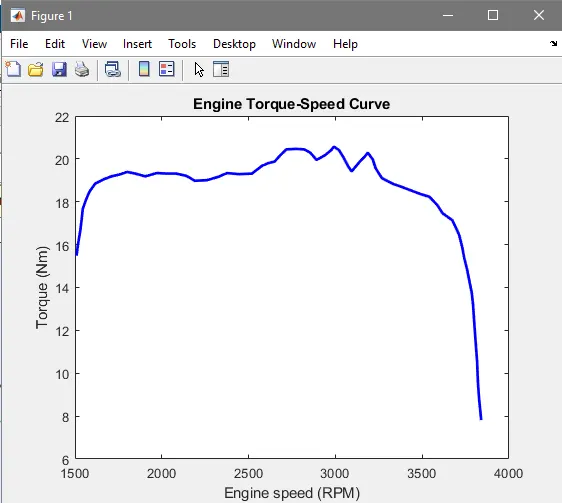
TORQUE VS SPEED CHARECTERITICS:
RESULTS:
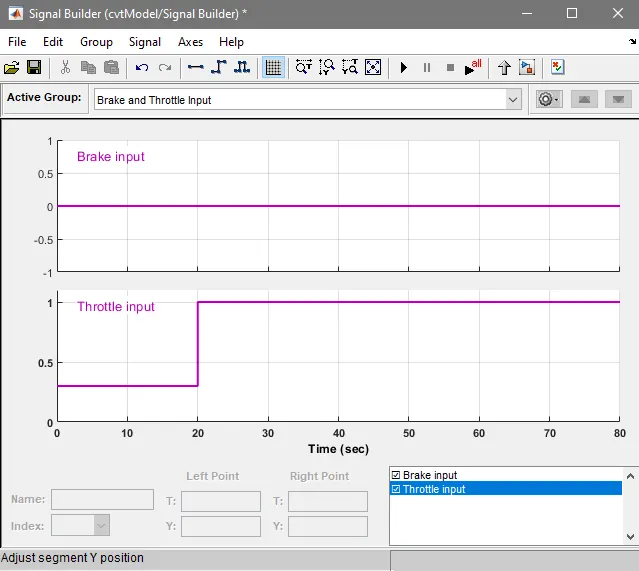
BRAKE AND THROTTLE INPUTS:
brake input is constant
throttle input is 0.3 for first 20 secs and then accelarates to 1 and stays the same throughout 80 sec
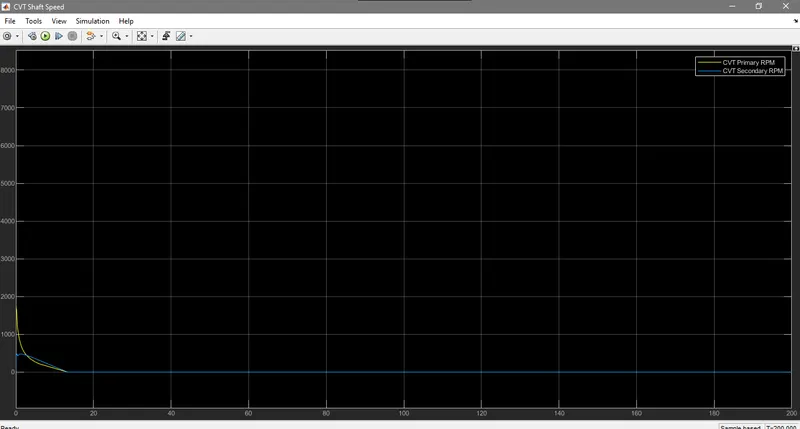
CVT RATIO:
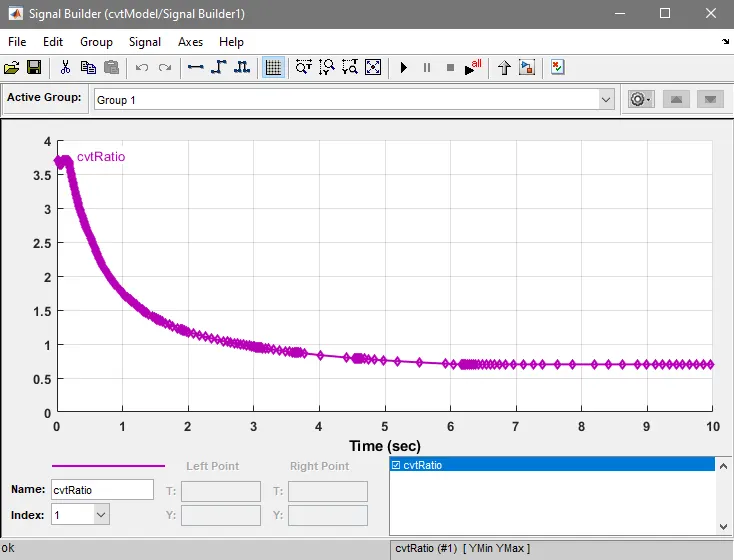
CVT Ratio 3.69 for first sec and drops down to 0.83 till 4 sec and remains constant for 0.7 till 10 sec
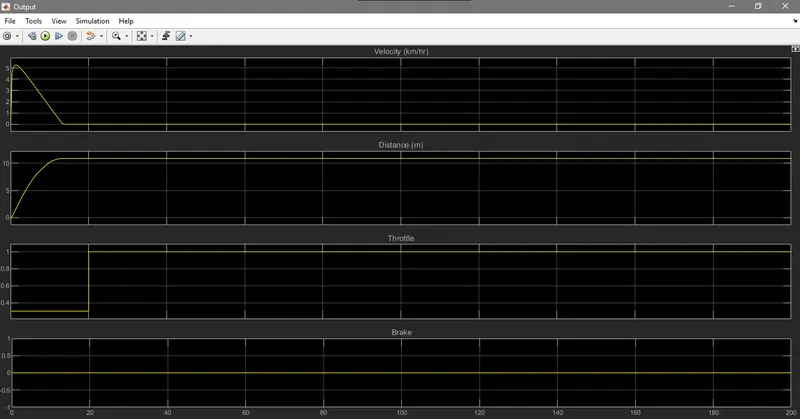
outputs
cvt shaft speed result
MODEL AND RESULTS WITH DASHBOARD:
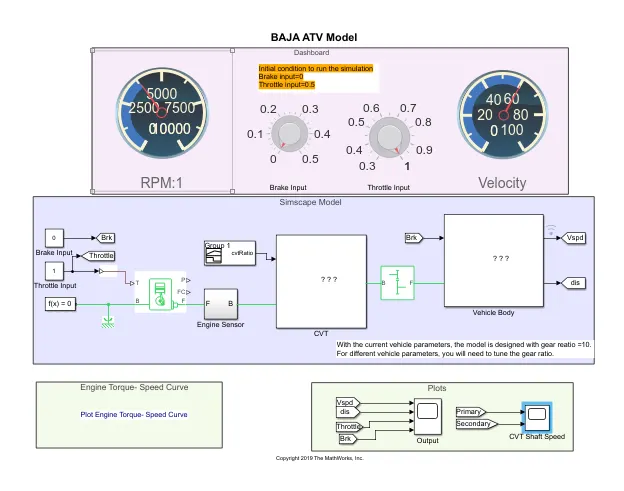
The above figure is the model of the BAJA ATV model with the dashboard in which we can control the braking and the throttle with knobs and get our desired results.
outputs:
Velocity, braking and throttle:
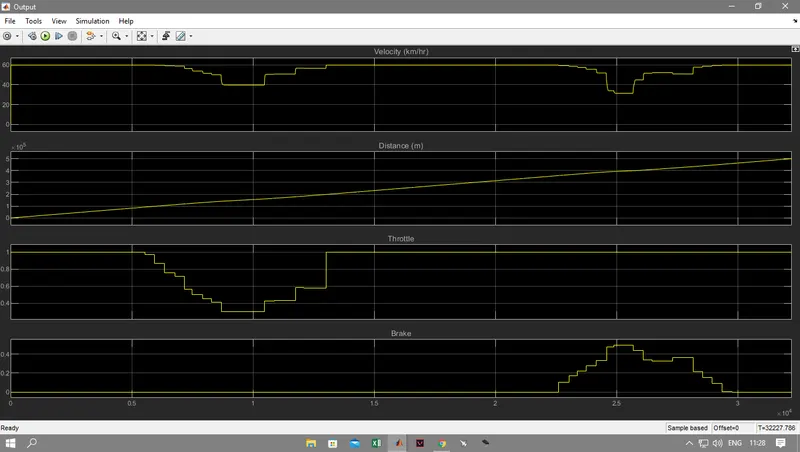
here we can see in the graph that as we decrease the throttle, the velocity also decreases and also by increasing the braking, we are decreasing the velocity.
CVT SHAFT OUTPUT:
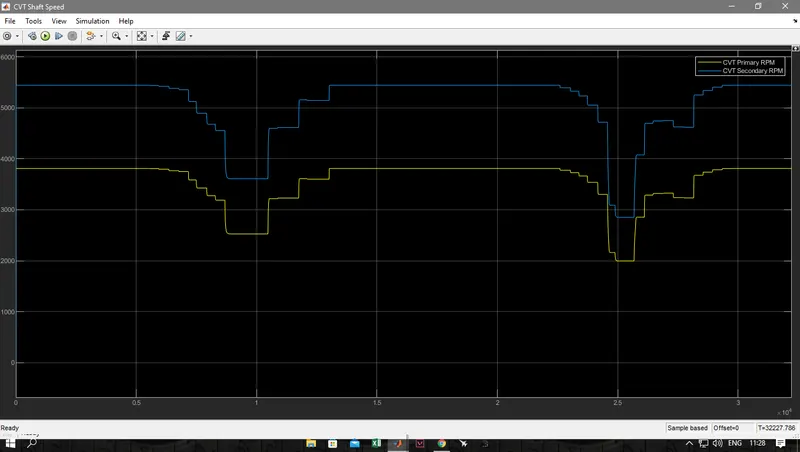
in the above figure we can see that the CVT primary shaft speed is grater than the CVT secondary shaft as they are directly prop[ortional to the shaft diameter
CONCLUSION:
HENCE WE HAVE SUCCESFULLY SIMULATED THE BAJA ATV MODEL AND FROM THHE OUTPUT WE CAN SEE THAT
- The velocity, CVT shaft speed and engine speed are directly proportional to the throttle input and inversely proportional to brake input
- CVT primary speed is greater than the CVT secondary speed s they are directly proportional to the shaft diameter
- the variations in the velocity of the vechicle can be observed as we change the throttle and the brake inputs
REFERENCE:
BAJA ATV MODEL FILE FROM MATHWORKS