Project
Q 1. Carry out a system-level simulation of an all-terrain vehicle. Prepare a technical report explaining the model properties & comments on the results.
ANS.
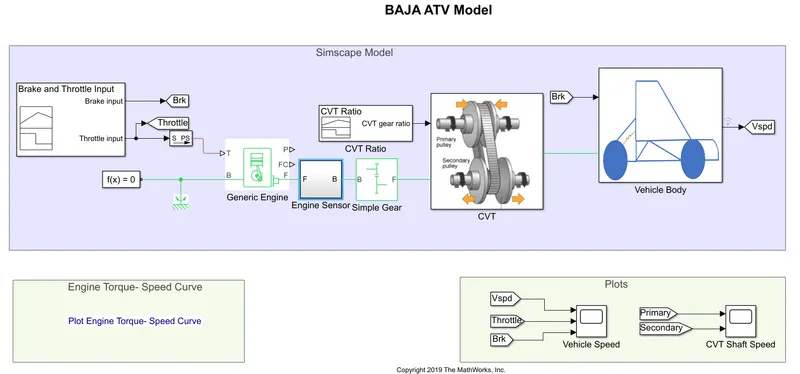
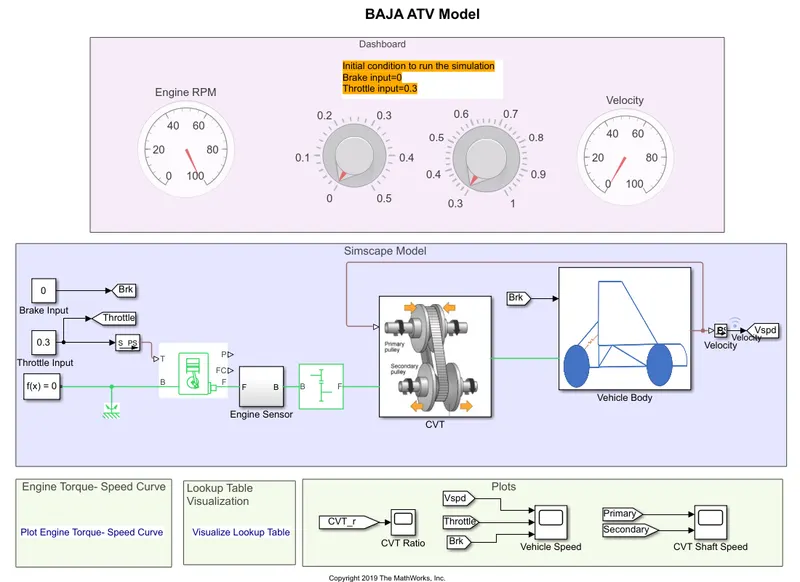
In this model, the components present are as follows :
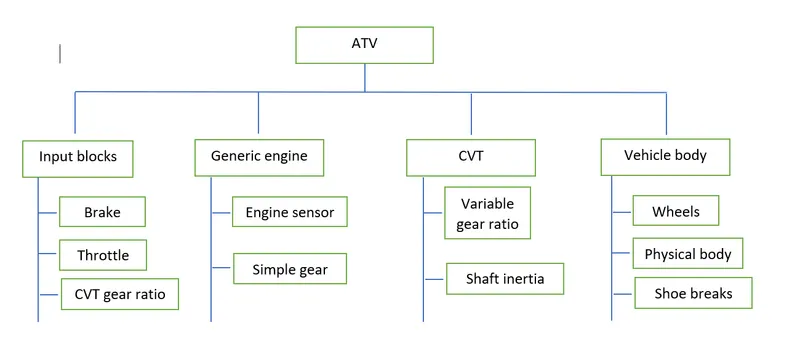
Brake and throttle input signal :
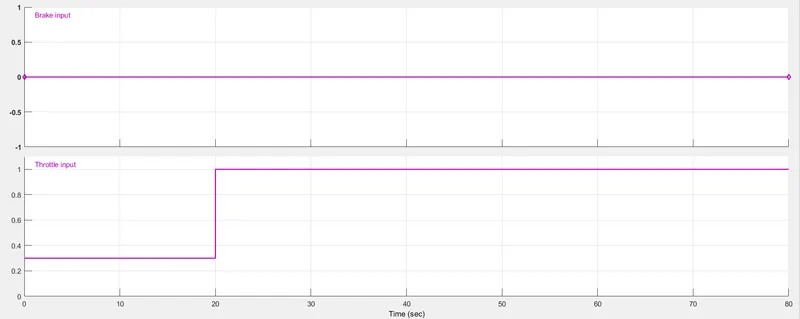
- No brake is provided.
- Constant throttle of 0.3 for first 20 secs, and full throttle of 1 for the remaining.
- Both of the above parameters are fed into the engine.
Generic Engine:
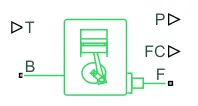
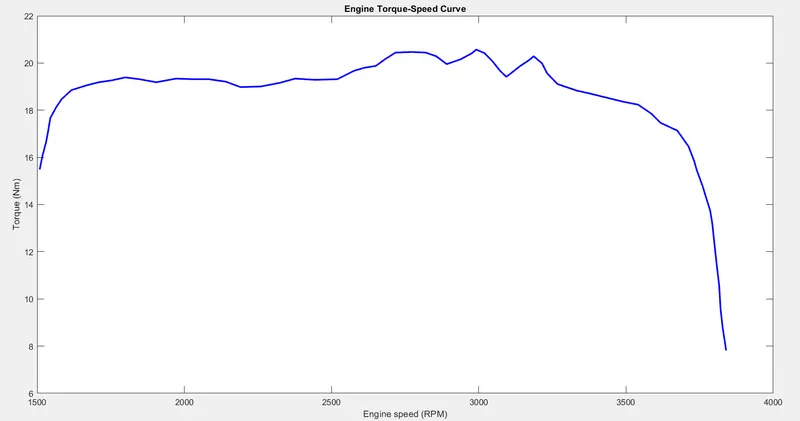
- The engine follows a programmed relation between speed and torque, modulated by the throttle signal. The throttle input is represented by 'T' and the speed-torque data points are extracted from the graph shown below and fed into the engine represented as column vectors.
- The crankshaft 'F' is connected to engine sensor that senses the angular diplacement and angular velocity of the crankshaft.
- The simple gear between engine and CVT gear box is to slow down the engine RPM (incase high) before it's fed to the CVT. An appropriate gear ratio needs to be selected so that over or under-revving isn't an issue.
Continuous Variable Transmission (CVT)
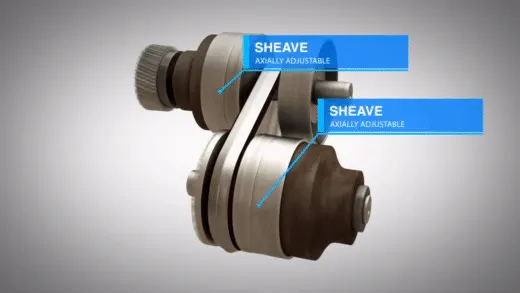
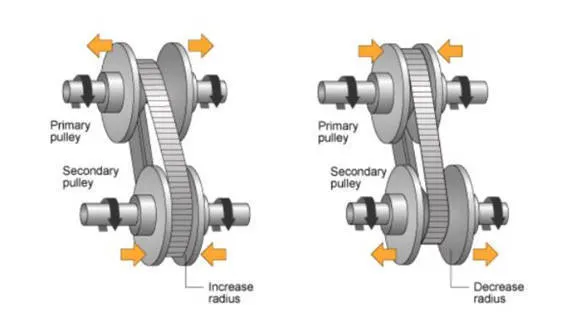
- As shown above, the two pulleys are connected using a steel or composite belt, whose diameters are continuously varying, work together to provide infinite gear ratios.
- Optimize engine speeds in a variety of road conditions, according to the speed and torque requirements of the terrain.
- CVT differs from automatic transmissions such that there are no gears to step up/down depending on the speed/torque requirements.
CVT subsystem block
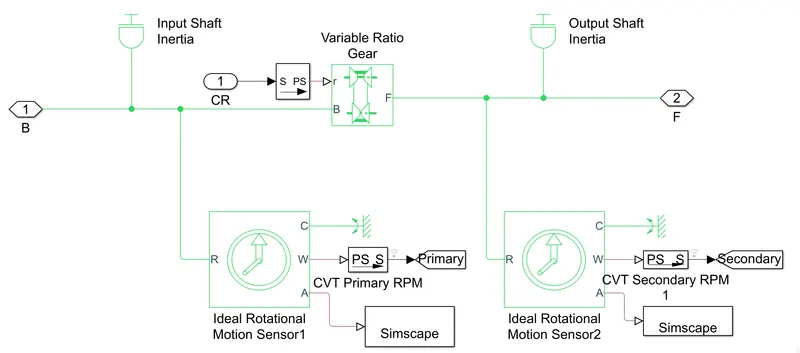
- Input and output shaft inertia represent primary pulley (driver) and secondary pulley (driven), respectively.
- The variable ratio gear block represents the multiple gears of CVT, with gear ratio input given to port 'R'.
- 2 rotational motion sensors are for tracking angular velocities of the two pulleys.
Vehicle Body subsystem block:
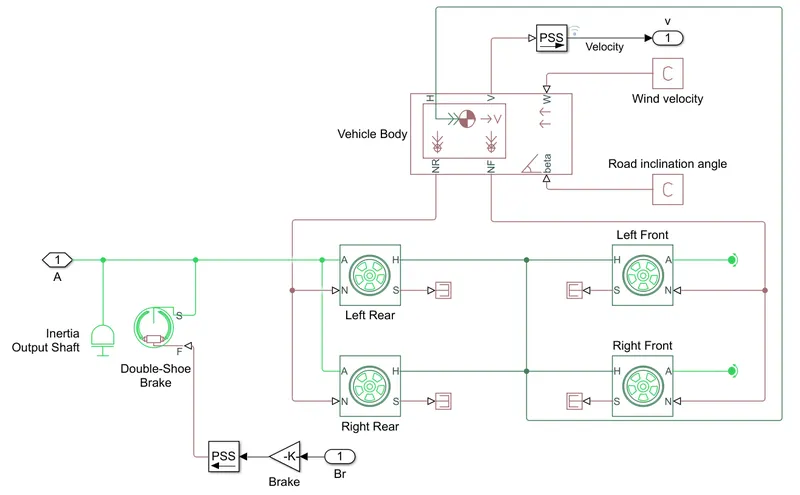
- The Vehicle Body accounts for body mass, aerodynamic drag, road incline, and weight distribution between axles due to acceleration and road profile.
- The Double-Shoe Brake applies brakes to the rear wheels. With this component, two brake blocks are applied at opposite ends of the drum. This prevents an unbalanced force from acting on shaft and bearing connecting the drum to wheel, which would be the case with a single-shoe brake.
All above conditions are applied to four wheels.
Vehicle speed output based on throttle and brake signals:
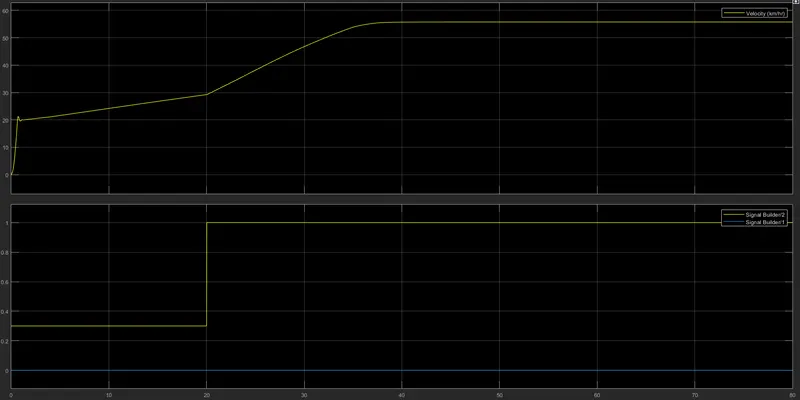
- Constant acceleration at throttle of 0.3 from 0 to 20 secs.
- After 20 secs the car accelerates till max velocity as throttle hits max value '1'.
CVT shaft speed output based on CVT gear ratio input:
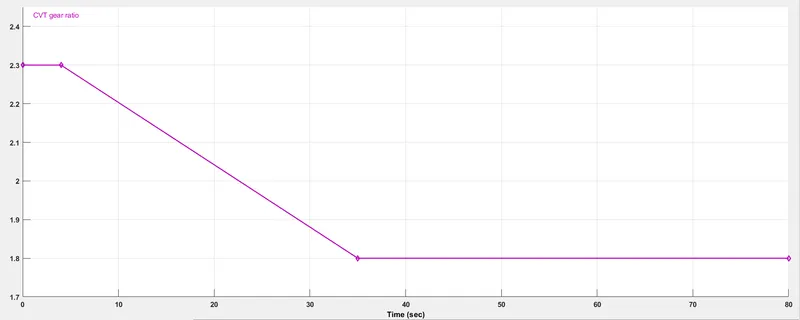
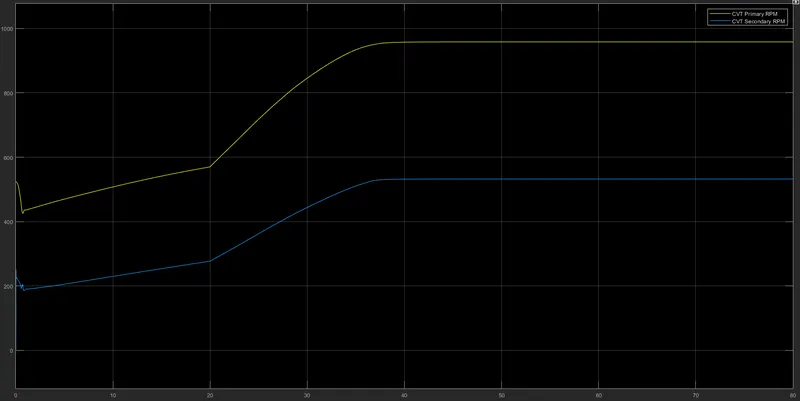
- The CVT gear ratio input is above 1 throughout, since lower secondary RPM than primary, because the output shaft will rotate slower in order to provide more torque to the wheels.
Varying CVT gear ratio:
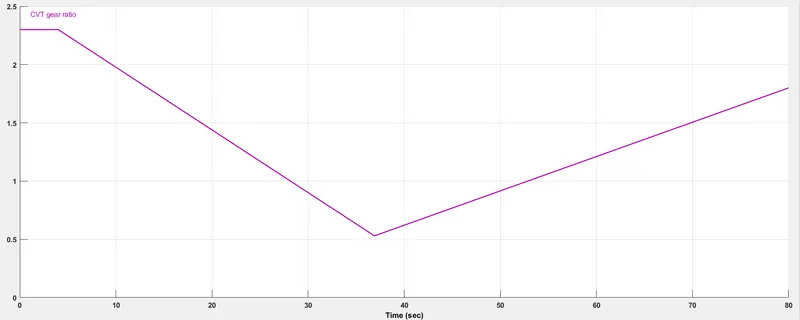
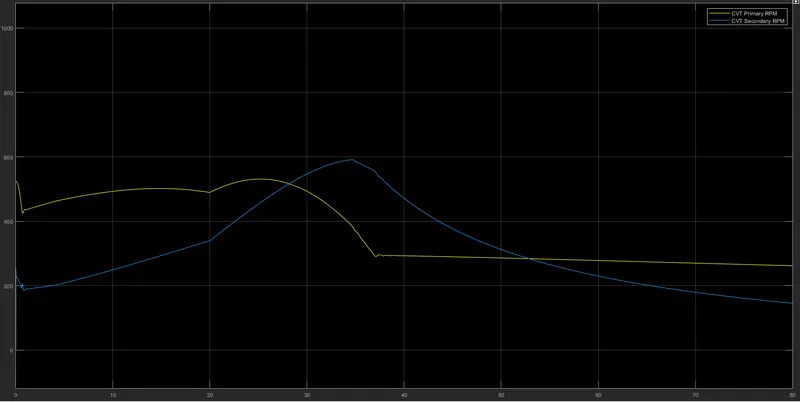
At about 26 secs, the CVT gear ratio falls below 1, secondary RPM becomes higher than primary RPM as velocity of vehicle increases with reduction in torque.
STUDY-1b- BAJA ATV with Conttinuous Variable Transmission(CVT)
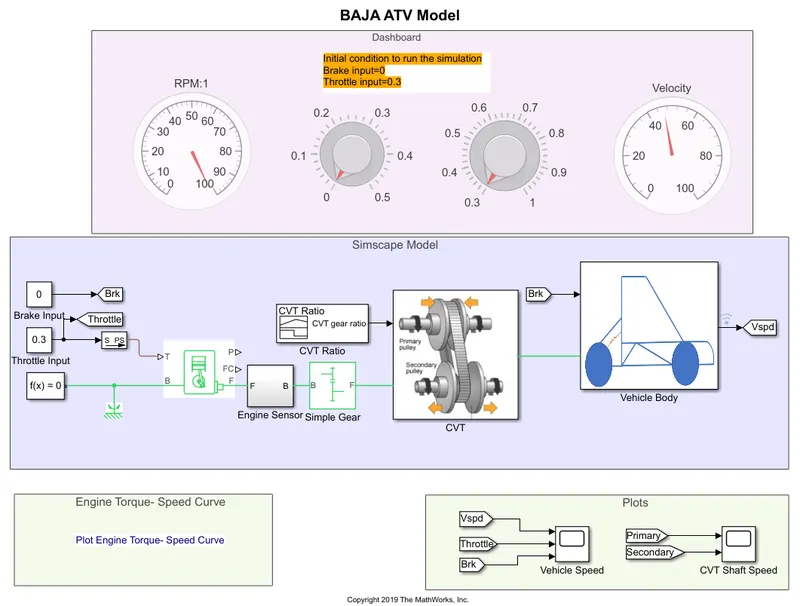
- The only difference between study 1a and 1b is throttle and brake inputs are via graphical reporesentation (dashboard control knobs) blocks while the simulation is runs for an indefinite period. This allows for various input scenarios.
STUDY-2- BAJA ATV with Lookup Table
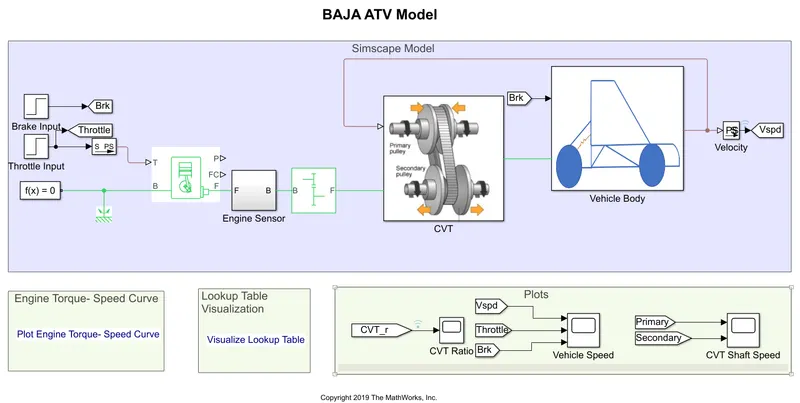
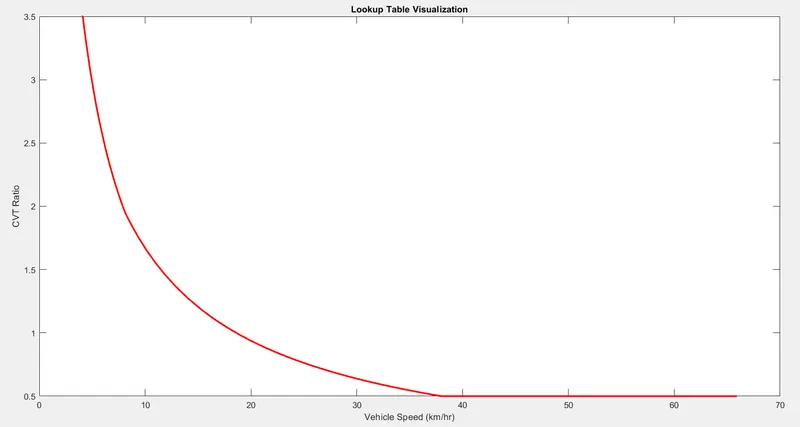
- The key difference with this study that the CVT gear ratio is not fed using a signal builder instead via a lookup table (BELOW).
- This lookup table data is the relation between CVT gear ratio and vehicle speed, that uses a simple MATLAB script.
- In study 1, CVT gear ratio was input manually to check the effect on vehicle's velocity. This is not feasible in real time. Using this lookup table, CVT is modelled based on vehicle speed since feeback is taken from vehicle velocity to calculate the gear ratio (refer feedback loop above - vehicle velocity input into CVT subsystem block).
Conclusion:
The BAJA ATV with CVT was modelled using two main studies. With focus on CVT, this project shows the effect of CVT on vehicle velocity, using multiple situations for different models of ATV design.