Project 2 Thermal modeling of battery pack
THERMAL MODELING OF BATTERY PACK
AIM:-
For a 10 cell series lithium ion battery model, simulate the thermal effects and compare life cycle performance at various temperatures, charge & discharge rates using MATLAB.
THEORY :-
Battery Thermal Management System:
Electric vehicles (EV) develop fast and have become popular due to their zero-emission and high tank-to-wheels efficiency. However, some factors limit the development of the electric vehicle, especially performance, cost, lifetime, and safety of the battery. Therefore, the management of batteries is necessary in order to reach maximum performance when operating at various conditions.
The battery thermal management system (BTMS) plays a vital role in the control of the battery thermal behavior. The BTMS technologies are air cooling system, liquid cooling system, direct refrigerant cooling system, phase change material (PCM) cooling system, and thermo-electric cooling system as well as heating.
These systems are analyzed through a trade-off between performance, weight, size, cost, reliability, safety, and energy consumption. According to the analysis two prime battery, thermal management systems are recommended: a combined liquid system (CLS) and a variant system with PCM.
The models of CLS and PCM systems were built and simulated using software MATLAB/Simulink. The simulation results predict the battery temperature variation and the energy consumption of BTMS. Through simulating the PCM system model, the effect of PCM on battery temperature variation was investigated and the proper PCM mass was estimated. As seen from the simulation results, BTMS is of great importance to control battery thermal behavior. Further study could be more comprehensive and accurate by combining the simulation mode with battery thermal electric and CFD models.
SIMULINK MODEL :-
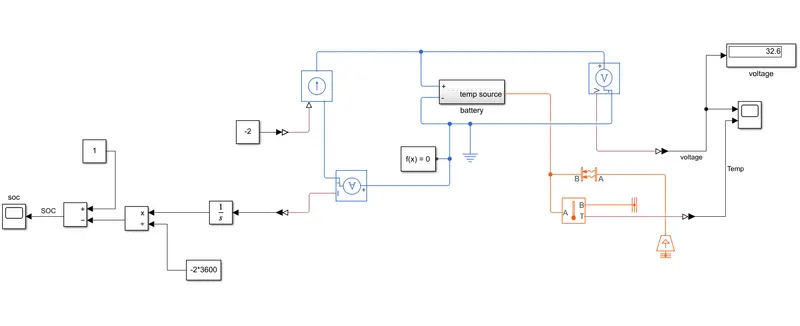
- In this model we are discharging charging the batteries which are connected in series .
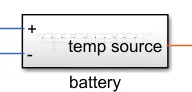
- we measure the temperature dependence of battery by supplying temperature from an external source to the battery.
- connection type is convective heat transfer. As in the real scenario also we don't have conductive heat transfer rather it is convective heat transfer is happening.
- and using a temperature sensor we plot the change in temperature .
- controlled current source gives charge/discharge rate to the battery subsystem .
- current sensor is connected between negative terminal of the battery and controlled current source . current output from current sensor is then integrated and then divided by 3600 to get charge/discharge in coulombs units
- then output is subtracted from 1 to get state of charge of battery pack . 1 means the battery pack is fully charged .
- voltage sensor is connected across the battery pack to get battery voltage .
Battery ( table based) :
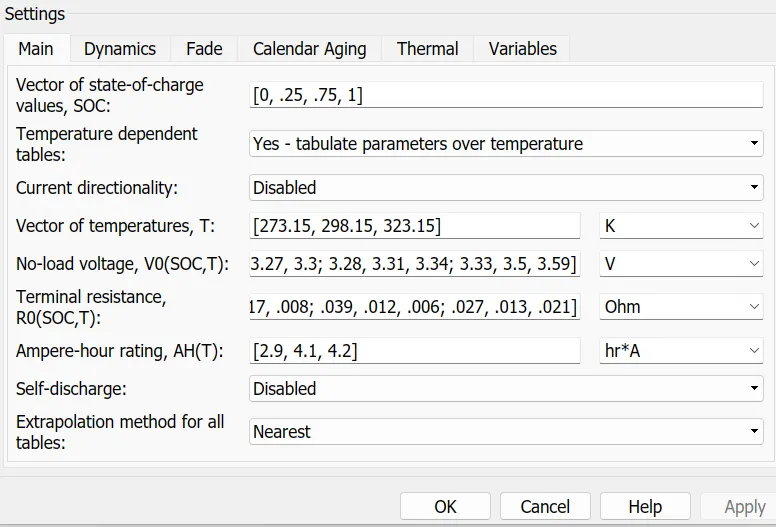
This block models a battery based on tabulated characteristics as functions of state of charge (SOC) and optional temperature (T).
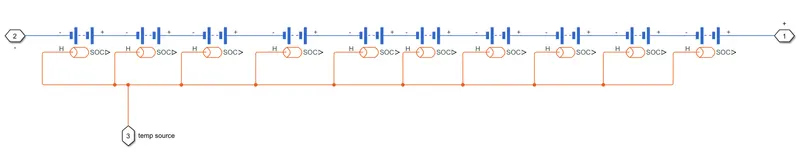
Battery subsystem :
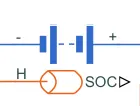
Here ten batteries are connected in series . since batteries are connected in series , voltage will gets added up and capacity remains the same .
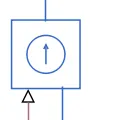
Controlled current source :
The block represents an ideal current source that is powerful enough to maintain the specified current through it regardless of the voltage across it. we are giving a constant current of 4.2 A through a PS constant block . here the controlled current source block arrow is downwards, shows its discharging .
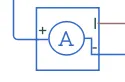
Current sensor :
The block represents an ideal current sensor, that is, a device that converts current measured in any electrical branch into a physical signal proportional to the current.
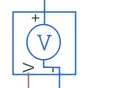
Voltage sensor :
The block represents an ideal voltage sensor, that is, a device that converts voltage measured between any electrical connections into a physical signal proportional to the voltage.
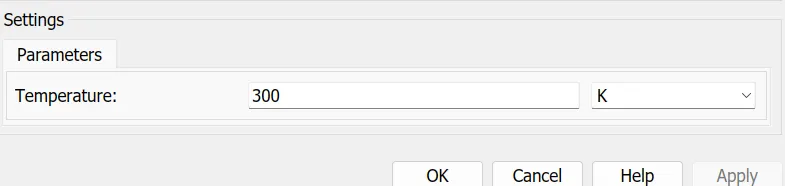
Temperature source :
This block represents an ideal energy source in a thermal network that can maintain a constant absolute temperature at the port regardless of the heat flow rate.

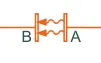
Convective heat transfer :
This block models heat transfer in a thermal network by convection due to fluid motion. The rate of heat transfer is proportional to the temperature difference, heat transfer coefficient, and surface area in contact with the fluid.
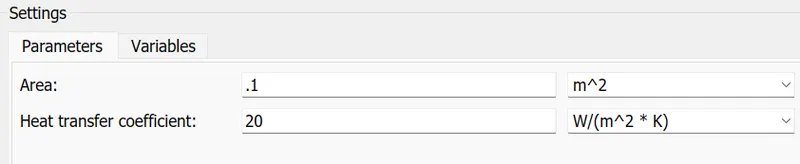
area of contact is .1 m^2 and heat transfer coefficient is 20 .
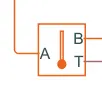
Temperature sensor :
This block measures temperature in a thermal network. There is no heat flow through the sensor.
RESULTS :-
the model is simulated for 1000 seconds .
1. Different discharge rates
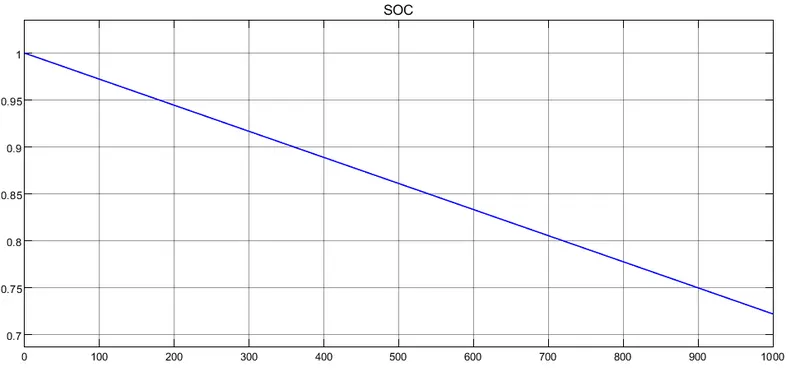
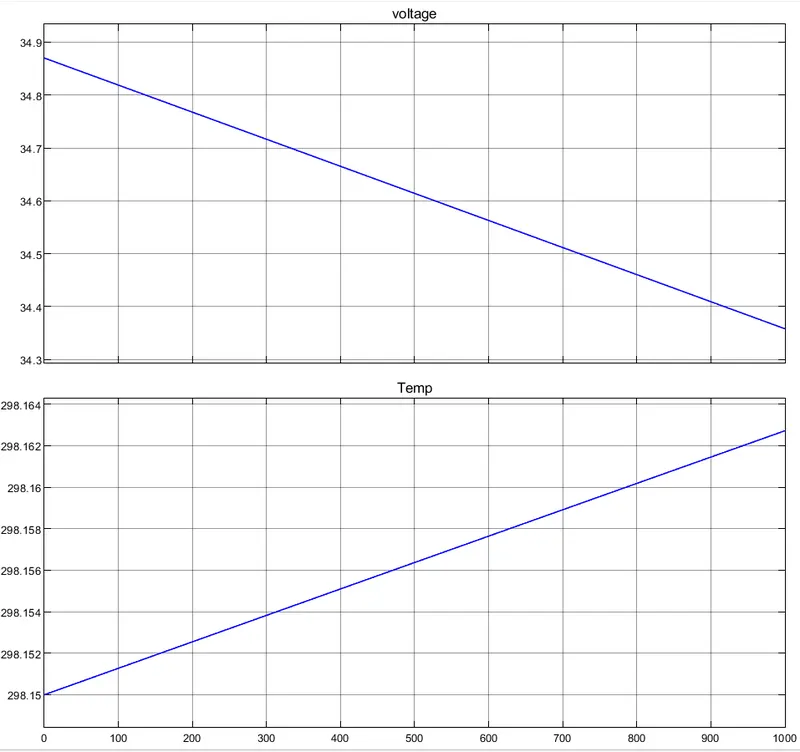
discharge rate of 1A
SOC plot :
Voltage and temperature plot :
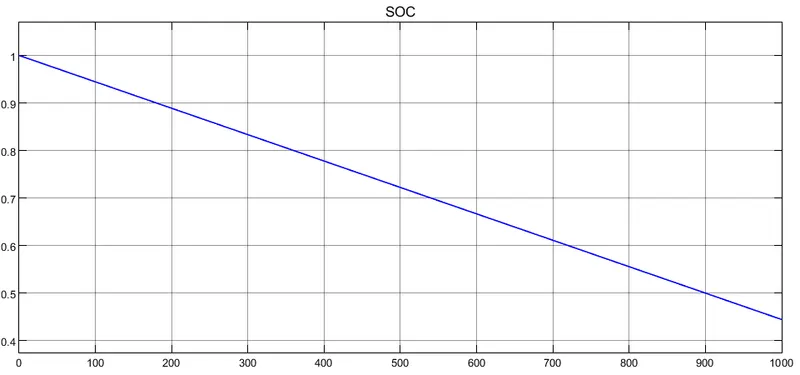
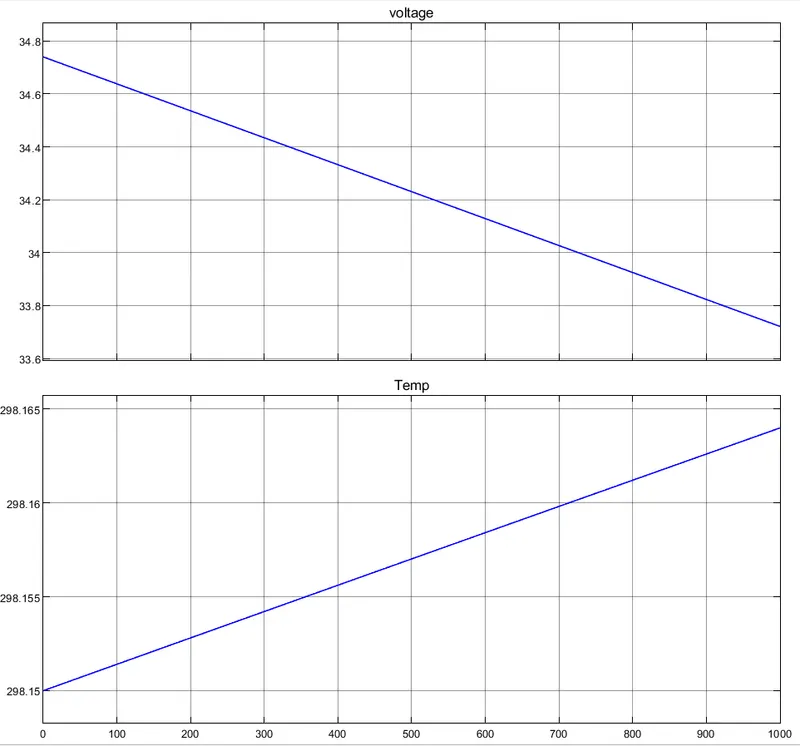
Discharge rate of 2A
SOC plot :
Voltage and temperature plot :
- we are simulating the model for 1000 seconds .
- while discharging initially SOC of the batteries is 100% .
- when discharged with 1A SOC was reduced to 72% . but when discharged with 2A SOC was reduced to 45%.
- these different discharge rates have thermal effects on battery .
- we are giving thermal source of 300k through convective heat transfer for both discharge rates .
- we can see that for high discharge rate the temperature is higher
2. Different charge rates
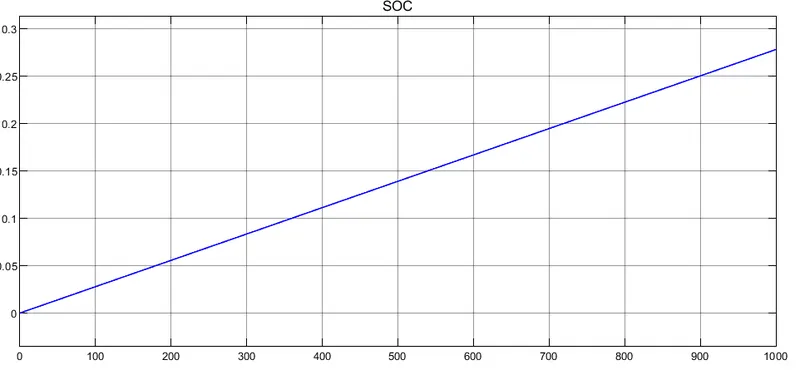
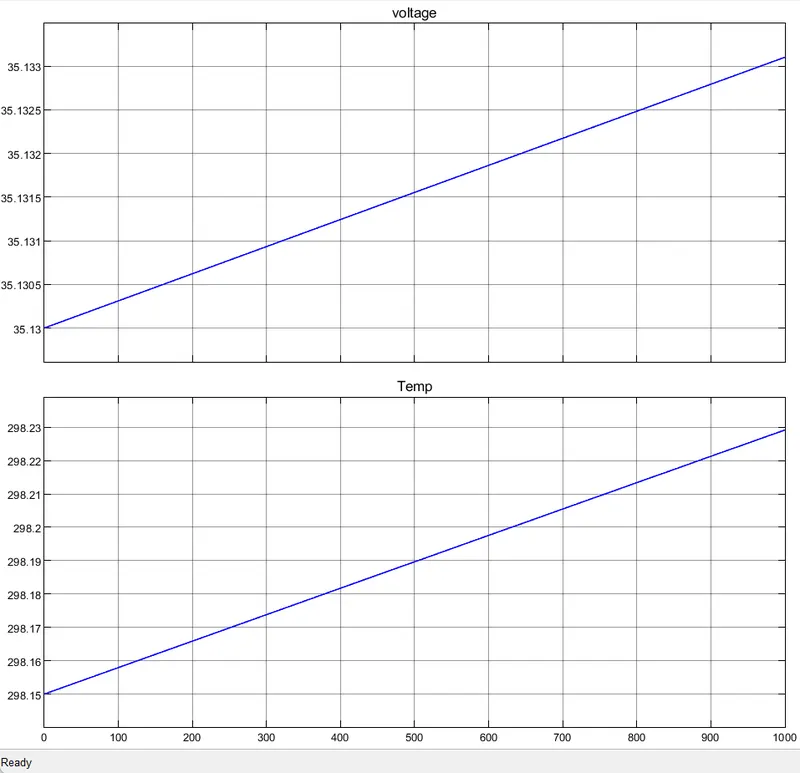
charge rate of 1A
SOC plot :
Voltage and temperature plot :
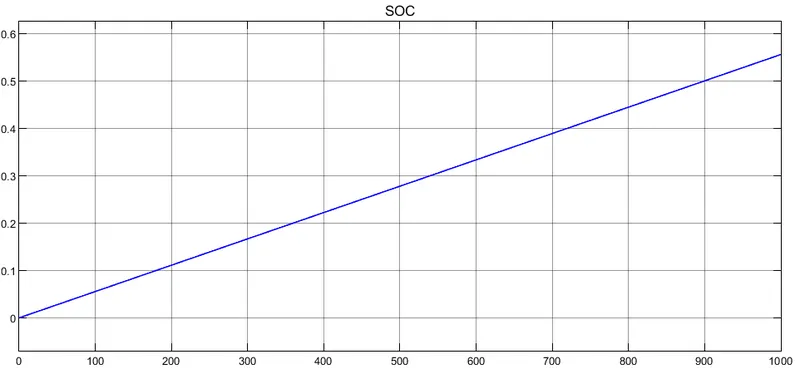
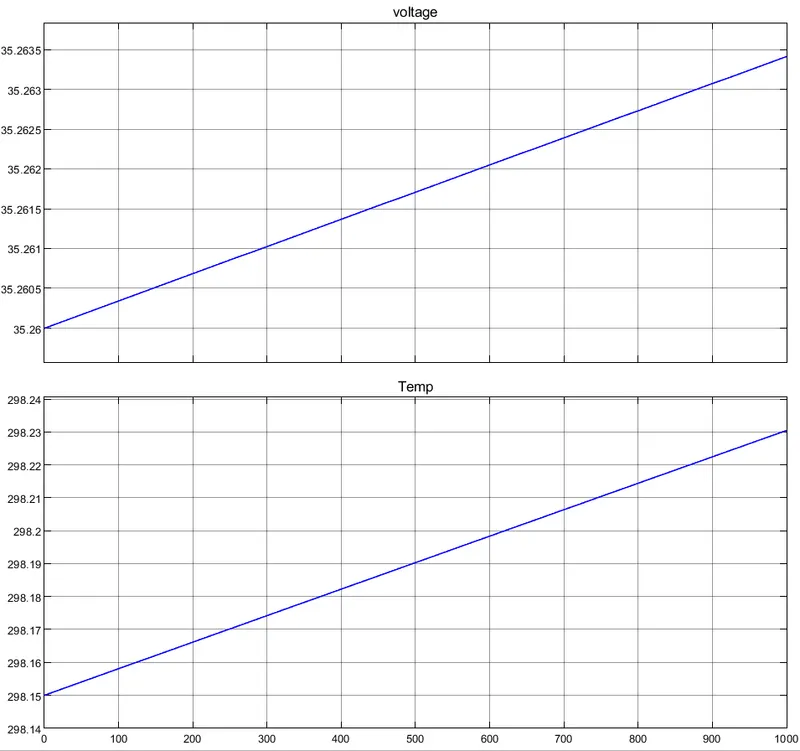
charge rate of 2A
SOC plot :
Voltage and temperature plot :
- while charging initially SOC of the batteries is 0% .
- when charged with 1A the battery pack was charged to 27% . but when charged with 2A the battery pack was charged to 55%.
- these different charge rates have thermal effects on battery .
- we are giving thermal source of 300k through convective heat transfer for both charge rates .
- we can see that for high charge rate the thermal effect on the battery increases .
3. different temperature source
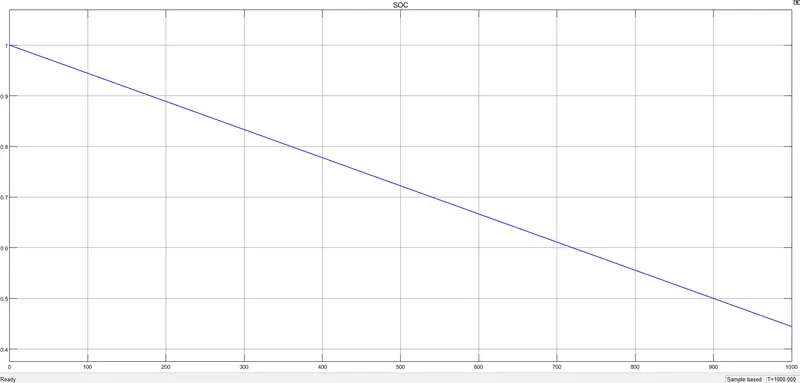
Temp = 300K
Temp = 310K
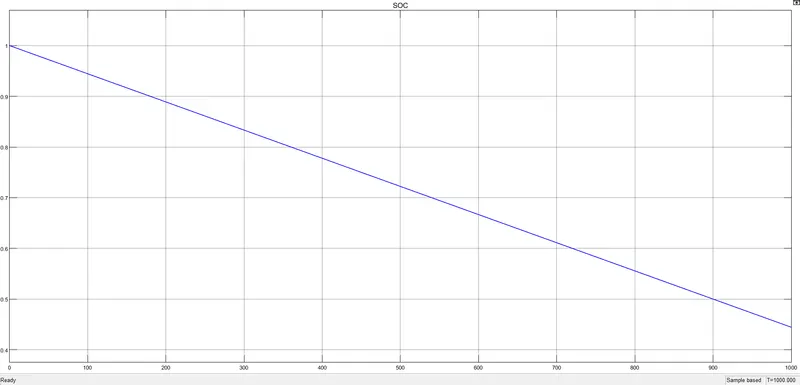
- different tempeature have effects on SOC of the battery pack .
- here we consider discharge case .
- even though both plots for 300K and 310K appears to be same , on close observation it is seen that for high temperature the SOC is discharged faster compared to low temperature .
CONCLUSION :-
we have successfully simulated thermal model of battery pack and the results are satisfactory.