Project 2 Thermal modeling of battery pack
AIM:
Design and Simulate Thermal Modeling of battery pack.
OBJECTIVE:
For a 10 cell series lithium ion battery model, simulate the thermal effects and compare life cycle performance at various temperatures, charge & discharge rates using MATLAB.
BLOCKS USED:
* Powergui: To Set simulation type, simulation parameters, and preferences.
* Signal Builder: The Signal Builder block allows you to create interchangeable groups of piecewise linear signal sources and use them in a model.
* Simulink - PS Convertor: Converts the Simulink input signal to a Physical Signal.
* Controlled Current Source: The block represents an ideal current source that is powerful enough to maintain the specified current through it regardless of the voltage across it.
* Resistor
* Electrical Reference
* PMC Port: Physical Modeling Connection Port block for subsystems.
* Solver Configuration: Defines solver settings to use for simulation.
* Battery - Table Based with Thermal Port: This block models a battery based on tabulated characteristics as functions of state of charge (SOC) and optional temperature (T).
* Conductive Heat Transfer: This block models heat transfer in a thermal network by conduction through a layer of material. The rate of heat transfer is governed by Fourier's law and is proportional to the temperature difference, material thermal conductivity, area normal to the heat flow direction, and inversely proportional to the layer thickness.
* Temperature Sensor: This block measures temperature in a thermal network. There is no heat flow through the sensor. The physical signal port T reports the temperature difference across the sensor. The measurement is positive when the temperature at port A is greater than the temperature at port B.
* Convective Heat Transfer: This block models heat transfer in a thermal network by convection due to fluid motion. The rate of heat transfer is proportional to the temperature difference, heat transfer coefficient, and surface area in contact with the fluid.
* Thermal Reference
* Go to and From Block.
* Perfect Insulator: This block represents a terminus in a thermal network with no heat flow and no energy storage. Use this block as an insulation for thermal conserving ports to prevent heat exchange with the environment and to model an adiabatic process. This block can also be used to set an initial value and priority for the temperature at the connected port.
* Scope and Display.
PROCEDURE:
Simulink model:
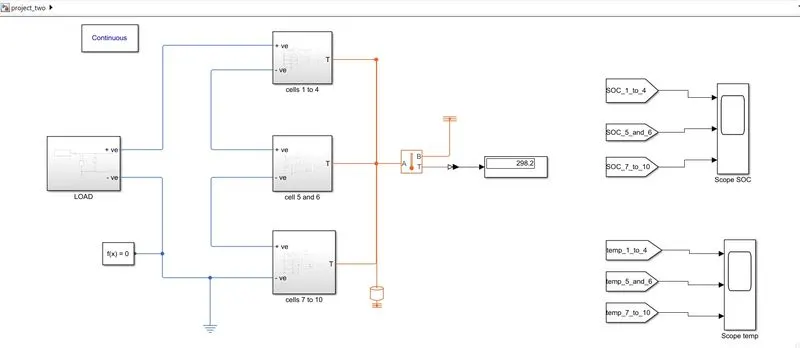
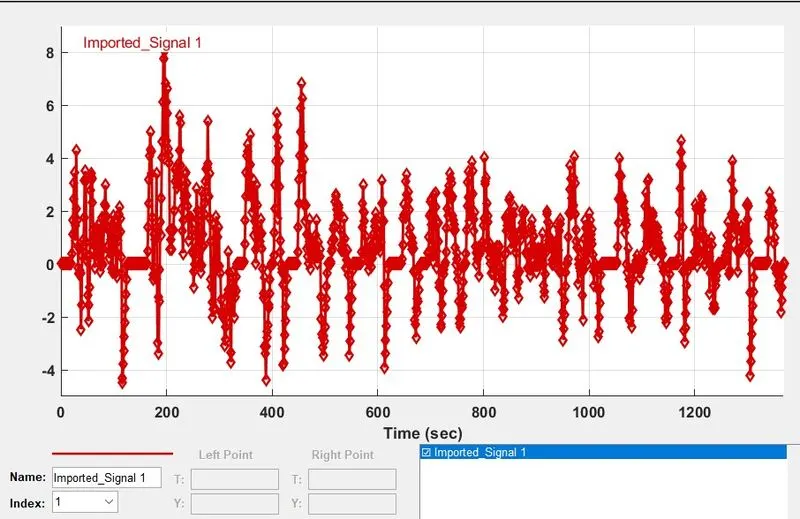
*In this model UDDS current profile is used as input to the battery pack with help of signal builder.
*The 3 modules are connected as shown above with 10 cells in series connection.
Subsystem module 1:
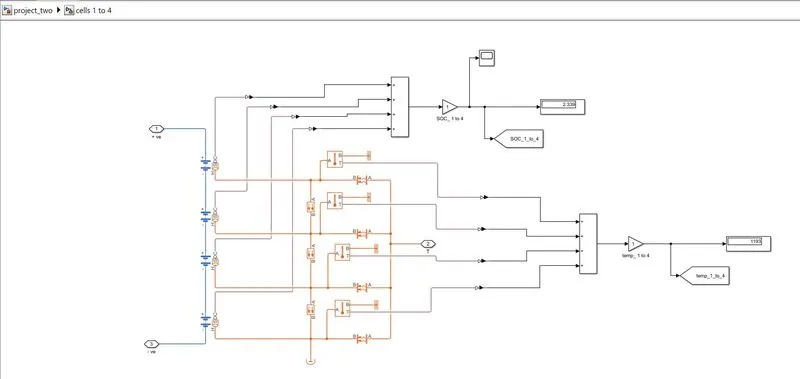
* In this subsystem, we used 4 batteries in series connection. (The battery specifications assumed are 2.5Ah capacity, with initial temperature 298K.)
* Conductive heat transfer bock is used with the parameters 401W/(K*m) as thermal conductivity, area 10m^2 and thickness of 0.1m.
* Convective heat transfer block is used with heat transfer co-efficient as 20 W/(K*m^2) and area as 10m^2.
* Perfect insulator is used as this block models internal energy storage in a thermal network. The rate of temperature increase is proportional to the heat flow rate into the material and inversely proportional to the mass and specific heat of the material.
* Temperature sensors are used to sense the temperature of cell and display the value.
* SOC of every cell is calculated by add and gain block.
Subsystem module 2:
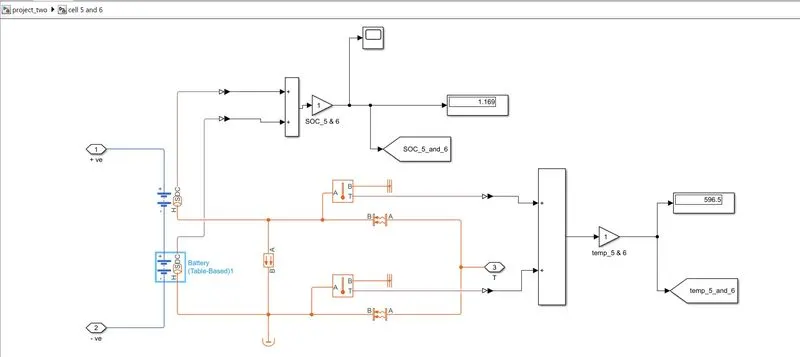
* In this subsystem, we used 2 batteries in series connection with same parameters as above.
Subsystem module 3:
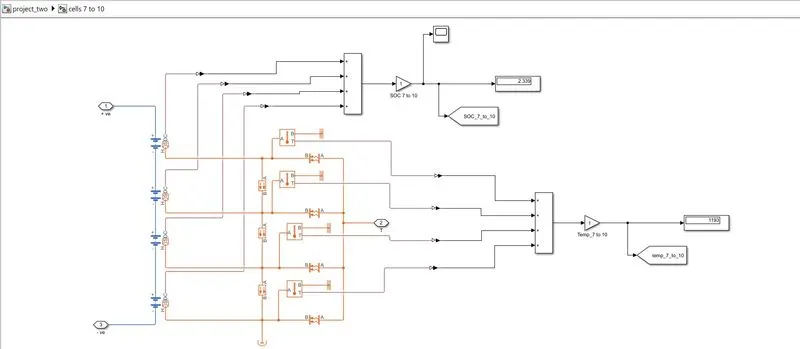
* In this subsystem, we used 4 batteries in series connection with same parameters as above.
RESULTS:
SOC of Each Module:
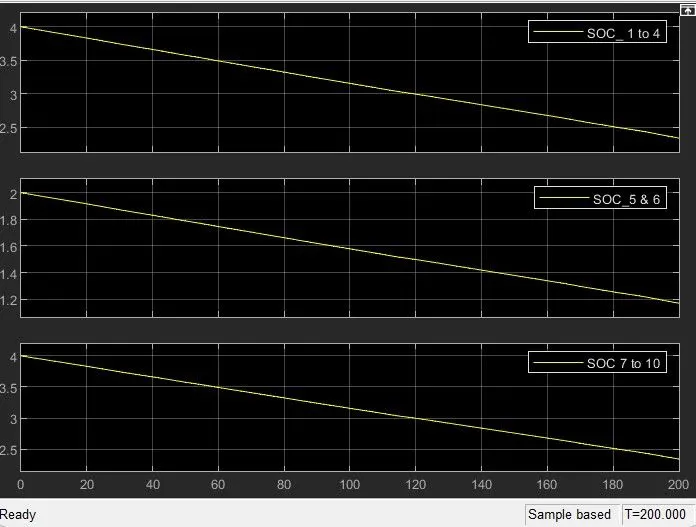
* Here we can observe that the SOC is gradually reducing from their respective 100% with the duration of time. It is observed that the battery pack will reach 0% by the 251 second.
Temperature of Each Module:
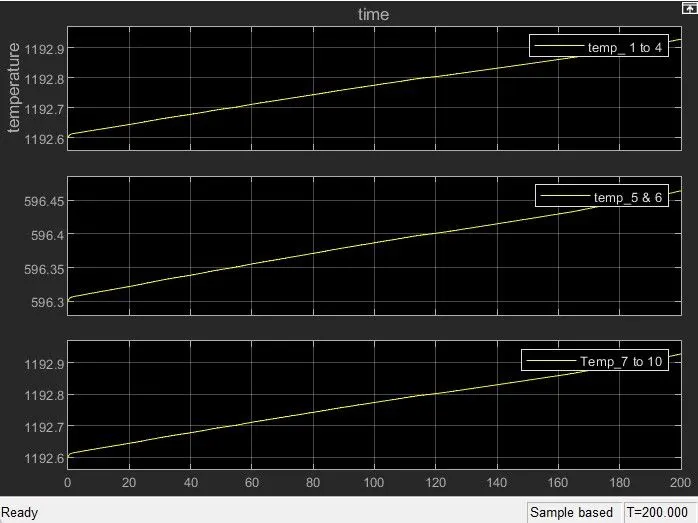
* The internal temperatures of the battery packs are increasing with respect to time.
CONCLUSION:
A Thermal modelling of a battery pack is designed and simulated.