Project 2 Thermal modeling of battery pack
Note- This is Live EV Batch 21.
Objective-
For a 10 cell series lithium ion battery model, simulate the thermal effects and compare life cycle performance at various temperatures, charge & discharge rates .
Simulink Model-
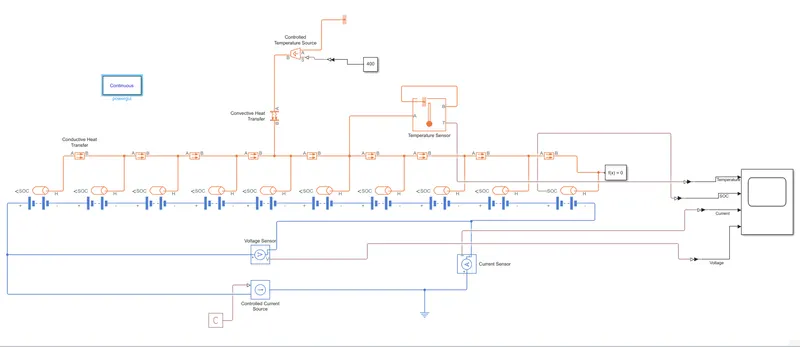
Model Explanation-
As the performance of EV is totally dependent on battery pack performance.There are some factors which affect the battery pack performance like temperature,environment condition and discharge rate etc.
Battery works on the principle of voltage difference.At high temperature,the electron inside battery excited which decrease the voltage difference between the terminals of battery.
If there are larger temperature difference inside battery then reaction rate be will be uncontrolable which will increase the battery temperature and can happen thermal runway.If the battery temperature is not maintained then fire explosion can be happen.
- So we need a thermal management system to save the battery life and to increase the battery performance.
BTMS
1. Cooling-To remove excess heat.
2. Heating-In cold climates.
3. Insulation-In extreme cold or hot weather, the temperature difference between the inside and outside of the battery pack is much larger than that in mild weather. Battery temperature will thus fall (cold) or rise (hot) sooner out of the proper temperature range. To prevent this, good insulation can slow down the falling or rising of battery temperature, especially when the vehicle is parked outdoors.
4. Ventilation-Ventilation is required to exhaust the hazardous gases within battery pack. In some systems, such as air systems, this function is combined with cooling and heating functions.
The cycle life of battery is the number of charge and discharge cycle that a battery can complete before loosing performance. After a certain period of time battery performance decreases.So chaging and discharging happens very fast.
- Here we are using 10 number of battery connected in series.
- Heat transfer is observed between the blocks by convective and conductive block.
- A controlled temperature source is used to observe the heat effect.
- Temperature sensor is used to sense the temperature of the battery pack.
- Voltage sensor and current sensor is used to measure the voltage and current respectively.
- All are output is connected to scope to see the result.
Results-
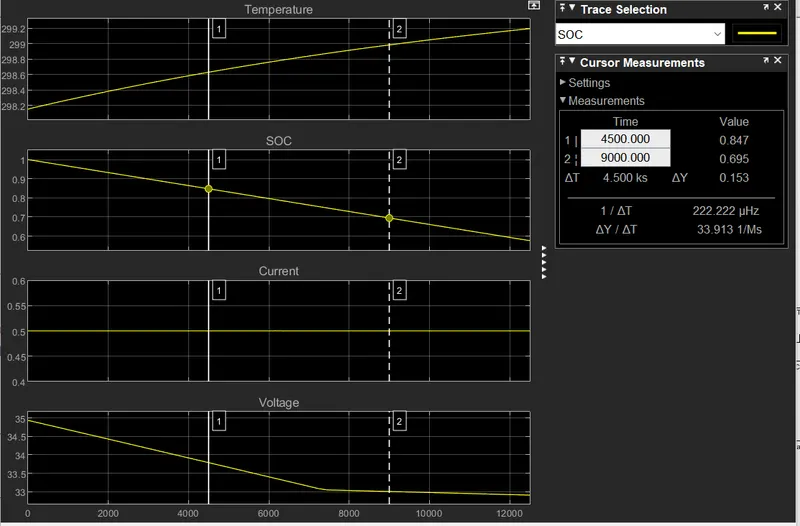
At 0.5C and 300K-
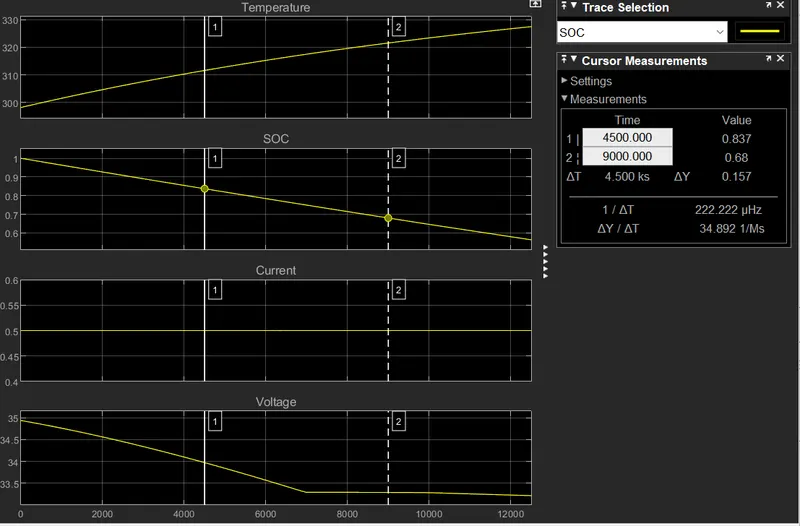
At 0.5C and 350K-
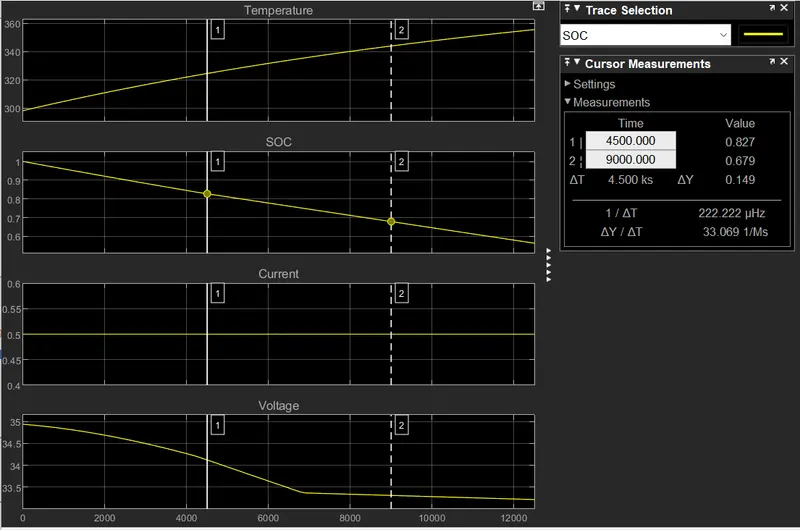
At 0.5C and 400K-
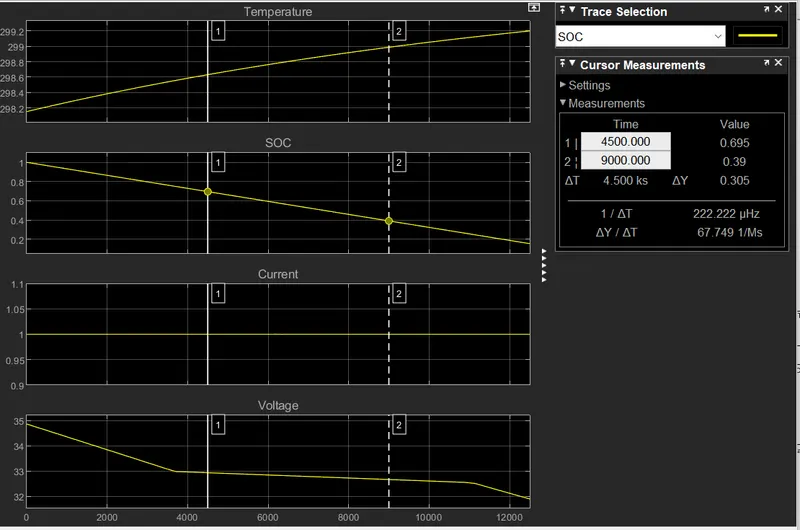
At 1C and 300K-
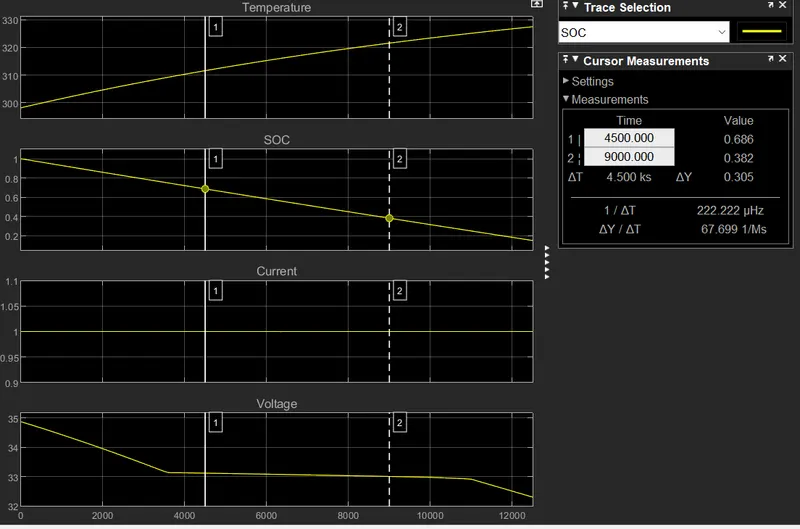
At 1C and 350K-
At 1C and 400K-
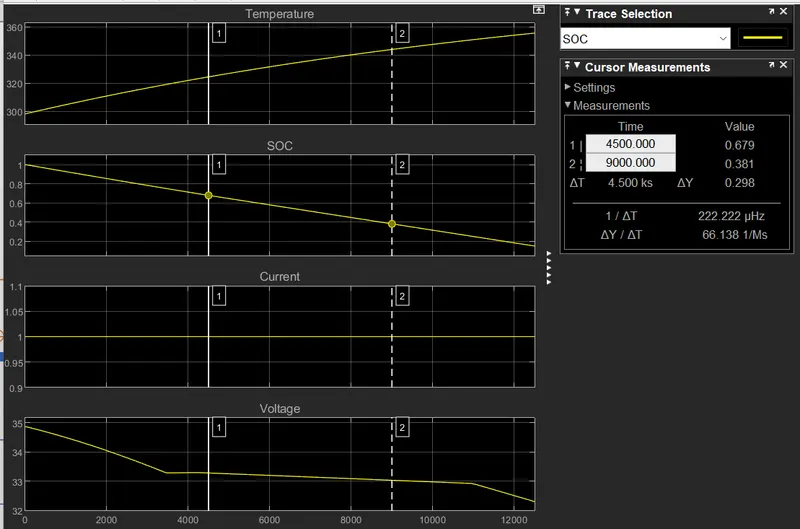
As from above scope result ,we can conclude that after increasing the temperature on same discharge rate ,the value of SOC is degrading.So more temperature makes SOC fall down without increasing the load demand.
|
Discharging/Charging Rate |
Ambient Temperature |
Battery SOC |
|
0.5C |
300K |
84.5% |
|
0.5C |
350K |
83.5% |
|
0.5C |
450K |
82.5% |
|
1C |
300K |
69.5% |
|
1C |
350K |
68.6% |
|
1C |
450K |
67.5% |
That is ,Battery is going discharge earlier than its capacity.So life cycle will reduce.