Project 2 Thermal modeling of battery pack
EV LIVE BATCH 21
For a 10 cell series lithium ion battery model, simulate the thermal effects and compare life cycle performance at various temperatures, charge & discharge rates using MATLAB.
For EV battery packs, battery generates heat when it is being charged or getting discharged. During fast charges, batteries must be cooled down. This is because the high current going into the battery produces excess heat that must be extracted to preserve the high charging rate and not overheat the battery. Also, while discharging, the more the discharge rate, the more heat will be produced.
Taking care of the battery temperature is important because, high battery temperature leads to poor performance, short lifetime, capacity degradation, thermal runaway and fire explosion. So, to achieve uniform temperature variation in the battery modules and to maintain the battery system in the optimum temperature range, Thermal management techniques are used, also called as BTMS - Battery Thermal Management System, responsible for managing/dissipating the heat generated during the electrochemical processes occurring in cells, allowing the battery to operate safely and efficiently.
The cycle life of batteries is the number of charge and discharge cycles that a battery can complete before losing performance. As you use the battery and recharge it, it slowly loses the ability to return to its original capacity. There is not a standard test, but a general rule of thumb is that the life cycle of the battery is the number of cycles you get before you cannot recharge your battery to more than 80% of the original capacity.
Temperature has significant effect on life cycle of the battery. Extreme temperatures in batteries lead to a decreased battery life. The optimal operating temperature for batteries is about 25 degrees C or 77 degrees F. Although, the impact of temperature on battery life can be a bit confusing. It might happen that higher temperatures improve the performance of batteries and cold temperatures decrease it. This is true when referring to capacity, not life cycle.
So, to simulate the thermal effects at various temperatures, charge & discharge rates, which will affect the battery life, the model can be given as,
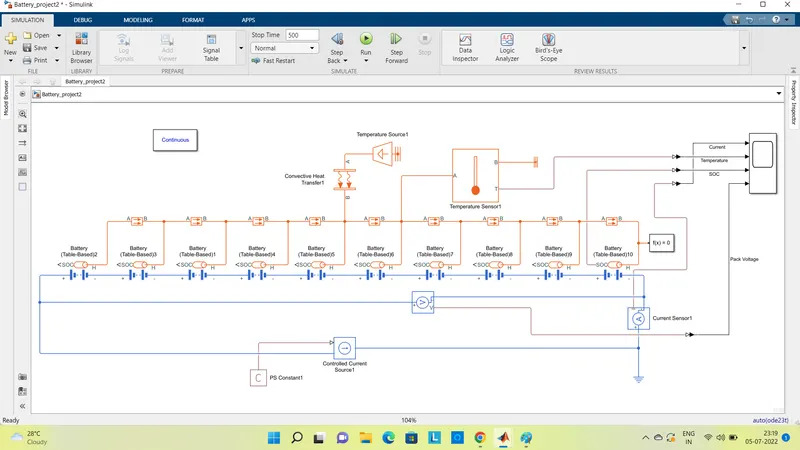
Here, 10 similar Table based Batteries are taken and connected in series configuring SOC and the thermal port to analyse the behavior of the battery with the effect of temperature. With this block we can assign, parameters of the datasheet or lookup table data to the battery.
Every battery parameter are taken as,
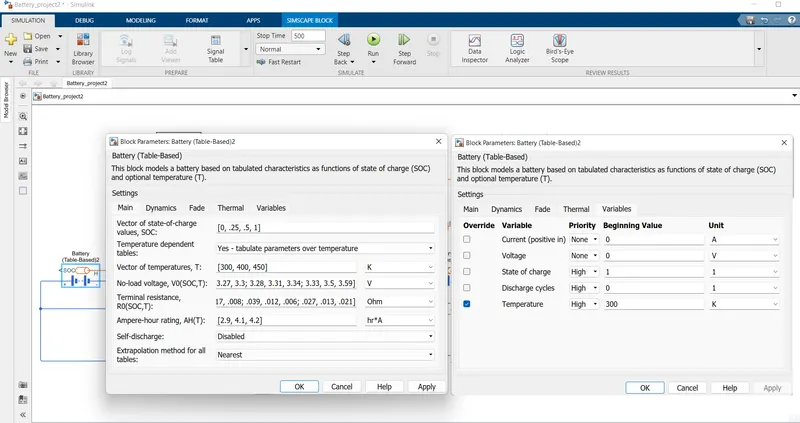
As, 10 batteries are connected in series, voltage rating of the battery is increased. On an average, single battery voltage rating is 3.3 V. so, for 10 series connection, battery pack voltage will be 33V with same current rating.
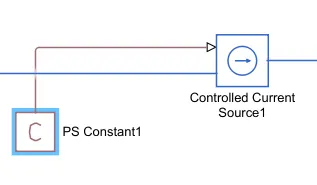
Battery is supplied with constant current source with C-rate of 1C initially with PS-constant, which will provide constant current inspite of variable voltage or temperature. A current sensor is also connected to see the supplied currrent. Also a voltage sensor across the battery pack, to analyse the effect on voltage with change in temp and C-rate.
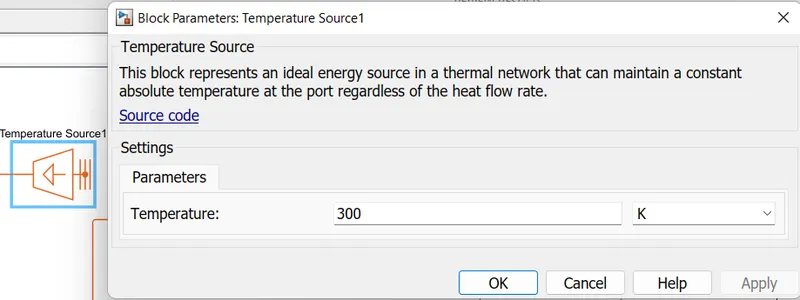
Further more, to analyse effect of temperature rise on the performance of the battery, a certain temperature of 300 K is fed to the thermal port of each battery via common Temperature Source and Convective Heat Transfer.
Temperature Source block represents an ideal energy source in a thermal network that can maintain a constant absolute temperature at the port regardless of the heat flow rate.
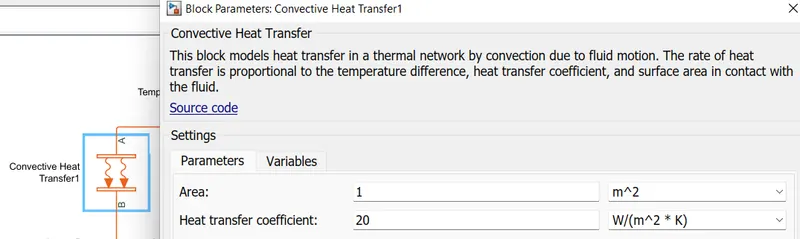
Convective Heat Transfer block models heat transfer in a thermal network by convection due to fluid motion between two bodies, here A to B. The rate of heat transfer is proportional to the temperature difference, heat transfer coefficient, and surface area in contact with the fluid. Block parameters are taken as,
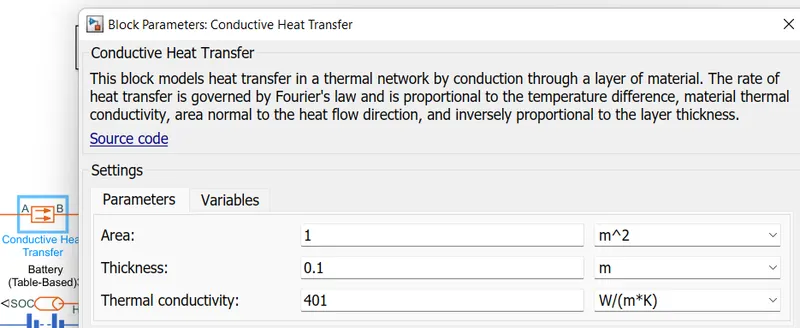
Also, conductive heat block, represents a heat transfer by conduction between two layers of the same material. It is used between each battery to incorporate the heat transfer among the batteries. Block parameters are taken as,
A temperature sensor block is connected which measures temperature in a the thermal network of the battery pack. There is no heat flow through the sensor. The physical signal port T reports the temperature difference across the sensor. The measurement is positive when the temperature at port A is greater than the temperature at port B. For this, a thermal reference block is coonected to port B, which represents a reference point in a thermal network of the battery pack where the temperature is equal to absolute zero.
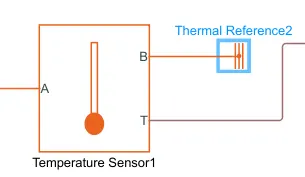
hence, change in temperature can be analysed with respect to time. Also, a solve configuration is attached for simulation, and is run for 500 sec. results obtained are,
- For Temp = 300 K with constant C-rate of 1C
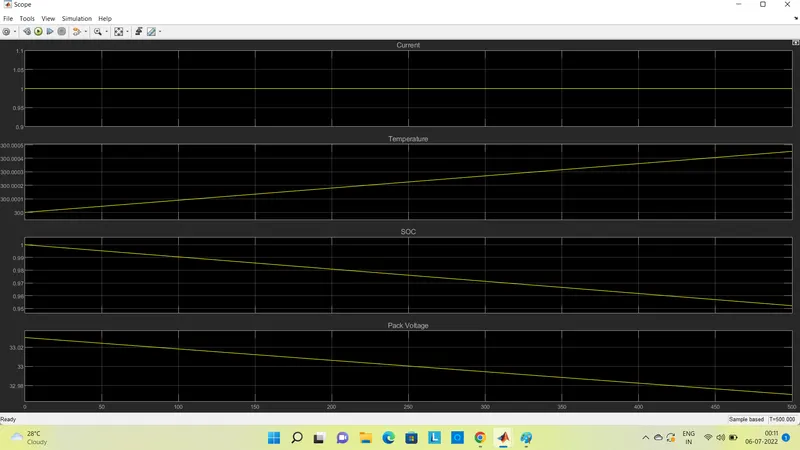
here, it can be seen that, temperature is nominal increasing and SOC of the battery is getting reduced effectively to almost 95%. Also, battery pack voltage is reducing with respect to time with constant C-rate of 1C.
- For Temp = 400 K with constant C-rate of 1C
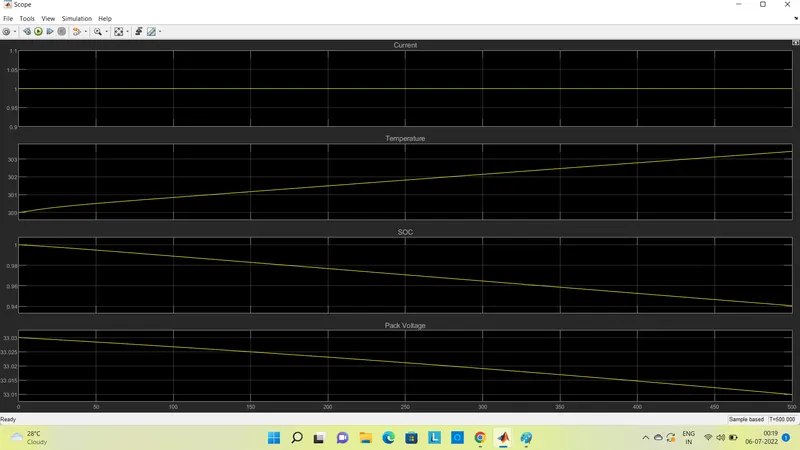
Now, with increase in source temperature, battery pack temp is increasing significantly with further reduced SOC value of 94% and also battery pack voltage is reducing accordingly.
- For Temp = 450 K with constant C-rate of 1C
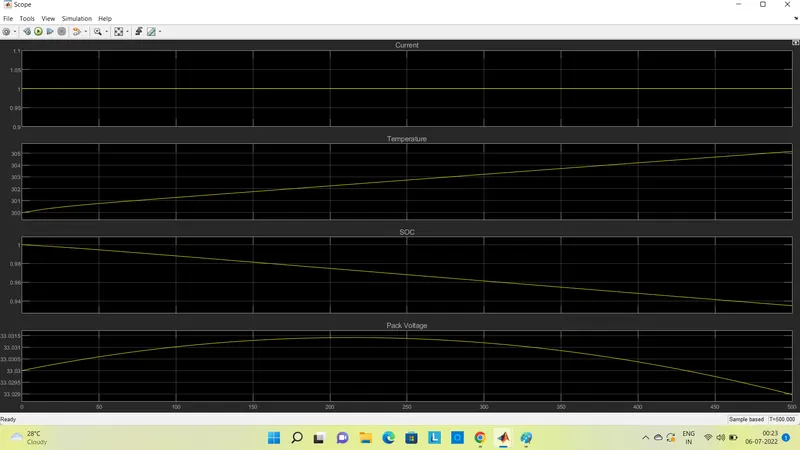
Here, with further increasing source temp, battery pack temperature increases adequately. The SOC value degreases marginally to about 93% and battery pack voltage performance tries to increases slightly with given temp rise, which will lead to rapid decrease in the battery life cycle as stated earlier.
Now, keeping the temperature constant and changing the C-rate, the results can be obtained as,
- For 2C keeping temp. constant at 300K
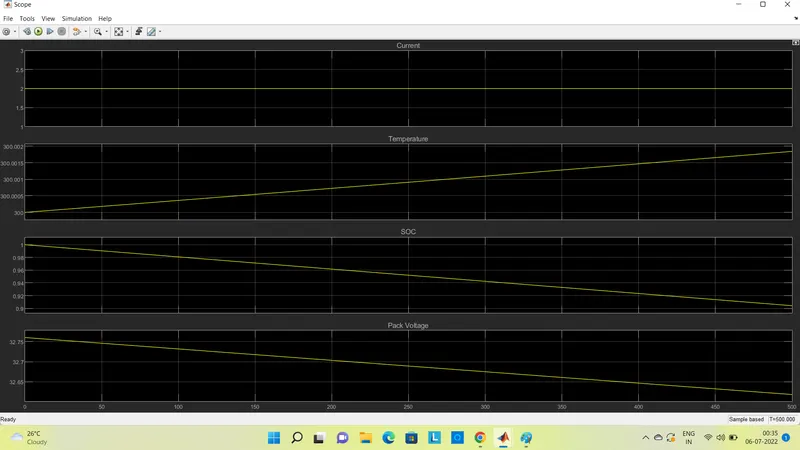
Temperature rise is nominal but with increased C-rate, SOC is falling rapidly to almost 90%. also the effective battery pack voltage value is less than that of voltage value for previous C-rate and is reducing significantly.
- For 3C keeping temp. constant at 300K
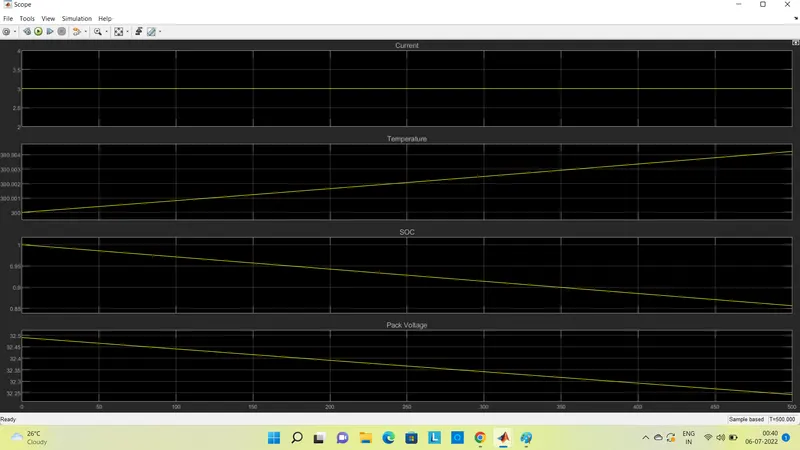
Here, again Temp rise is normal but SOC has reduced to almost 85% and again effective battery pack voltage value is less than that of previous value and reducing adequately.
- Conclusion:
Hence we can conclude that, with increase in temperature and C-rate i.e. charge and discharge rate, the SOC of battery pack reduces rapidly with reducing effective battery pack voltage. So, ultimately life cycle of the battery is getting reduced and battery will be aging more rapidly.