Project 2 Thermal modeling of battery pack
To simulate the thermal effects and compare life cycle performance at various temperatures, charge and discharge rates using matlab, For a 10 cell series lithium ion battery model.
Here in this we follow the model of lithium-ion battery pack with fault.
Simulink model of Lithium-ion battery pack with fault (for reference):
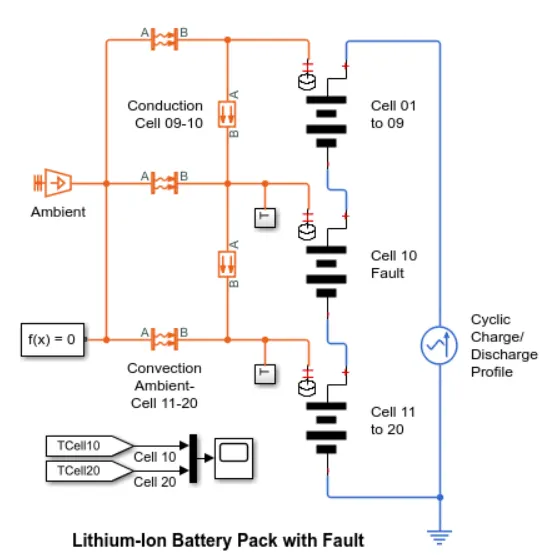
Simulink Model:
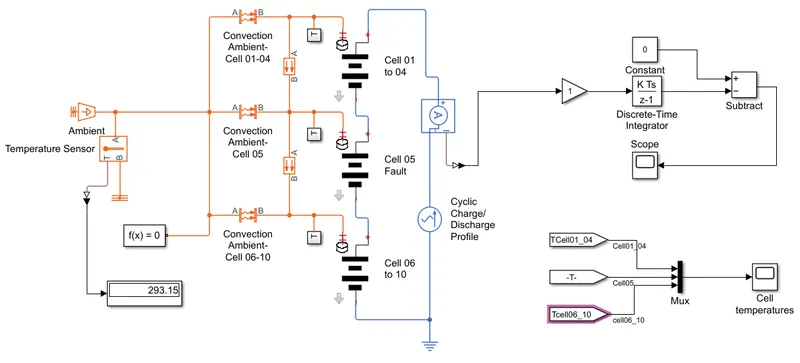
Here is our simulink model which shows the representation of the 10 cell series connection. A lithium-ion battery pack of 1- cells is used. In order to check for the thermal effects, one of the cells is considered faulty. Fault in the sense that the temperature of this cell is higher than the other nine cells. The battery is assumed to be air-cooled and provided with ventilators with ambient air and temperature. For modeling this case all the cells are connected to ambient temperature. The convective heat transfer from the surroundings to the cells is also modeled using the respective blocks. There are temperature sensor blocks used to detect the temperature from the cells. The current drawn from the cells is controlled by the controlled current source block. A data of drive cycle is used here. A signal builder block is used to feed this drive cycle data and it is stored in the form of current vs time.
Parameters in the model:
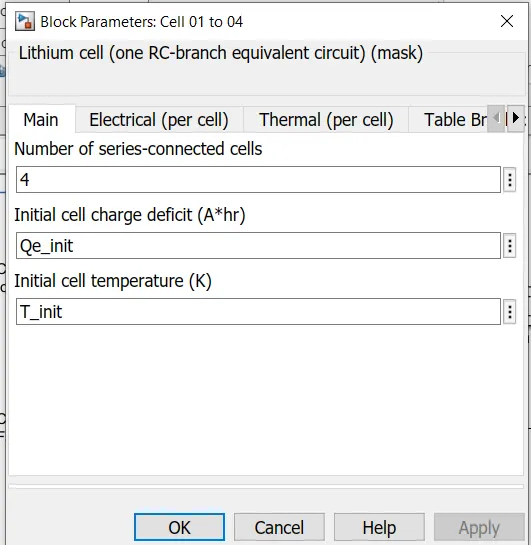 Cell 01 to 04
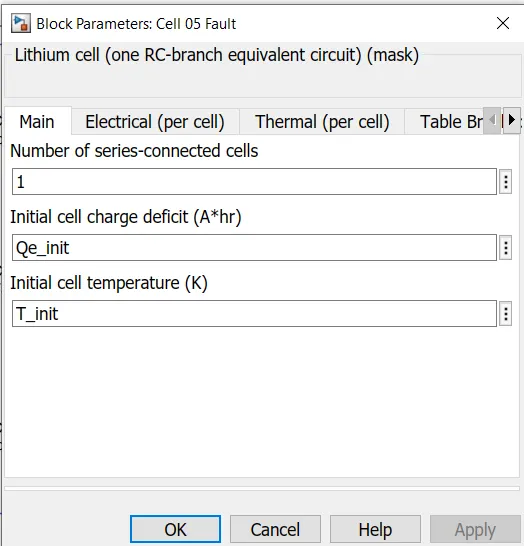 Cell 05
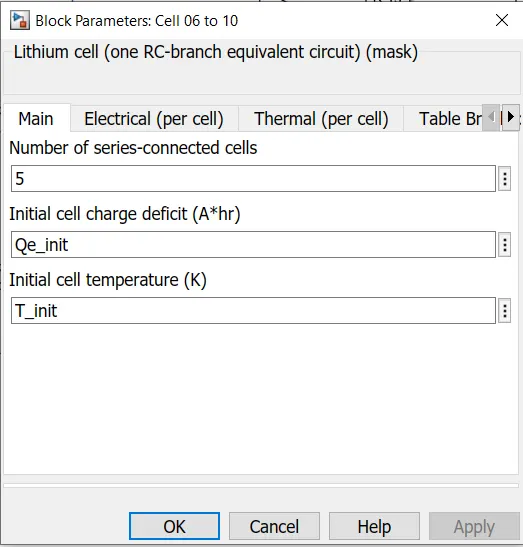 Cell 06 to 10
Subsystem inside the battery cell:
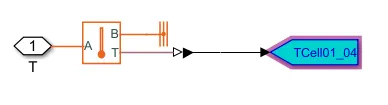 Cell 01 to 04
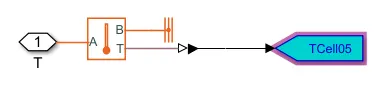 Cell 05
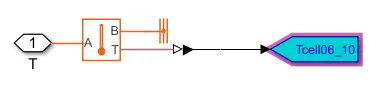 Cell 06 to 10
Major blocks used in the system:
Temperature sensor: This block is to measure the temperature in a thermal network. there will be no heat flow through the sensor.
Temperature source: This block represents an ideal energy source in a thermal network that can maintain a constant absolute temperature at the port regardless of the heat flow,
Conductive heat transfer: This block, models heat transfer in a thermal network by conduction through a layer of material. The rate of heat transfer is governed by fourier's law and is proportional to the temperature difference, material thermal conductivity, area normal to the heat flow direction, and inversly proportional to the layer thickness.
Convective heat transfer: This block, models heat transfer in a thermal network by convection due to fluid motion. The rate of heat transfer is proportional to the temperature difference, heat transfer coefficient, and surface area in contact with the fluid.
Current sensor: The block represents an ideal sensor that is a device that converts current measured in any electrical branch into a physical signal proportional to the current.
Ac current source: The ideal AC current source maintain the sinusoidal current through it, independent of the voltage across its terminal.
Result:
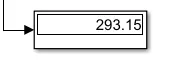
Here the ambient temperature is displayed,
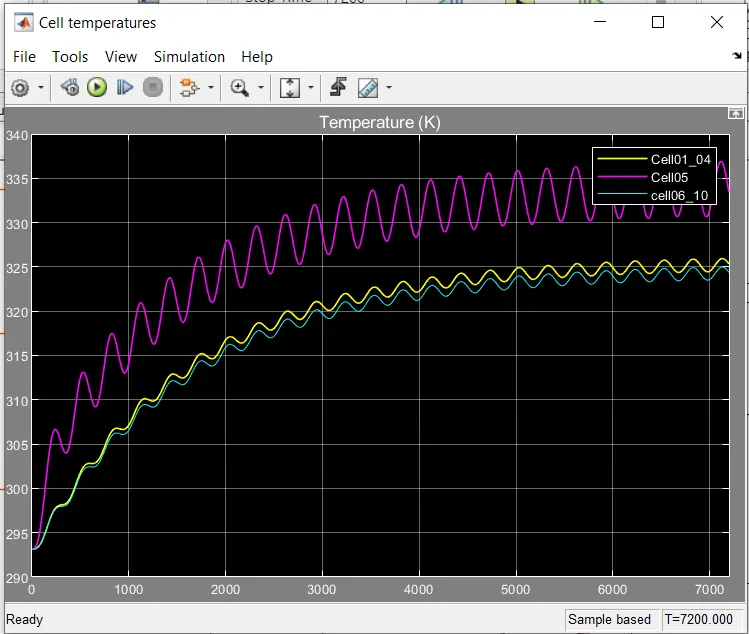
Temperature of the cells,
SOC of the cells,
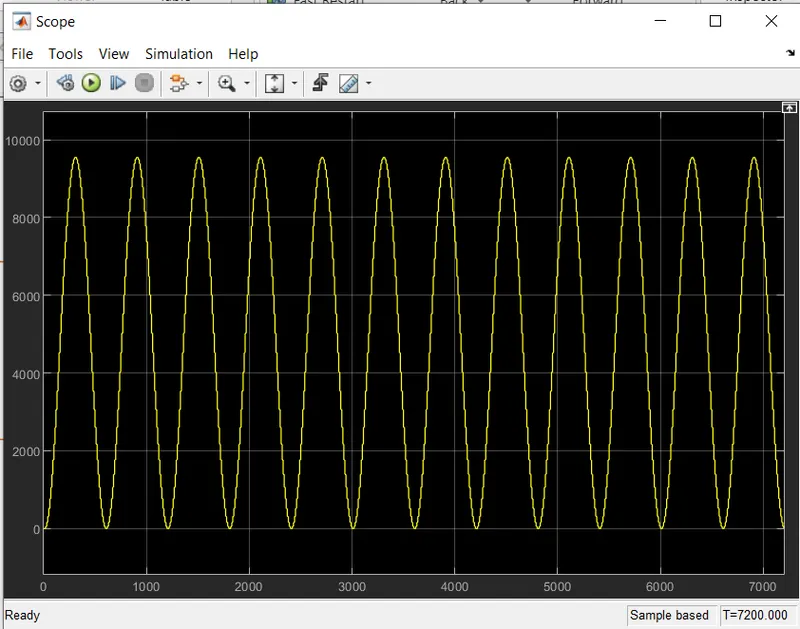
From the above Temperature and SOC grapg we got the idea that,
At the ambient temperature of 293.1K, The healthy cells reach 326K and the faulty cell reaches 336K. The temperture of the faulty cell is higher than the other cells and the faulty cell has 7.5K temperature more than the others. The SOC of the cell is a wave with equal frequency.