Project 2 Thermal modeling of battery pack
AIM:
For a 10 cell series lithium ion battery model, simulate the thermal effects and compare life cycle performance at various temperatures, charge & discharge rates using MATLAB.
OBJECTIVES:
For a 10 cell series lithium ion battery model, simulate the thermal effects and compare life cycle performance at various temperatures, charge & discharge rates using MATLAB.
The model used in this project serves as the base model and on this model changes will be made to our requirements to get desired results.
INTRODUCTION:
In electric vehicles, thermal management makes it possible to not only improve battery power and longevity, but also to reduce the size of electric engines. Temperature is thus the main parameter that needs to be controlled in a battery, hence the need to use suitable electrical and thermal insulation materials. Here is a summary of the main issues related to thermal management. In an electric vehicle, the battery is made up of clusters of independent cells that are sensitive to cold and heat. The heat produced by the battery must be dissipated at the same time as ensuring protection from external conditions. The aim is to maintain a stable temperature, thus guaranteeing constant operation and preventing premature aging.
SIMULINK MODEL:
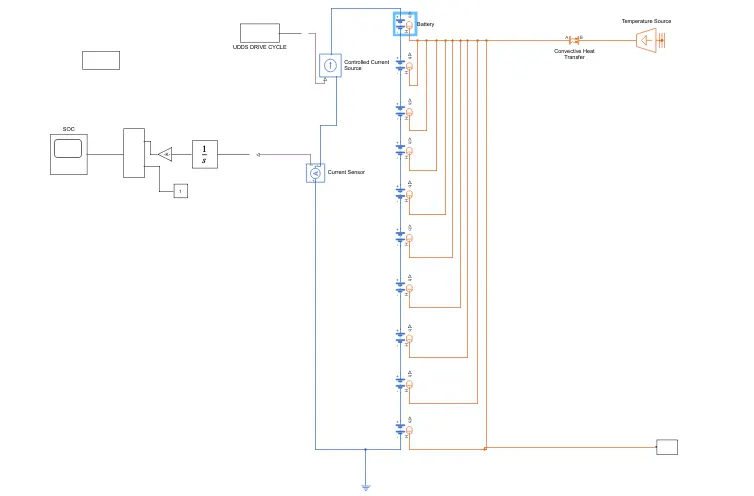
HOW THE CONNECTION IS MADE:
- First we have take a table based battery system and from the block choices we have chosen this ("Uninstrumented | Show thermal port") battery model for this challenge.
- Then we have taken 9 more of the same battery model and coonecteed them in series.
- The battery parameters we have used for this challenge is quite simple. We have used the parameters of Lithium-ion battery Panasonic NCR 18650B. The battery paramters is given in the modelling part.
- We have introduced a temperature source so that the desired temperature can be given as we opt for different cases and see the results of how temperaure of the battery pack differs thir SOC.
- Also a Convective heat transfer block is added between the battery and the temperature source.
- A controlled current source along with a current sensor is added between the terminals of the battery.
- The curent sensor is then connected to the part where the SOC of the battery pack is calculated.
- Also a solver configureation, electrical reference and a powergui block is also added in the model.
BLOCKS USED IN SIMULINK MODEL:
Battery configuration:
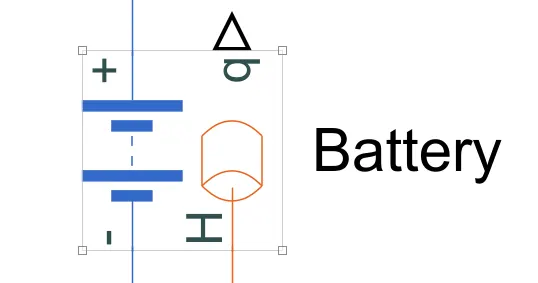
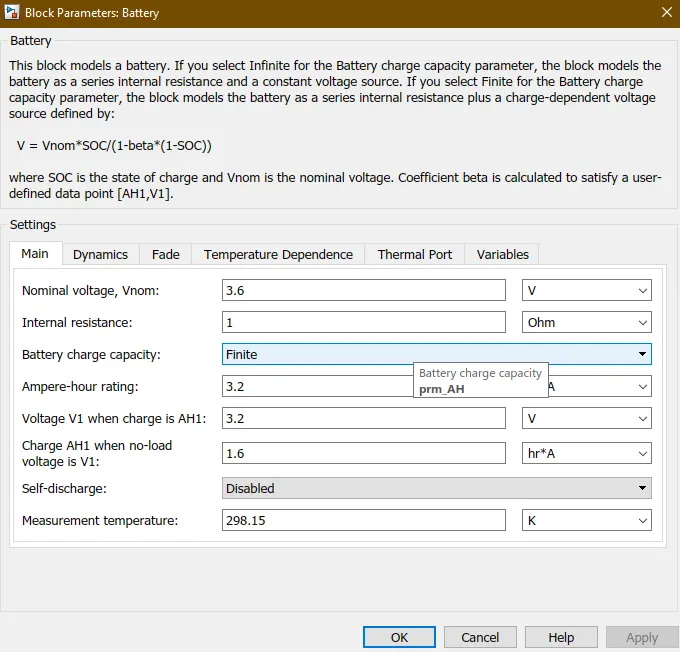
For this challenge, a table based battery is used with thermal port. The battery parameters of Panasonic NCR18650B cell is used :-
Temperature Source:
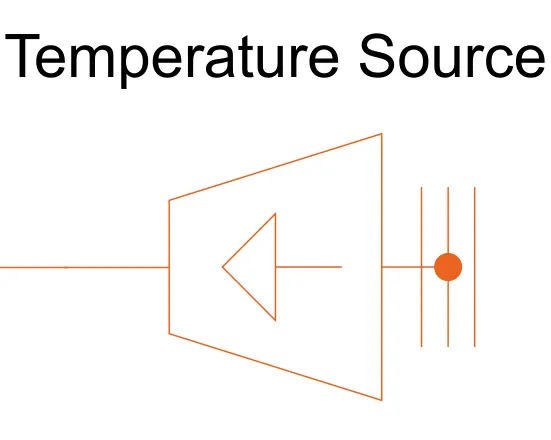
This block represents an ideal energy source in a thermal network that can maintain a constant absolute temperature at the ports regardless of the heat flow rate.
Convective heat transfer
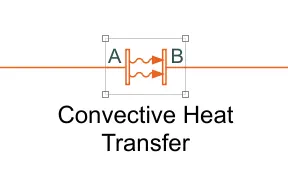
The convective heat transfer block represents a heat transfer between two bodies by convection using fluid motion. The transfer is governed by Newton's Law of Cooling and the equation is Q = k*A(T_A - TB)
where
Q = heat flow
k = convection heat transfer coefficient
A = Surface area
T_A,T_B = Temperature of the bodies
Convections A abd B are thermal convection ports associated with the points between which the heat transfer by convection takes place. The block positive direction is from port A to port B meaning that the heeat flow is in positive direction.
Controlled current source:
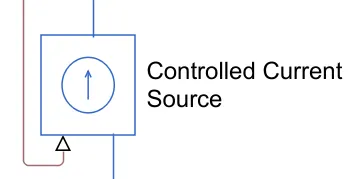
The Controlled current source block represents an ideal current source that is powerful enough to maitain the specified current through it regardless the voltage across it.
The output is I=Is where Is is the numerical value presented at the physical Signal port.
This controlled current source is connected across the batterey terminals.
Current sensor:
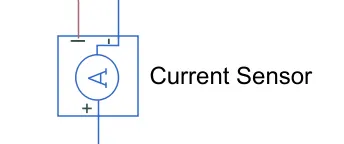
The Current sensor block represents an ideal current sensor, a device that converts current measured in any electrical branch into a physical signal proportional to the current.
Connections + and - are electrical conserving ports through which the sensor is inserted into the circuit. The connection used here is a physical signal port that outputs the measurement result.
Electrical reference:

The electrical reference block represents an electrical ground. Electrical conserving ports of all the blocks that are directly connected to the ground must be connected to an electrical reference block. A model with electrical elements must contain at least one electrical reference block.
Signal Builder:
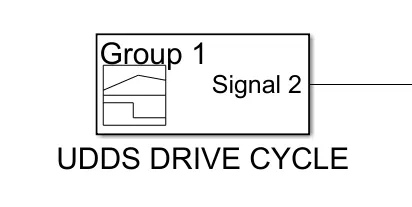
This block allows us to make or add any type of pulse or signal to input into the system.
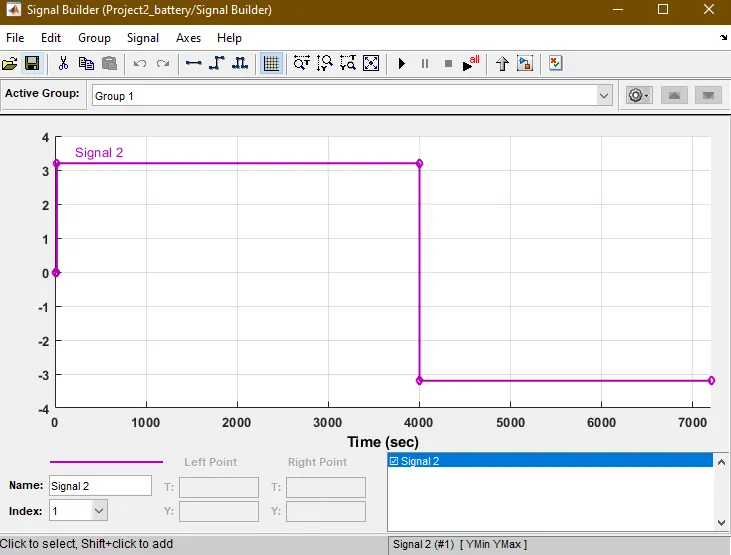
Here the signal I have used will describe the SOC for the challenge. The positive part of the signal shows us that the battery is being discharged at 3.2 A for 4000 secs. Then from 4000 secs, the battery is being charged till 7200 secs.
SOC calculation:
For Soc calculation, the block here is used is the gain block, integrator and sum block with PS simulink converter.
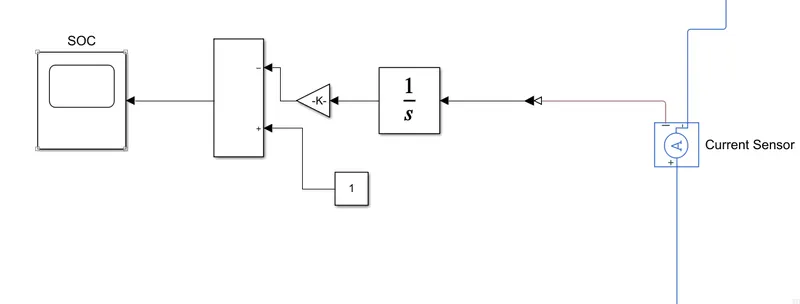
Working of the block is pretty simple. The current coming out from the current sensor is integrated then multiplied bt thr gain containing the value 1/(3.2*3600) and then substracting it from 1 in the constant block gives us the required SOC for the 10 series connected battery pack.
RESULTS:
TEMPARTURE: 20 degree Celcuis or 293K
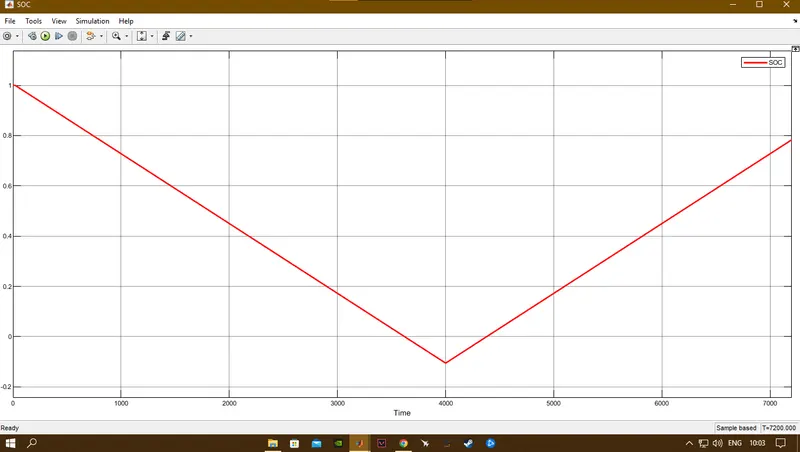
Temperature: 40 degree Celcius or 313k
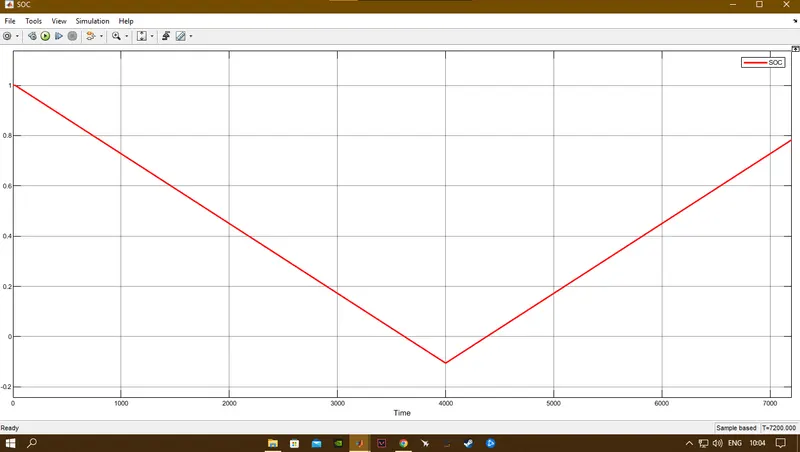
Temperature: 60 degree Celcius or 333k
EXPLAINATIONS FOR THE PLOTS:
In the above plots we can see that the SOC of the battery is dropping to negetive at 4000 secs at a constant discharge rate of 3.2 A and also the battery is charging from 4000 secs at a constant charging of 3.2 A for 7200 secs and the SOC remains same at 78% after 7200 secs.
CONCLUSION: Here we can see that whatever temperature there is the SOC of the battery pack remains the same for all the 3 cases. This is beacuse it is not a practical test rather than a simulation. In this cas we are unable to apply many factors such as discharge effect, fading, entropy weather conditions.
Though however the life cycle of the battery is nearly impossible to get in the simulation s it also depends on several conditions such as battery usage and it is quite complicated, the life cycle for a single Panasonic NCR18650B lithium-ion cell is 2233 cycles under normal conditions.