Project 2 Thermal modeling of battery pack
Obective -
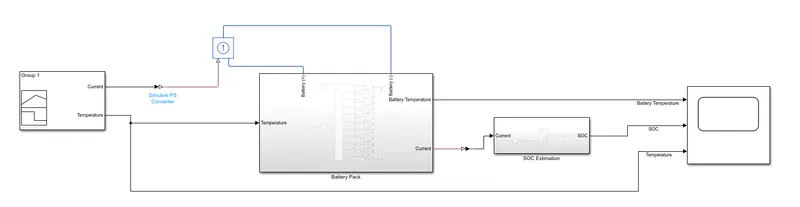
To simulate the thermal effects and compare life cycle performance at various temperatures, charge and discharge rate for a 10 cell Lithium ion battery model using MATLAB.
Model -
Blocks Used -
- Signal Builder -
The Signal Builder block allows you to create interchangeable groups of piecewise linear signal sources and use them in a model.
- Controlled Current Source -
The Controlled Current Source block represents an ideal current source that is powerful enough to maintain the specified current through it regardless of the voltage across the source.
- Battery Pack Subsystem -
- Battery -
The Battery block represents a simple battery model.
- Current Sensor -
The Current Sensor block represents an ideal current sensor, that is, a device that converts current measured in any electrical branch into a physical signal proportional to the current.
- Convective Heat Transfer -
The Convective Heat Transfer block represents a heat transfer by convection between two bodies by means of fluid motion.
- Temperature Sensor -
The Temperature Sensor block represents an ideal temperature sensor, that is, a device that determines the temperature differential measured between two points without drawing any heat.
- Controlled Temperature Source -
The Controlled Temperature Source block represents an ideal source of thermal energy that is powerful enough to maintain specified temperature difference across the source regardless of the heat flow consumed by the system.
- Sum -
The Sum block performs addition or subtraction on its inputs. The Add, Subtract, Sum of Elements, and Sum blocks are identical blocks.

- Electrical Reference -
The Electrical Reference block represents an electrical ground. Electrical conserving ports of all the blocks that are directly connected to ground must be connected to an Electrical Reference block. A model with electrical elements must contain at least one Electrical Reference block.
- Thermal Reference -
The Thermal Reference block represents a thermal reference point, that is, a point with an absolute zero temperature, with respect to which all the temperatures in the system are determined.
- Solver Configuration -
Each physical network represented by a connected Simscape block diagram requires solver settings information for simulation. The Solver Configuration block specifies the solver parameters that your model needs before you can begin simulation.
- SOC Estimation Subsystem -
- Rate Transition -
The Rate Transition block transfers data from the output of a block operating at one rate to the input of a block operating at a different rate.

- Discrete Time Integrator -
It perform discrete-time integration or accumulation of signal.

- Gain -
The Gain block multiplies the input by a constant value (gain).

- Scope -
It display signals generated during simulation

Expalantion -
- The current and temperature signals are provided using signal builder block.
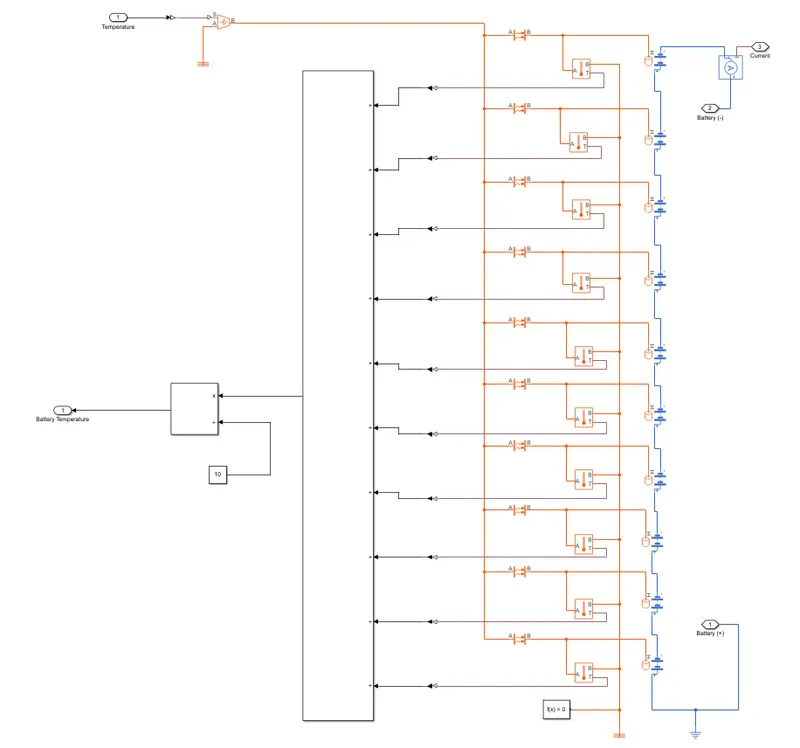
- 10 cells are connected in series to form a battery pack.
- The batteries here are connected with exposed thermal port mode.
- The temperature is transfer to battery by means of convention heat transfer.
- The tempreature of battery is measure by temperature sensor.
- The current sensor calculates the current flowing in the circuit.
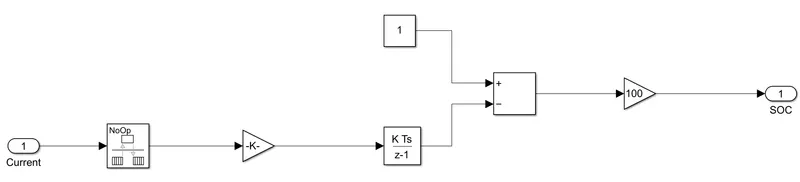
- This current is used to measure the SOC level of the battery pack.
- The SOC is measure by integrating the current flowng battery circuit.
Input Parameters -
- The Current and Temperature values -
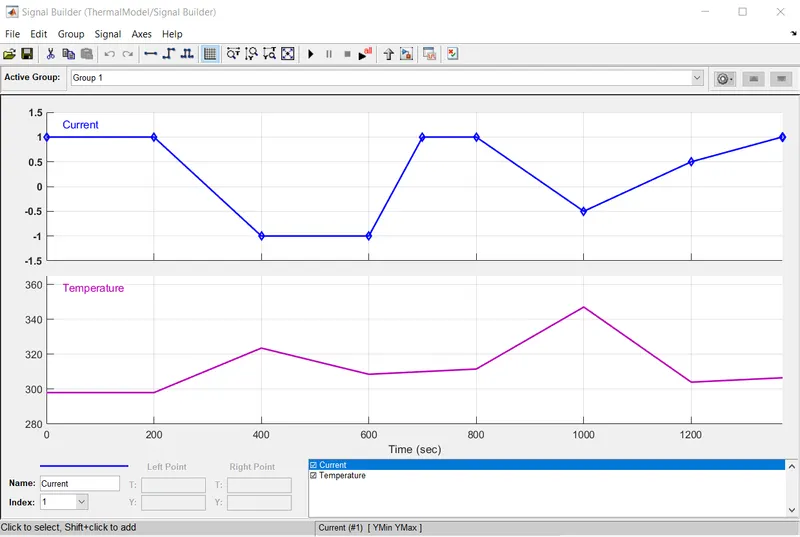
- The Battey Input parameters
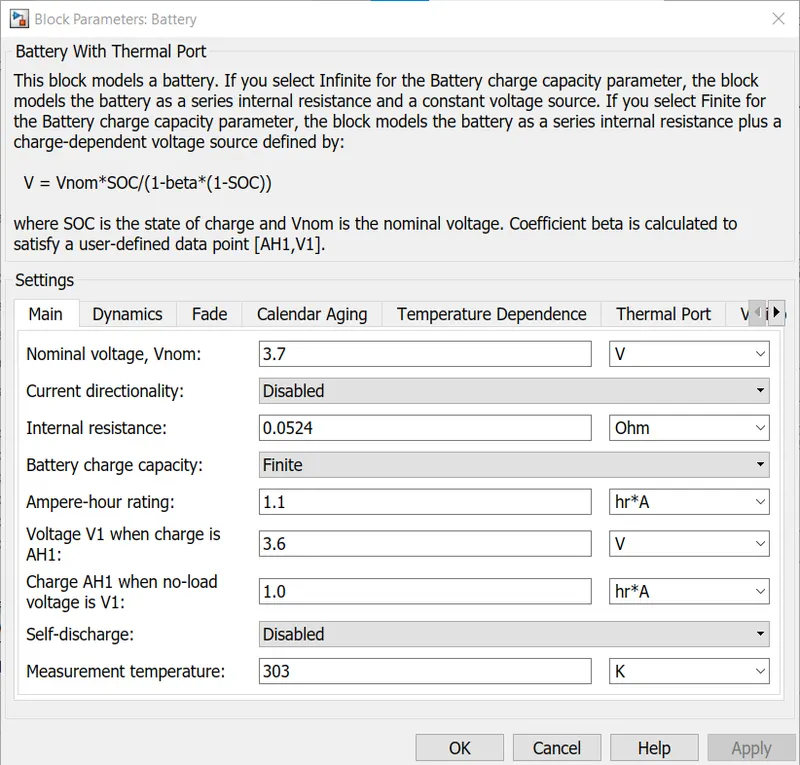
- The stop time is 1370 seconds.
Results -
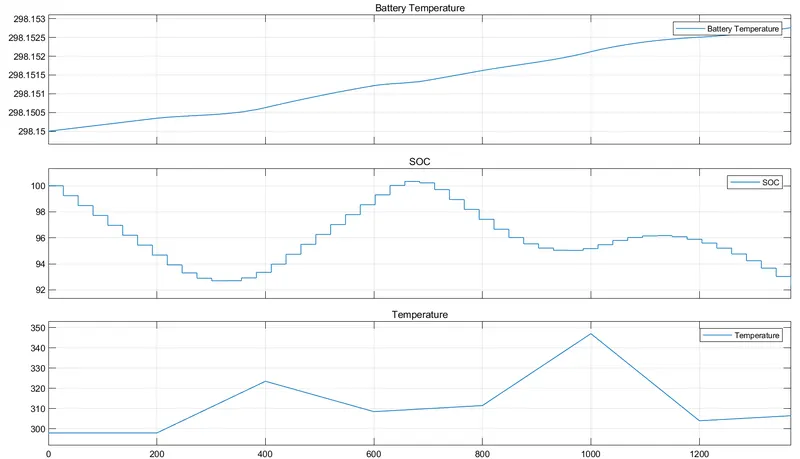
- From the graph we can conclude that when the current is constant (when current is 1A) battery is discharging.
- When the current direction is changed, i.e.-1A, the battery starts charging.
- The battery temperature remains almost constant.
- It increases when there is sudden change in current values.