Project 2 Thermal modeling of battery pack
Aim :- Thermal modeling of Battery Pack.
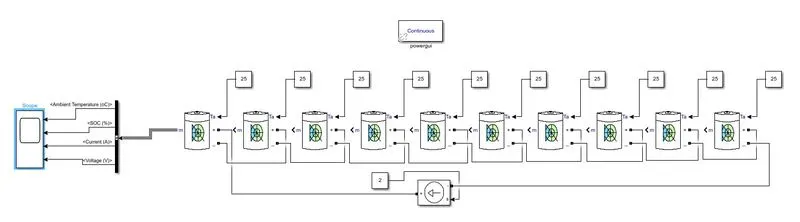
Objective :- Create 10S lithium ion battery model.
Simulate the thermal effects and compare life cycle performance.
Theory :-
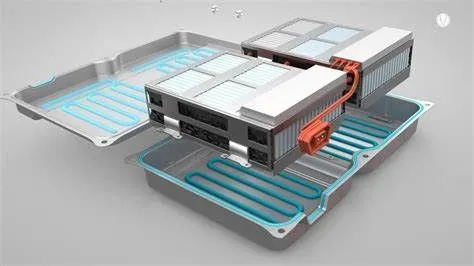
Why Thermal Management System is essential ?
Large variations in temperature of batteries causes reduction in life span & power of battery. It also reduces working of electrochemical systems & efficiency of battery. For example, as temperature falls below -10℃, the performance of Li-ion batteries deteriorates severely, while at high temperature, these types of batteries are prone to uncontrolled temperature build-up. Hence there’s a requirement of using battery thermal management system in high voltage battery pack. For battery packs it's important to manage the pack to stay within the desired temperature range for optimum performance and life, and also to scale back uneven distribution of temperature throughout a pack which might cause reduced performance. If a battery is operated outside of its operating temperature range, then battery thermal management system will always include an indoor switch. This would prevent fire or explosion risk, but the battery also becomes temporarily unavailable. A number of works have reported that Li-ion battery calendar life and cycle life degrade quickly if kept or used at high temperature. A well-designed battery thermal management system will ensure good battery performance, safety and better capacity. Methods like liquid cooling (indirect or direct;passive or active), air cooling (natural or forced), cooling with the help of phase change materials, or combination of them have been used. Natural air cooling or forced air cooling can’t provide uniform temperature to battery pack. By using indirect active liquid cooling method, a large amount of heat can be dissipated compare to natural air cooling or forced air cooling. Some ventilation should always be provided for the passing out potentially hazardous gases generated by batteries. However, it's desirable to stay the cooling fluid break away the battery then for little battery packs, cooling by fluid might not actually be possible. It is known that the desired operating temperature for most Li-ion batteries is 0℃ to 35°C, although ambient temperatures can vary from -50°C to 50°C.
Simulink Model,
Block used in the model,
Generic Battery,
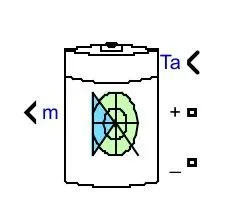
It implements a generic battery model for most popular battery model.We can simulate temperature and aging effect for lithium ion battery using generic battery model.
Controlled Current Source,
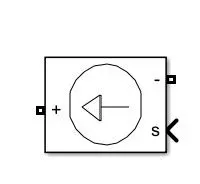
It can provide controlled current in the AC or DC form to charge or discharge your battery to simulate the model.We can provide signals to the block as per our requirement.
Charge At Various Charging Rates and Temperature Rates,
1). Temp = 25 0c , Charging Rate = 2A , t = 1000sec.
Output,
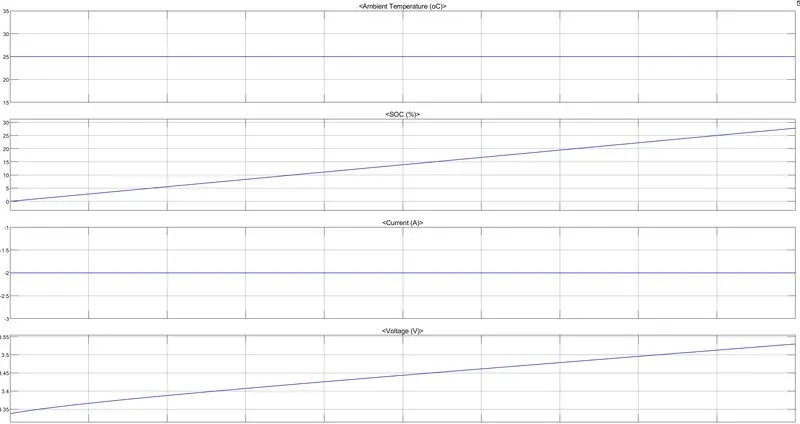
In the above graph as we can our state of charge is increasing from 0 to 28 in 1000 sec of simulation.For the 25 degree Celsius SOC is 27%. And the voltage is increasing from 3.34V to 3.35V.
The table below shows the SOC at different temp range and 2A charge current,
| Temp in Degree Celsius | SOC in % |
| 25 | 27 |
| 35 | 26.3 |
| 45 | 25.8 |
2). Temp = 25 0c , Charging Rate = 4A , t = 1000sec.
Output,
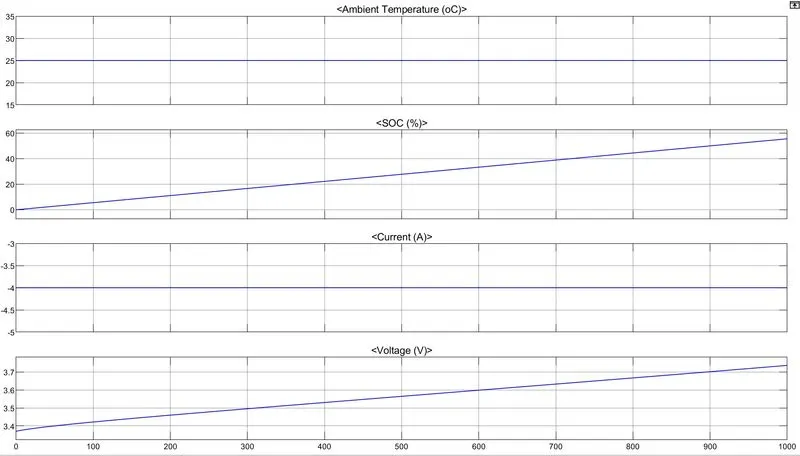
In the above graph the state of charge of the battery pack is 58% at 4A charging rate.Voltage is also increasing from 3.37V to the 3.72V.Increase in temp affecting the SOC as well as voltage of the battery also.
The table below shows the SOC at different temp range and 4A charge current,
| Temp in degree Celsius | SOC in % |
| 25 | 58 |
| 35 | 57.1 |
| 45 | 56.7 |
3). Temp = 25 0c , Discharging Rate = 2A , t = 1500sec.
To observe the battery condition at discharge rate we need to connecct our controlled current source block in inverse direction which is +ve of battery terminal connect to the -ve of the controlled current source block and vice versa.And also change the battery SOC percentage to 100% as we need to discharge it.
Output,
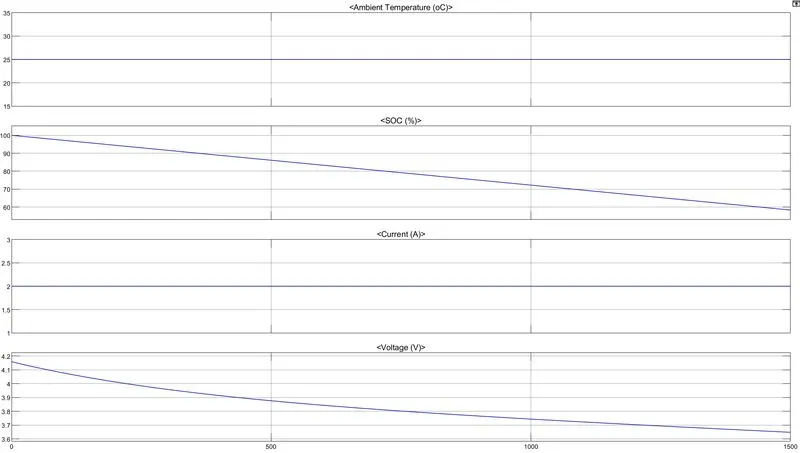
As we can see for 1500sec the state of charge is 58.6 % at 2A discharging rate and voltage of the battery is also getting reduced to the 3.65V,which is 4.16V at the initial stage.
The table below shows the SOC at different temp range and 2A discharge current,
| Temp in Degree Celsius | SOC in % |
| 25 | 58.6 |
| 35 | 55.8 |
| 45 | 55.2 |
4). Temp = 25 0c , Discharging Rate = 4A , t = 1500sec.
Output,
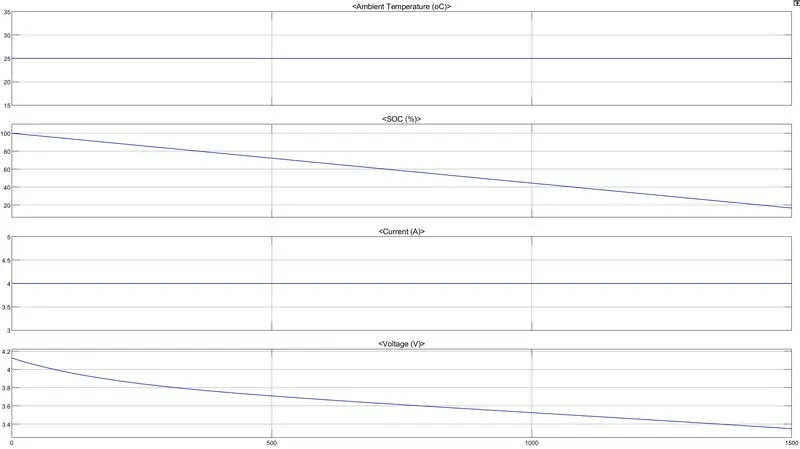
The graph shows the discharge rate 4A for the battery pack.For 1500 sec time span the battery pack got discharge upto 17.5 % which is the current SOC of the battery pack. Voltage also get drop upto 3.37V from 4.14V.
The table below shows the SOC at different temp range and 4A discharge current,
| Temp in Degree Celsius | SOC in % |
| 25 | 17.5 |
| 35 | 15.1 |
| 45 | 13.8 |
Conclusion,
During complition of the project I get to know how temperature can affect the battery pack with various temperature ranges. And also how we can simulate the model using simulink blockset.