Project 2 - Resources, Quality, Safety, and Closer for EPC Project
1.What are the various resources used on the Site, and what factors are considered before they are made available?
Labor
The labour resource concerns the staff involved during a project.
Every employee won't necessarily be engaged for the whole duration of a project. While the project manager are going to be engaged from start to complete, the involvement of others can vary. Staff availability is additionally an element. A personal may be involved in another project at the organization or an earlier activity may have taken longer than planned.
Equipment
As a resource, equipment covers variety items of varying uses. There are computers, monitors, servers, keyboards, telephones, interactive whiteboards and variety of other computing and office items. Desks, chairs, filing cabinets, piece of furniture and it can be machinaries,vehicles are within the equipment resource category.
Equipment is mostly purchased once and used over multiple projects. However, as the company expands, the requirement for more staff and space necessitates more monetary allocation to the present resource. Equipment also has a good life-span.
Materials
Materials are a consumed resource. they're expended within the completion of a project and will also form a part of deliverables.
Office stationery is common example of this kind of resource in project management. Nails, cement and screws are materials within the construction industry; Fuel may be a primary material.It can be steel , aggregates etc.
Money
Money may be a secondary resource type in project management. it's used to purchase, acquire, and maintain all other resources during a project. This is often usually within the variety of investment and business capital.
• Resource mobilization may be a process where resources essential for the event are identified.
• It involves the implementation and continuation of works for achieving project requirements.
• It refers to all or any activities involved in securing new and extra resources for project.
• It also includes maximizing existing resources and using them more effectively.
• Mobilization refers to the preliminary work and operations necessary for the movement of personnel, equipment, supplies, and incidentals to the project site
• E.g., arranging manpower, machinery, and materials as per the project requirements.
Factors Affecting Resource Allocation
• Changes within the Scope of The Project- Projects are always vulnerable to changes.
• Lack Of Resources-Having qualified, skilled resources may be a must for the success of the project.
• Availability Of the Resources.
• Project Dependencies.
• Inefficient Planning.
• Lack Of Teamwork.
The selection of any equipment will rely on many factors.
o Use and condition at the project site:
o Cost of equipment:
Another important factor is that the cost of equipment, which is pivotal in selecting the equipment.
o Efficiency of the equipment
The efficiency includes the capacity of kit together with the flexibility to perform with none downtime.
o Safety requirements:
The safety requirements may dictate the choice of particular equipment over others.
The following steps must be followed before resources are made available
a)Resource planning
Resources are people, equipment, place, money, or anything that you just need so as to try to to all of the activities that you simply planned for. Every activity in your activity list must have resources assigned to that. Before you'll be able to assign resources to your project, you wish to understand their availability. Resource availability includes information about what resources you'll use on your project, when they’re available to you, and therefore the conditions of their availability. Don’t forget that some resources, like consultants or training rooms, need to be scheduled before, and that they might only be available at certain times. You’ll must know this before you'll be able to finish planning your project.
b) Estimating the Resources
The goal of activity resource estimating is to assign resources to every activity within the activity list. There are five tools and techniques for estimating activity resources.
Expert judgment means bringing in experts who have done this type work before and getting their opinions on what resources are needed.
c)Alternative analysis
Means considering several different options for a way you assign resources. This includes varying the quantity and type of resources you use. Many times, there’s over a method to accomplish an activity and alternative analysis helps decide among the chances.
d)Published estimating data
Published estimating data are some things that project managers during a lot of industries use to assist them determine what number resources they have. They depend upon articles, books, journals, and periodicals that collect, analyze, and publish data from other people’s projects.
e)Project management software
PMS like Microsoft Project will often have features designed to assist project managers estimate resource needs and constraints and find the simplest combination of assignments for the project.
f)Bottom-up estimating means breaking down complex activities into pieces and dealing out the resource assignments for every piece. it's a process of estimating individual activity resource need or cost so adding these up together to come back up with a complete estimate. Bottom-up estimating may be a very accurate means of estimating, provided the estimates at the schedule activity level are accurate. However, it takes a substantial amount of your time to perform bottom-up estimating because every activity must be assessed and estimated accurately to be included within the bottom-up calculation. The smaller and more detailed the activity, the greater the accuracy and value of this method.
The Steps of Resource Allocation in Project Management are
1 Create a project plan using an appropriate tool
2 Identify resource requirements for project tasks
3 Find available resources with matching skill set
4 Bridge the demand-capacity gap using multiple channels
5 Allocate resources as per demand
6 Re-allocate resources between projects if required
7 Track and monitor resource usage
2.What is Lean Construction, and how does it affect the overall project's time and cost?
Lean construction may be a relationship-focused production management system that aims to eliminate waste from the whole construction process and deliver greater value to clients.
• There are six principles of lean construction. They are:
o Identifying value from the Customer's point of view
o Defining the value stream
o Eliminating waste
o Flow of work processes.
o Planning and Scheduling
o Continuous Improvement
Below are a number of the key benefits of lean benefits.
• Having less waste and using fewer materials can significantly reduce costs
• Reduced construction time thanks to the increased planning and strategic vision
• Reduced workers and management stress
• Improved results as a result of improved communication and fewer employees
• Increased profits and turnovers
• Improved worker accountability
• Improved customer and job satisfaction resulting in more performance commitment
• Reduced accidents and increased safety in job sites because of increased worker focus and understanding.
3. what's the method of certification of quantity and the way it help within the formation of vendor Bills?
• On site, the contractor must submit an inventory of executed items along with his payment application.
• Check all the documents as per the contract work order.
• Check for vendor quantities available as per PO (purchase order)/WO (work order).
• Check the BOQ quantity as per project specification.
• Documents are routed to the PMC or billing/contracts departments supported the project structure.
• A traditional measurement method is dimension preparation (taking-off) and dimension-processing, which is finished by hand using dimension paper and other tools.
• Actual measurement of the executed quantity or work done is measured within the presence of both the contractor and therefore the client representative.
• The quantity obtained from the particular measurement is confirmed with the BOQ and drawings.
• After due verification and rectification, the Quantity takeoff is transferred to the ultimate billing format.
• These are the documents required for the preparation of contractors bills.
o Summary of Bill
o Certified copy of the measurement book
o Supporting documents of additional claims (if any)
o Legal compliances
o Status of the previously paid bills
o Copy of PO/WO
o Quality Inspection Reports
An invoice may be a document that describes the products and services that a company offers to a customer and specifies the customer’s responsibility to pay money for those products and services. An invoice details what quantity your client owes you when payment is due and what services you rendered.
So once you get the particular quantity this quantity will be used for vendor bills
4.What are different advances in the invoicing and how RA Bill is formed and its approval process?
- Mobilization advance:
- Mobilization advance is a type of advance which is paid prior to the start of work in instalments as specified in the contract.
- If the contract stipulates a time limit for the release of advance payment, the time limit should be followed
- The mobilisation advance may be given in one or more payments, depending on the contract terms.
- The contractor is required to submit proof of use of such an advance for legitimate use of work
- A genuine, irrevocable guarantee/bond of the needed amount, as per contract circumstances, may be delivered in exchange for a mobilisation advance.
- Such a bank guarantee/bond must be independently verified by the bank.
- Payments in projects
- Advance payments
- When a portion of a contractual sum is paid in advance of the exchange, that is, before any work or commodities have been finished, this is known as an advance payment, sometimes known as a down payment or an ex gratia payment.
- Conditions of Advance payment:
- Materials, equipment, and T&P must be for Bonafede use.
- The contractor must use the advance to complete the job.
- The contractor must deliver goods, equipment, and T&P to the job site in a timely manner.
- Conditions of Advance payment:-
- To reduce the risks, advance payments should be returned as soon as possible.
- If the advances are interest-bearing, the interest should be recovered as well.
- Plant/machinery/equipment advance :-
- Only the plant/machinery/equipment required for Bonafede utilisation of work will receive an advance.
- Because the risk associated with such an advance is larger, it is released when the contractor delivers the plant, machinery, or equipment to the job site.
- However, if the contractor's condition changes, the advance should be released accordingly, possibly by obtaining a guarantee.
- If an advance is paid for off site delivery as per contract terms, the contractor must provide a guarantee bond.
- Before releasing advance funds, the employer must inspect the plant, machinery, and equipment.
- The contractor shall hypothecate and insure the plant, machinery, and equipment to the employer.
- The amount of the advance will be determined by contract provisions.
- It could be 5-10% of the contract value in high-value properties.
- Secured Advance:-
- A secured advance is paid on items delivered to the job site, but it is not measured until the contractor signs the indenture.
- The materials must be for use by end user
- Materials should be non-perishable, non-fragile, and non-combustible, and should be used in close proximity to the task.
- If the materials are perishable, the risks are higher, therefore the goods should be insured in the employer's name to cover the risks.
- Advance for work done:
- Sometimes a advance is made against work that has been completed but not measured, and the measurements and payment may take some time to alleviate the contractor's financial situation.
- It must verify that the advance does not exceed the amount permissible for the work performed in this circumstance.
- As soon as feasible, the advance payment should be applied to the measured and passed bill.
- Advance payment for off-site materials/equipment:-
- Advances are sometimes provided against products or equipment on hand at the factory or yard, and other times against invoices or dispatch vouchers if the contractor has paid a large advance payment but has not yet delivered or carried the materials to the job site.
- Because this poses a high danger to the employer, all essential precautions should be taken in accordance with the contract terms and the regulations of the Works Manual.
- In the procurement process, we studied the subcontractors' work order/purchase order award and process.
- The certification is divided into 2 parts
- Quantity certification
- Amount certification
- In the case of a lump sum contract, the quantity certification takes place based on percentage completion, whereas for a unit rate contract, the quantity certification is based on actual quantities.
- The work performed by the subcontractor is recorded and the quantity is monitored.
- The measurement sheet is maintained for the same.
- At the end of the month, the subcontractor raises the proforma invoice based on the work executed during the month.
- The proforma invoice includes the cumulative work done, previously certified quantity, quantity executed in the month, along with unit rate as per the purchase order.
- The proforma invoice is acknowledged and provided to the supervisor monitoring the work of the subcontractor.
- The supervisor confirms the quantity executed by the subcontractor.
- If needed, joint measurement is carried out along with the subcontractor.
- A joint measurement is a record of quantities signed off by the contractor and the subcontractor.
- In case the quantity is found incorrect, the correct quantity is updated to the Cost Engineer
- A Cost Engineer will verify the unit rates used in the proforma invoice match with Work Order (WO) unit rates.
- The total cost of each item is also verified based on the quantity certified.
- The cost engineer will prepare the reconciliation statement, considering the earlier invoices and the current invoice.
- The cost engineer will countersign the proforma invoice before it is provided to the project manager along with the reconciliation statement.
- The Project Manager will verify the documents and sign the proforma invoice before it is submitted to the finance team.
- In case the ERP is used the approval workflow will take place digitally.
- The original hard copy of the certified proforma invoice is submitted to the finance team while updating the details in the ERP system if available.
- Based on the approval of the proforma invoice, the subcontractor would raise the invoice to the contractor for payment.
- Based on the credit period mentioned in the WO, the payment is processed by the finance team considering the advance, retention, deduction, and recovery clauses of the WO.
- This will update the WO pending amount and quantity based on the certification.
- The Cost Engineer reviews if the quantity balance in the WO is enough to complete the work in scope.
- If needed, the process of revising the WO is initiated to avoid the stoppage of work.
- Advance payments
5.Describe the many processes involved in quality management, as well as the various manuals and guidelines that are employed in the process.
A quality management process could be a collection of procedures, which most companies generally follow to confirm the standard of the deliverables. The initiation of a QMP usually involves setting quality targets that the purchasers have agreed to.
Once it's done, then the company starts to manage the standard Control and Quality Assurance Process. These two procedures help the workers in measuring the standard of the deliverables and be told any errors that have occurred.
Various process involved in quality management are
• Engineering quality control:
o Total design assurance arrangement in keeping with design, material selection, specification
o Drawings in step with standards and quality parameters
• Procurement quality control:
o “Ensures that the resulting systems are for the unavoidable people in their use”.
oSo QC is an integral a part of the system and is an important element altogether the tests that are necessary for the acquisition of products.
The nature of the development project is to fulfill the owner's needs in terms of a specified work idea, a budget, and an explicit schedule to satisfy the owner's / user's expectations.
Three key processes, namely, a "Quality Assurance Process", "Quality Control Process", and "Continuous Improvement Process", are set forth to live, report and improve the deliverables' actual quality. These three processes are important components of the standard Management Process are defined below:
Quality assurance (QA) may be a way of preventing mistakes and defects in manufactured products and avoiding problems when delivering products or services to customers, which ISO 9000 defines as "part of quality management focused on providing confidence that quality requirements are going to be fulfilled.
Quality control (QC) may be a process by which entities review the standard of all factors involved in production. ISO 9000 defines internal control as "A a part of quality management focused on fulfilling quality requirements".
Continuous improvement process (abbreviated as CIP or CI) is an ongoing effort to boost products, services, or processes.
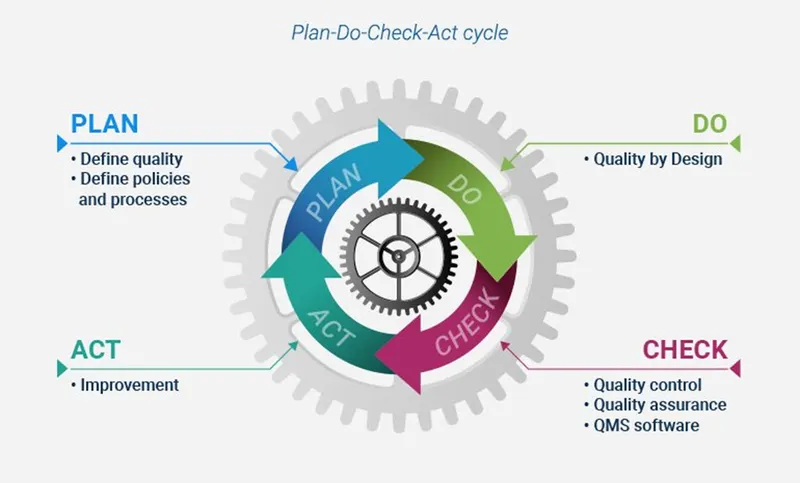
- The ISO 9000 set of standards cover a wide range of quality management issues
- It includes some of the most well-known ISO standards.
- The standards provide organisations with guidance and completeness, ensuring that their goods and solutions are consistently matching the needs of their customers, and that this condition is frequently improved
|
ISO 19011:2011 |
Provides guidance on quality management system internal and external audits. |
|
ISO 9004:2009 |
Focuses on ways to improve the sustainability, efficiency, and effectiveness of a quality management system |
|
ISO 9001:2015 |
Sets the quality management system's requirements |
|
ISO 9000:2015 |
Covers key concepts and language |
- ISO 9001:2015 is the only standard in the family that can be certified, and it aids in the establishment of quality management system criteria (although this is not a requirement).
- It can be utilized by any organization, and in any type of field.
- The quality management system outlines how a business might meet the needs of its customers and other stakeholders.
- The ISO 9001 standard is built on the principles of continuous improvement and PDCA.
- It does not specify what "quality" or "fulfilling customer demands" goals should be, but it does urge firms to set these goals and improve their procedures to achieve them.
6.What are risk and hazard and different occupational hazard on site in detail.
RISK
Risk refers to a situation that's exposed to harm, danger, or loss.
It is the Potential of harm
It represents the Probability
It may be expressed in degrees.
Examples are
Fall of fabric or Fall of person
Property damage or burn
Injury by caught in between
Death or injury from car crash
Death or injury from car crash
Drowning
Environmental Damage
HAZARD
Hazard is defined as something which will cause harm, loss or danger.
It is the Potential source of harm
It represents a entity, situation or setting
It can't be expressed in degrees.
Examples of hazards are
Working at height
Fire
Rotating Machinery Parts
Wet Road Conditions
Poor Visibility
River/Work near water bodies
Plastic Bags
• An “occupational hazard” is Any condition that causes a risk to employee health in any workplace
• According to OHSAS(occupational health and safety standard), there are six major kinds of workplace risks
Safety-Spills on floors, confined spaces, acting from heights, machinery with moving parts, steep stairs, or exposed electrical wiring are all samples of conditions, substances, or objects which will cause injury to a worker
o Chemical-Environmental smoke, cleaning products, acids, CO, pesticides, and flammable liquids are among the hazardous chemicals and toxins found in various workplaces
o Biological-Workers is also exposed to biological health hazards like blood, fungi, viruses, animal droppings, and bug bites in some settings, like zoos, farms, medical offices or hospitals, or veterinary clinics
o Physical-Radiation, prolonged exposure to sunlight, excessively hot or low temperatures, and noise are samples of environmental risks that may affect your body without you touching it.
o Ergonomic-Over time, these dangers place a load on your health. within the short term, you'll feel sore or constrained, but sitting or standing in awkward positions or doing the identical movements repeatedly over time can contribute to long-term injury and sickness
o Work organization hazards-Workplace violence, discrimination, molestation, and other factors may be harmful to one's mental, emotional, and physical health
7.What is hierarchy of control in safety and different ways to mitigate different occupational hazards?
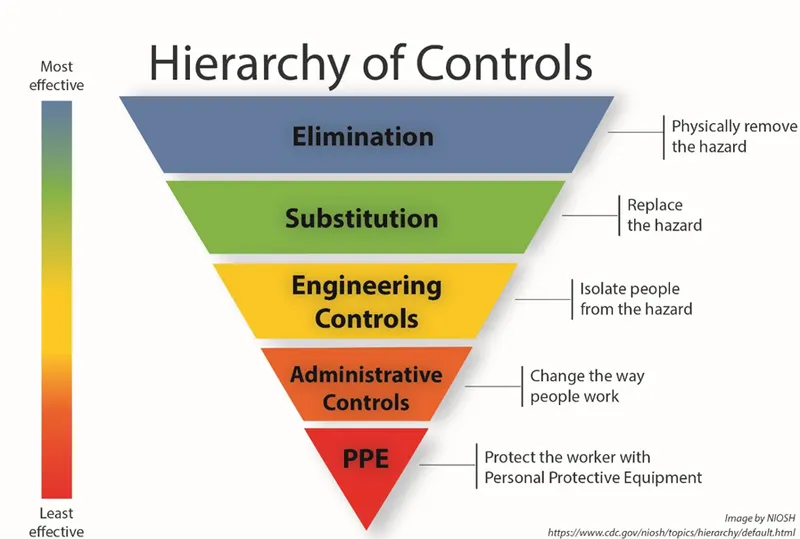
Controlling exposures to hazards within the workplace is significant to protecting workers. The hierarchy of controls may be a way of determining which actions will best control exposures. The hierarchy of controls has five levels of actions to cut back or remove hazards. the popular order of action supported general effectiveness is:
1. Elimination
2. Substitution
3. Engineering controls
4. Administrative controls
5. Personal protective equipment (PPE)
Using this hierarchy can lower worker exposures and reduce risk of illness or injury.
Elimination
Elimination removes the hazard at the source. this might include changing the work process to prevent employing a toxic chemical, heavy object, or sharp tool. it's the well-liked solution to shield workers because no exposure can occur.
Substitution
Substitution is employing a safer alternative to the source of the hazard. An example is using plant-based printing inks as a substitute for solvent-based inks.
When considering a substitute, it’s important to check the potential new risks of the substitute to the initial risks. This review should consider how the substitute will combine with other agents within the workplace. Effective substitutes reduce the potential for harmful effects and don't create new risks.
Elimination and substitution may be the foremost difficult actions to adopt into an existing process. These methods are best used at the planning or development stage of a piece process, place, or tool. At the event stage, elimination and substitution could also be the best and cheapest option. Another good opportunity to use elimination and substitution is when selecting new equipment or procedures. Prevention through Design is an approach to proactively include prevention when designing work equipment, tools, operations, and spaces.
Engineering Controls
Engineering controls reduce or prevent hazards from coming into contact with workers. Engineering controls can include modifying equipment or the workspace, using protective barriers, ventilation, and more. The NIOSH Engineering Controls Database has samples of published engineering control research findings.
The most effective engineering controls:
are a part of the initial equipment design
remove or block the hazard at the source before it comes into contact with the worker
prevent users from modifying or interfering with the control
need minimal user input for the controls to figure
operate correctly without interfering with the work process or making the work process tougher
Engineering controls can cost more upfront than administrative controls or PPE. However, long-term operating costs tend to be lower, especially when protecting multiple workers. additionally, engineering controls can save cash in other areas of the work process or facility operation.
Administrative Controls
Administrative controls establish work practices that reduce the duration, frequency, or intensity of exposure to hazards. this might include:
work process training
job rotation
ensuring adequate rest breaks
limiting access to hazardous areas or machinery
adjusting line speeds
PPE
PPE is equipment worn to reduce exposure to hazards. samples of PPE include gloves, safety glasses, hearing protection, hard hats, and respirators. When employees use PPE, employers should implement a PPE program. While elements of the PPE program rely on the work process and therefore the identified PPE, the program should address:
workplace hazards assessment
PPE selection and use
inspection and replacement of damaged or worn-out PPE
employee training
program monitoring for continued effectiveness
Employers shouldn't depend upon PPE alone to regulate hazards when other effective control options are available. PPE may be effective, but only if workers use it correctly and consistently. PPE may appear to be less costly than other controls but are often costly over time. this can be very true when used for multiple workers on a day after day.
When other control methods are unable to scale back hazardous exposure to safe levels, employers must provide PPE. This includes:
while other controls are under development
when other controls cannot sufficiently reduce the hazardous exposure
when PPE is that the only control option available
Administrative controls and PPE require significant and ongoing effort by workers and their supervisors. they're useful when employers are within the process of implementing other control methods from the hierarchy. Additionally, administrative controls and PPE are often applied to existing processes where hazards don't seem to be well controlled.
1.Eliminate or minimize risks at the source
2. Reduce risks through engineering controls or other physical safeguards
(Use specially coated self-cleaning glass, use movable lift/platform)
3. Provide safe working procedures
(Carry out a secure Job Analysis, and describe safe work procedures)
4. Provide, wear and maintain personal protective equipment
(Harness, helmet)
Identifying high-risk occupations
Data on work-related accidents and diseases is important for improving prevention. Having assessed the economic consequences and also the varieties of accidents that the majority frequently occur at its workplace, an organization can identify “high-risk” occupations or processes and devise better accident prevention strategies to reduce or eliminate future accidents at work.
Since most hazardous conditions at work are, in essence, preventable, efforts should be targeting prevention at the workplace, as this offers the foremost cost-effective strategy for his or her elimination and control.
The most prevalent environmental hazards
WHO concludes that mechanical factors, unshielded machinery, unsafe structures at the workplace and dangerous tools are the foremost prevalent environmental hazards in both industrialized and developing countries and these affect the health of a high proportion of the workforce.
There is a growing body of knowledge showing that the majority accidents are preventable which relatively simple measures within the work environment, working practices, safety systems and behavioral and management practices are able to reduce accident rates even in high-risk industries by 50% or more in a very relatively short period of your time.
Accident prevention programs are a vital and technically feasible a part of occupational health services; they're shown to own high cost-effectiveness and yield rapid results.
The main contributing factors to occupational accidents
The British Safety Council suggested the subsequent main contributing factors to occupational accidents.
The organization lacks a health and safety policy, structure, work involvement and management system
Poor safety culture
Lack of information and lack of awareness of data sources
Lack of, or poor, government policies, legislation, enforcement and advisory system
Lack of incentive-based compensation system
Lack of, or poor, occupational health services
Lack of research and proper statistics for priority-setting
Lack of effective training and education
8. What are the various forms of project evaluation and the way progress are often measured at the Site?
• Project evaluation could be a stepwise process for acquiring, documenting, and organizing information on project outcomes, like short-term outputs (immediate results of activities, or project deliverables), moreover as immediate and longer-term project outcomes (changes in behavior, practice, or policy resulting from the project).
• Project evaluation is usually of the subsequent types:
o Pre-project evaluation
• The only reliable method for evaluating a project before it's started is thru pre-project evaluation.
o Ongoing evaluation
• To make sure that your project is proceeding as planned and meeting all of the scheduling and budget milestones you've set, you want to constantly monitor and report on your add real time.
o Post-project evaluation
• Analyzing the project's results and effects is crucial once it's been completed.
• The effectiveness of the project in achieving the initial objectives and aims is gauged by the outcomes.
• The project's success in bringing a few noticeable change for the audience is also ascertained by its impacts.
o External evaluation
• Another alternative is to rent external companies to try and do project reviews.
• These organizations normally haven't any previous affiliations or involvement with the project, which ends up during a high level of objectivity while performing and finishing the review.
• For projects with a high number of stakeholders or multiple moving parts, external review is useful.
The most common thanks to conduct performance measurement is thru Earned Value Management (EVM). EVM compares cost and schedule progress against project baselines, budgets, and expected future outcomes.
Usually, project managers measure project progress among each milestone, using scope, time and value measures, but real progress may be measured among “the customer satisfaction level” at the achievement of every project milestone.
A Daily report of a construction site is that the day-to-day documentation of the progress achieved in an ongoing project usually consisting of staff contributions, material & equipment inventory, and progress evaluation.
physical progress are going to be indicated in terms of dates, hours worked, and installed quantities.
The following methods is adopted for tracking the progress of the project
1. Comparing the schedule of the project to the particular work that happened
2. Comparing the installed or used quantities with the estimated quantities
3. Checklists for project deliverables and completion rates
9. What are different types of closure in a project and what it's required
This is the final stage of the construction project and is just as important as the other stages.
This is the process of finalizing and documenting all the construction work required to complete the project.
All products are officially finalized and delivered at this stage, and all documents are signed, approved, and archived.
Normal Project:
This level is reached after the project has been completed on time.
Premature Project:
The project was finished ahead of schedule and in accordance with all performance specifications.
Perpetual Project:
The project has been expanded due to the change in limits.
Failed Project:
Need of project closure
Even after the completion of the project, it was deemed to failure as it was unable to fulfill the stipulated requirements.
If you don't have a clear closing procedure in place, you risk losing track of important information, which can lead to confusion, a never-ending project, unsatisfied clients, and even liability issues.
This process ensures that the ultimate stakeholder has the knowledge, tools, and training needed to effectively manage and use the finished product.
The project closing process also assures that the project is officially finished and no longer counts as a project.
Without dedicated support and resources, having finished goods or deliverables is impossible.
Failure to identify the team or persons who will oversee owning and sustaining the solution after it is delivered.
Liability difficulties arise as a result of late payments, contracts, or deliverables.
10.What are the digital technologies being implemented in the construction industry?
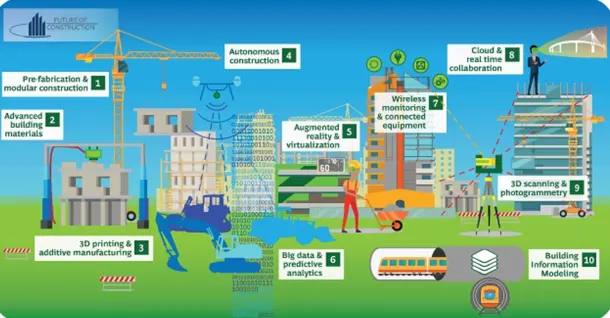
Construction technology can be defined as any tool, software, or machinery used for construction purposes.
Construction technology helps to
Increase productivity
Enhance the construction output
Common Data Environment (CDE)- CDE is a single collaborative platform to capture all project information in one place.
All the stakeholders of the project will have a single source of truth for all information.
5D BIM- 5D BIM is an integration of 3D intelligent models, time as the 4th dimension, and cost as the 5th dimension.
BIM is a 3D model that creates and maintains the information for the 3D elements throughout the project lifecycle.
Scan to BIM- The process of capturing real objects through 3D scanning and turning them into digital models is called "Scan to BIM".
"Scan to BIM" is useful in planning, monitoring, or managing the construction already completed.
The facility management of large process plants, linear projects like pipelines and water lines, greatly benefits from using 3D models of the facility.
Augmented Reality(AR)/Virtual Reality(VR)- Augmented Reality (AR) is a combination of physical reality and virtual reality.
The user can see the designed location of doors and windows, mechanical, electrical and plumbing (MEP) services, and other incomplete items in an empty shell
Virtual reality- It is an extension of 3D modelling where user can feel being inside the simulated virtual world and get interactive computer generated immersive experience.
IoT - IoT is nothing but physical objects with sensors, processing ability, and technology that can connect with other systems over the internet to share information.
Data analytics- Construction work generates huge amount of data during different phases from the following areas
Scheduling,Execution,Design,Contract,Health and safety,Finance,Quality
This data can be analyzed and information can be separated from just data.
It helps responsible people to make an informed decision.
Data analytics is the process of examining data to find trends and extract conclusions.
Machine Learning (ML) in Construction
Machine Learning (ML) is a part of Artificial Intelligence (AI) that teaches machines to learn and process information as humans do.
The amount of data can be crucial in the learning process of the machine.
With more data, greater accuracy can be achieved.
There are many areas in construction which can utilize AI to improve the risk assessment.