Project 1 - Effective project management in the Public sector
Project 1
1MW Palakkuzhi mini hydro electric project
General information about the project:
The Palakkuzhy mini Hydro Electric Project is proposed to harness the yield from a
catchment area of 5.24 km² of Palakkuzhi stream, alittle tributary of Bharathapuzha, in
Kizhakkenchery Village, Alathur Taluk, Palakkad District. This site was also included within the list
of small hydro sites identified by the Kerala State Electricity Board way back in 1990.
The Palakkuzhi Small Hydro Power project with installed capacity of 1000KW ensuring 3.78 MU of energy once a year gains importance during this context
The DPR prepared by KSEB has been updated by IRTC who are consultants of the Palakkuzhy project. The civil and hydro-mechanical design has been made by Aarvee Associates,Hyderabad
1.what's the method of Tendering? And why it's required.
The term tender refers to an invite to bid for a project. Tendering usually refers to the method whereby governments and financial institutions invite bids for giant projects that has got to be submitted within a finite deadline. The word tender can even check with the acceptance of a proper offer, like a tender offer.
Simply put, a tender is an offer to do a particular work or supply particular goods at a particular price. Also referred to as a bid, it is a process whereby businesses have the opportunity to put forward their goods or services at their price to the organisation that has put out the tender.
The work is divided into three parts .
1.Dam site
2.Penstock route
3.Power house
The competitive e-tender process includes an award for engineering, procurement, and construction of A diversion weir 72m long, 25m long spillway in the middle and non-overflow sections of 27m and 20m length on right and left bank respectively. An LPP of 294m length and 0.9m diameter to convey the waters from the dam intake to Penstock intake.A single inclined Penstock of 425 m length and 0.6 m diameter penstock branching into two horizontal feeder pipes of 2X13 m length and 0.40 m diameter each, near the Power Station.A power station size 18X12 housing 2 machines of 500 each 3.78 Mu of energy will be contributed by this scheme annually.The project cost is 13 crore
2.How mode of Tender is selected & tender is Floating for the Bidding process.
Buying/Tendering authority releases the tender notice by publishing it on their official websites and/or via local/national newspapers. All the interested bidders/contractors can submit their technical and commercial proposals along with the pre-qualification bid.
In order to 'Float' a tender', you will have to provide publicity to it by publishing it on the newspapers and websites and then create a mode to invite and receive tenders and follow up procedures, etc.
Here the company is calling for bids from contractors who have Previous experience of similar work Availability of Plant, Equipment and Machinery., Availability of Technical and Managerial organization.
The bidder should have an aggregate turnover of not less than 75% of the probable amount of contract of the project bidded for the last three completed financial years and the annual turnover for each of the last three completed financial years of the bidder should not be less than 25% of PAC.
In case of joint venture, all partners combined shall meet the requirement. However the lead bidder should have a consolidated turnover of not less than 30 % of PAC for the last 3 years.
The 4 main types of tenders are:
- Open tender.
- Selective tender.
- Negotiated tender.
- Single-stage and two-stage tender.
Here it's an open tender . Both the government and the commercial sector use open tendering as their primary procurement method.
- Anyone can file a tender to supply the goods or services necessary under open tendering, and every organisation has an equal chance.
- Any interested contractor will be able to submit a bid when an invitation to tender is published in electronic and print media.
- A deposit is usually required to obtain tender paperwork, which deters frivolous applications.
- Mostly adopted by public bodies.
- There can be local, national, or international competitive bidding - LCB, NCB, or ICB.
- Advantages are
- Maximum Competition
- There is no favoritism
- Beneficial for new businesses seeking to establish themselves.
3.What are the different kinds of contracting modes and the suitable work type with suitable tender modes?
Different types of contracting methods are
Lumpsum
Item rate
Percentage rate
Cost plus fixed fee
Target cost
Etc.
Here the company chose item rate contract
In item rate contract
- The client provides the design, drawings/specifications, and item-wise BOQ to the contractor with tender documents.
- The contractor quotes itemised unit rates to the client.
- The client assumes the design and quantification risk, and the contractor assumes the cost estimation risk.
- Most of the time, the rates are binding on the contractor, while the BOQ is not binding on the client.
- The contractor is paid based on the actual measurement of executed quantities.
- Important checkpoints for clients and contractors:
- On the basis of measurement and justification for engineering
- Additional Items - Claims
- Large-scale public-sector projects
- Suitable for the work, which might be divided into appropriate parts or items.
- Contractor Payment Methods
- Contract suitability for item rate
- The pros of this contract are
PROS
Costs will be calculated at the beginning of the project.
The contractor gets the money for work done at the site.
Cost control by monitoring each item of the BOQ
Risk is minimised by providing the right BOQ.
4.Explain Key plans to execute the awarded work.
So after awarding the work, the following stage is to come up with a correct plan for the execution
The planning involves initially sorting out the various activities involved within the entire project work
The work is assessed into three sub categories i.e. a correct work breakdown structure is formed.
The main activities are classified under the subsequent main headings
Ie.
Level 1 civil works, electrical works,mechanical works
level 2 -Dam site, Penstock route, power house (under civil works)
Level 3 will Include all the development activities under these level 2 headings
Then a correct schedule is requested for the contractor for the completion of activities. And as per the contracts the proposed completion is 4 years after awarding the tender
So the team will prepare a schedule consistent with that .
5.How Project Management is very important within the successful completion of the project. How time overrun is controlled.
Project management may be a proactive process that seeks to assist the correct people do the correct tasks at the correct time. Without a group project management method, many teams tend to figure reactively—handling issues as they arise instead of proactively planning for known risks and setting project goals and parameters from the start.
Project managers help teams break down a project into more manageable pieces. By breaking the project into a transparent process of assigned tasks, milestones, and deadlines, project managers can direct their teams more efficiently and react to issues with greater agility.
It helps in realistic planning and also it allows your team to concentrate on the work that matters, free from the distractions caused by tasks that are going off track or budgets spinning out of control. It empowers them to deliver results that will actually impact the business's bottom line.
Time overrun is defined as " a condition where a construction project doesn't complete within the designed schedule ". Different stakeholders are to blame for delay in construction projects.
The key factors causing construction time overrun were: financial problems, unrealistic contract durations imposed by clients, poorly defined project scope, client-initiated variations, under-estimation of project cost by consultants, poor inspection/supervision of projects by consultants.
The delay in a construction project can be avoided by taking actions like
Always expect the unexpected.
Say “no” to tight deadlines.
Keep project documentation readily available.
Get it in writing.
Trust in your team.
Always do the cost analysis before starting a project.
Set clear expectations from the beginning.
Don't underestimate the quantity of work involved.
Make a resource management plan.
Build some buffer into your estimates.
Split up projects into phases.
Following steps may be taken for the management of your time overrun
Understand the actual reasons why your budget overrun.
Create an action plan.
you have to be responsive to your customers and subcontractors.
Talk to your team honestly and agree on the priorities.
Try to retrieve the budget, but do not be greedy.
6.What are the tools utilized in Project Management?
- Gantt Charts
Gantt chart is one of the highest project management tools. A Gantt chart may be a visualization of your project timeline and also the dependencies between your various work items.
Gantt charts are helpful to keep track of the project schedule, checking for any deviations from the project plan and identifying delays. Businesses can continue track of their planned schedule and budget with the assistance of Gantt charts. And if things don't go as planned, Gantt charts help in identifying the critical tasks which will ensure your project gets completed on time.
- Project Baseline
A project baseline could be a graphical way of representing your project values by comparing the baseline which is that the standard you set for your project against your actual performance.
The project baseline could be a project management tool that encompasses the scope baseline, cost baseline, and schedule baseline. Your baseline helps in tracking your real-time progress. It may also help avoid scope creep by
1.keeping the unplanned activities under check.
2.Communication and coordination between parties.
3.Slowness in decision making process.
4.Suspension of work.
- Communications management plan
A project communication plan is a tool that ensures there's a regular, relevant flow of information between the project members, clients, and other stakeholders. The plan includes details regarding who communicates what, to whom and the way often.
This project management tool ensures everyone involved is kept within the loop, and it helps maintain relationships. There's the plain advantage of keeping your stakeholders within the loop, since satisfying their needs is an integral part of a project's success. A communication plan will help tackle any risks that will arise and improve collaboration among the members of your team.
4.Project monitoring and control activities
Monitoring and control keeps the projects on track. The right control methods can play a major part in completing projects on time.the information gathered also lets project managers make informed decisions. they will benefit from opportunities, make changes and avoid crisis management issues.
When putting in place a project’s monitoring and control process, first establish the project baselines. This includes the scope, schedule and budget. Use this information to benchmark the project’s progress throughout the life cycle.
5.Planning & Scheduling
Planning and scheduling are important features of any Project Management tool. To manage and synchronize a team in an exceedingly proper manner, it's important to keep each and each team member’s tasks and responsibilities visible and distinct. A decent project management tool will facilitate your effortlessly planning and assigning tasks to your team members, together with the due dates. it'll also aid in setting priorities and selecting deadlines. Moreover, it'll notify you whenever your project nears the scheduled completion date but your activity remains incomplete.
7.What are the roles of the Supply Chain in the smooth and successful completion of the project?
Supply chain management is the administration of the movement of products and services. It includes all procedures that transform raw materials into finished products.
Supply chain project management may be a process that enables you to coordinate resources and activities so as to deliver an outlined goal within a group timeframe, budget and scope.
Its inclusion actively simplifies the availability side processes so on increase consumer value and achieve a competitive advantage within the market.
The other benefits of supply chain management are
Better collaboration. Information flow could be a prominent challenge for companies. ...
Improved internal control.
Higher efficiency rate.
Keeping up with demand.
Shipping optimization.
Reduced overhead costs.
Improved risk mitigation.
Improved cash flow
8.What are the tools and measures for cost control? And why cost overrun needs to be controlled and the challenges.
- Cost management is the process of estimating, assigning, and regulating the prices of a project's execution.
- It comprises compiling, analysing, and reporting cost data so as to raise budget, forecast, and track expenditures.
- Cost management is undertaken at this stage to form a competitive offer.
- Before construction projects, anticipate and control the goal cost, then establish the expected cost, and eventually, determine if the bidding offer supported proper profits.
The challenges in cost management are lack of resources,outdated technology,Inaccurate estimations etc.
Cost management can prevents overruns
That is project managers can avoid overspending on specific areas by allocating costs early within the planning process. A wise budget will include a risk allowance to ensure that the project's success isn't jeopardized by unexpected costs. Also, it aids future planning like resource optimization is aided by cost reports. within the future, this might cause more accurate budgets.
The goal of cost control is to ensure that the project's ultimate cost doesn't exceed what was budgeted or intended.
The process of project cost control may be divided into following steps:
- Observe the value expended on an item, an activity, or a set of activities.
- Compare it with available standards.
The standard can be a predefined accepted cost estimate or it might be the tender estimate
- Calculating the variance between the observed and therefore the standard.
- Communicating any warning signs immediately to the concerned people so timely corrective measures are often taken.
The following tools are adopted for cost monitor and control
Scheduling/time/progress control
Monthly report
Measuring progress in site
Typical reports to help the progress review
The following are the challenges/reasons for cost overruns
- Lack of the detailed project budget outline.
- No contingency plan in effect, resulting in unexpected costs spiraling out of control.
- Not using any tools to trace project spending.
- Incomplete resource utilization plan.
- Not tying costs to specific tasks or making a piece breakdown structure.
cost over run are often controlled by
Thorough Project Planning.
Know Your Vendors.
Use a Project Planning Tool.
Keep Stakeholders Updated.
Monitor Progress.
Reassign Resources.
Earned value analysis and unit costing are the samples of measures which we will use for cost monitor sand control
In earned value analysis Earned value (EV), also referred to as Budgeted Cost of work Performed (BCWP), could be a project success metric utilized by project managers.It's the relationship between a project's budget and therefore the proportion of the time it takes to complete it. it is a method for measuring the status of any project by taking into consideration time and price.
Unit costing is additionally utilized in those industries where production is continuous and units are identical. In Unit costing costs are accumulated and ascertained for every element of cost and cost per unit is calculated by dividing the total cost by the number of units produced.
It is possible to estimate the project's total cost and an estimated completion date.
The forecasts are also used to define trends and measure variances.
As a result, if there are any unfavourable trends or variations, the project manager can take the mandatory action.
Project cost reports are normally issued monthly during this system.
Thus, the report aids in monthly cost review, comparing the particular cost to the estimated main products and performing corrective steps within the event of cost overruns.
This also aids within the frequent evaluation of the anticipated total cost and expected profit at the site level;
The cost statement is the most significant input for creating the project cost report.
Careful collaboration between the accountant and therefore the engineers is crucial within the compilation of this report for the formation of the value statement.
9.Co relate and explain Earned Value with Cost Control. Give an example.
- Earned Value Management (EVM) is the methodology that measures the performance of a project based on the physical progress and cost expended.
- Project managers can determine whether a project or its operations are on schedule and within budget by using various parameters.
- The potential cost at the conclusion of the project can also be determined using EVM in a variety of ways.
Earned value (EV), also known as Budgeted Cost of Work Performed (BCWP), is a project success metric used by project managers.
It's the relationship between a project's budget and the proportion of time it takes to complete it.
|
Performance Measure |
Formula |
Description |
|
Schedule Variance (SV) |
EV-AC |
Indicates the difference between the budgeted cost and actual value of work completed at a given point in the project. A positive number indicates that project expenditures are less than expected. |
|
Cost Variance (CV) |
PV-AC |
Indicates the difference between the budgeted cost and the actual cost at a point in the project. A positive number indicates that project expenditures are less than expected. |
|
Cost Performance Index (CPI) |
EV/AC |
Compares expenditures to actual value at a point in the project. Values greater than 1 indicate a positive situation in a project with expenditures below budgeted amounts (under budget). |
|
Schedule Performance Index (SPI) |
EV/PV |
Compares the expected value (planned work and project results at a point in the project to the actual value of work achieved. Actual value at a point in the project. Values greater than 1 indicate a positive situation in a project with the volume of work (productivity) exceeding the plan. |
- Assume that the activity has an original budget of Rs 1000. In a particular period of project the planned % of activity is 40% whereas actual progress is 30%. The cost expended to perform the activity till date is Rs 350. Then different EVM parameters are as below:
- PV = 40% x Rs 1000 = Rs 400
- EV = 30% x Rs 1000 = Rs 300
- AC = Rs 350
- In our example, SV = Rs 300 – Rs 400 = -Rs100 indicates that activity is behind schedule.
- In our example, CV = Rs 300 – Rs 350 = -Rs50 indicates that activity is having cost overrun.
- In our example CPI = 300/350 = 0.86 indicating activity is performing with only 86% efficiency of the cost plan and hence over budget.
- In our example SPI = 300/400 = 0.75 indicating activity is performing with only 75% of efficiency of schedule and hence behind schedule.
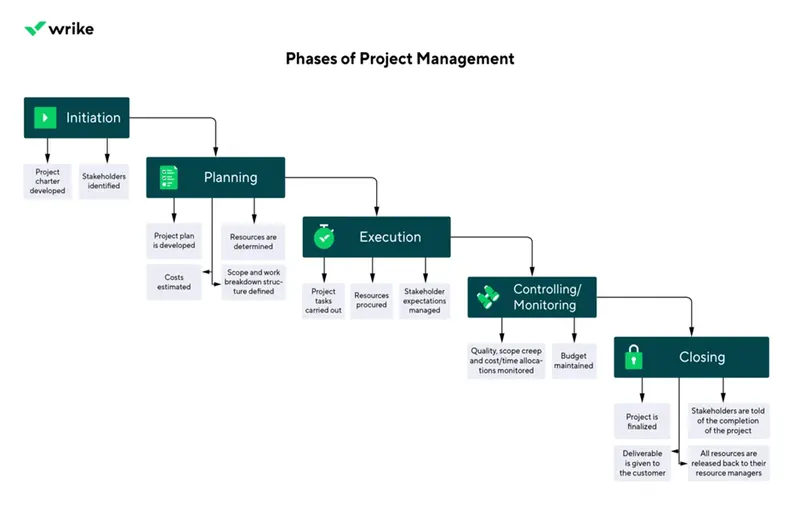
10.Draw a Flow Diagram of the above topics.
The following flowchart shows the different phases of construction and activities involved in each phases