Project 2 - Modeling of 3 phase Induction Motor Drive
Aim: Electric vehicle application using an Induction Motor.
EV Refresher Batch-5
Simulation Model of Direct Torque control of an Induction Motor Drive.
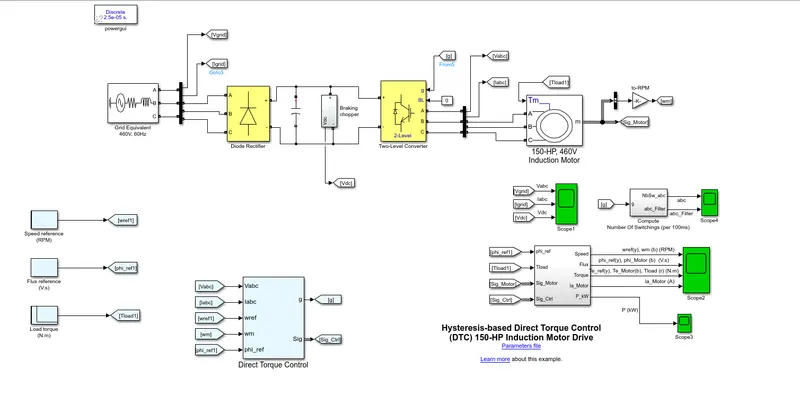
Above shows the Simulation model of Direct torque control Induction Motor Drive. In this model DC bus is connected to a three phase, two level converter.
These converter generate the variable voltage and the frequency required for variable speed operation of the induction motor.
Direct Torque Control (DTC) is an optimised AC drives control principle where inverter switching directly controls the motor variables: flux and torque.
The measured input values to the DTC control are motor current and voltage. The voltage is defined from the DC-bus voltage and inverter switch positions.
Result:
When
- Initial Speed = 1500 RPM
- Final Speed = 500 RPM
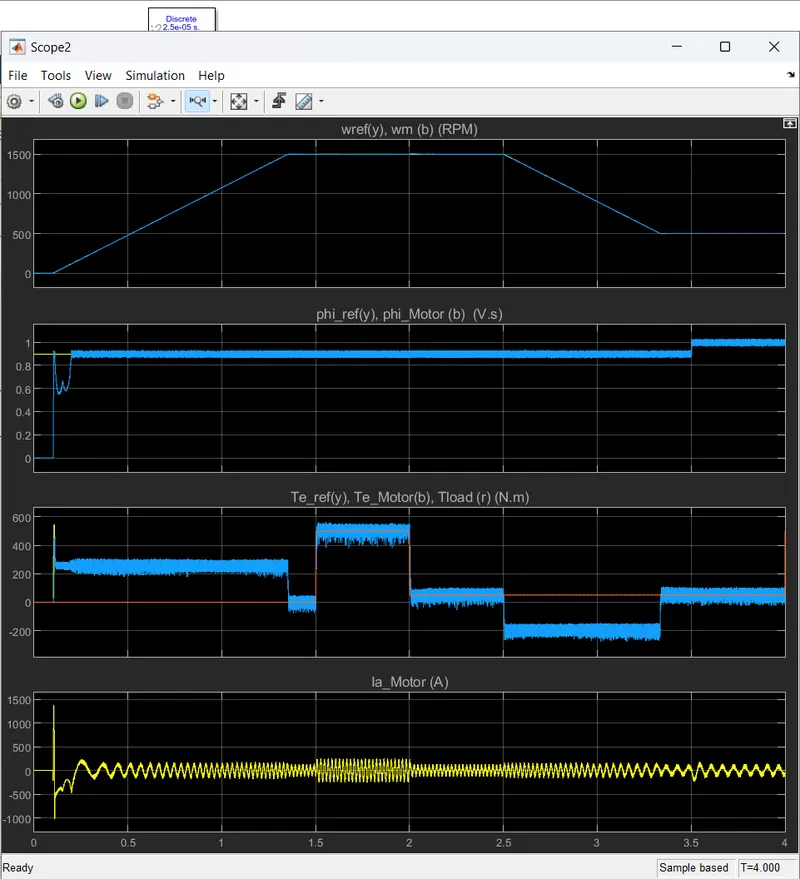
flux reference is set before simultaion.
Here is the At 0.1 s speed referance is set to 1500RPM. and the motor starts to accelerate. The motor speed precisely follows the speed reference. The 1500 RPM set point is reached at 1.35 s.
At 1.5 s, a load torque of 500 N.m is applied to the motor. The DTC control operates to maintain the motor speed at 1500 RPM.
At 2 s, the load torque is reduced to 50 N.m and at 2.5 s, the speed reference is reduced to 500 RPM. Observe on Scope 1 that the braking chopper operation dissipates the kinetic energy produced by the motor in order to avoid overvoltage on the DC bus. Finally, at 3.5 s, the flux reference is increased from 0.9 to 1.0 V.s.
When
- Initial Speed = 1500 RPM
- Final Speed = 1000 RPM
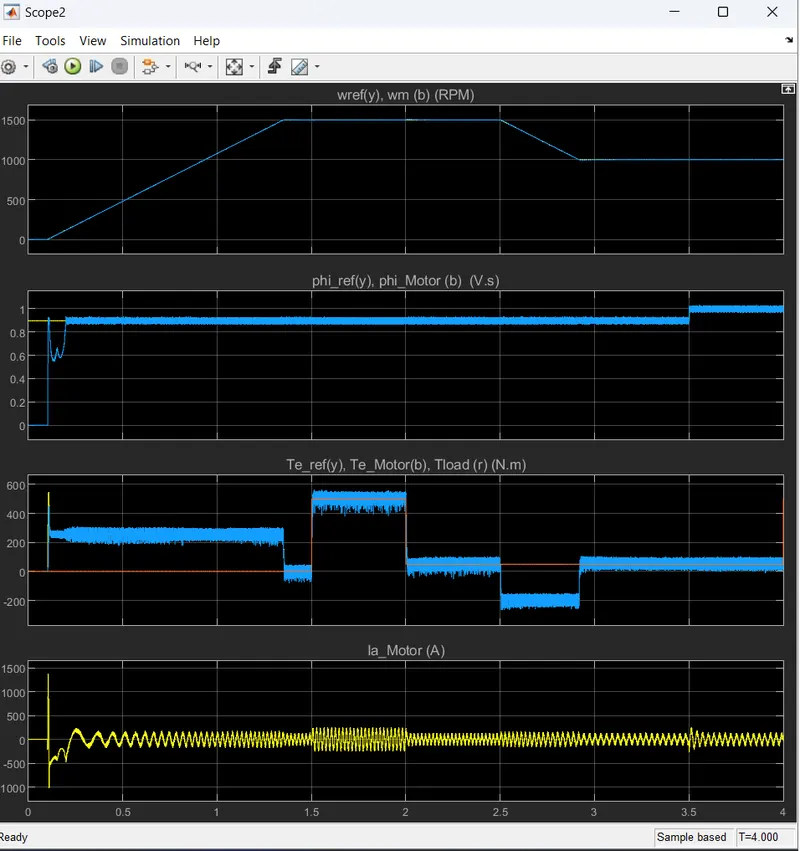
Here is the At 0.1 s speed referance is set to 1500RPM. and the motor starts to accelerate. The motor speed precisely follows the speed reference. The 1500 RPM set point is reached at 1.35 s.
At 1.5 s, a load torque of 500 N.m is applied to the motor. The DTC control operates to maintain the motor speed at 1500 RPM.
At 2 s, the load torque is reduced to 50 N.m and at 2.5 s, the speed reference is reduced to 1000 RPM. that the braking chopper operation dissipates the kinetic energy produced by the motor in order to avoid overvoltage on the DC bus. Finally, at 3.5 s, the flux reference is increased from 0.9 to 1.0 V.s.
Applications:
- Lifts.
- Cranes.
- Hoists.
- Large exhaust fans.
- Lathe machines.
- Crushers.
- Oil extracting mills.
- Textiles.
Conclusion:
In this project we learned about Direct Torque control of an Induction Motor Drive.