Project 2 - Clinical Investigation Plan
Due to recently implemented regulations for medical devices and in vitro diagnostics (IVD), the medical device industry is taking a major step towards the strictly regulated world of pharmaceuticals. Clinical data requirements for medical devices and IVD products have been sharpened considerably, and the previously feasible option of riding piggyback on clinical
data from similar, marketed products has become very difficult.
Many legacy devices (i.e., existing CE-marked devices) are therefore in a situation where they need to acquire more clinical data, sometimes complemented by slimming their device claims to limit the amount of data required. Devices not yet on the market need a plan to collect sufficient clinical data before applying for their CE mark.
The market for compiling study documentation for the medical device industry is therefore booming.
Regulations
First, make sure to comply with applicable regulations, standards, and guidelines. In the EU, medical devices are regulated
under the Medical Device Regulation (MDR), IVD products under the In Vitro Diagnostics Regulation (IVDR), and pharmaceuticals under the Clinical Trials Regulation (CTR).Medical device investigation protocols must follow the ISO 14155 standard for good clinical practice (GCP) and IVD study protocols the ISO 20916,5 whereas the pharmaceutical industry follows the International Conference on Harmonization guideline E6 (ICH E6).
Always consider if other standards (e.g., product-specific) and national guidelines also apply. Although the EU is in the process of centralising guidance for collecting clinical data, the work is not complete and additional requirements may exist. In case of
differences between standards, the most stringent requirements always apply.
Although the medical device industry is incorporating increasing vocabulary from the
pharmaceutical industry, differences still exist.
Some of the most important differences in terminology are presented in Table 1. Clinical studies are divided into phase I to
phase IV studies, whereas clinical investigations use a different terminology referring to pre- and post-market investigations, where pre-market clinical investigations are further divided into pilot stage or pivotal stage investigations. 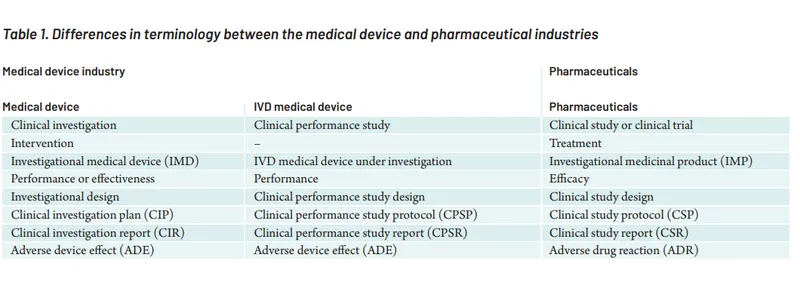
When embarking on writing a CIP, start by reading the clinical evaluation plan (including the clinical development plan), clini -
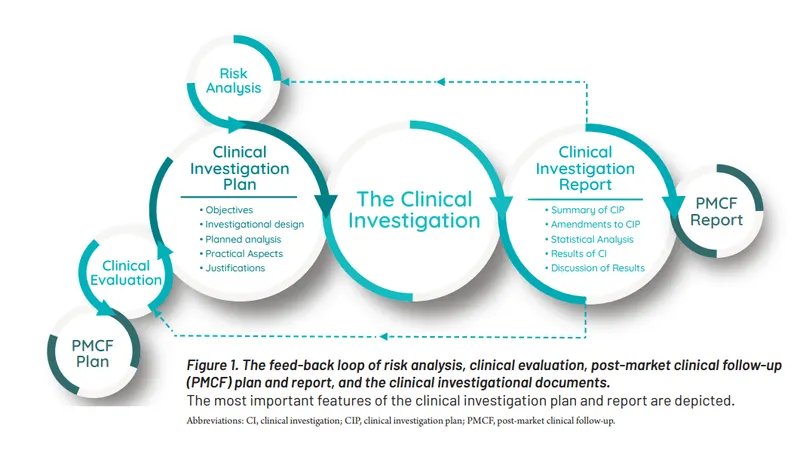
cal evaluation report, risk management report, and if available, the post-market clinical follow-up (PMCF) plan. If these have not been recently performed or updated, stop, and take a step back. They are essential building blocks laying the foundation for planning a clinical investigation, as described below. Ultimately, results from the completed investigation will be fed back into the PMCF report and into the risk analysis and clinical evaluation documents, which should be updated with the new clinical data, re-assessing their benefit-risk conclusions. This feed-back loop between risk analysis, clinical evaluation, PMCF, and clinical investigations, is illustrated in Figure 1.
Clinical evaluation
A clinical evaluation is a requirement for all medical devices according to the MDR. During a clinical evaluation, pertinent data in relation to the device under evaluation and similar devices is identified through a systematic literature review, and by gathering manufacturer data. The state-of-the-art of the medical field is defined and the clinical data is appraised, analysed, and summarised in a clinical evaluation report.
Potential gaps between existing data and data required by current regulations, are detected, and highlighted. In other words, a well-performed clinical evaluation identifies the need for a clinical investigation as well as appropriate endpoints, acceptance criteria, and investigational design, and hence lays the basis for planning a clinical investigation.
Risk analysis
Risks associated with the investigational medical device and any related clinical procedure should also be estimated when planning a clinical investigation, in accordance with ISO 14971.Residual risk according to an initial risk analysis, and risks to the subject related to the clinical procedure or required follow-up procedure, must be balanced against anticipated benefits. In
simpler words, a risk-benefit balance must be achieved.
The clinical investigation plan
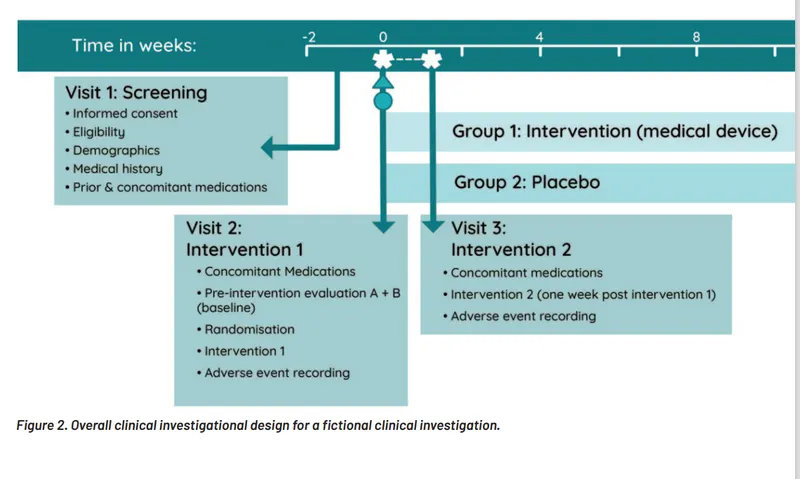
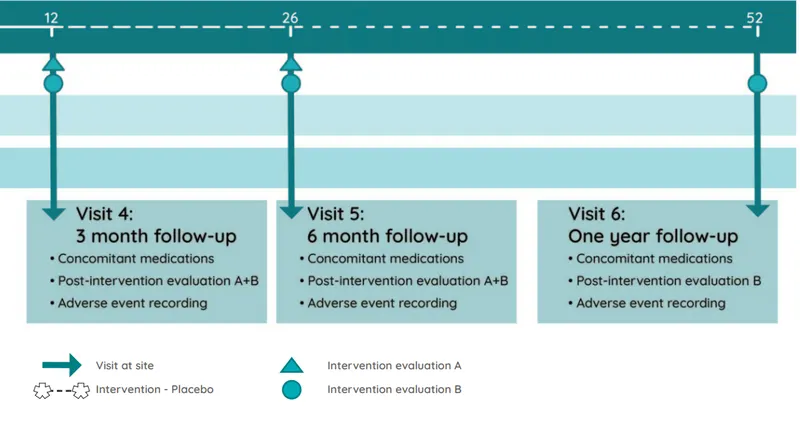
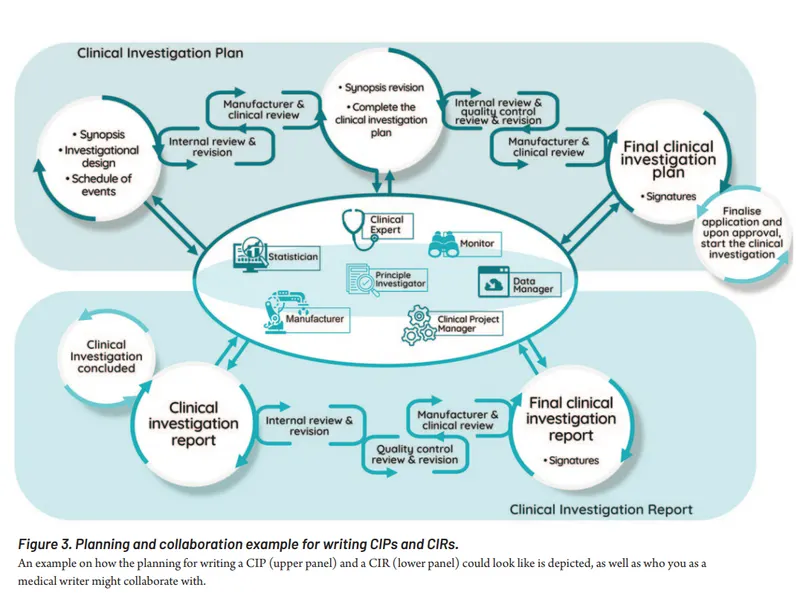
The CIP is the key document of the clinical investigation, and the basis of the application sent to the Ethics Committee (EC), and potential competent authority, for approval. A CIP must clearly outline all objectives of the clinical investigation and justify them based on scientific and ethical principles. The CIP should present the investigational design and methodology, including details on intervention and control groups, number of visits, their timepoint and content, defined endpoints, and a rationale for the chosen design. A way to facilitate the understanding and presentation of the investigation is to include a schematic figure of the overall clinical investigational design.
In Figure 2, an example of such an image from a fictional clinical investigation is presented. It is also common, and advisable, to include a table summarising the frequency and timing of clinical visits, and what will be done during each visit (e.g., procedures, lab tests, etc.). This table is called the schedule of events or schedule of activities, and is equivalent to the similar table that would be found in a clinical study protocol for an investigational medicinal product.
Principal features of the statistical analysis to be performed must be included in the CIP, as well as practical aspects such as the organisation, conduct, monitoring and record-keeping of the clinical investigation. For example, processes for how the informed consent shall be obtained, and how to capture data for each enrolled subject,
should be specified. Importantly, all anticipated adverse device effects (i.e., adverse events related to the use of an investigational medical device) must be presented, together with a rationale for the related benefit-risk ratio.
The coordinating investigator and the sponsor must sign off on the content of the CIP before the
application is submitted. Principal investigators (PIs) for all participating sites, must agree to conduct the investigation accordingly, typically by signing the final CIP (i.e., the version
approved by the EC and competent authority).
Any changes to the CIP after its approval, must be described in an amendment that must also be
approved, if considered substantial.
Although all information required by applicable regulations and guidelines should be present in a CIP, it’s not always necessary to include a full description of this information, e.g., when it comes to data management, statistics, and monitoring. An option is to provide a short description in the CIP and refer to a separate document for details. This may save time and reduce costs, as these separate documents can be updated without affecting the CIP, thus reducing amendments, and approval rounds. Note however, that for less complex investigations it
can be easier to keep everything in the CIP.
The clinical investigation report
Once the investigation is closed and the statistical analysis has been performed, it’s time to write the CIR. A CIR is always required, even if the clinical investigation is terminated prematurely. The main goals of the CIR are to describe the clinical
investigation’s design, conduct, statistical analysis, and results. In other words, the CIR should summarise the CIP, explain any deviations from it, and present and discuss the results of the clinical investigation. The discussion should include a critical appraisal of the results compared to stated objectives.The CIR must include data from all participating investigational sites so not to exclude any non-favourable data, and must never reveal subject identity. Ideally, all PIs should review the CIR. The final CIR requires signatures from the sponsor and coordinating investigator (or PI for single-centre investigations), before being made available to the EC and/or applicable regulatory authorities, depending on the country. The results from the clinical investi gation should also be published in a publicly accessible database, and as mentioned above, should be used to update the risk analysis and clinical evaluation.
CLINICAL INVESTIGATION DESIGN
1 General clinical investigation design and justification of design
Note: The scientific integrity of the investigation and the credibility of the data from the investigation depend
substantially on the design of this investigation.
Describe the design of the investigation and its rationale, the type (e.g., blind – who is blinded, with comparator,
parallel design), allocation ratio and framework (e.g., superiority, equivalence, non-inferiority, exploratory).
Provide a description of intended procedures and stages, the expected duration of subject’s participation,
description of sequence and duration of all investigation periods, incl. follow-up. Provide a discussion of the
known or potential problems and limitations of the design.
The following information should be included in this chapter:
Intervention to be studied (MD and procedures),
Population to be studied and the number of subjects to be included (if known or applicable),
Level and method of blinding/masking (e.g. double-blind, open, blinded evaluators and unblinded subjects and/or
PI(s)),
Kind of comparator(s), (e.g. sham, no treatment, active drug, dose-response, historical and investigation
configuration (parallel, cross-over)). Describe the control group(s)
Method of assignment to intervention (randomisation, stratification),
Expected duration of subject participation and a description of the sequence and duration of all investigation
periods, including follow-up, if any.
2 Methods for minimising bias
Describe measures to be taken in order to minimise or avoid bias; if applicable describe randomisation, blinding
and other measures in the chapters below.
2.1 Randomisation
Describe the exact randomisation method (unit, what, allocation ratio, number generation mechanisms, block
randomisation, stratification, how it is done and concealment of list). You can refer to chapter 7.3 as appropriate.
2.2 Blinding procedures
Describe how blinding is ensured, and who will be blinded after subjects’ assignment to the intervention(s) (e.g.,
investigation subjects, care providers, outcome assessors, data analysts).
2.3 Other methods for minimising bias
Describe other methods if applicable (e.g., the use of validated questionnaires).
3 Unblinding Procedures (Code break)
If the investigation is blinded, describe under which circumstances unblinding is permissible and the unblinding
procedures. Describe the unblinding procedure in case of suspension or premature termination of the
investigation.
CLINICAL INVESTIGATION POPULATION
Describe in the subchapters below the population to be studied; this should include a description of the
investigation settings if relevant (e.g., out-patients, community clinic, academic hospital) and list of
centres/countries where data will be collected (or reference to where list of investigational sites can be obtained).
Provide plan of actions to be taken if the enrolment goals are not met.
1 Eligibility criteria
Describe in detail the inclusion and exclusion criteria for the subjects’ eligibility to the investigation (if applicable,
for example for cluster randomized investigations, eligibility criteria at the investigational sites level and
individuals who will perform the interventions (e.g., surgeons, …)). Create a list of criteria and be as specific as
possible.
Subjects fulfilling all of the following inclusion criteria are eligible for the investigation:
• Informed Consent signed by the subject
• Etc. continue as applicable for this investigation
The presence of any one of the following exclusion criteria will lead to the exclusion of the subject
(following list is given as an example only. Please indicate here the exclusion criteria applicable to the
investigation):
• Contraindications and limitations of the MD as described in the instructions for use.
• Contraindications to the class of MD under investigation, e.g. known hypersensitivity or allergy to the
device material, ... Do not merely write a generic sentence here, but clearly state the names of the
substances that have a known potential for allergies, include the trade-names where applicable. For
example: “Patients with known iodine allergy, including previous reactions to Betadine™ or other iodine
based disinfectants”.
• Clinically significant concomitant disease states (e.g., renal failure, hepatic dysfunction, cardiovascular
disease, etc.),
• Vulnerable subjects (except the objectives of the investigation concern vulnerable subjects specifically),
• Known or suspected non-compliance, drug or alcohol abuse,
• Inability to follow the procedures of the investigation, e.g. due to language problems, psychological
disorders, dementia, etc. of the subject,
• Participation in another investigation with an investigational drug or another MD within the 30 days
preceding and during the present investigation,
• Previous enrolment into the current investigation,
• Enrolment of the PI, his/her family members, employees and other dependent persons,
• Specific exclusions for the disease under investigation,
• Etc. adapt the list and continue as applicable for this investigation.
Note: In line with the recommendations of the EU GCP Inspector‘s Working Party (web-Link) the inclusion and
exclusion criteria must all be mapped individually in the CRF. An overall statement regarding a subject's eligibility
in the trial such as 'Did the subject satisfy all study entry criteria?' is not accepted.
It is the expectation that a qualified physician who is an investigator or a sub-investigator for the trial has
assessed each individual eligibility criteria and has taken the final decision to include the subject in the trial. This decision should be documented prior to the subject receiving the first intervention.
2 Recruitment and screening
Describe how, where and by whom subjects are recruited / preselected for the investigation. Subjects must be
given enough time to consider and to council with relatives and experts (see the guidance document “Guideline
of swissethics for the time for consideration between information and consent” published on
swissethics.ch/topics/position papers, available in German and French). Indicate the expected duration of the
recruitment period. Mention details in case of advertisement; describe any screening requirements (e.g.
laboratory or diagnostic tests), if the investigation foresees a screening visit. Describe any payment or
compensation given to subjects (ISO14155).
3 Assignment to investigation groups
Describe how subjects are randomised (tools, by whom, when) and how associated treatment assignment will be
made. Mechanism of implementing the allocation sequence (e.g., central telephone; sequentially numbered,
opaque, sealed envelopes), describing any steps to conceal the sequence until interventions are assigned.
4 Criteria for withdrawal / discontinuation of subjects
Describe the criteria and procedures when and how subjects are withdrawn from the investigation and if and
under which circumstances subjects will be replaced. Describe reasons that would lead to investigation
discontinuation (voluntary withdrawal, non-compliance, …) and the reasons that would lead to intervention
discontinuation.
CLINICAL INVESTIGATION INTERVENTION
1 Identity of the medical device under investigation
Describe all treatments for each arm of this investigation. Methods, equipment and timing for assessing,
recording and analysing variables.
1.1 Experimental Intervention (medical device)
Describe the experimental intervention, the specific medical or surgical procedures involved in the use of the MD,
route and place of implantation, and any deviation from the commercial product, if applicable. Do not repeat here
the information provided in the chapter 3.2.
Include a description (especially for pre-market investigations) of how the MD is used or implanted, the necessary
training and experience needed for its use (e.g. may also be supported by pictures or sketches of the handling,
application, implantation), proctoring during the intervention.
1.2 Control Intervention (standard/routine/comparator)
If applicable: Describe the intervention with the comparator(s): routine (standard) MD, or medicinal product, or
any other intervention used as comparator, as applicable. Give and describe the name, material, model/type,
including software version and accessories, if any, etc. of the routine (standard) MD (e.g. add a picture of the
MD), route and place of implantation, and any deviation from the commercial product, if applicable. Describe any
other comparators (medicinal products, interventions, …).
Describe the procedure in case of sham-interventions.
Include a description of the necessary training and experience needed for its use (e.g. may also be supported by
pictures or sketches of the handling, application, implantation).
1.3 Labelling and Supply (re-supply)
Describe how the MD under investigation and the comparator, if applicable, are labelled and are provided to the
investigational site. If applicable describe logistics of re-supply. For post-market device investigations labelling is
not mandatory. Describe deviation from the commercial products if applicable. The label of the MD must be done
according to Art. 6.10 ISO14155, and indicate that the investigational device is exclusively for use in an
investigation, unless this is not required (for example depending on the clinical development stage and of the
design of the investigation).
1.4 Storage Conditions
Describe how the MD under investigation and the MD/medicinal products for the standard/routine/comparator
therapy are stored (e.g., temperature range, exposure to light, sterile environment, etc.). MD supplies must be
kept in a secure, limited access storage area under the recommended storage conditions.
(For devices already in use: "supply, "storage", "return or destruction" are according to standard procedures and
may be simply mentioned in the CIP without specific details.)
2 Discontinuation or modifications of the intervention
Describe criteria for discontinuing or modifying allocated interventions for a given subject (e.g., removal of the
implanted MD in response to harms, subject request, or improving/worsening disease).
3 Compliance with clinical investigation intervention
Describe the procedures for monitoring subject compliance and the strategies to improve adherence to the
intervention, and any procedures for monitoring adherence (e.g., return of unused MD, laboratory tests). Define
non-compliance and how such subjects should be handled.
4 Data Collection and Follow-up for withdrawn subjects
Describe the type and timing of data to be collected for withdrawn subjects. Note: If a subject withdraws from the investigation and gives the reason(s), this/these shall be recorded. If such withdrawal is due to problems related to the MD safety or performance, the PI shall ask for the subjects’ permission to follow his/her status/condition outside the investigation.
Data and material already collected will be evaluated as far possible according to Art. 3 Abs. b ClinO-MD. In case
of withdrawal, after the evaluation the data will be a) anonymised (if possible) or b) not anonymised (i.e. the data
remains coded). Please specify which one. The biological material will be anonymised (if possible) or destroyed
after evaluation.
5 Clinical investigation specific preventive measures
Describe any specific preventive measures, including rescue medication for the subjects or treatments that are
prohibited (restrictions). Their use should be recorded in the CRF. Describe their potential impact on the
objectives of the investigation.
6 Concomitant Interventions (treatments)
Describe any specific or relevant concomitant care and interventions that are permitted (additional treatments)
during the investigation. Their use should be recorded in the CRF. Describe their potential impact on the
objectives of the investigation.
7 Medical Device Accountability
Provide plans of accurate and adequate records maintenance from shipment to the sites until return or disposal
including the quantities, the dates of receipt, use, and return, identification of each MD (batch number/serial
number or unique code), the expiring date if applicable, the subject identification, the physical storage location,
the date on which the MD was returned by the patient/explanted, if applicable, the date of return of unused,
expired or malfunctioning MDs, if applicable.
The accountability includes the accountability of the comparator(s).
8 Return, Analysis or Destruction of the Medical Device
Provide a statement if the MD under investigation is shipped back to the Sponsor disposed/destructed at the
hospital at the end of the investigation. Add procedures for preparation and shipment of used MD at the end of
the investigation.
For MD already in use at the hospital "return or disposed/destructed" are according to standard procedures and
mentioning this in the CIP is enough (no details needed).
In case of device deficiencies, including malfunction, usability issues, or inadequacy in the information
supplied by the manufacturer including labelling, the devices will be returned to the sponsor for analysis.
Add procedures for documentation by the centre (e.g. pictures that need to be taken in situ and of the explant), and
for preparation and shipment of used devices and explants.