Project 2
Brief introduction:
Almost all Standards emphasize on Risk Based approach. In addition, there are specific Standards for risk assessment. Establishment of system, extent of controls to be applied, decisions to be taken etc. all these are nowadays being based on risk based approach. Organizations have grown significantly whenever they are implemented the risk management tool effectively.
And for some of the recent Standards, lime in ISO 9001:2015, the Preventive Action has been removed, which is said to be effectively replaced by the risk based approach.
Ability of establishing and implementing the risk management tool is these days considered to be of prime importance, no matter, what field you are in.
Project Description:
Assume that you are working in a Medical Device manufacturing company. The company is designing, manufacturing, packaging, transporting, delivering, installing as well as providing post delivery services including maintenance. Select any device or device family. Prepare a detailed risk assessment for the selected device(s) to cover all important steps of the process starting from design to delivery to post delivery services. For example, need to cover processes (but not limited to):
- Design and development
- Marketing and sales
- Purchase of raw material and services
- Manufacturing (may include interim steps as fabrication, welding, assembly etc.)
- Packing and packaging
- Transporting
- Installation
- Periodic maintenance
- Break down maintenance
- Disposal etc.
The risk assessment (table) should include:
- Activity
- Risk (hazard)
- Risk rating (severity X probability) – clear matrix providing a guide to classify as to What is High, what is Medium, what is Low. For example “Low” probability means may be once in a year, while “High” probability is say over 12 times in a year. “High” severity may be classed as the one that affects the performance of device adversely or increases charges of contamination etc. (In this way for severity and probability – for each High, medium, and low conditions will have to be defined)
- Proposed action to reduce risk
- Residual risk evaluation
- Where possible, also identify opportunities
The student can assume, or use actual on site information based on previous or ongoing experience, and / or use internet to draw required information.
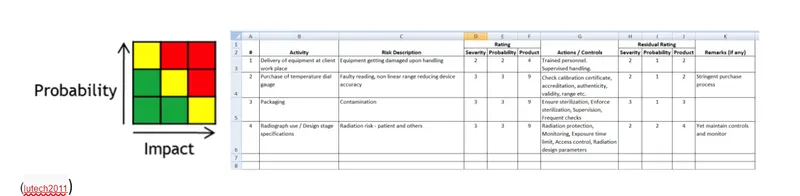
Activity: Design and development Risk (hazard): Error in device design or functionality Risk rating (severity X probability): High (affects device performance and may lead to injury or harm to patients) Proposed action to reduce risk: Thorough testing and review of device design and functionality by a team of experts, including engineers and medical professionals. Implementing a robust quality management system to ensure that design and development processes meet regulatory requirements. Residual risk evaluation: Moderate (implementation of the proposed actions will greatly reduce the risk but there may still be a small chance of errors occurring) Opportunities: Use of new technologies and advancements in the field to improve device design and functionality.
Activity: Marketing and sales Risk (hazard): Misrepresentation of device capabilities or false advertising Risk rating (severity X probability): High (misrepresentation can lead to harm or injury to patients and damage to the company's reputation) Proposed action to reduce risk: Developing clear and accurate marketing materials that accurately represent the device's capabilities and limitations. Training sales representatives to effectively communicate the device's features and safety information. Residual risk evaluation: Low (implementation of the proposed actions will greatly reduce the risk of misrepresentation) Opportunities: Differentiation from competitors by emphasizing the device's unique features and benefits.
Activity: Purchase of raw material and services Risk (hazard): Purchase of substandard raw materials or services that do not meet regulatory requirements Risk rating (severity X probability): High (use of substandard materials can lead to device failure and harm to patients) Proposed action to reduce risk: Implementing a robust supplier management system that includes regular audits and inspections to ensure that suppliers meet regulatory requirements and provide high-quality materials and services. Residual risk evaluation: Low (implementation of the proposed actions will greatly reduce the risk of purchasing substandard materials or services) Opportunities: Building long-term relationships with suppliers that can provide consistent, high-quality materials and services.
Activity: Manufacturing (may include interim steps as fabrication, welding, assembly etc.) Risk (hazard): Device failure or defects during the manufacturing process Risk rating (severity X probability): High (device failure or defects can lead to harm or injury to patients) Proposed action to reduce risk: Implementing a robust quality management system that includes regular inspections and testing of devices during the manufacturing process. Residual risk evaluation: Low (implementation of the proposed actions will greatly reduce the risk of device failure or defects) Opportunities: Use of automation and technology to improve manufacturing process.
Activity: Packing and packaging Risk (hazard): Damage to device during packaging or transport Risk rating (severity X probability): Medium (damage to the device can result in costly repairs or replacement, but will not cause harm to patients) Proposed action to reduce risk: Implementing robust packaging and handling procedures to ensure that devices are properly protected during transport and storage. Residual risk evaluation: Low (implementation of the proposed actions will greatly reduce the risk of damage to devices) Opportunities: Use of new packaging materials and technologies to improve device protection during transport.
Activity: Transporting Risk (hazard): Device damage or loss during transport Risk rating (severity X probability): Medium (damage to the device can result in costly repairs or replacement, but will not cause harm to patients) Proposed action to reduce risk: Implementing robust shipping and logistics processes to ensure that devices are properly tracked and protected during transport. Residual risk evaluation:
| Activity | Risk (Hazard) | Risk Rating (Severity X Probability) | Proposed Action to Reduce Risk | Residual Risk Evaluation | Opportunities |
|---|---|---|---|---|---|
| Design and development | Device failure | High (Severity: High, Probability: High) | Thoroughly test and validate design | Low (Severity: Low, Probability: Low) | Identify and address potential failure points during design phase to reduce risk of failure in the field |
| Marketing and sales | Misleading marketing claims | Medium (Severity: High, Probability: Low) | Accurately and clearly communicate the capabilities and limitations of the device in marketing materials | Low (Severity: Low, Probability: Low) | Ensure that marketing claims are backed up by reliable evidence to build trust with customers |
| Purchase of raw materials and services | Quality issues with raw materials | High (Severity: High, Probability: High) | Source raw materials from reputable suppliers and thoroughly test materials before use | Low (Severity: Low, Probability: Low) | Establish relationships with high-quality raw material suppliers to ensure consistent quality |
| Manufacturing | Device contamination | High (Severity: High, Probability: High) | Implement strict cleanliness protocols and regularly test finished devices for contamination | Low (Severity: Low, Probability: Low) | Invest in advanced cleaning and testing equipment to further reduce risk of contamination |
| Packing and packaging | Device damage during shipping | High (Severity: High, Probability: High) | Use appropriate packaging materials and methods to protect the device during shipping | Low (Severity: Low, Probability: Low) | Work with shipping partners to identify best practices for transporting medical devices |
| Transporting | Device loss during shipping | High (Severity: High, Probability: High) | Use tracking systems to monitor the movement of devices and implement measures to prevent loss during shipping | Low (Severity: Low, Probability: Low) | Invest in advanced tracking systems and work with reliable shipping partners to reduce risk of loss |
| Installation | Device malfunction during installation | High (Severity: High, Probability: High) | Thoroughly train installation technicians and provide clear installation instructions | Low (Severity: Low, Probability: Low) | Develop comprehensive installation procedures and invest in technician training to reduce risk of installation errors |
| Periodic maintenance | Device malfunction during maintenance | Medium (Severity: High, Probability: Low) | Thoroughly train maintenance technicians and provide clear maintenance instructions | Low (Severity: Low, Probability: Low) | Develop comprehensive maintenance procedures and invest in technician training to reduce risk of maintenance errors |
| Breakdown maintenance | Device malfunction during breakdown maintenance | High (Severity: High, Probability: High) | Thoroughly train breakdown maintenance technicians and provide clear breakdown maintenance instructions | Low (Severity: Low, Probability: Low) | Develop comprehensive breakdown maintenance procedures and invest in technician training to reduce risk of maintenance errors |
| Disposal | Environmental impact of device disposal | Medium (Severity: High, Probability: Low) | Implement a responsible disposal program that adheres to all relevant regulations | Low (Severity: Low, Probability: Low) |
Collaborate with disposal partners to identify best practices for environmentally responsible disposal of medical devices |
The risk rating is a way to quantify the level of risk for a specific activity or process by taking into account both the probability of the risk occurring and the severity of the consequences if it does occur. The residual risk evaluation is then determined by considering the effectiveness of the proposed actions to reduce the risk. It's also important to note that the specific definitions for severity and probability, as well as the risk ratings, will vary depending on the specific device and the organization's risk management policies. In addition, it's important to review and update the risk assessment regularly to ensure that it remains current and relevant.