Project 2
Robotic surgery are types of surgical techniques that uses robotic systems. Robotic surgery, also called robot-assisted surgery, allows doctors to perform many types of complex procedures with more precision, flexibility and control than is possible with conventional techniques. This technique is usually associated with minimally invasive surgery procedures performed through tiny incisions and is also sometimes used in certain traditional open surgical procedure.
When using robotically assisted minimally-invasive surgery, instead of directly moving the instruments, the surgeon uses one of two methods to administer the instruments. These include using a direct telemanipulator or through computer control. A tele manipulator is a remote manipulator that allows the surgeon to perform the normal movements associated with the surgery. The robotic arm carry out those movements using end effector and manipulator to perform the actual surgery. In computer-controlled systems, the surgeon uses a computer to control the robotic arms and its end-effectors, though these systems can also still use tele manipulators for their input.
A kidney transplant is a surgery to place a healthy kidney from a living or deceased donor into a person whose kidneys no longer function properly. When kidneys lose this filtering ability, harmful levels of fluid and waste accumulate in the body, which can raise blood pressure and result in kidney failure. End-stage renal disease occurs when the kidneys have lost about 90% of their ability to function normally. People with end-stage renal disease need to have waste removed from their bloodstream via a machine or a kidney transplant to stay alive. These transplant can be deceased-donor transplant, Living donor transplant and preemptive kidney transplant.
In the last two decades, major advances in surgery have been facilitated by advances in the field of bioengineering, biotechnology and medical instrumentation. These have led to major patient benefits such as reduced perioperative morbidity and shorter hospital stay in all surgical specialties, in part due to the introduction of minimally invasive and robotic surgery. In the past half century, renal allotransplantation has advanced as a superior renal replacement therapy compared to established dialysis technique, becoming the gold-standard treatment for the majority of patients with established renal failure
As with any major open surgical operation technique, open kidney transplant (OKT) is associated with morbidity such as post-operative pain, surgical site infection (SSI), delayed mobilization, significant time to return to daily activities and long-term complications such as incisional hernia. To address these issues, technology has answered by developing new surgical techniques with the aim of further improving patient outcomes following surgery. The advent of robotics and its integration into surgical practice have revolutionized several areas of complex surgical enterprise. Some transplant has also been incorporated with robotic technology into various areas of transplantation, including donor nephrectomy.
In robotic-assisted surgery, our surgeons use a computer-controlled robotic arm to perform the transplant. The surgeons direct the movements of the arm and use tiny instruments inserted through small incisions to transplant the donor kidney.
Situations in which robotic technique is helpful are in third and subsequent transplants and in pediatric recipients. Minimally invasive surgery already plays a role in renal transplantation, with variations of laparoscopic donor nephrectomy becoming established as the gold-standard worldwide The 6–10 cm incision required for minimally invasive donor nephrectomy allows safe donation with significant benefits for living donors. For the implantation of grafts, various minimally invasive approaches have been explored to minimize the complications associated with the OKT approach.
The most widely used clinical robotic surgical system includes a camera arm and mechanical arms with surgical instruments attached to them. The surgeon controls the arms while seated at a computer console near the operating table. The console gives the surgeon a high-definition, magnified, 3D view of the surgical site. Surgeons who use the robotic system find that for many procedures it enhances precision, flexibility and control during the operation and allows them to better see the site, compared with traditional techniques. Using robotic surgery, surgeons can perform delicate and complex procedures that may be difficult or impossible with other methods.
AI is used in a large spectrum of studies in kidney transplantation, ranging from pathological evaluation to outcome predictions. Those studies pave the way for increased automation, which will increase standardization and speed in medical evaluations. CAD and quantifiable personalized predictions are developing at a great pace that will enhance precision medicine.
ABLOCK DIAGRAM OF SURGICAL ROBOT
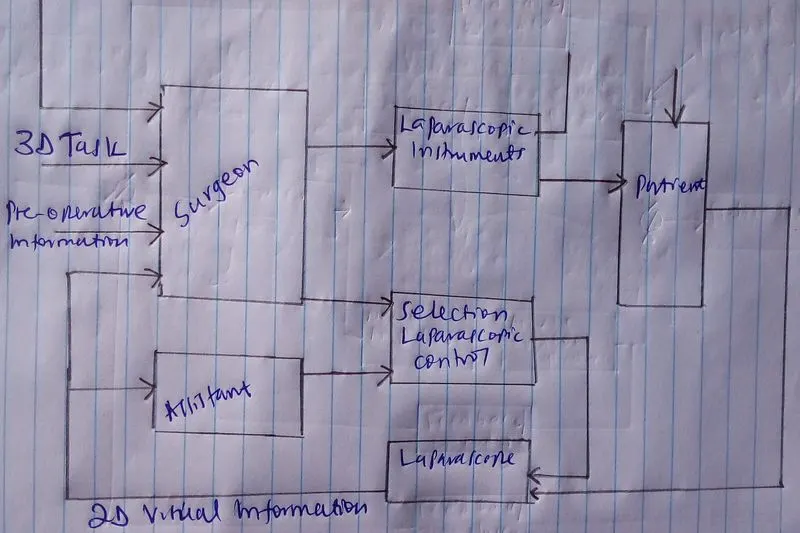
FLOW CHART OF THE ENTIRE PROCEDURE DUEING ROBOTIC SURGERY.

References
Spiers, H. V. M., Sharma, V., Woywodt, A., Sivaprakasam, R., & Augustine, T. (2022). Robot-assisted kidney transplantation: an update. Clinical Kidney Journal, 15(4), 635–643. https://doi.org/10.1093/CKJ/SFAB214
Alamgir A, Hussein H, Abdelaal Y, Abd-Alrazaq A, Househ M. Artificial Intelligence in Kidney Transplantation: A Scoping Review. Stud Health Technol Inform. 2022 May 25;294:254-258. doi: 10.3233/SHTI220448. PMID: 35612067.