Project 1
DESIGNING A MULTI-PARAMETER PATIENT'S MONITORING SYSTEM.
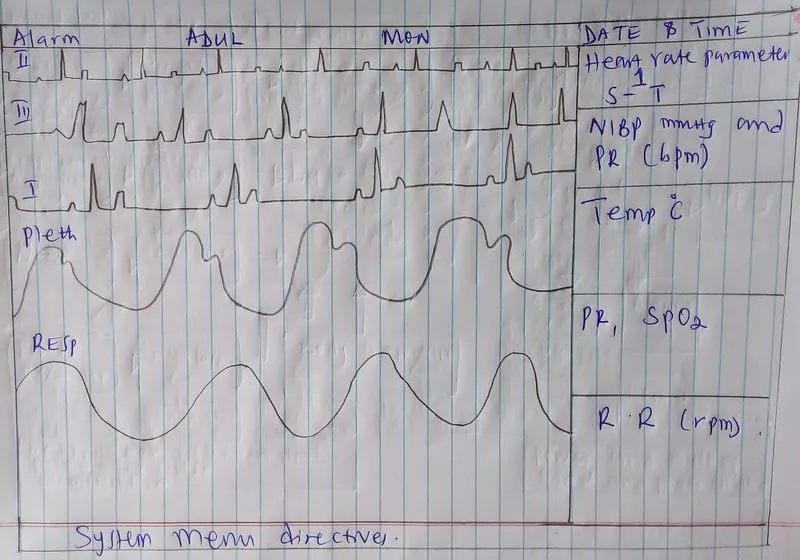
A multi-parameter monitor is a medical device for monitoring patient's vital signs.It is mainly used in intensive care or hospitalization and in general basic model are used to monitor cardiac activity (ECG),blood pressure (NIBP),respiration(RESP),Oxygen saturation (SPO2) and tempratue(TEMP).They display the value of each parameter while presenting evolution curves over time.
GENERAL CONSIDERATION OF THE MULTI-PARAMETER PATIENT'S MONITOR
- The device should be lightweight,easy to carry and operate.
- Preferably 7'' high resolution (800x480 pixel) color TFT to display multiple traces of signal wave forms for ECG,Plethysomogram, and respiratory wave form.
- Accurate NIBP measurment with over pressure protections.
- Unique pulse oximetry technique achieves accurate SPO2 and respiratory rate measurment.
- Should have visual and auidable alarm,recall of alarm events.
- Flexible high and low alarm limit setting operation.
- Should have real time monitoring of battery capacity when the battery power is insufficient,low battery voltage alarm indication that displays on the LCD screen.
- Should be easy to configure the display color,font and wave form lay out for user customization.
- There should be protection aganist defibrilator discharge and resistance aganist the interference from Electro surgical unit(ESU).Pacemaker pulse detection and inhibition functions should be available.
- There should be a provision for patient selection among Adults,paediatric and neonate in the set up menu.
- The NIBP component should have cuff of different sizes.
- There should be optional networking capability for connecting to central work station.
Physiological signals that can be determined using the monitors:-
(i) Electrocardiogram(ECG)
This is a device used to detect cardiac abnormalities by measuring the electrical activity generated by the heart muscles.An electrocardiogram records the electrical signals from the heart to check for different heart conditions.The electrodes are placed on the chest to record the hearts electrical signals,which causes the heart to beat and the signals are shown as waves which on an attached computer monitor or printer.
In a multi-parameter patient's monitoring system, a 5 lead ECG must be incooperated where these leads must consist of Ag/AgCl electrode since they are cheap and easily available.The ECG component of the device must be able to deal with extremely weak signals ranging from 0.5VmV to 5.0mV combined with a DC component of upto +/-300mV resulting from the electrodes skin contact plus a common mode component of of upto 1.5mV resulting from the potential between the electrodes and the ground.A defibrilation patient protection unit must be included to protect the patient from both micro and macro electric shock.
(ii) None invasive blood pressure(NIBP) monitor.
In a multi-parameter patient monitor,a none invasive blood pressure measurement device can be incoperated .This device will be in a position to use cuff method to measure blood pressure of the patient under care.This device should consist of a leak proofed tube that will be connected to the monitor from one side and the other side will have a cuff which is strapped around the patients upper arm for inflation.The monitor should have a cuff inflation/deflation NIBP control knob of high sensitivity to regulated the cuff expansion size in response to arterial blood flow and pulse rate per minute.The display screen should be able to display the blood pressure reading on the screen interms of systolic and diastolic pressure and also pulse rate in beats per minute.
There is need for defibrilation protection unit during the design since the device will be in direct contact with the patient.
(III)Pulse oximeter
This is a non invasive device which is used to measure the oxygen saturation level in the blood.The device is keptable of rapidly detecting changes in oxygen concentration and this level shows how efficiently blood is carrying oxygen to the extrimities from the heart.
The oximeter probe consists of two parts,that is the light emitting diodes which is the Red and infrared red(IR) light and a photo detector on the opposite side.The beams of light are shone through the tissue from one side of the probe to other side.The blood and the tissue absorb some of the lights emitted by the probe. The device is based on two physical principles that is the presence of a pulsitile signal generated by arterial blood which is relatively independent of non pulsitile arterial blood,venous,capillary blood and other tissues.Another principle is the fact that oxyhemoglobin(Hbo2) and reduced hemoglobin(Hb) have different absorption spectra.
The multi-parameter monitoring system should have a pulse oximeter probe with two light emitting diodes(LEDs) that emits Red light at 660nm and infrared at 940nm wave length with a sensitive photodetector to respond to any minimal changes to oxygen concentration in the blood.The device should have a defibrilation protection unit as its always in direct contact with the patient. The display screen should be able to display the oxygen concentration (SPO2) in breath per minute and alse the breathing signal wave on the screen.
(IV)Body temprature probe.
The multi-parameter patient monitor should have a temprature probe which is connected to a cable of approximately 2m in length,and can detect a temprature range of about 40 to 145 degree celcius and maximum temprature of 150 degree celicius and can operate in a voltage supply of about 4.8V and accuracy of 0.8% .
A BLOCK DIAGRAM SHOWING A MULTI-PARAMETER PATIENT'S MONITOR

screen layout for displaying the parameters on the display