Project 1 - Design and Develop a IOT based Wireless Wearable Health Monitoring System or a Home Healthcare System to monitor the physiological parameters of ECG, Heart Rate, Pulse Oximetry, Cuffless Blood Pressure and Body Temperature.
Design project:-A wearable IoT based health monitoring system.
Introduction;
Wearable health monitoring system refers to a variety of wearable medical devices and supportive accessories which are used to monitor body physiological parameters. Medical wearables utilize sensors, actuators, software, and electronic patches attached to the skin to monitor a patient’s health, identify anomalies, and even treat health conditions. Examples include everything from a wearable vital signs monitor to a smart watch glucose monitor or wearable pain relief devices. The concluded research reveals that in 2020, the global wearable technology market topped off at $40.65 billion and is expected to grow at a rate of 13.8% compound annual growth rate from 2021 to 2028.
The most sophisticated examples of wearable technology include artificial intelligence (AI) hearing aids, Google Glass and Microsoft's HoloLens, and a holographic computer in the form of a virtual reality (VR) headset. An example of a less complex form of wearable technology is a disposable skin patch with sensors that transmit patient data wirelessly to a control device in a healthcare facility.
As measuring wearable devices, mechanical sensors can obtain mechanical stimulus information and convert it into electrical signals to achieve functions such as stimulus acquisition, transmission, and storage. When mechanical stimuli, such as pressure, strain, motion is applied, the mechanical sensor can convert it into electrical signals such as resistance, voltage, and capacitance, and based on the mechanical stimulus electrical signal regression curve, we can infer the magnitude of the mechanical stimulus. In accordance with different mechanical stimuli, mechanical sensors can be substantially divided into strain sensors, pressure sensors, position sensors, velocity sensors, tactile sensors,
Wearables work differently, based on the category they belong to, such as health, fitness or entertainment. Predominantly, wearable technology functions by incorporating microprocessors, batteries and connectivity to the internet so the collected data can be synced with other electronics, such as mobile devices or laptops. Wearables are embedded with built-in sensors that keep track of bodily movements, provide biometric identification or assist with location tracking.
Consumer electronics, such as smartwatches and fitness trackers, are prominent use cases for wearable technology. However, with the recent advancements in the internet of things (IoT) and AI, wearable technology is being incorporated into all types of scenarios from healthcare, navigation systems, consumer goods and professional sports to advanced textiles.
Objective of the project;
The objective is to design an IoT based wearable monitoring devices that can be operated remotely in the healthcare system.
Design considerations:
Conductive textiles with sensors: - A conductive textile is a fabric which can conduct electricity. Conductive textiles will be made with metal strands woven into the construction of the textile or by conductive yarns which are conductive thanks to a metal-coating. Conductive fibers consist of a nonconductive or less conductive substrate, which is then either coated or embedded with electrically conductive elements, often carbon, nickel, copper, gold, silver, titanium or PEDOT. Metals may be deposited chemically with autocatalytic chemistry, printed with conductive nanoparticle inks, or applied with physical vapor deposition methods. Textile-based sensors are often tied to certain parts of the human body to collect mechanical, physical, and chemical stimuli to identify and record human health and exercise. The conductive textile should have specific physiological sensors that will be worn on the body to measure them as required.
Functional internet system: -This will work as a media to transmit measured physiological parameters to relevant destinations from the patient.
Power supply: -Following the ultra-low current consumption of wearable electronics, batteries for wearable electronics present an array of design challenges. They must retain a usable charge sitting in box in a consumer electrics warehouse, and come alive for a time before a battery activation. From that starting point, the battery must offer at least 15 hours of wearable life. Low voltage operation is only one of the many challenges. Many wearable sensors function on voltages as low as 0.8 volts (stepped-down as efficiently as possible from a 3-volt source). If the load is bursty the microcontroller’s current consumption is low (35- or 40µA per MHz).
Band width: - NarrowBand-Internet of Things (NB-IoT) selection is a standards-based low power wide area (LPWA) technology developed to enable a wide range of new IoT devices and services. NB-IoT significantly improves the power consumption of user devices, system capacity and spectrum efficiency, especially in deep coverage. Battery life of more than 10 years can be supported for a wide range of use cases. This is important in order for the user to achieve wider area transmission of physiological parameters. This helps to determine the transmission rate of the system. The transmission rate determines the speed of the communication link or channel and varies with different wireless technologies such as Bluetooth, WiFi, ZigBee. In wireless communications, the transmission rate depends on several factors like the frequency band of the technology, modulation techniques, and the complexity of the transceiver.
User of the device: - This is a very important design consideration where the device must suit the environment whether for military or routine applications. Must be able to withstand all conditions for proper durability and user satisfaction.
Size of the device: -The device must be miniaturize and embedded into the routine body wears like a shirt that will be focused towards the areas of interest. Bulky devices might cause discomfort and stigma among patients. In this the innovators must ensure that the device is user friendly.
complete block schematic of IoT device to acquire physiological parameters
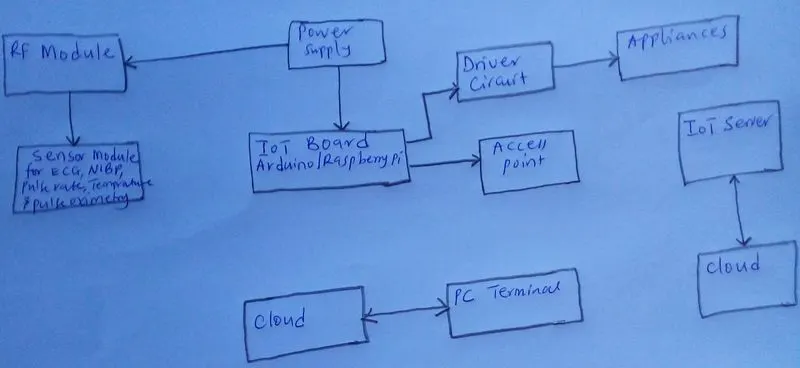
Block Diagram of Internet of Things (IoT) above comprises of the IoT Board which is the heart of the application where one can write the program and dump on it. This Board may be either Arduino or Raspberry Pi depending upon the application. Arduino Suite can be used as a platform to dump the program (Python/C++) using I2C Communication Protocol or Serial Communication Protocol. The Sensor Module will measure the physiological parameters and provides an output in terms of voltage which is given to an analog input of an Arduino/Raspberry board. For Transmitting/Receiving the radio signals a RF module is used. During the IoT application the configuration of a network is required. Virtual Private Server (VPS) is software defined, and can be easily configured. Most of the IoT Cloud servers like Amazon, Microsoft etc., they will use web based user interface in order to manage the server. The IoT Server can be used for monitoring and data gathering the information. The data received or transmitted through gateway server will be securely stored in Big Data Analytics.
Introduction of special nodes called storage nodes to perform the processing required for sensor anomaly detection. A storage node acts like normal sensor nodes in that it performs the basic functions of normal sensor nodes where it has higher storage capacity and processing capability to use prediction and outlier detection for detecting sensor anomaly. The storage nodes can be connected to mains power and used as cluster heads, so individual sensors in a cluster communicate with the base station via its cluster head. The proposed approach is based on three algorithms: Sequential Minimal Optimization Regression (SMO regression) for the prediction of sensor value, Dynamic Threshold (DT) calculation for error computation, and Majority Voting (MV) for decision on whether to generate alarm.
Preferably symmetric encryption can be used, where a single key gets used to encrypt and decrypt data. The fact that the data gets encrypted offers a secure layer of security, particularly compared to using hardcoded or default passwords, but sharing and storing the encryption key creates risk.
For the device certification plan,there will still be need for prototyping,prototype testing preclinically and clinically and then product development as per the specifications.Certification and accreditations will be done by the relevant bodies both locally and internatrionally.The process of certifications will then start with application to the relevant bodies which will be followed by inspection of the device and clinical outcome when the device is used.The team will make the inspection report that permits the producer to continue with massproducton or put to unend the production when conditions are not meet.
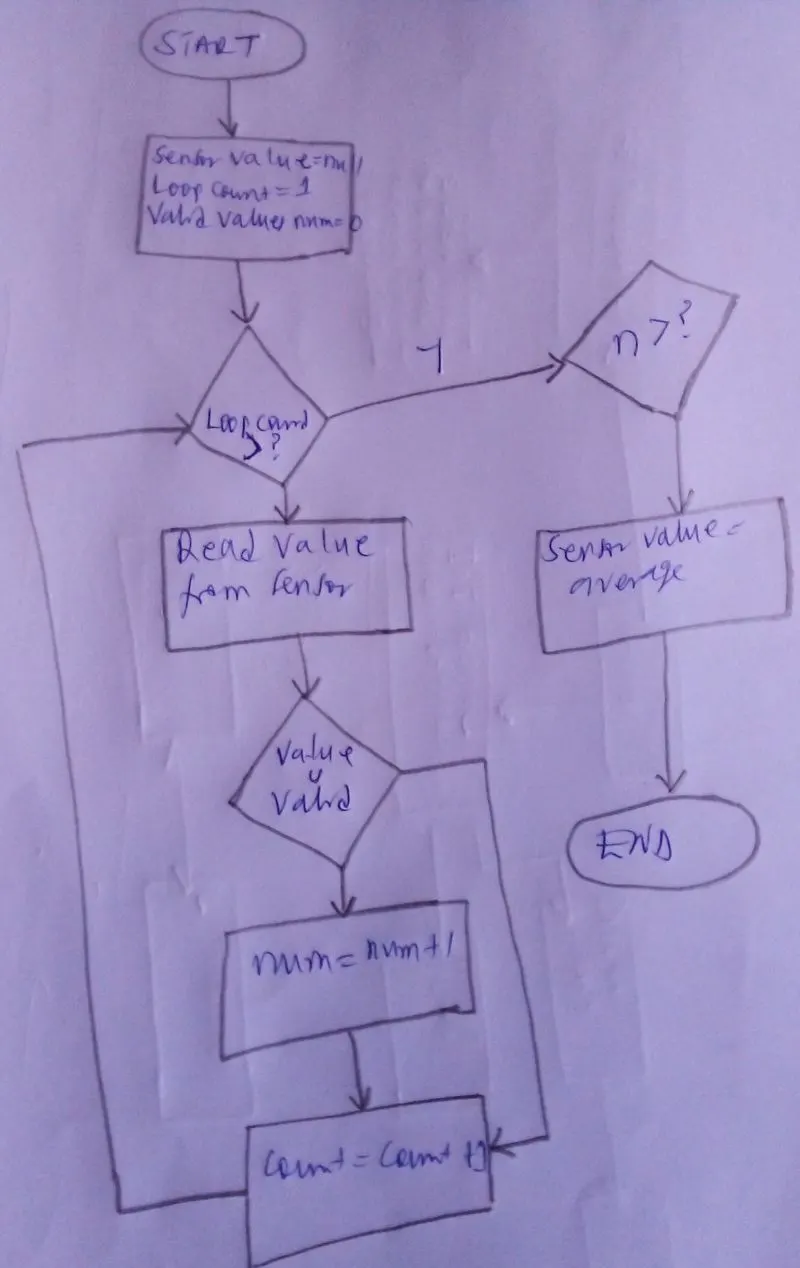
flow diagram how the data acquisition is proposed