Project 2 - 2D meshing on the instrumental Panel
Aim:- To discuss the meshing process used for the instrumental panel using the casting method in ANSA and the mid-surface extraction method chosen to accurately represent the complex geometry of the component.
Objectives:-
- To provide a comprehensive overview of the casting method in ANSA and its application in the meshing process for the instrumental panel.
- To discuss the mid-surface extraction method chosen and the reasons for its selection, including its benefits and limitations.
- To evaluate the accuracy and quality of the finite element model generated through the meshing process and suggest potential improvements for future simulations.
Introduction:-
An instrumental panel is a collection of instruments and displays used to monitor and control various systems in a vehicle, aircraft, or other complex machinery. The panel usually includes a variety of gauges, switches, and indicators that provide information about the vehicle's performance and status.
The importance of an instrumental panel lies in its ability to provide real-time information about the state of various systems in the vehicle. This information allows operators and pilots to make informed decisions about how to operate the vehicle, ensuring that it is functioning safely and efficiently. By monitoring critical parameters such as engine temperature, fuel level, and speed, an instrumental panel can help prevent accidents and equipment failures, and can ultimately save lives. In addition, the instrumental panel can also help improve the efficiency of the vehicle by providing feedback on how it is operating, allowing operators to make adjustments and optimize performance.
Why Midsurface by casting/extrusion?
The importance of midsurfacing done by casting/extrusion in ANSA lies in its ability to efficiently and accurately create a finite element mesh for complex 3D geometries. Midsurfacing involves the creation of a simplified mid-plane surface that approximates the 3D geometry, which can then be meshed using 2D elements. This process can significantly reduce the complexity of the mesh and improve computational efficiency, while still maintaining the accuracy of the results.
Casting and extrusion methods are particularly useful for creating mid-surfaces for geometries with thin walls, such as those found in automotive and aerospace structures. These methods can accurately capture the thin-wall geometry, including the curvature and thickness variations, while still maintaining a simplified surface for meshing. Additionally, these methods can help preserve the symmetry of the geometry, reducing the number of elements required for analysis and improving computational efficiency.
Overall, midsurfacing using casting/extrusion in ANSA is important for improving the accuracy and efficiency of finite element analysis for complex 3D geometries, particularly those with thin-walled structures.
Steps carried out
- Import the geometry of the instrumental panel into ANSA and create a new project.
- Clean the geometry to remove any unwanted features, such as fillets or small holes, using the relevant ANSA tools.
- Extract the mid-surface of the geometry using the midsurfacing tool in ANSA. Choose the casting/extrusion method for mid-surface extraction.
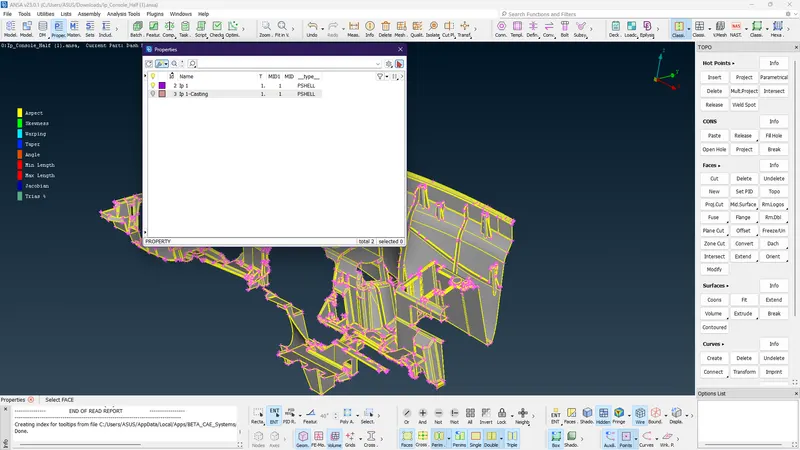
- Check for any errors or gaps in the mid-surface using the surface deviation tool in ANSA. Adjust the parameters until the surface deviation is minimized.
- Use the align manager tool in ANSA to check for any geometrical errors and inconsistencies in the mid-surface geometry. Fix any errors using the relevant ANSA tools.
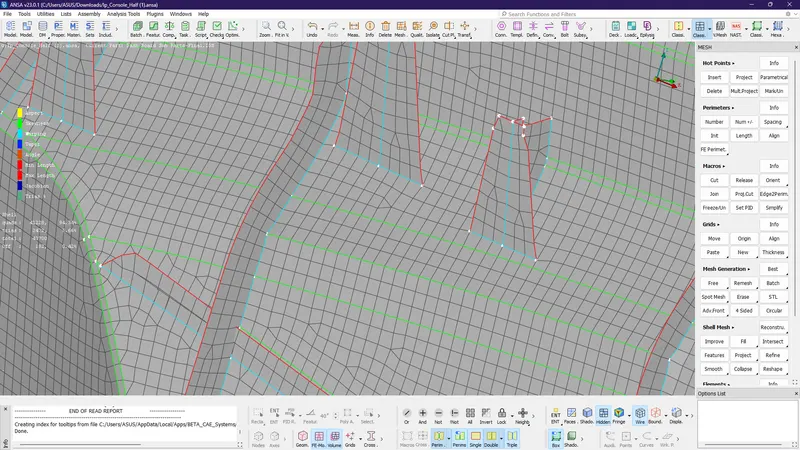
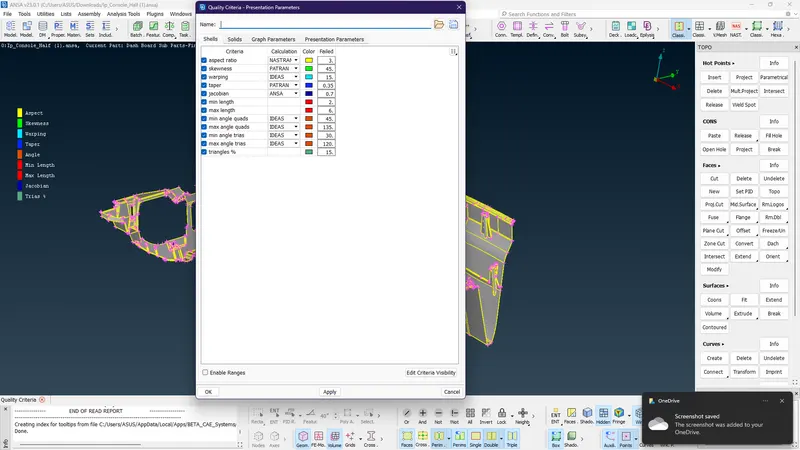
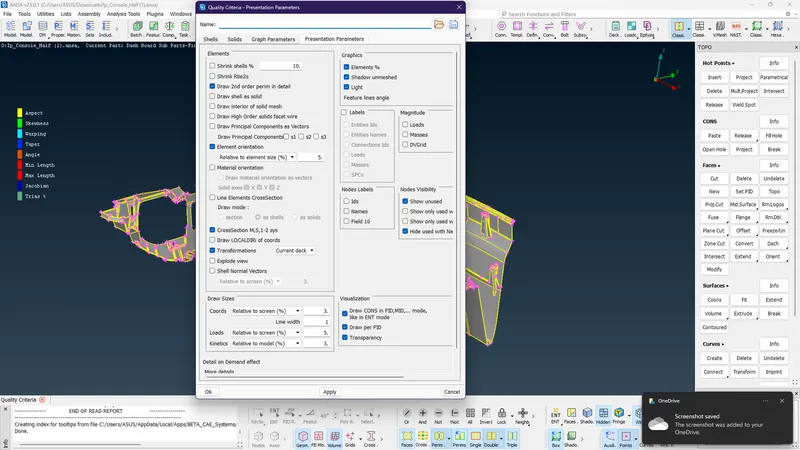
- Set the element quality criteria, such as aspect ratio, skewness, and jacobian, to ensure the quality of the mesh. Use the mesh diagnostic tool to check the quality of the mesh and adjust the parameters if necessary.
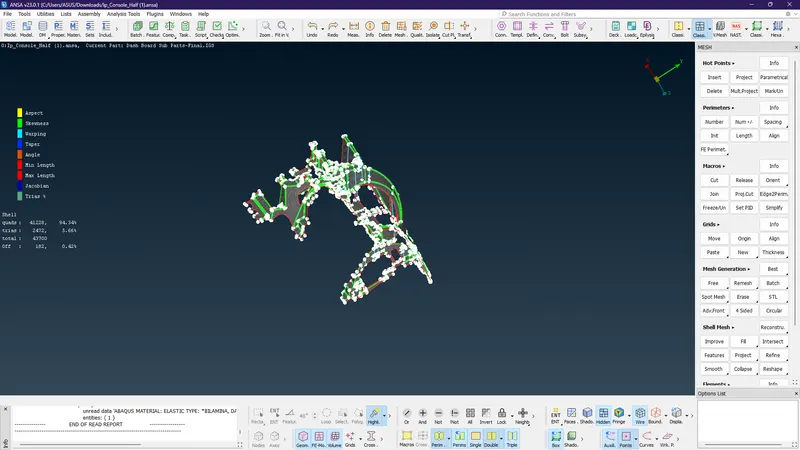
Results:-
trias:-5.66%
quad:-94.34%
off elements:-0.42%
Conclusion:-This method helps to extract the mid-surface of the geometry and create a high-quality mesh for simulation. The align manager tool ensures that the geometry is aligned correctly and any geometrical errors are fixed, resulting in more accurate simulation results. The use of appropriate element quality criteria and mesh diagnostic tools further improves the accuracy of the analysis. Overall, this process helps to ensure that the instrumental panel is accurately meshed and can provide valuable insights into its performance in real-world applications.
Link to the model:- https://drive.google.com/file/d/19oJxjAyy95rBwdoOqxyrOKBAJOqh1A5q/view?usp=share_link