Project 2
Project 2:
Hybrid electric vehicle:
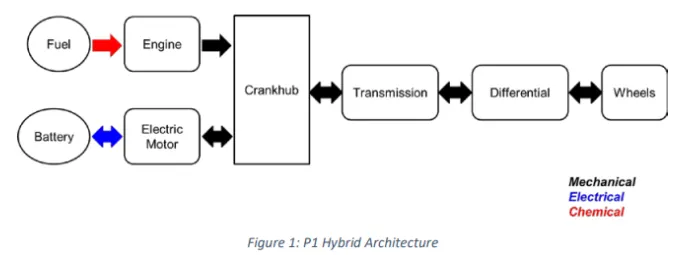
Initialization file script:
Initialization file for loading the variables for the Conventional vehicle simulation model
Vehicle Parameters
M = 1500; % Vehicle weight [kg]
Cr = 0.015; % Rolling resistance coefficient
Rw = 0.35; % Rolling radius [m]
Cd = 0.33; % Drag coefficient
Af = 2; % Frontal area [m2]
rhoa = 1.225; % Air density [kg/m3]
Vwind = 0; % Wind velocity [kmph]
g = 9.81; % Gravitational acceleration [m/s2]
theta = 0; % Slope [deg]
myu_road_tire = 1; % Coefficient of friction between tire - road interface
Powertrain Parameters
FDR = 3.73; % Final Drive Ratio / Diff Ratio
DiffEff = 0.99; % Differential efficiency (assumed independent of operating conditions)
NumGear = 4; % Number of gears in transmission
TransGear = [1:NumGear]; % Transmission Gears
TransRatio = [3.06, 1.62, 1, 0.7]; % Corresponding Transmission ratios
TransEff = 0.90; % Transmission efficiency (assumed independent of operating conditions)
TC_SR = [0, .5, .6, .7, .8, .87, .92, .94, .96, .97, 1]; % Torque Converter Speed Ratio (Matlab default) -> TurbSpd/PumpSpd
TC_TR = [2.232, 1.5462, 1.4058, 1.2746, 1.1528, 1.0732, 1.0192, 1, 1, 1, 1]; % Torque Converter Torque Ratio (Matlab default) -> TurbTrq/PumpTrq
TC_Cf = 1e-4 * [.72558, .66322, .63463, .59042, .51331, .4144, .29287, .22444, .12186, .04386, 0]; % Torque Converter Capacity Factor (Matlab default) -> PumpTrq/PumpSpd^2 [Nm/rpm^2]
load Vehicle_Data/Engine_data_1_9L_Saturn_95kW
load Vehicle_Data/Trans_Shift_map
load Vehicle_Data/EM_Honda_Insight_10kW
load Vehicle_Data/ESS_NiMH6
ESS_init_soc = 0.8;
SOC_max = 0.9;
SOC_min = 0.6;
Driver Parameters
Kp = 10; % P gain for driver PI model
Ki = 1; % I gain for driver PI model
Drive_Cycle_Select =2; % Drive cycle selection
% Drive cycle values in m/s
if Drive_Cycle_Select == 1
load DriveCycles/UDDS;
elseif Drive_Cycle_Select == 2
load DriveCycles/HWFET;
elseif Drive_Cycle_Select == 3
load DriveCycles/FTP;
elseif Drive_Cycle_Select == 4
load DriveCycles/US06;
elseif Drive_Cycle_Select == 5
load DriveCycles/NEDC;
elseif Drive_Cycle_Select == 6
load DriveCycles/WLTP;
end
time_end = cyc_time(end);
vel_end = cyc_vel(end);
Simulink model:
P1 Hybrid Architecture Hybrid Drives Development :
Vehicle model:
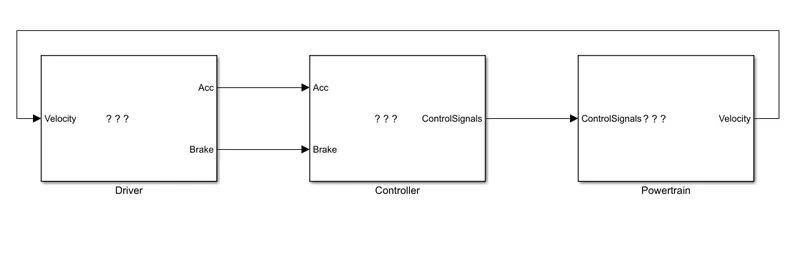
- In vehicle mode we have 3 major part
- These are Driver, Controller, Powertrain.
- We taking output velocity as a feedback value to run vehicle to follow the drivecycle
Driver:
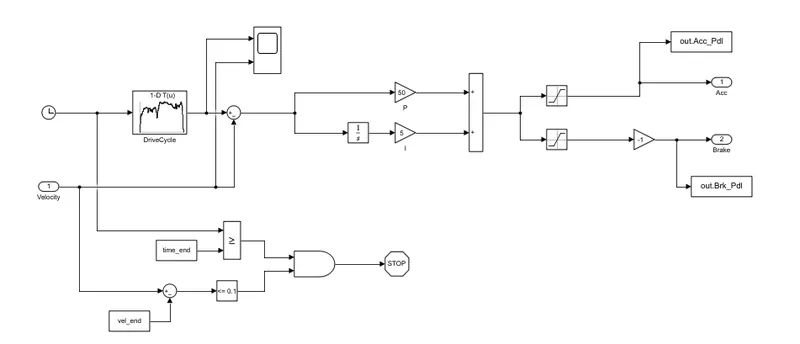
- Here we having the drivecircle.
- Drive cycle is the standard cycle to calculate or evaluate the model such as fuel ecconomy, performance and speed etc.
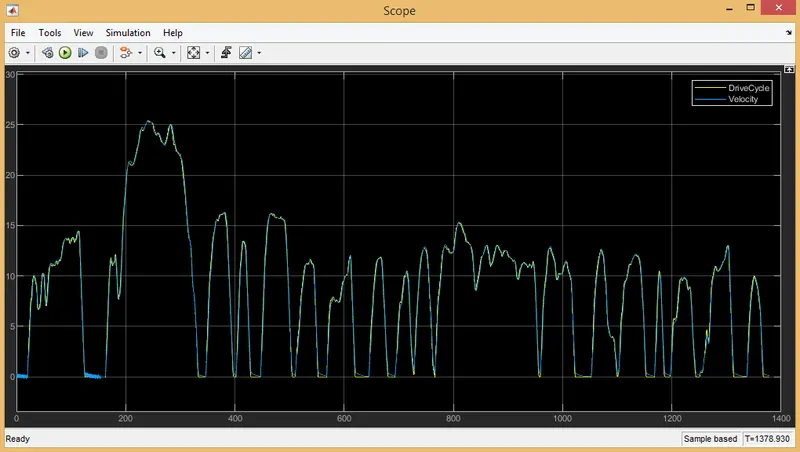
- Here by getting the velocity as a feed back value we control the vehicle speed of the model.
- And also have P,I controller also.
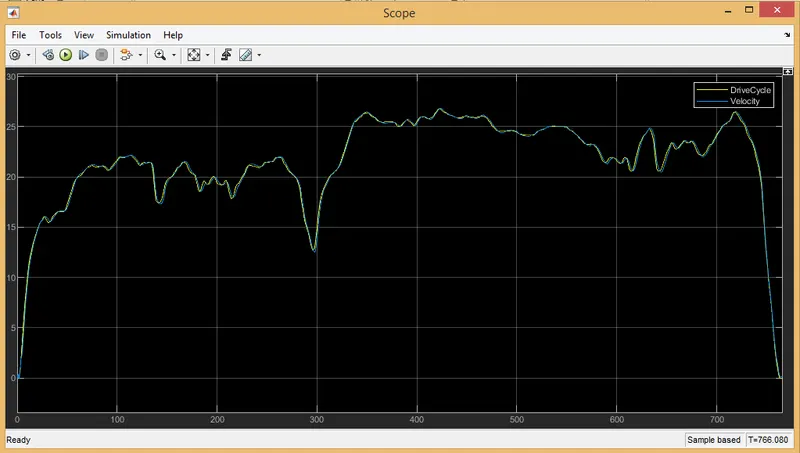
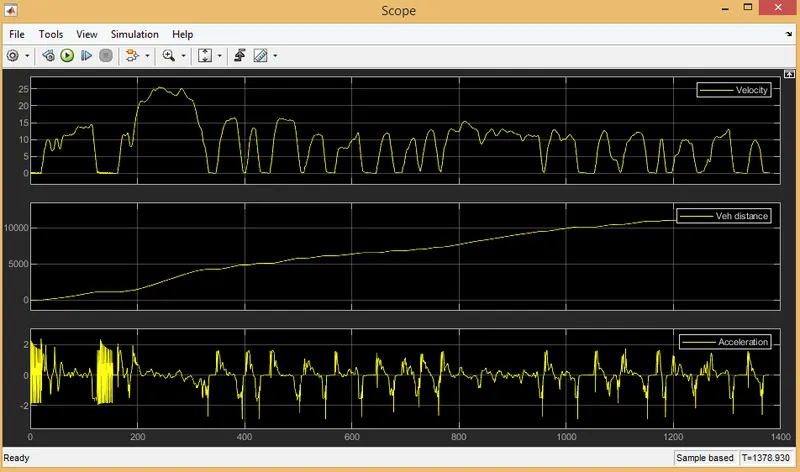
Result scope of the drive cycle and velocity:
- HWFET
- UDDS
Controller:
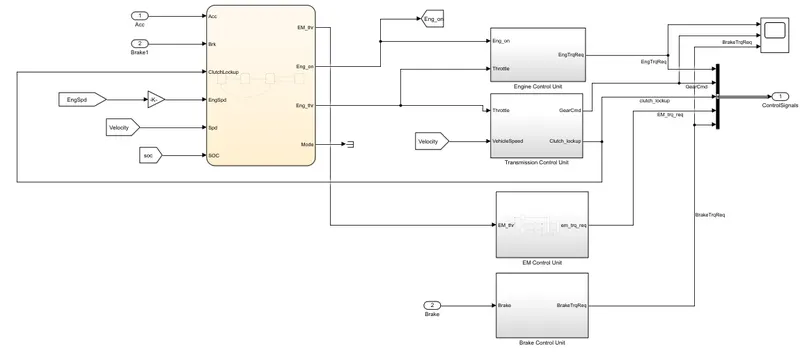
- In this controller unit we have 4 major control unit in this hybrid model.
- 4major controller unit are Engine control unit, Transmission control unit, EM control unit, Brake control unit.
1 Engine control unit:
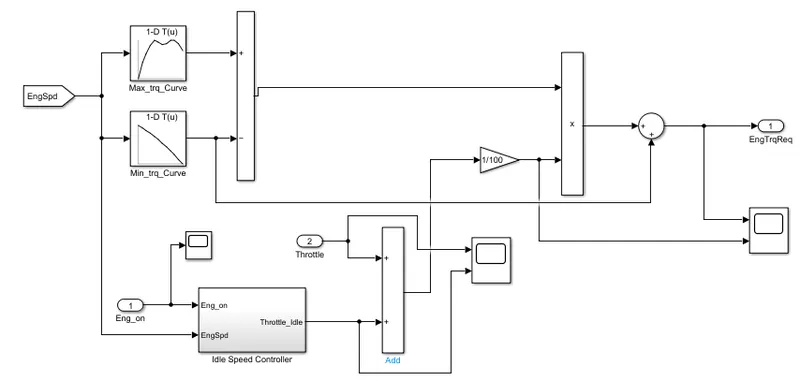
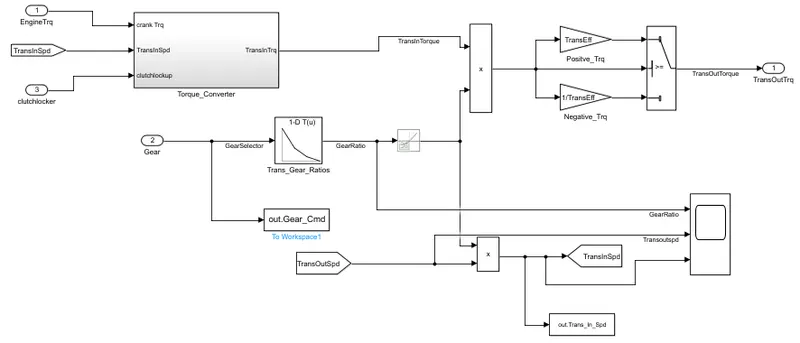
2 Transmission control:
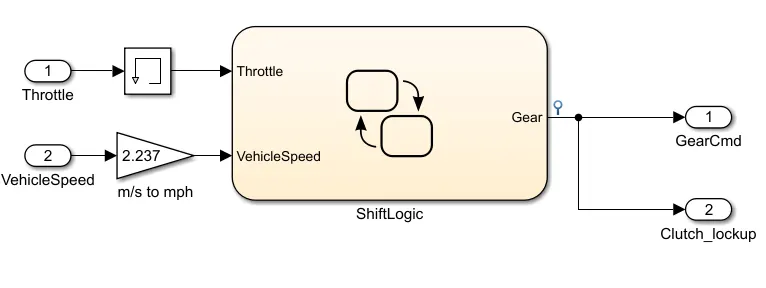
3 EM control unit:
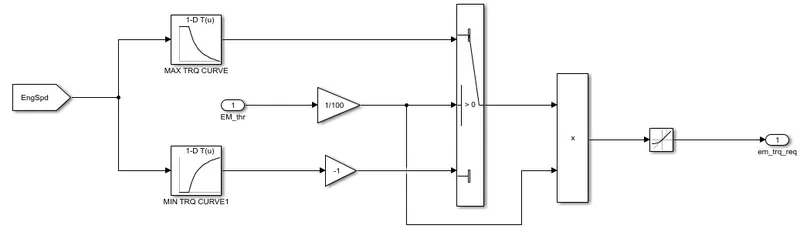
4 Brake control unit:
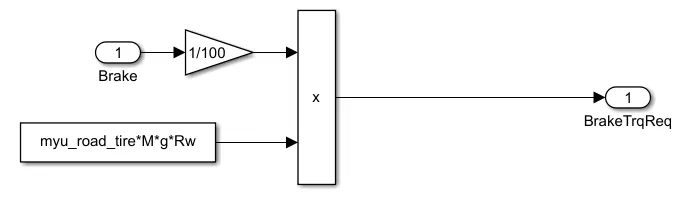
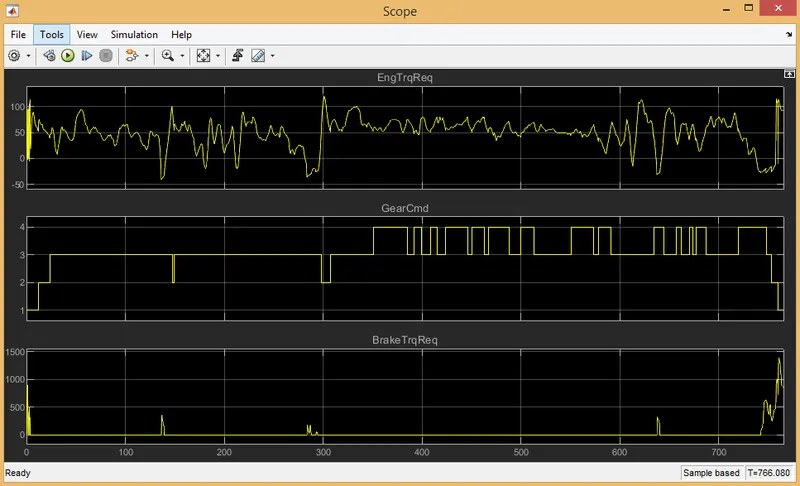
Scope:
- HWFET
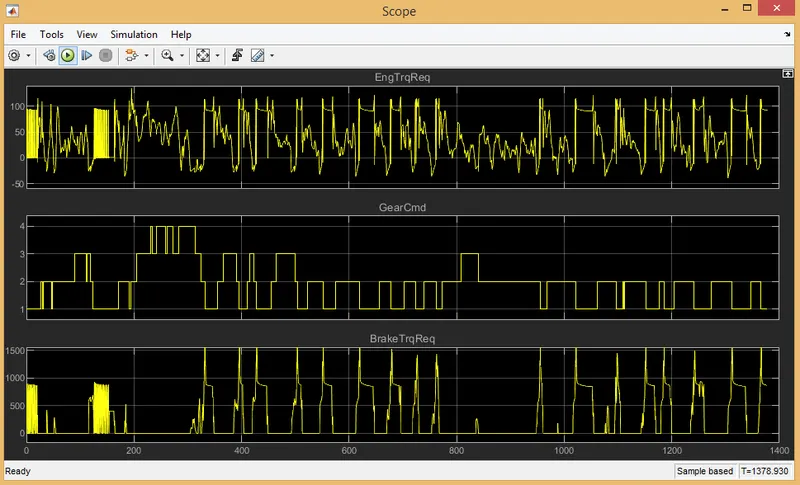
- UDDS
Powertrain:
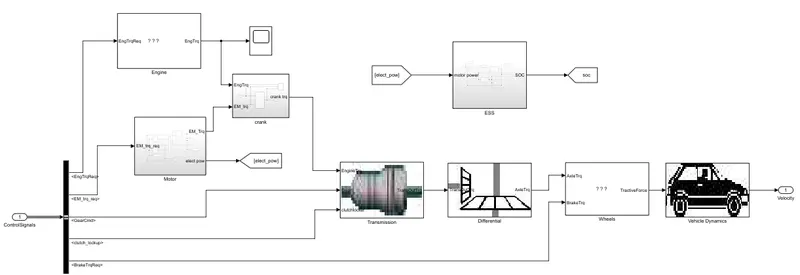
- A powertrain is an assembly of every component that pushes your vehicle forward.
- Car's powertrain creates power from the engine and delivers it to the wheels on the ground.
- The key components of a powertrain include an engine, electric motor, transmission, driveshaft, axles, and differential.
Engine:
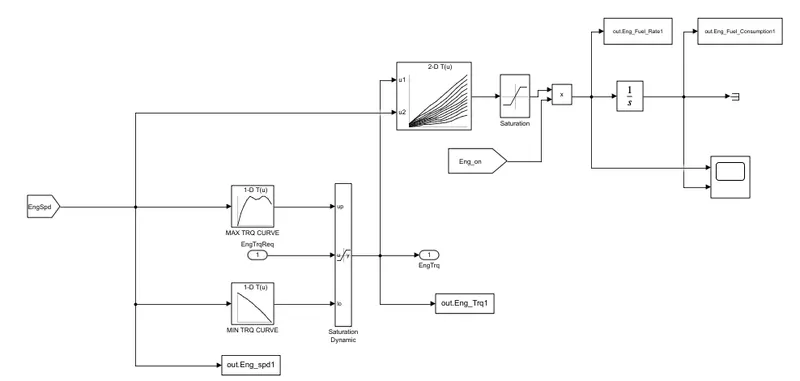
scope:
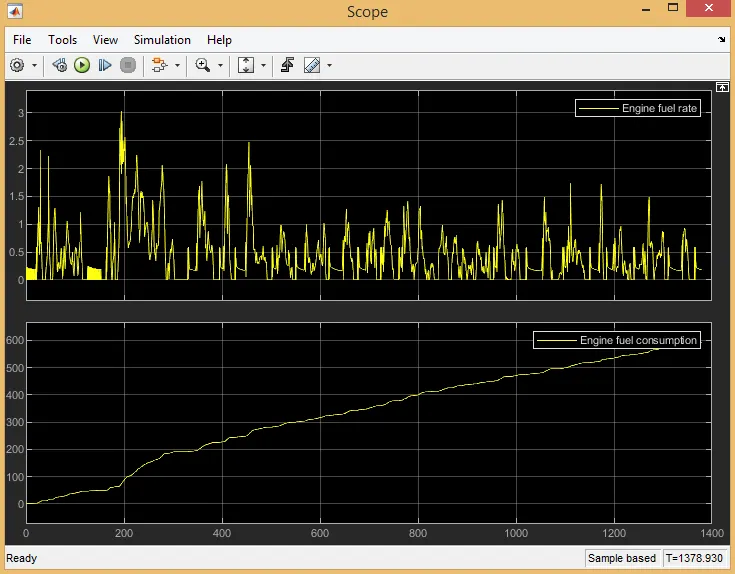
- HWFET
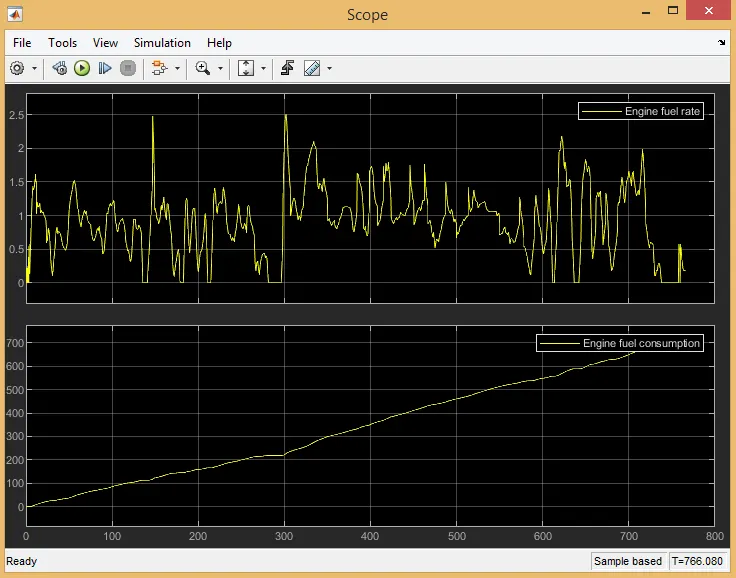
- UDDS
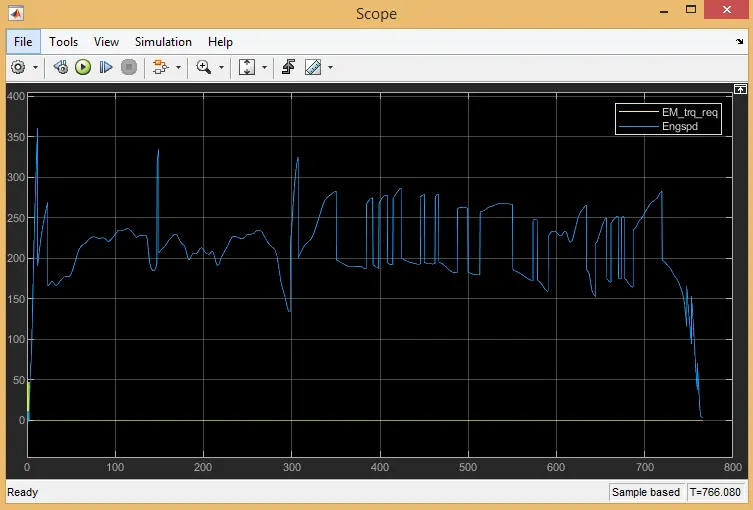
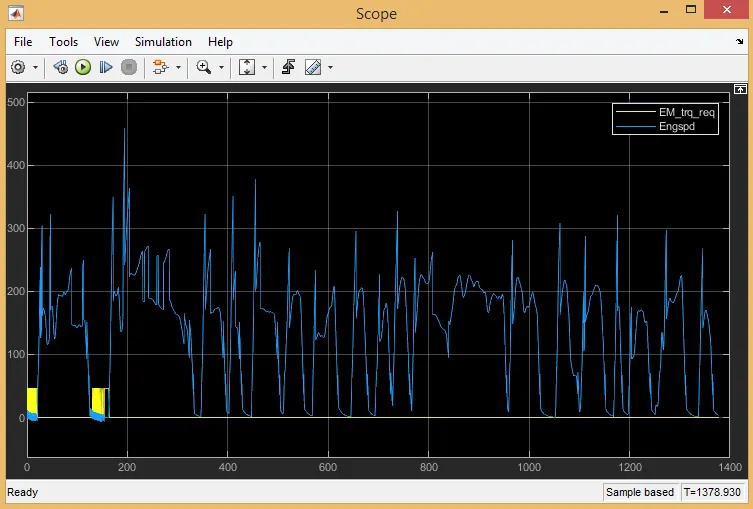
Electric motor:
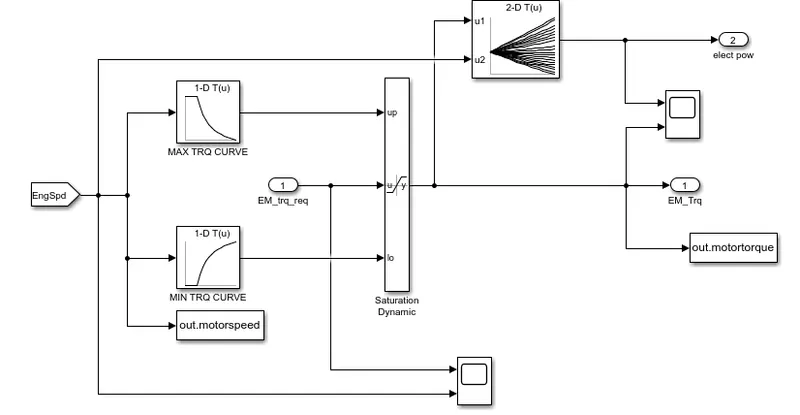
scope:
- HWFET
- UDDS
ESS:
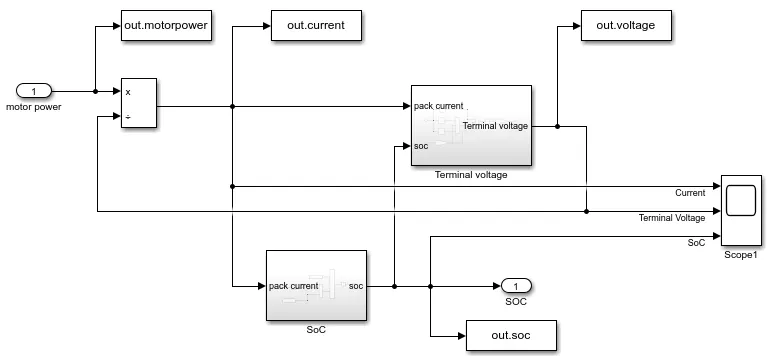
Scope:
- HWFET
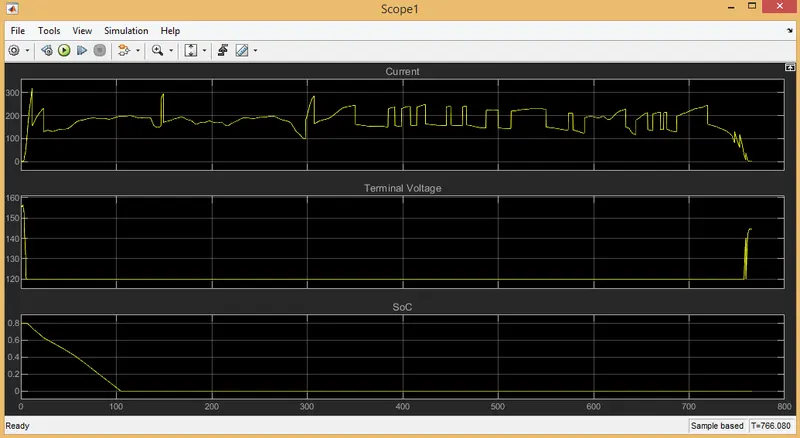
- UDDS
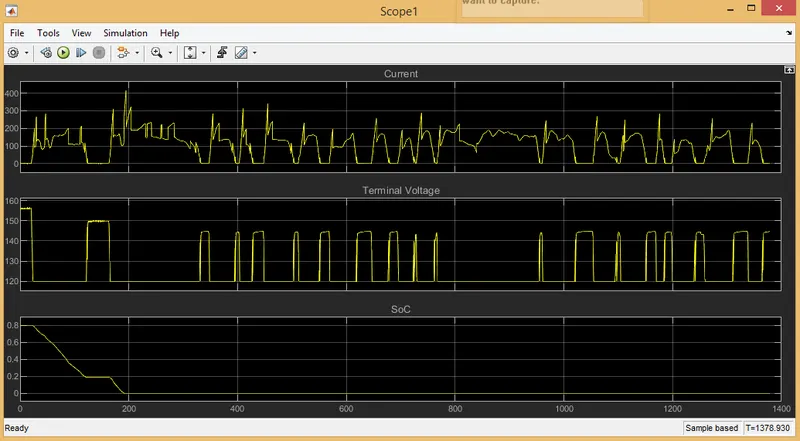
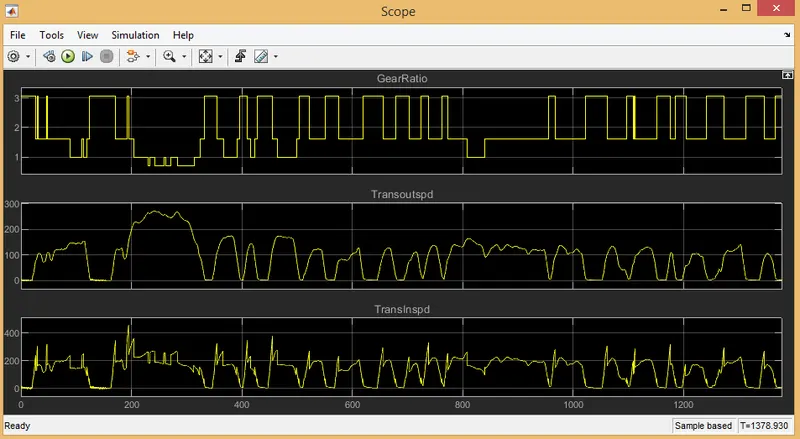
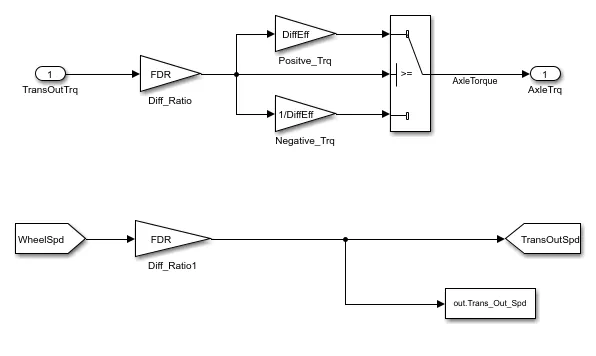
Transmission:
- UDDS
Differntial:
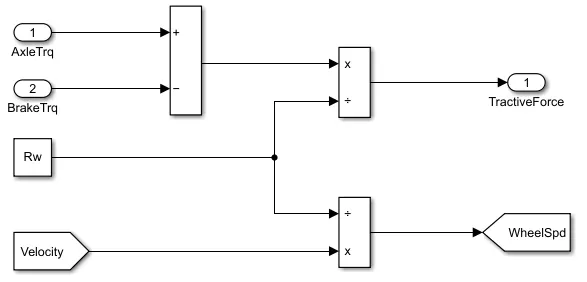
Wheel:
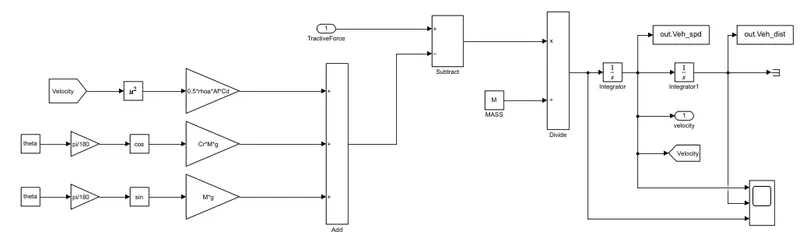
Vehicle Dynamic:
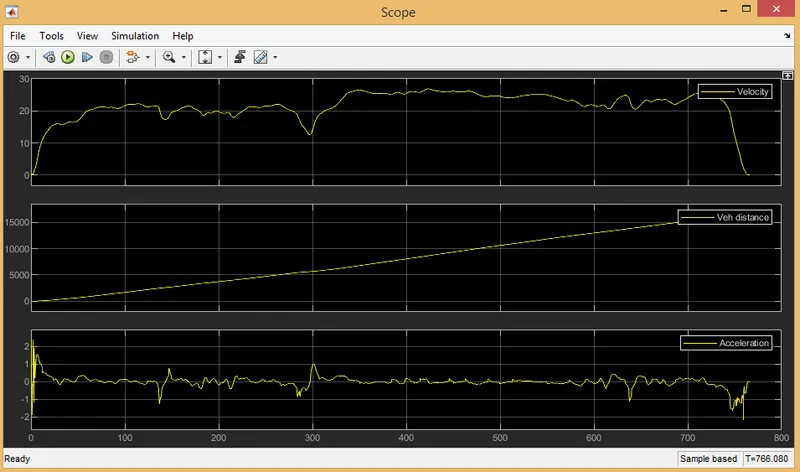
Scope:
- HWFET
- UDDS
Processing file:
Post-Processing File
File for post-processing the Conventional vehicle simulation model data
Time = out.tout;
Acc_Pdl = out.Acc_Pdl; % Accelerator pedal [%]
Brk_Pdl = out.Brk_Pdl; % Brake pedal [%]
Gear_Cmd = out.Gear_Cmd; % Transmission gear
Trans_In_Spd = out.Trans_In_Spd*30/pi; % Transmission input speed [rpm]
Trans_Out_Spd = out.Trans_Out_Spd*30/pi;% Transmission output speed [rpm]
Eng_Trq = out.Eng_Trq1; % Engine brake torque [Nm]
Eng_Spd = out.Eng_spd1*30/pi; % Engine speed [rpm]
Eng_Fuel_Consump = out.Eng_Fuel_Consumption1; % Engine fuel consumption [g]
Veh_Dist = out.Veh_dist/1000; % Distance traveled by vehicle [km]
Veh_Spd = out.Veh_spd*18/5; % Vehicle speed [kmph]
Motr_Spd = out.motorspeed;
Motr_Pwr = out.motorpower;
Motr_Trq = out.motortorque;
SOC = out.soc;
Current = out.current;
Voltage = out.voltage;
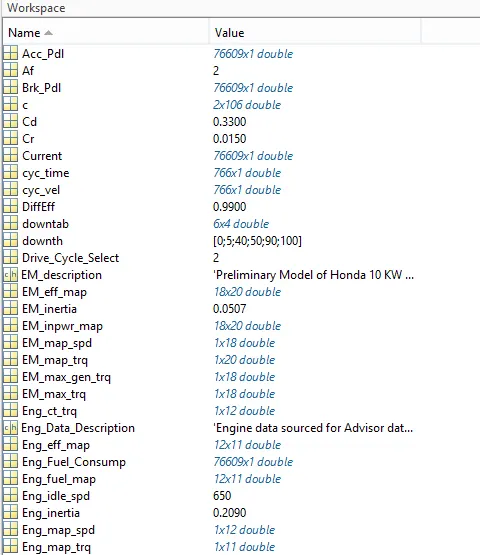
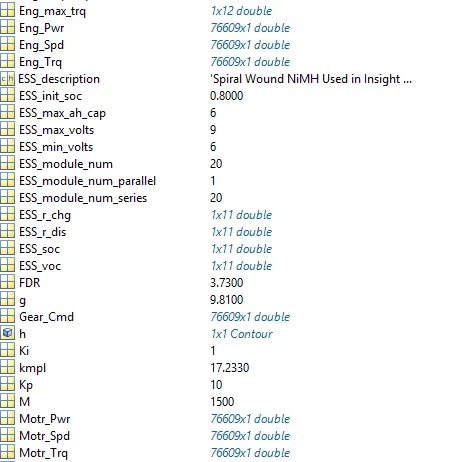
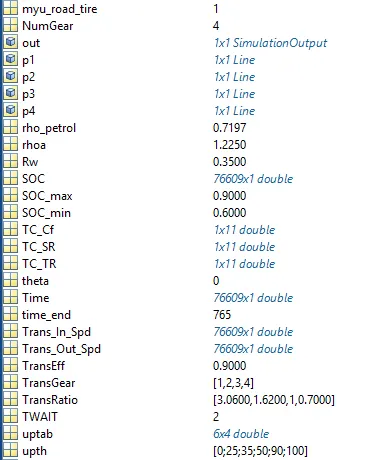
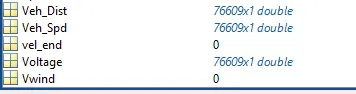
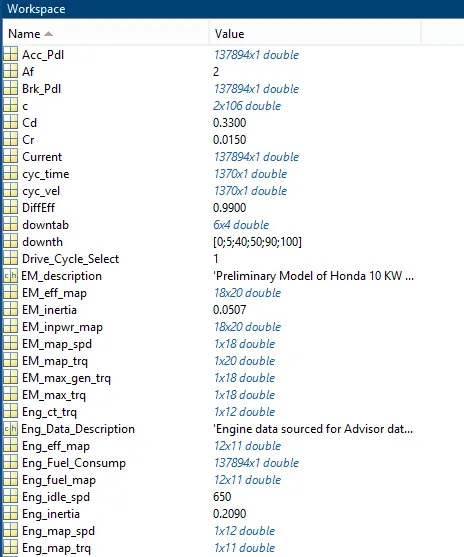
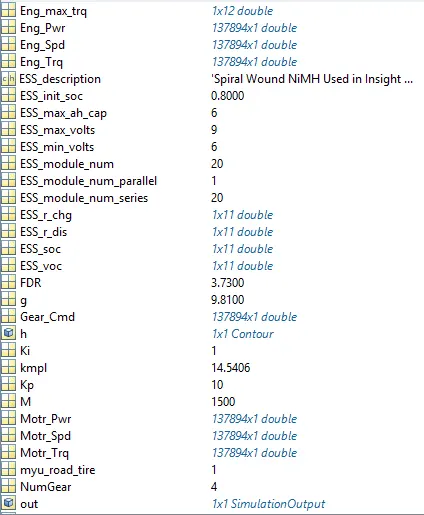
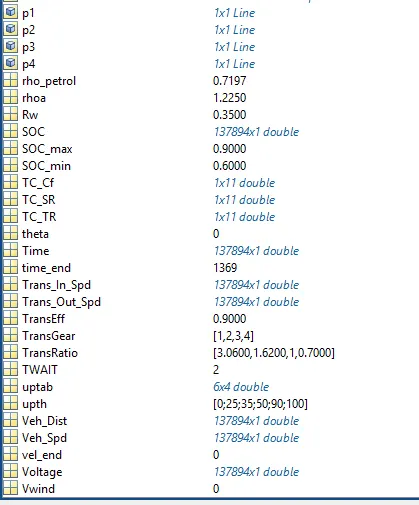
workspace:
- HWFET
- UDDS
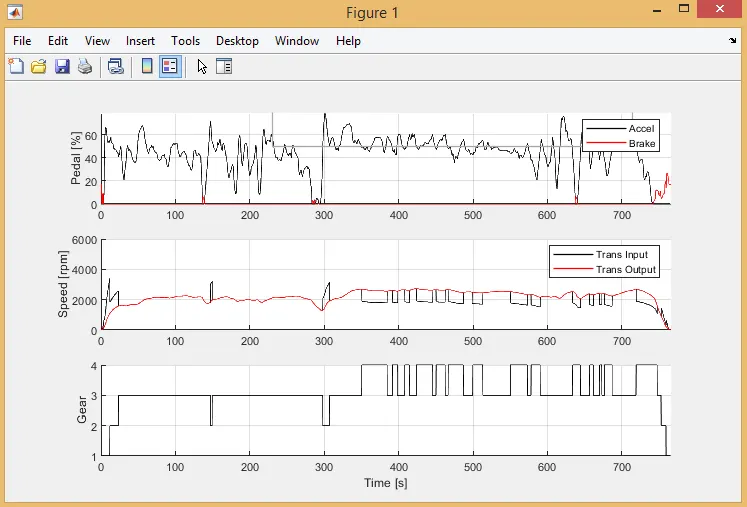
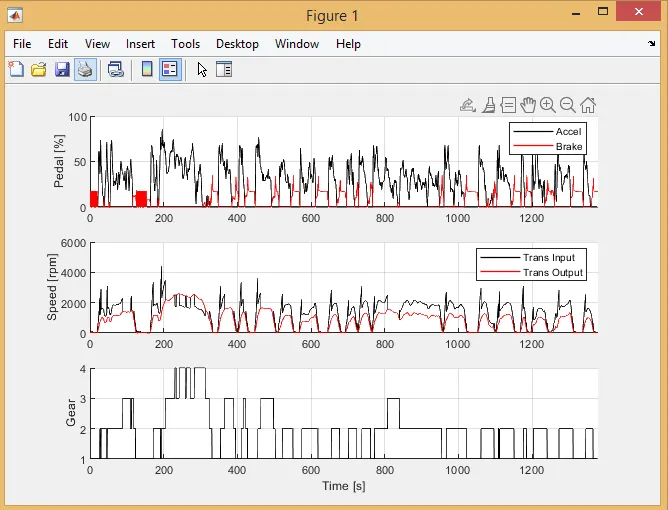
Plotting vehicle characteristics time trace
figure()
subplot(3,1,1)
hold on
grid on
plot(Time, Acc_Pdl, 'linewidth', 1, 'Color', 'black');
plot(Time, Brk_Pdl, 'linewidth', 1, 'Color', 'red');
ylabel('Pedal [%]')
xlim([0, Time(end)]);
legend('Accel','Brake');
subplot(3,1,2)
hold on
grid on
plot(Time, Trans_In_Spd, 'linewidth', 1, 'Color', 'black');
plot(Time, Trans_Out_Spd, 'linewidth', 1, 'Color', 'red');
ylabel('Speed [rpm]')
xlim([0, Time(end)]);
ylim([0, 6000]);
legend('Trans Input','Trans Output');
subplot(3,1,3)
hold on
grid on
plot(Time, Gear_Cmd, 'linewidth', 1, 'Color', 'black');
xlim([0, Time(end)]);
xlabel('Time [s]');
ylabel('Gear');
- HWFET
- UDDS
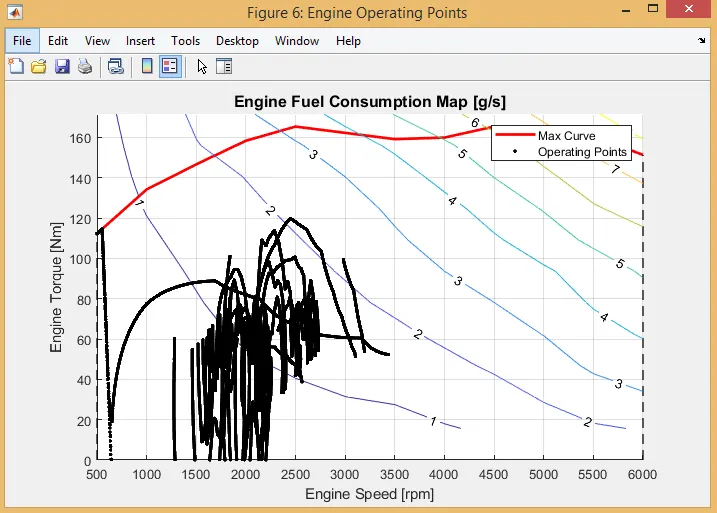
Plotting engine operating points on engine fuel map
figure('Name','Engine Operating Points');
hold on
grid on
title('Engine Operating Points','fontsize',12);
p1=plot(Eng_map_spd*30/pi,Eng_max_trq,'linewidth',2,'color','r');
p2=line([Eng_map_spd(end)*30/pi Eng_map_spd(end)*30/pi],[0 Eng_max_trq(end)]);
set(p2,'linewidth',1,'linestyle','--','color','k');
p3=line([Eng_map_spd(1)*30/pi Eng_map_spd(1)*30/pi],[0 Eng_max_trq(1)]);
set(p3,'linewidth',1,'linestyle','--','color','k');
[c,h] = contour(Eng_map_spd'*30/pi,Eng_map_trq,Eng_fuel_map');
clabel(c,h);
xlabel('Engine Speed [rpm]');
ylabel('Engine Torque [Nm]');
title('Engine Fuel Consumption Map [g/s]');
p4 = plot(Eng_Spd,Eng_Trq,'.','color','k');
legend([p1 p4],{'Max Curve','Operating Points'});
axis([Eng_map_spd(1)*30/pi Eng_map_spd(end)*30/pi 0 Eng_map_trq(end)]);
- HWFET
- UDDS
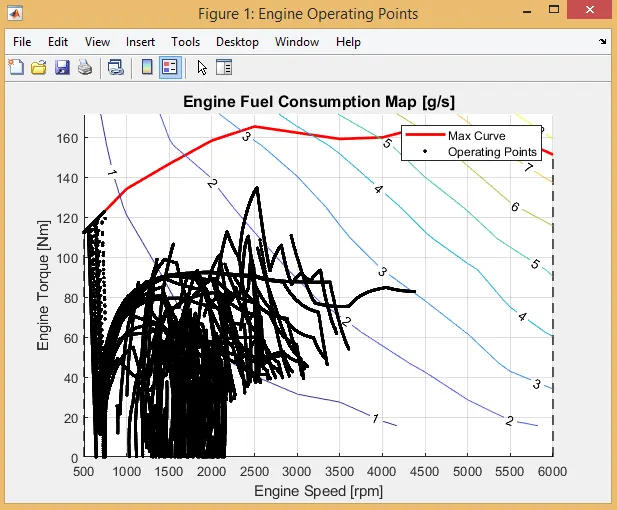
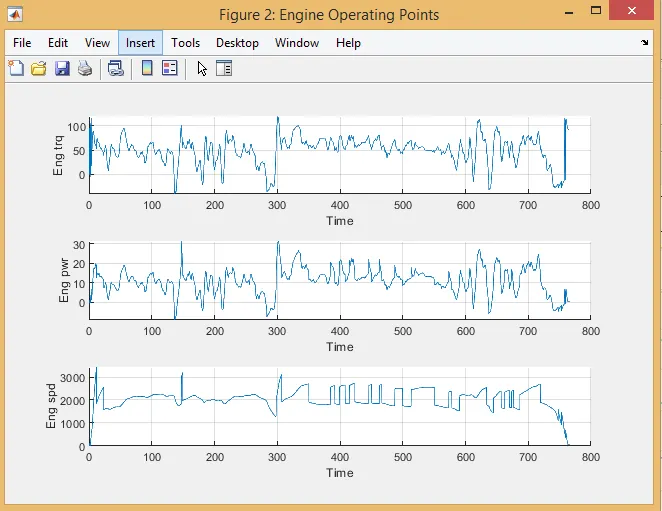
figure (2) Engine
title('Engine');
subplot(3,1,1);
hold on
grid on
plot (Time,Eng_Trq);
xlabel('Time'); ylabel('Eng trq');
subplot(3,1,2);
hold on
grid on
plot (Time,Eng_Pwr);
xlabel('Time'); ylabel('Eng pwr');
subplot(3,1,3);
hold on
grid on
plot (Time,Eng_Spd);
xlabel('Time'); ylabel('Eng spd');
- HWFET
- UDDS
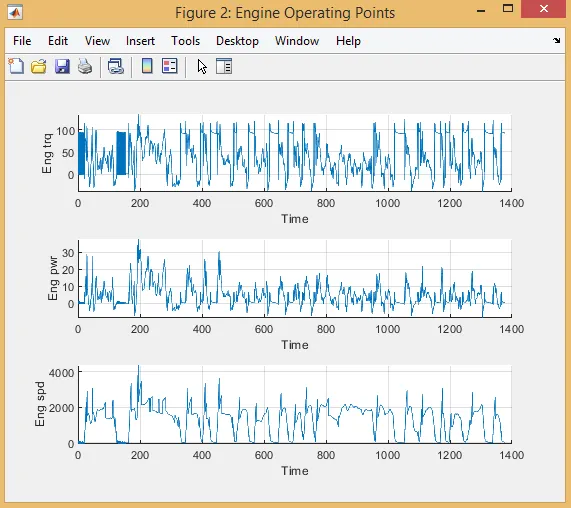
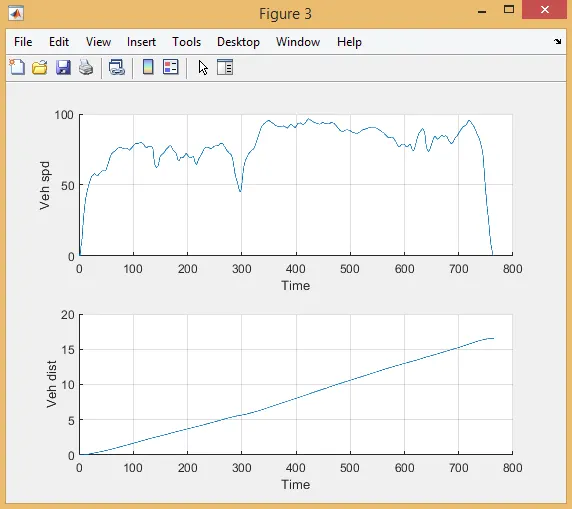
figure (3) Vehicle
title('Vehicle');
subplot(2,1,1);
hold on
grid on
plot (Time,Veh_Spd);
xlabel('Time'); ylabel('Veh spd');
subplot(2,1,2);
hold on
grid on
plot (Time,Veh_Dist);
xlabel('Time'); ylabel('Veh dist');
- HWFET
- UDDS
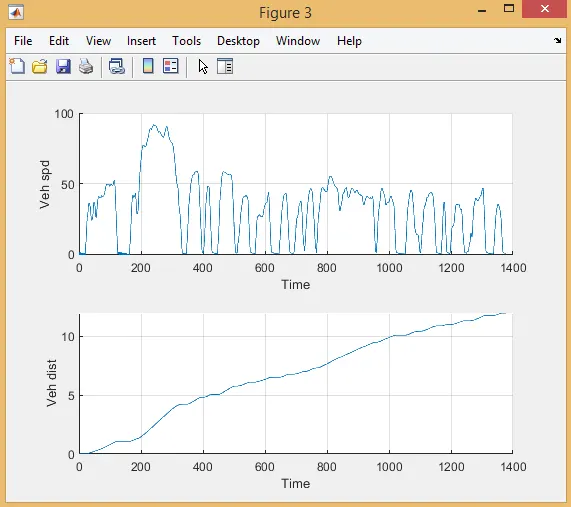
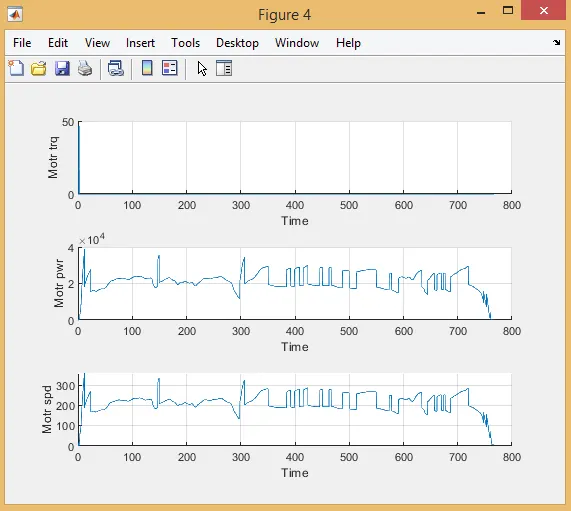
figure (4) Motor
title('Motor');
subplot(3,1,1);
hold on
grid on
plot (Time,Motr_Trq);
xlabel('Time'); ylabel('Motr trq');
subplot(3,1,2);
hold on
grid on
plot (Time,Motr_Pwr);
xlabel('Time'); ylabel('Motr pwr');
subplot(3,1,3);
hold on
grid on
plot (Time,Motr_Spd);
xlabel('Time'); ylabel('Motr spd');
- HWFET
- UDDS
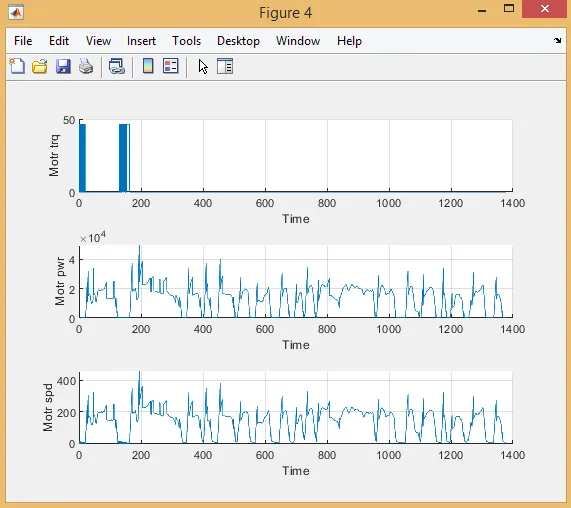
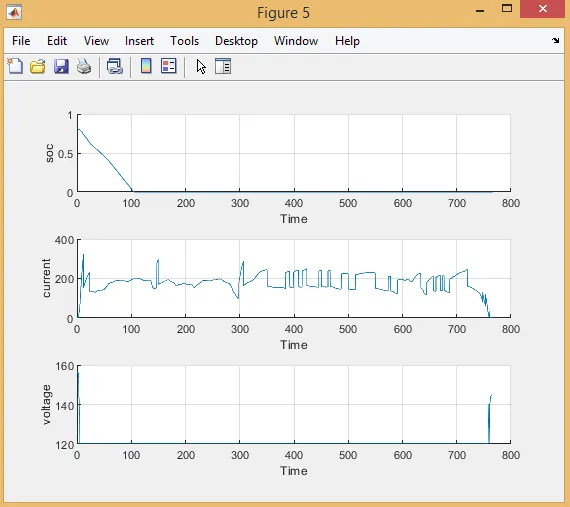
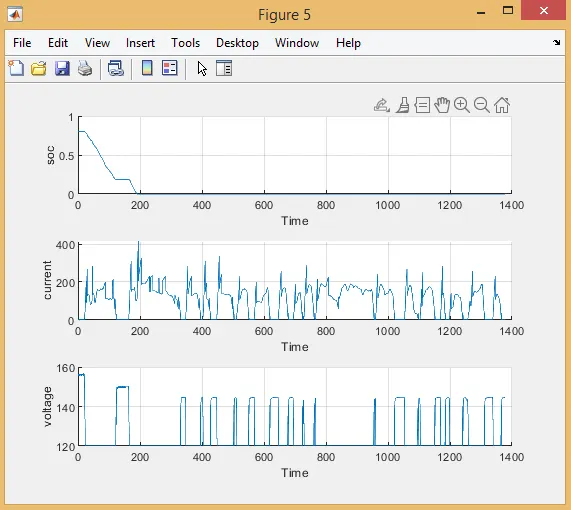
figure (5) Battery
title('Battery');
subplot(3,1,1);
hold on
grid on
plot (Time,SOC);
xlabel('Time'); ylabel('soc');
subplot(3,1,2);
hold on
grid on
plot (Time,Current);
xlabel('Time'); ylabel('current');
subplot(3,1,3);
hold on
grid on
plot (Time,Voltage);
xlabel('Time'); ylabel('voltage');
- HWFET
- UDDS
Data Analysis
Eng_Pwr = Eng_Spd.*pi./30.*Eng_Trq./1000; % Engine brake power [kW]
rho_petrol = 0.7197; % Density of petrol [kg/L]
kmpl = (Veh_Dist(end))./(Eng_Fuel_Consump(end)./1000/rho_petrol); % Fuel economy [kmpl]
- HWFET

- UDDS

IF WE COMPARE THE KMPL VALUES FOR UDDS AND HWFET CYCLE WE CAN SEE THAT KMPL IS MORE FOR HWFET BECAUSE IT HAVE MINIMUM IDLE LOSSES AND BREAKING IS NOT FREQUENT IN HIGHWAY CYCLE SO IT ULTIMATELY COMES UNDER MORE FUEL CONSUMPTION.
CONCLUSION
- Hence, the p1 forward energy-based fuel consumption model of a HYBRID vehicle has been successfully Simulated using MATLAB and Simulink.
- Analyses and understands vehicle operating points based on engine speed, torque, transmission speed, pedal positions, gear, and distance travelled.
- Post process calculations were performed and the required graphs were successfully plotted.
- Successfully calculated vehicle fuel efficiency numbers (kmpl) for the given city cycle (UDDS) and highway cycle (HWFET)
- By comparing the Hybrid and conventional vehicle we getting good result for the Hybride, less fuel consumption for hybrid, good efficiency and good operating point for hybrid