Project
1.
AIM: To study and analyze the BAJA all-terrain vehicle ATV model.
OBJECTIVES: To study the various results obtained from the model and to prepare a detail report based on results obtained. The models are:
1. BAJA ATV model without a dashboard.
2. BAJA ATV model with dashboard.
3. BAJA ATV model using lookup table without dashboard.
4. BAJA ATV model using lookup table with dashboard.
THEORY:
Definition of all-Terrain vehicle:
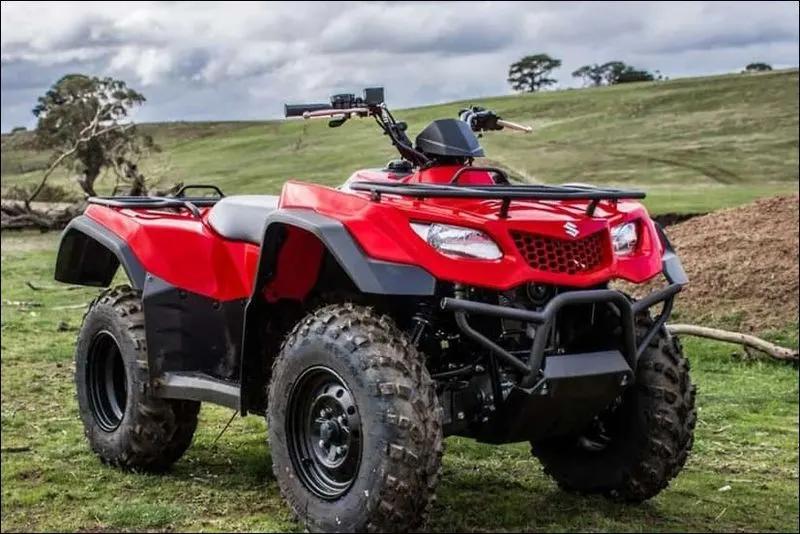
The term ATV stands for All-Terrain Vehicle. It is also known as a quad or quadricycle type vehicle. An All-Terrain motor vehicle could have three, four or even six wheels. Unlike a motorcycle, generally, the ATVs have more than two wheels. This vehicle runs on low-pressure tires. However, it has handlebars instead of wheel for controlling the steering. An ATV is designed to handle a broader variety of terrain than regular vehicles. In some countries it is a street-legal motor vehicle and licensed for use on public roads. However, it is not street-legal or roadworthy within some states, territories, and provinces of some countries.
Riding an ATV:
Most dirt bikes are considered the ATVs because they are designed for off-road use only. Generally most ATVs come with three or four wheels. Some specialized applications require six-wheel models. Engine sizes of ATVs range from as low as 49ccto 1,000cc. However, the size of the engine depends upon the application. Generally, the intended use of All Terrain Vehicles is by a single operator only.
However, some manufacturers make ATVs for use by two. Of them, one is the operator and other is passenger. So, manufacturers refer these ATVs as Tandem ATVs. The rider or main operator must wear a helmet just like a motorcycle rider.
Development:
The development of the All Terrain Vehicles started way back in the early 19th century. In 1893, Royal Enfield manufactured and sold the first powered quadricycle. However, it was mainly designed for use as a horseless carriage for road use. Most earlier generation ATVs had large balloon tires instead of a mechanical suspension.
In early 1980s, manufacturers introduced All Terrain Vehicles with better components like suspension, racks and lower-profile tires. In the late 1980s, due to safety issues with three-wheel ATVs, manufacturers upgraded them to four-wheel models. Later, manufacturers like polaris designed & developed the ATVs with six wheels for specialised operations such as military.
USES OF ALL TERRAIN VEHICLE:
- hosing your Garden
- Loading Logs
- Mounting
- Transporting Materials
- Lawn Raking
- Seed/Salt/Rock Spreading
- Lawn/Field Mowing
- Field plowing
- Hunting
- Winching
- Camping
- Killing weeds
- Snow Plowing
INFORMATION OF BAJA SAE:
Baja SAE is an design series competition run by the SAE International. Teams of students from universites all over the world design and build small off-road cars. The cars all have engines of the same specifications.
The goal in Baja SAE racing is to design, build and race off-road vehicles that can withstand the harshest elements of rough terrain. The vehicles used in Baja SAE racing are often similar to buggies. Before 2007, the events were called "Mini Baja". Each year as many as 141 Baja cars are entered in the Baja SAE events across the US and around the world. International events are endorsed by SAE International and are held in Brazil, Korea, South Africa and México.
All cars must adhere to SAE International's rules, and pass SAE's technical inspection and judging; a car may not race until all safety inspections are passed. Small engine manufacturer briggs and stratton sponsors Baja SAE teams by providing the SAE sanctioned engine free of charge, at a replacement rate of one engine for every two years in competition.
The dynamic events include hill climbs, sled pulls, maneuverability events, rock crawl, and suspension & traction events. Previously the cars had to be able to float and propel itself on water under its own power. This was changed from the 2012 competitions onward due to safety concerns.
Static events, such as written reports, presentations and design evaluations are provided by participating teams. This is when the teams are judged on ergonomics, functionality, and producibility of their cars; ensuring that the final placement of the team does not rest solely on the vehicle's performance but rather on a combination of static and dynamic events. Required reports detail the engineering and design process that was used in developing each system of the team's vehicle, supported with sound engineering principles.
Also, a cost report that provides all the background information necessary to verify the vehicle's actual cost is used to rate the most economically feasible for production. These reports are submitted weeks in advance of each event, where the presentations and design evaluations are given on site in the presence of SAE design judges. Teams with noticeable differences between the car and the cost report can be audited, where if the report and car do not match, the team will be served penalty points.
CONTINUOUSLY VARIABLE TRANSMISSION(CVT):
A continuously variable transmission (CVT) is anautomatic transmssion that can change seamlessly through a continuous range of gear ratios. This contrasts with other transmissions that provide a limited number of gear ratios in fixed steps. The flexibility of a CVT with suitable control may allow the engine to operate at a constant RPM while the vehicle moves at varying speeds.
In CVT we have mainly two pulleys:
-Driver pulley
-Driven pulley
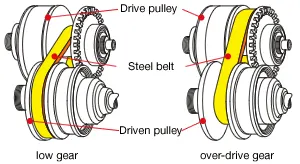
This both pulleys are connected to each other through belt. Driver pulley with the help of the belt drives the driven pulley. Driver pulley have two conical plates namely:
1) Fixed plate-which is connected to engine input shaft and it do not move.
2) Conical plate-it is movable, it slides on surface of the shaft. Same construction is applicable to driven pulley.
ADVANTAGE OF USES AN CONTINOUSLY VARIABLE TRANSMSSION:
1)One of the advantages of a CVT is its ability to continuously change its gear ratio. This means that no matter what the engine speed it, it is always performing at its peak efficiency. CVTs often offer better fuel economy as a result, especially when driving in the city.
2)most cars equipped with CVTs offer a smoother ride .This is because the transmission never shifts.
3)A CVT is lighter than a traditional automatic, and this, combined with the smoother operation, helps to improve the fuel efficiency of vehicles that come equipped with a CVT.
4)Because of the lack of gearing, it is easier for CVT vehicles to find and maintain an ideal torque ratio as well. It has an easier time taking off from a stoplight and an easier time climbing difficult terrain because the variable transmission allows it to run in the right "gear" and stay there.
5)They have a more connected feeling between the engine and the speed of the vehicle.
6)The driver has a better sense of control with actual upshifting and downshifting.
7)Automatic transmissions are less expensive to maintain.
8)They offer a more engaging driving experience.
DISADVANTAGE OF USES AN CONTINOUSLY VARIABLE TRANSMSSION:
1)While the lack of upshifting and downshifting is considered an advantage of the CVT, some drivers miss the sensation of the vehicle moving through the shift points. If you prefer a sportier driving experience, then the lack of fixed gears makes the ride less engaging.
2)Another complaint that drivers tend to make about a CVT is the loud droning sound that occurs during acceleration. This happens because the CVT forces the engine to continuously run a constantly high rpm as it gets up to speed.
3)CVTs can be expensive to repair or replace.
4)Some of the common problems that owners run into include overheating, slipping, and sudden loss of acceleration. Shuddering is also a common problem.
5)Since CVTs depend on the belts to operate, if these suffer from excessive stretching or too much wear, the transmission can completely fail.
6)CVTs are harder to work on. Even basic maintenance often needs to be done by a trained mechanic.
7)They don't last as long as a conventional transmission.
BLOCKS USED IN SIMULINK MODEL:
1. Signal builder
2. Simulink to PS coverter
3. Rotational motion sensor
4. Generic engine
5. Inertia
6. PS terminator
7. Mechanical reference
8. Tire
9. Vehicle body
10. PS constant block
11. Double shoe brake
12. variable ratio transmission
13. Simple gear
14. solver configuration
15. Variable gear ratio
16. Scope
1) BAJA ATV MODEL WITHOUT A DASHBOARD:
PROCESS:
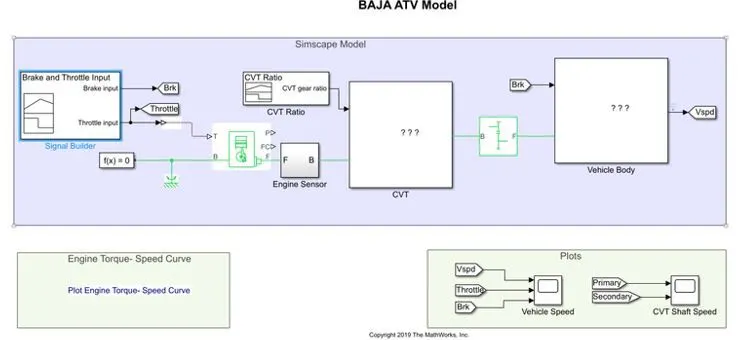
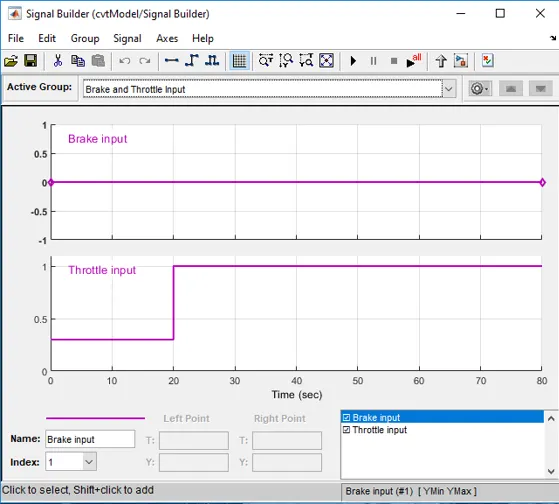
1) The throttle input is produced by signal builder block, and this input is then connected to engine and the brake input signal is also genrated by signal builder block.
2) The engine will generate the output which is rpm . this output is given to ideal rotational motion sensor which will sense the rpm.
3) Then this output is given to the CVT and again the CVT ratio is generated by signal builder block as shown.
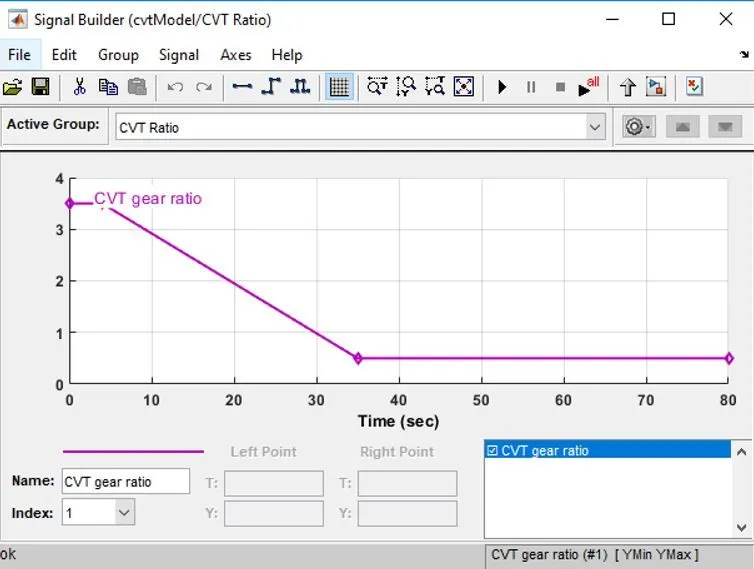
4) The output of the CVT is given to simple gear . to connect CVT and engine , we need some speed reduction , thus we use simple gear block.
5) The velocity is taken as output from vehicle block.
RESULT ANALYSIS:
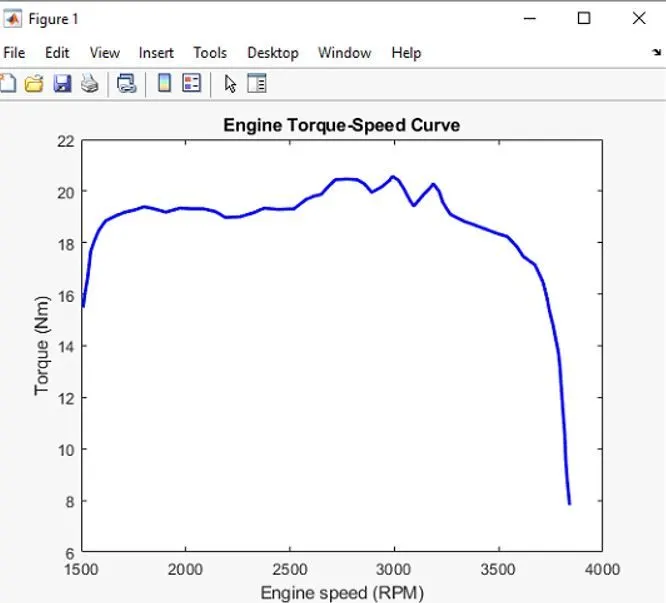
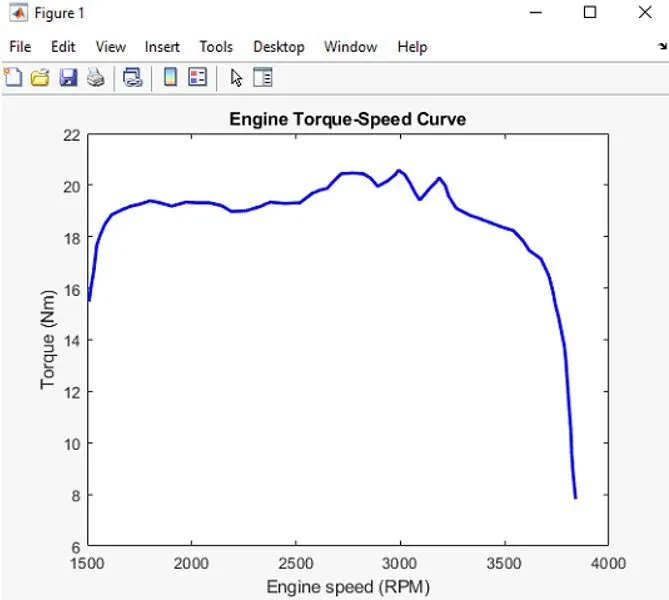
A) ENGINE SPEED AND TORQUE GRAPH: The graph shows the variation in torque and corresponding variation in engine speed.
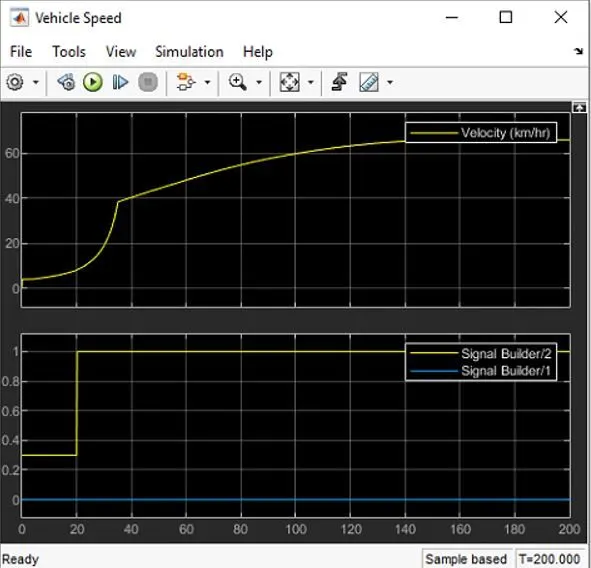
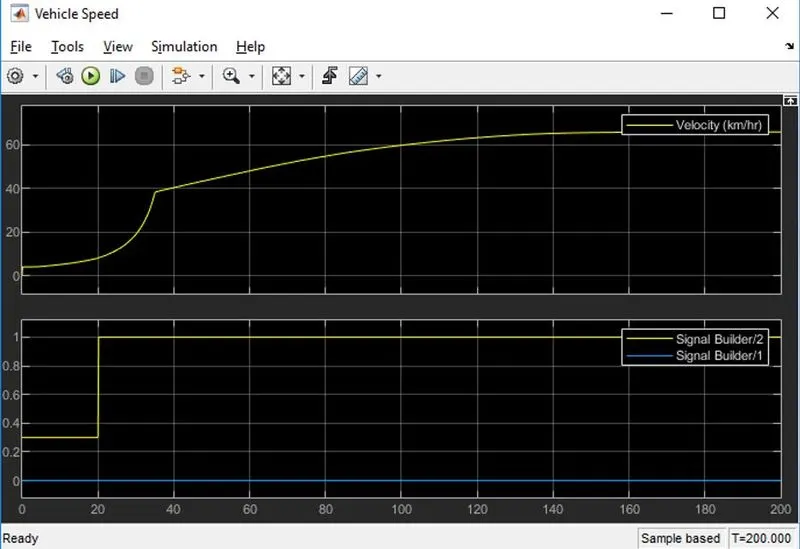
B) VEHICLE SPEED PLOT: In this model , the brake input is not given and throttle input is given 0.3 upto 20 seconds and then 1 after 20 seconds and we observed that the velocity increases as the throttle input increases. As we can see that , the value of velocity is near about 64 km/hr at full throttle=1 at near about 140 second and then the velocity remains almost constant.
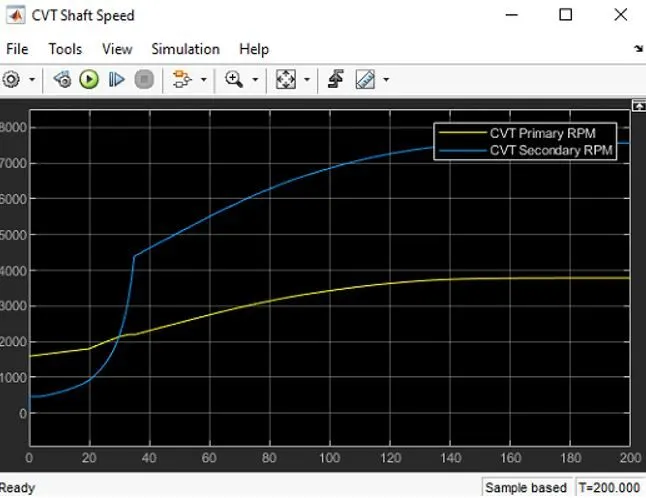
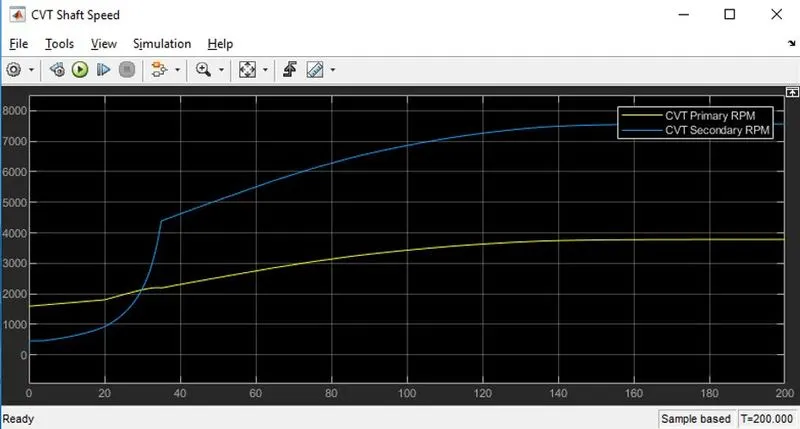
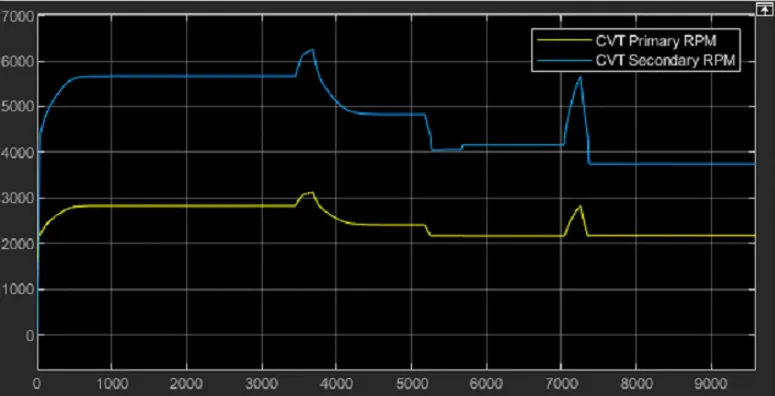
C) CVT SPEED PLOT: here two graphs are plotted , one for CVT primary RPM and other for CVT secondary RPM.
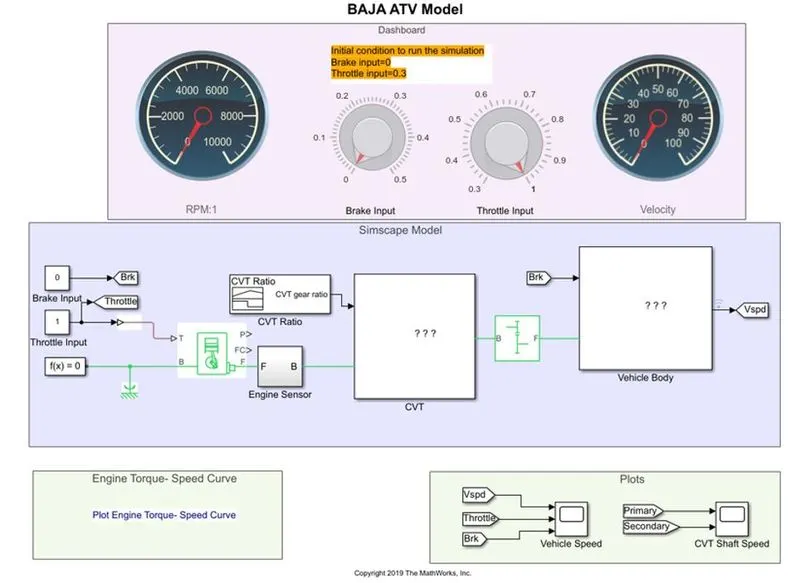
2) BAJA ATV MODEL WITH DASHBOARD:
This model works same as baja ATV model without dashboard ,the only difference is that , the throttle and the brake inputs are controlled by the user using the knob.
RESULTS OBTAINED:
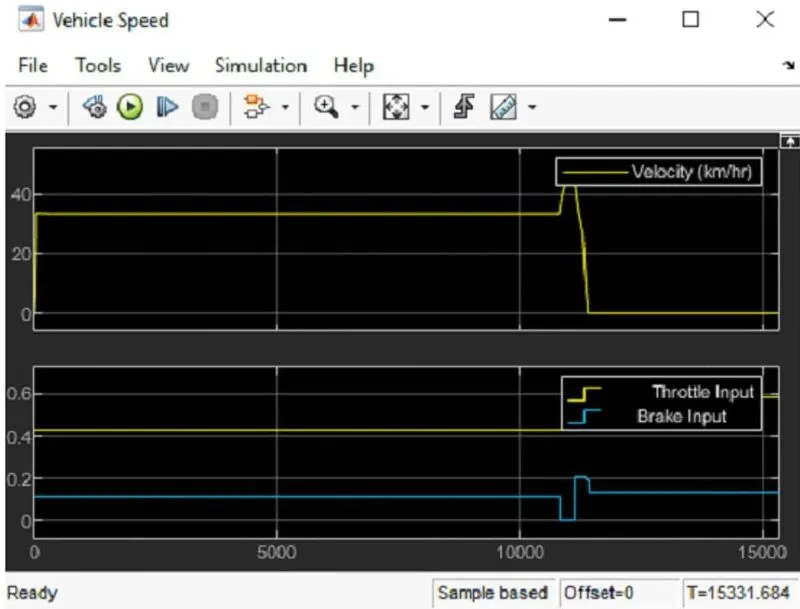
A) VEHICLE SPEED GRAPH: Thus as brake and throttle input changes , the velocity also changes.
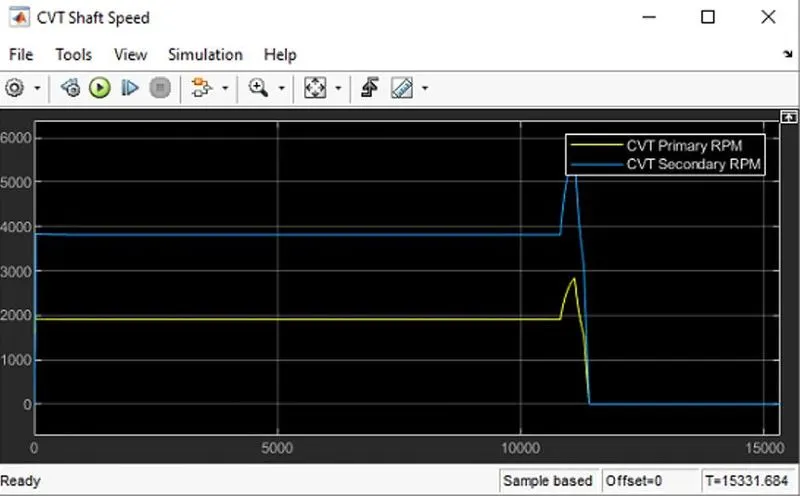
B) CVT SPEED GRAPH: The CVT primary RPM and CVT secondary rpm results are shown in the below graph.
3) BAJA ATV MODEL USING LOOKUP TABLE WITHOUT DASHBOARD:
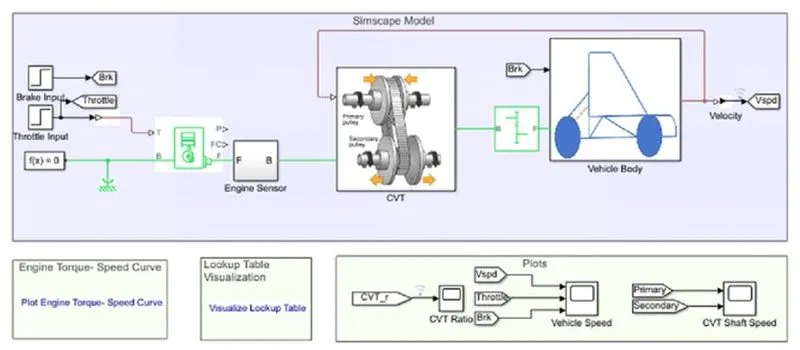
if we click the CVT block we get model:
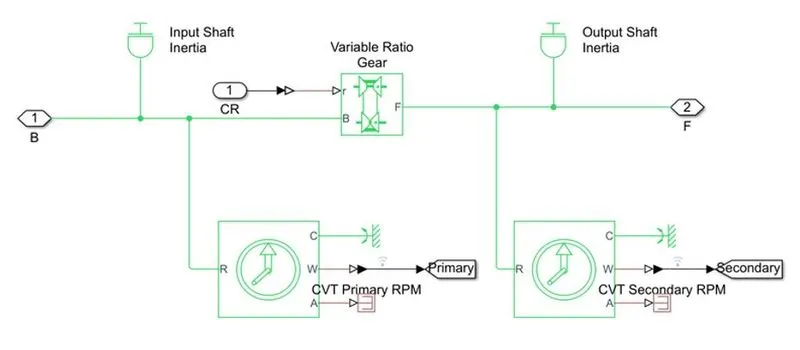
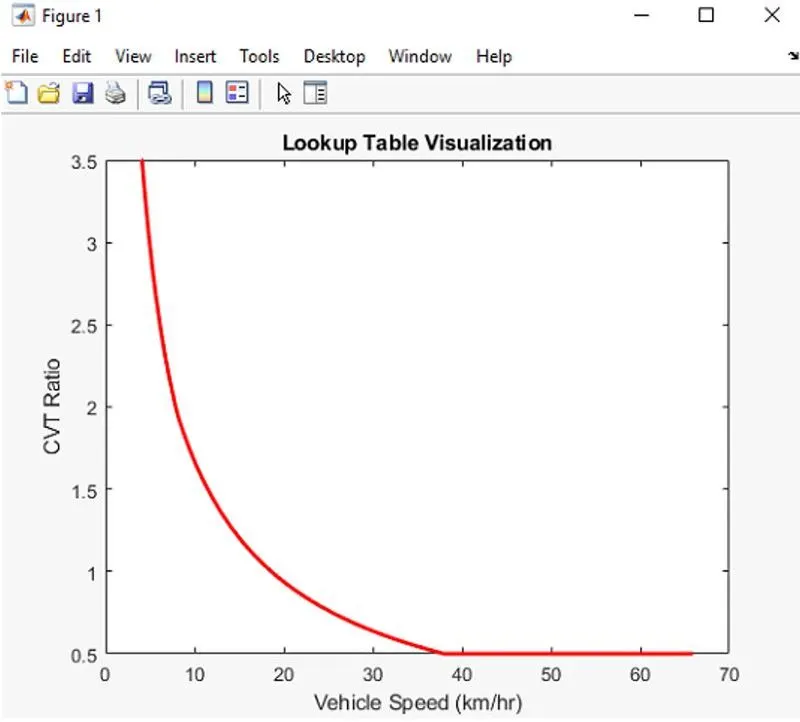
Here the gear ratio inputs to CVT is given using lookup table. all the other parameters are same as before only.
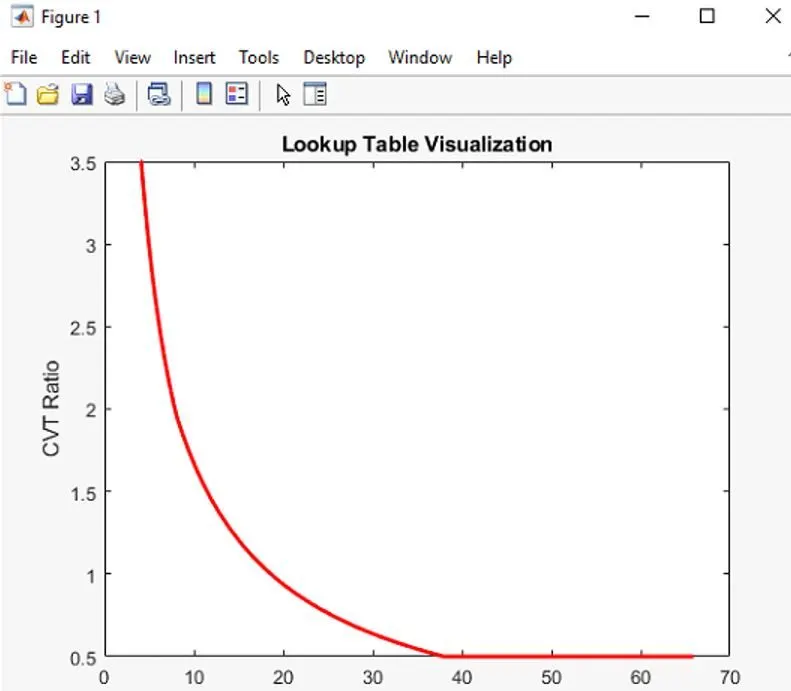
LOOK UP TABLE VISUALIZATION:
Lookup Table: A lookup table is an array of data that maps input values to output values, thereby approximating a mathematical function. Given a set of input values, a lookup operation retrieves the corresponding output values from the table. If the lookup table does not explicitly define the input values, Simulink can estimate an output value using interpolation, extrapolation, or rounding, where:
- Interpolation is a process for estimating values that lie between known data points.
- Extrapolation is a process for estimating values that lie beyond the range of known data points.
- Rounding is a process for approximating a value by altering its digits according to a known rule.
A lookup table block uses an array of data to map input values to output values, approximating a mathematical function. Given input values, Simulink performs a “lookup” operation to retrieve the corresponding output values from the table. If the lookup table does not define the input values, the block estimates the output values based on nearby table values.
OUTPUTS:
A) VEHICLE SPEED VARIATION BY VARYING THROTTLE AND SPEED:
B) CVT SHAFT SPEEDS:
4)BAJA ATV MODEL USING LOOKUP TABLE WITH DASHBOARD:
In this model , the knobs are used to control the inputs that is throttle and brake.
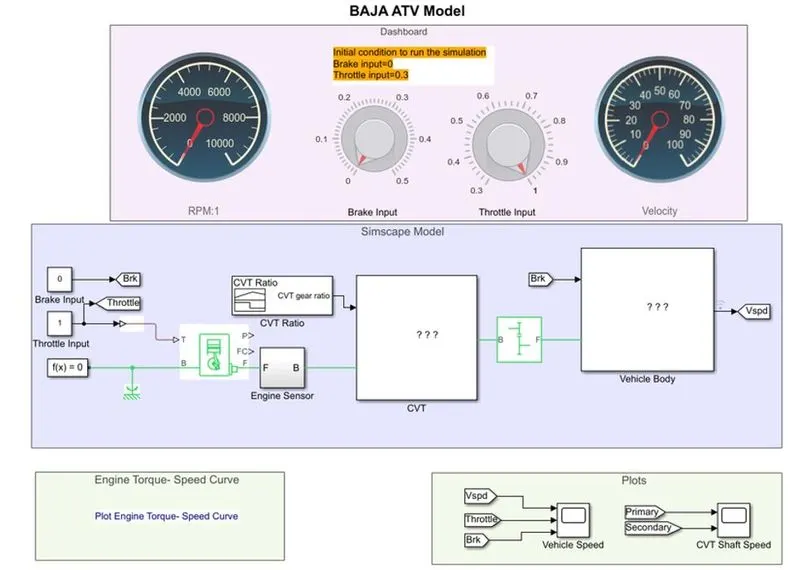
LOOK UP TABLE VISUALIZATION:
ENGINE TORQUE-SPEED CURVE:
OUTPUT:
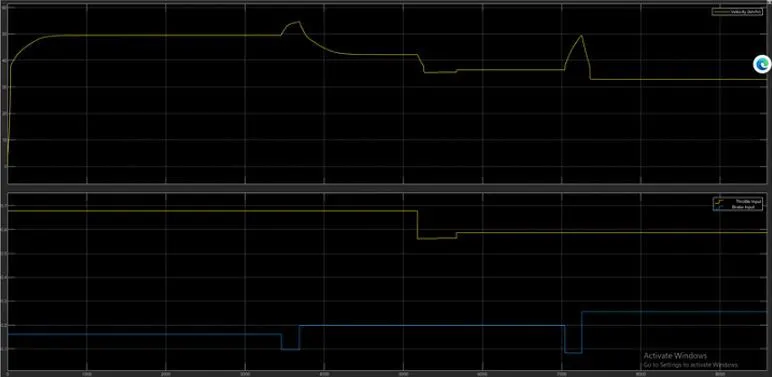
A) VEHICLE SPEED VARIATIONS BR VARYING THROTTLE AND BRAKE INPUTS:
This graph is near about same that we have obtained in BAJA ATV MODEL WITH DASHBOARD, Here the velocity gets varied as throttle input and brake input varies. as brake input increases , the speed of vehicle decreases.
B) SHAFT RPM:
CONCLUSION:
Thus we have studies all four models and the difference have been seen with different value inputs and the results are analysed properly.
REFERENCE:
https://in.mathworks.com/matlabcentral/fileexchange/70576-baja-all-terrain-vehicle-atv-model