Week 3 - Solving second order ODEs
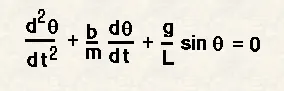
AIM: To write a program that solves the following ODE. This ODE represents the equation of motion of a simple pendulum with damping.
OBJECTIVE:
- The pendulum moves depends on the Newtons second law. When this law is written down, we get a second order Ordinary Differential Equation that describes the position of the "ball" w.r.t time.
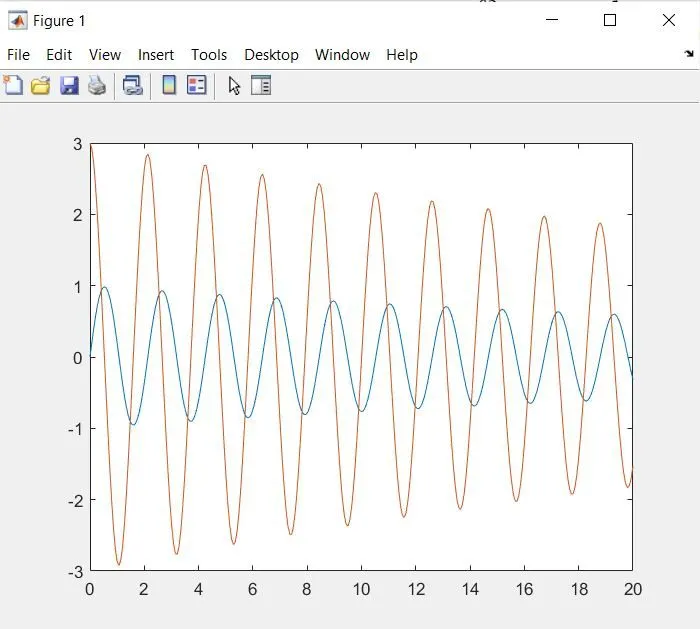
- Simulate the motion between 0-20 sec, for angular displacement=0,angular velocity=3 rad/sec at time t=0.
- By Using this information, animate the motion of the pendulum.
INPUTS:
L=1 metre,
m=1 kg,
b=0.05,
g=9.81 m/s2.
INTRODUCTION:
A second order ordinary differential equation is an ordinary differential equation in which any derivatives with respect to the independent variable have order no greater than 2.
Ordinary differential equations helps us to solve the many engineering systems. Such as harmonic motions, vibrarions, damping,etc.
For designing a simple pendulum it consists of a mass ‘m’ hanging from a string of length ‘l’ and fixed at a pivot point . When displaced to an initial angle ’θ’ and released, the pendulum will swing back and forth with periodic motion.
This ODE represents the equation of motion of a simple pendulum with damping in the below equation
MATLAB CODE:
clear all
close all
clc

%inputs
b=0.05;
l=1;
g=9.81;
m=1;

%inital condtion
theta_0=[0;3];

%time points
t_span=linspace(0,20,300);

%solve ode
[t,results]= ode45(@(t,theta) ode_func(t, theta,b,g,l,m),t_span,theta_0);
plot(t, results(:,1))
hold on
plot(t,results(:,2))

%Animating the transient motion of thesimple pendulum
figure(2)
ct=1;
for i=1:length(results(:,1))
 x0=0;
 y0=0;

 x1=l*sin(results(i,1));
 y1=-l*cos(results(i,1));


 plot([0 0],[-1.5 0.5])
 hold on
 plot([x0 x1],[y0 y1],'linewidth',1,'color','b')
 axis([-1.5 1.5 -1.5 0.5])
 plot(x1, y1,'o','MarkerSize',20,'color','r')
 pause(0.0001)
 M(ct)=getframe(gcf)
 hold off
 ct=ct+1

end
%making the video file
movie(M)
videofile=VideoWriter('simple_pendulum.avi')
open(videofile)
writeVideo(videofile,M)
close(videofile)
FUNCTION CODE FOR SOLVING THE ODE:
function [dtheta_dt]= ode_func(t,theta,b,g,l,m)
theta1=theta(1)
theta2=theta(2)
dtheta1_dt=theta2;
dtheta2_dt= -(b/m)*theta2 - (g/l)*sin(theta1);
dtheta_dt=[dtheta1_dt;dtheta2_dt];
end
OUTPUTS:
GRAPH OF ANGULAR VELOCITY AND ANGULAR DISPLACEMENT FOR A RANGE OF 20 SEC:
VIDEO LINK FOR SIMPLE PENDULUM: