Project
Aim- To study and analyse the system-level All-Terrain Vehicle model in Simulink and observe results.
Objective - To carry out a system-level simulation of an all-terrain vehicle and to prepare a technical report explaining the model properties & comments on the results.
Report
BAJA All-Terrain Vehicle (ATV)
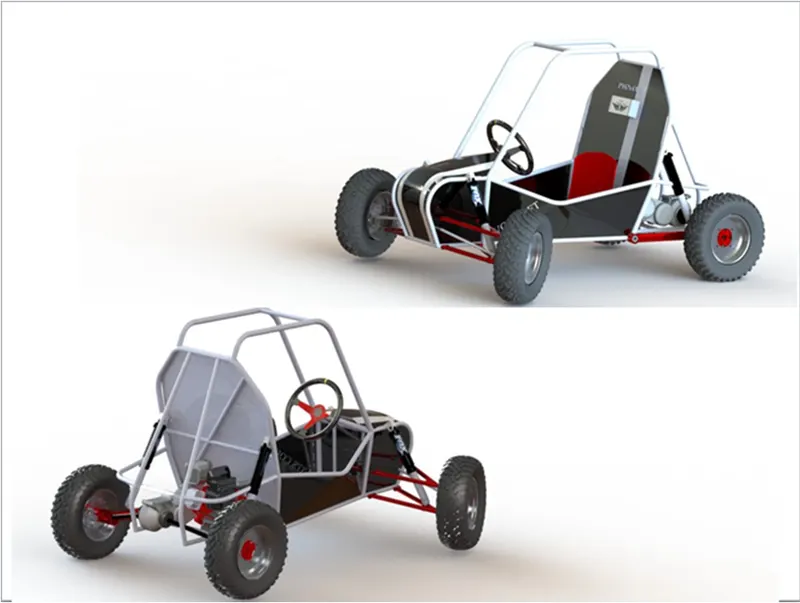
- An all-terrain vehicle (ATV), also known as a light utility vehicle (LUV), a quad bike, or simply a quad.
- Atv's offer excellant off road capabilities and can carry heavy equipment over long distance and narrow access points.
- They can also be customized for high performance riding, owing to which they find extensive applications across various industries, including sports, entertainement, agriculture, military and defense
- BAJA is basically an ATV competition where students get to design and develop their own ATV keeping in mind various considerations of design as well as safety
CONTINUOUS VARIABLE TRANSMISSION:
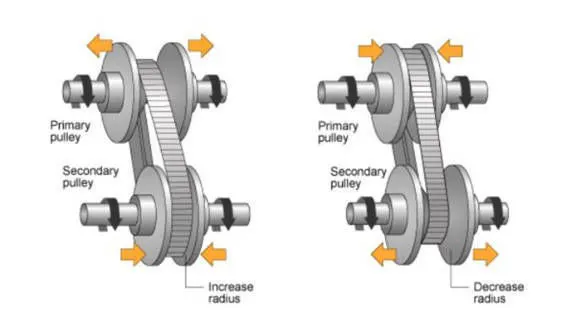
- A continuous variable transmission (CVT) is an automatic transmission that can change seamlessly through a continuous range of gear ratios. This contrasts with other transmissions that provide a limited number of gear ratios in fixed steps.
- The flexibility of a CVT with suitable control may allow the engine to operate at a constant RPM while the vehicle moves at varying speeds.
- CVTs are used in automobiles, tractors, motor scooters, snowmobiles, bicycles and earthmoving equipment.
- The most common type of CVT uses two pulleys connected by a belt or chain; however, several other designs have also been used at times.
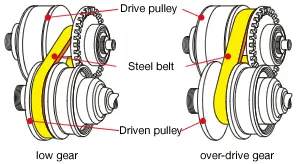
- Accordingly to the radius of both drive pulley and driven pulley, the purpose of reducing speed or overdrive condition is achieved
BAJA ATV Model
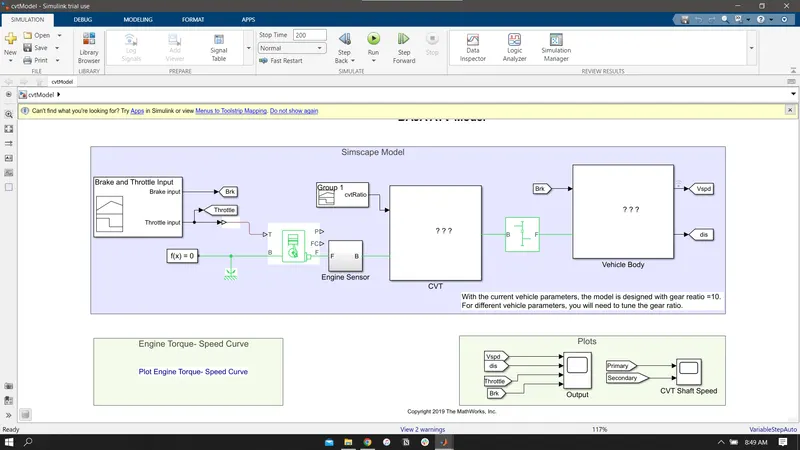
- the input for engine is acceleration (Throttle).
- Then the engine is connected with CVT and rpm input to CVT.
- The driven pulley of CVT give input to simple gear and then simple gear input to vehicle body block in vehicle body subsystem.
Components
- Engine used here is generic engine inbuild block.
- The Generic Engine block represents a general internal combustion engine. This block is a suitable generic engine for spark-ignition and diesel. Speed-power and speed-torque parameterizations are provided. A throttle physical signal input specifies the normalized engine torque. Optional dynamic parameters include crankshaft inertia and response time lag.
Input for engine
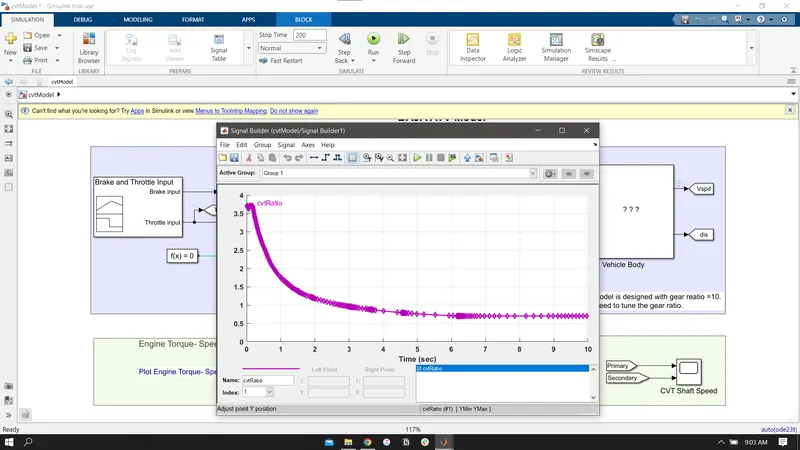
Throttle and brake input using signal builder
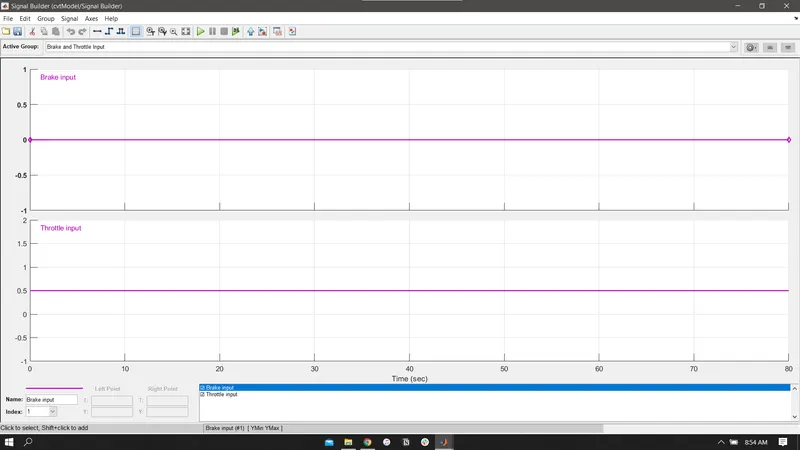
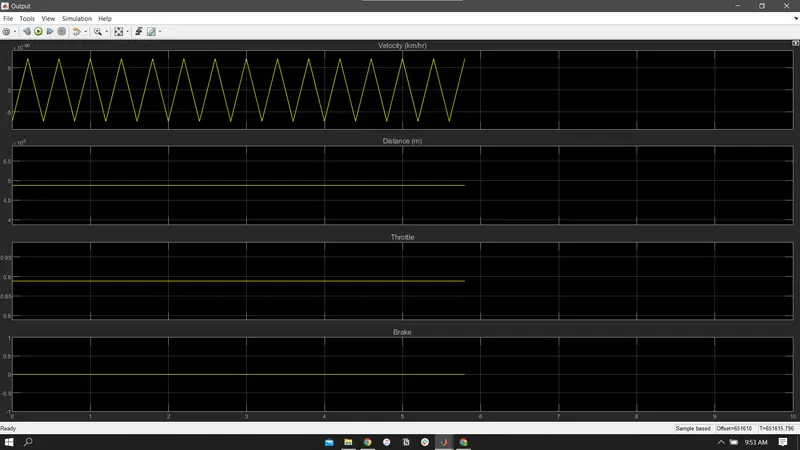
- We can observe that currently there is no break input and a constant throttle is provided to the system.
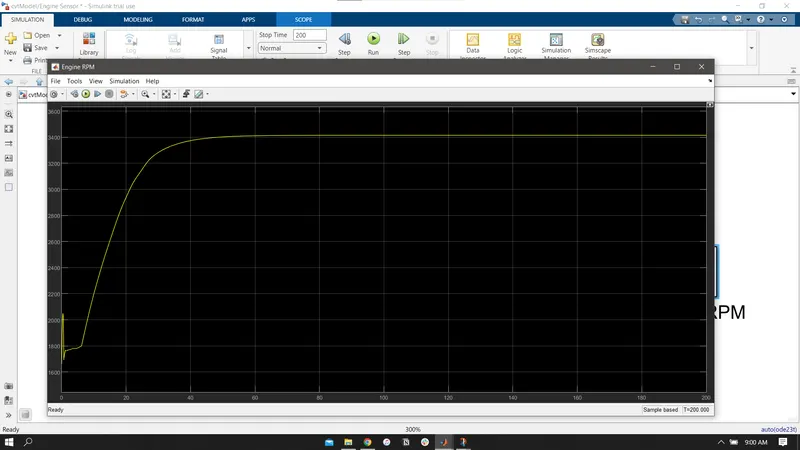
Engine Sensor
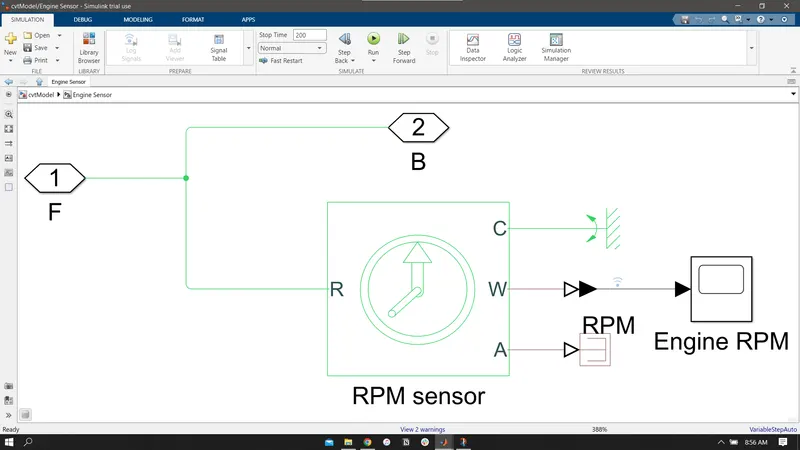
- Engine sensor is the Ideal Rotational Motion Sensor block represents an ideal mechanical rotational motion sensor, that is, a device that converts an across variable measured between two mechanical rotational nodes into a control signal proportional to angular velocity or angle.
- Connections R and C are mechanical rotational conserving ports that connect the block to the nodes whose motion is being monitored. Connections W and A are physical signal output ports for velocity and angular displacement, respectively.
Engine rpm measured (resultant plot)
CVT Subsystem
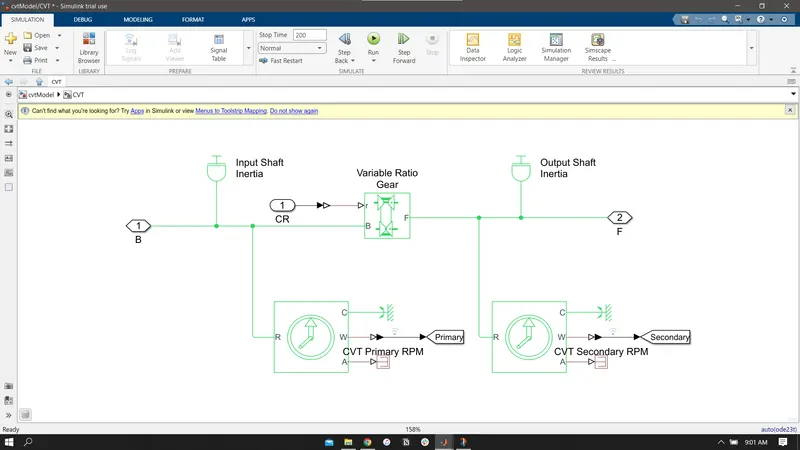
Variable ratio gear transmission: - Represents a variable ratio gearbox such as implemented by mechanical belt CVT, electric, or hydraulic transmissions. The physical signal input r defines the ratio of input to output angular shaft velocities. Connections B (base) and F (follower) are mechanical rotational conserving ports.
Input to CVT subsystem
Simple gear
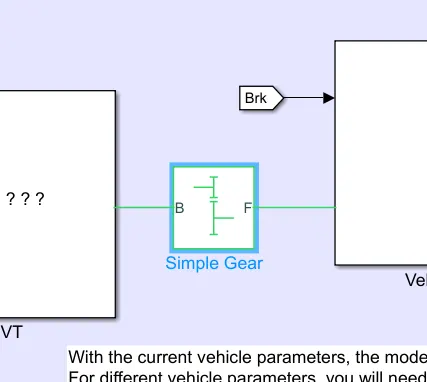
- Represents a fixed-ratio gear or gear box. No inertia or compliance is modelled in this block. You can optionally include gear meshing, backlash, and viscous bearing losses. Connections B (base) and F (follower) are mechanical rotational conserving ports. Specify the relation between base and follower rotation directions with the Output shaft rotates parameter. Optionally include thermal effects and expose thermal conserving port H by setting Friction model to a temperature-dependent setting.
- For different vehicle parameters, we need to tune the gear ratio.
- To connect the engine and CVT we need speed reduction so we add simple gear block.
Vehicle Body Subsystem
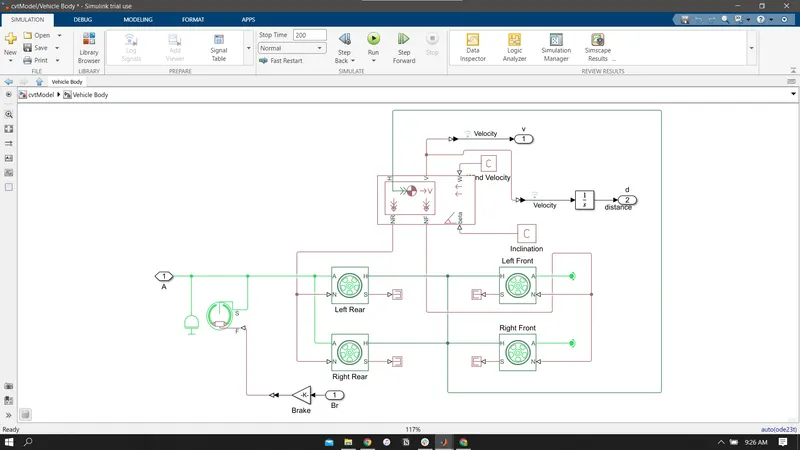
- This Represents a two-axle vehicle body in longitudinal motion. This block accounts for body mass, aerodynamic drag, road incline, and weight distribution between axles due to acceleration and road profile. The vehicle can have the same or a different number of wheels on each axle.
- Connection H is the mechanical translational conserving port associated with the horizontal motion of the vehicle body. The resulting traction motion developed by tires is connected to this port. Connections V, NF, and NR are physical signal output ports for vehicle velocity and front and rear normal wheel forces, respectively. Wheel forces are considered positive if acting downwards. Connections W and beta are physical signal input ports corresponding to headwind speed and road inclination angle, respectively.
Resultant Outputs
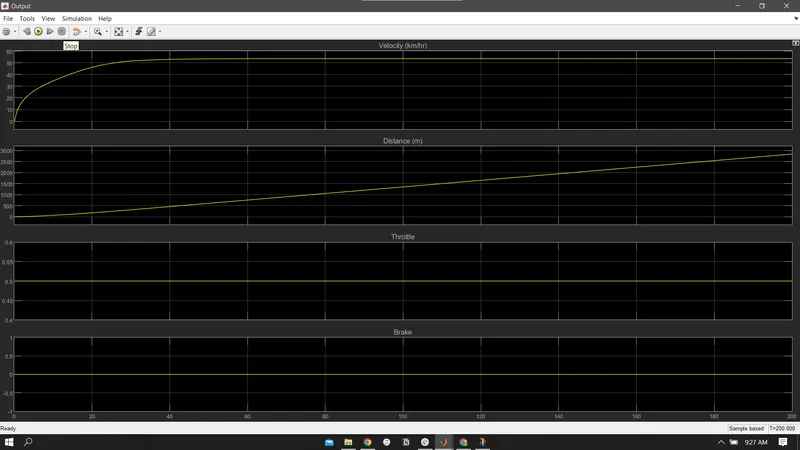
the velocity increases over time to 40 sec but after that it will constant.
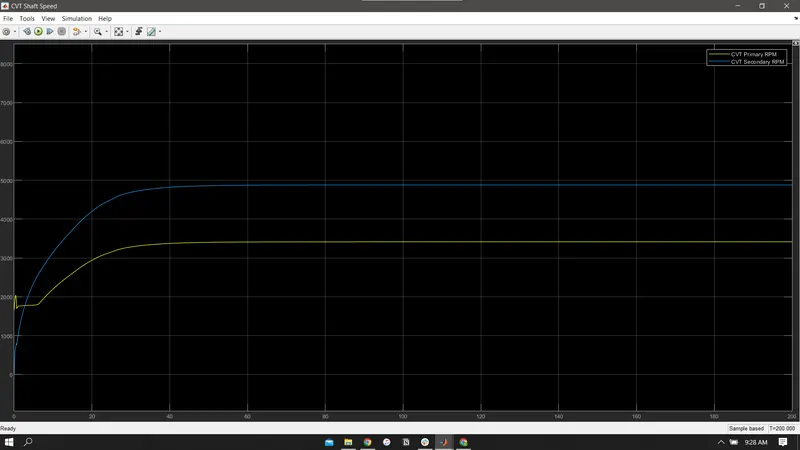
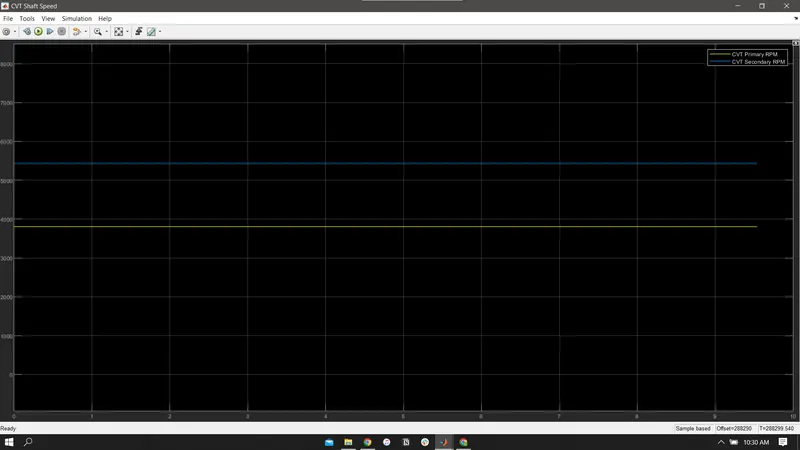
the secondary pulley rpm is greater than primary pulley because when we accelerate the vehicle the primary pulley will expand and secondary pulley will extract, this process is speed reduction.
BAJA CVt with dashboard
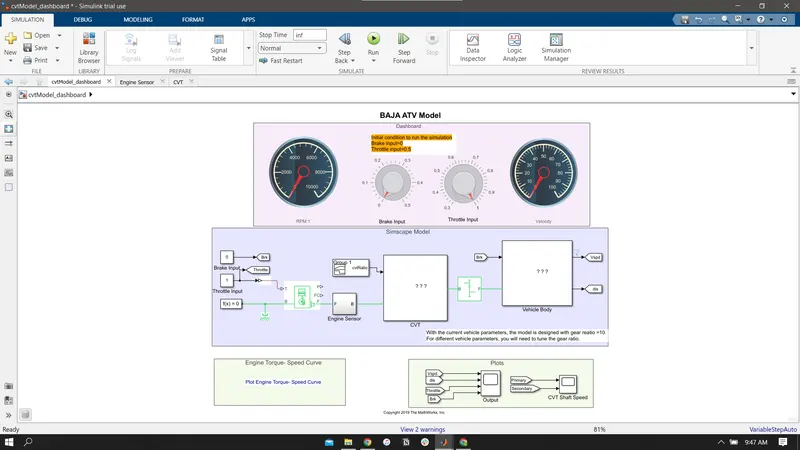
To give input dashboard knobs are used which are connected with constant block which provide input in running time.
Outputs