Project
AIM: To carry out a system-level simulation of an all-terrain vehicle (ATV) and write a technical report explaining the model properties and comments the result.
THEORY:
All-Terrain Vehicle :-
An all-terrain vehicle (ATV), also known as a light utility vehicle (LUV), a quad bike, or simply a quad, as defined by the Americal National Standard Institute (ANSI); is a vehicle that travels on low-pressure tires, with a seat that is straddled by the operator, along with handlebars for steering control. As the name implies, it is designed to handle a wider variety of terrain than most other vehicles.
. 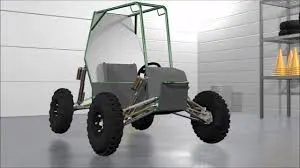
BAJA is basically an ATV competition where students get to design and develop their own ATV keeping in mind various considerations of design as well as safety. An ATV is designed in order to run on various terrains such as soil, Gravel, pebbles, etc.
Continuous Variable Transmission :-
A CVT likewise operates smoothly while climbing hills. This avoids the “gear hunting” you'll often feel with a conventional automatic transmission. And because a CVT is lighter in weight and delivers better power efficiency, it helps improve a vehicle's fuel economy. That's why many hybrid vehicles come with CVTs.
MODEL :
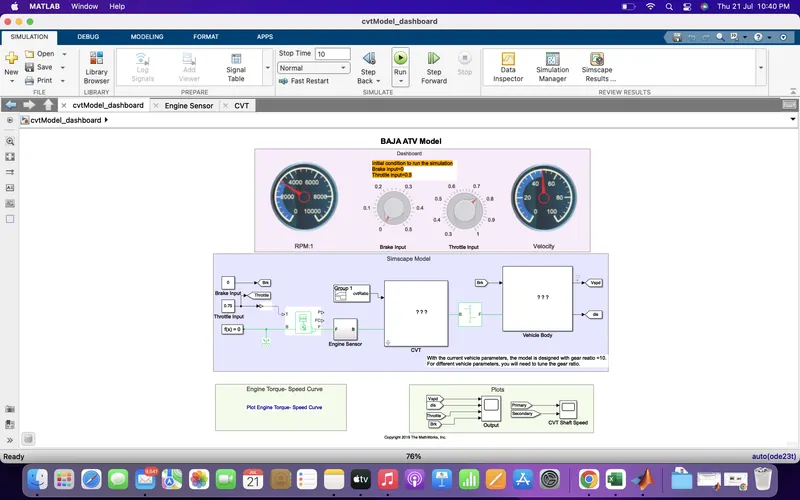
Common Block Used -
- Signal Builder - The Signal Builder block allows you to create interchangeable groups of piecewise linear signal sources and use them in a model.
- GOTO - The Goto block passes its input to its corresponding From blocks. The input can be a real- or complex-valued signal or vector of any data type. From and Goto blocks allow you to pass a signal from one block to another without actually connecting them. A Goto block can pass its input signal to more than one From block, although a From block can receive a signal from only one Goto block. The input to that Goto block is passed to the From blocks associated with it as though the blocks were physically connected.

- From - The From block accepts a signal from a corresponding Goto block, then passes it as output. The data type of the output is the same as that of the input from the Goto block. From and Goto blocks allow you to pass a signal from one block to another without actually connecting them.
- Simulink PS Converter
- Solver Configuration - Each physical network represented by a connected Simscape block diagram requires solver settings information for simulation. The Solver Configuration block specifies the solver parameters that your model needs before you can begin simulation. Each topologically distinct Simscape block diagram requires exactly one Solver Configuration block to be connected to it.
- Mechanical Rotational Reference - The Mechanical Rotational Reference block represents a reference point, or frame, for all mechanical rotational ports. All rotational ports that are rigidly clamped to the frame (ground) must be connected to a Mechanical Rotational Reference block.
- Scope - The Simulink Scope block display time domain signals. It display signals generated during simulation.
- Simple Gear - The Simple Gear block represents a gearbox that constrains the connected driveline axes of the base gear, B, and the follower gear, F, to corotate with a fixed ratio that you specify.
The follower-base gear ratio is
gFB=rFrB=NFNBgFB=rFrB=NFNB
where:
NBNB is the number of teeth in the base gear.
NFNF is the number of teeth in the follower gear.
- Generic Engine - The Generic Engine block represents a general internal combustion engine. This block is a suitable generic engine for spark-ignition and diesel. Speed-power and speed-torque parameterizations are provided. A throttle physical signal input specifies the normalized engine torque.
SUBSYSTEM MODEL:
Engine Sensor:-
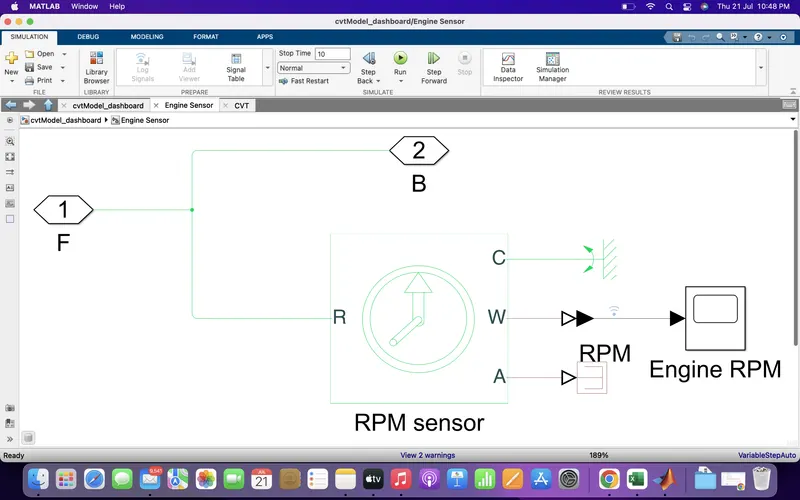
CVT:-
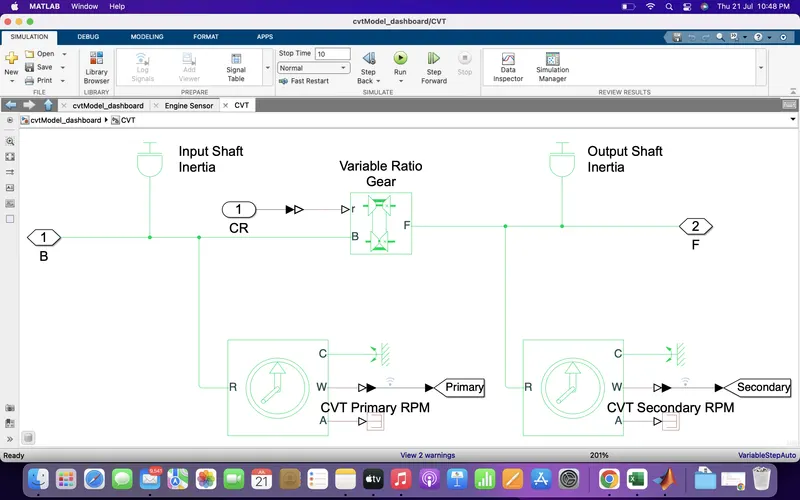
OUTPUT :
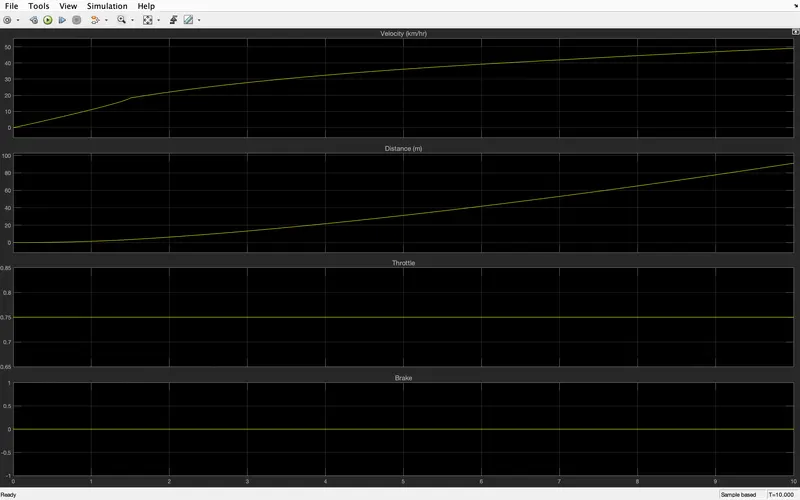
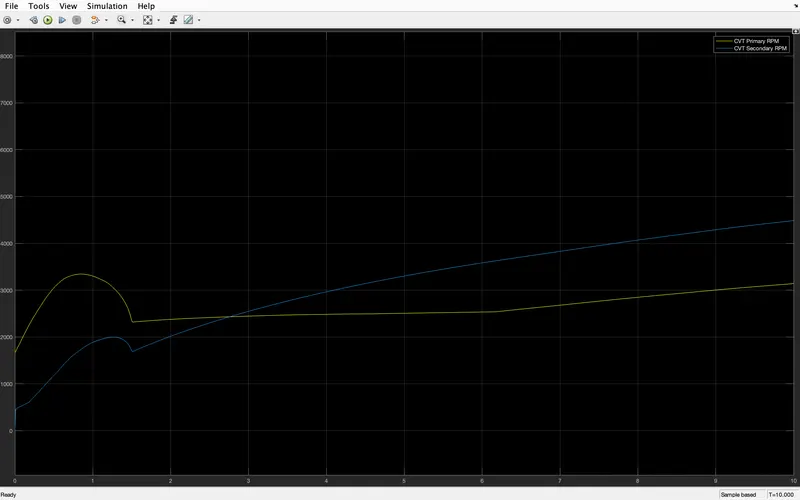
These are the two scopes result we got.
CONCLUSION:
The model runs perfectly.