Project-1: Powertrain for aircraft in runways
1. Search and list out the total weight of various types of aircrafts.
The different terms represent different weights or masses1. For each flight, the weights are taken into account for several reasons.
A brief description about these is below:
Manufacturer's empty weight (MEW):
It is the weight of the aircraft "as built" and includes the weight of the structure, power plant, furnishings, installations, systems and other equipment that are considered an integral part of an aircraft.This excludes any baggage, passengers, or usable fuel2.
Zero-fuel weight (ZFW):
This is the total weight of the airplane and all its contents (including unusable fuel), but excluding the total weight of the usable fuel on board.As a flight progresses and fuel is consumed, the total weight of the airplane reduces, but the ZFW remains constant.Maximum zero fuel weight (MZFW) is the maximum weight allowed before usable fuel and other specified usable agents (engine injection fluid, and other consumable propulsion agents) are loaded.
Operating empty weight (OEW): (Roughly equivalent to basic empty weight on light aircraft)It is the basic weight of an aircraft including the crew, all fluids necessary for operation such as engine oil, engine coolant, water, unusable fuel and all operator items and equipment required for flight but excluding usable fuel and the payload.
Payload:It is the carrying capacity of an aircraft. It includes cargo, people, extra fuel. In the case of a commercial airliner, it may refer only to revenue-generating cargo or paying passengers.
Maximum takeoff weight (MTOW)This is the maximum weight at which the pilot of the aircraft is allowed to attempt to take off.
Regulated takeoff weight (RTOW)Depending on different factors (e.g. flap setting, altitude, air temperature, length of runway), RTOW or maximum permissible takeoff weight varies for each takeoff. It can never be higher than MTOW.
2) Is there any difference between ground speed and air speed?
Airspeed is the vector difference between the ground speed and the wind speed. On a perfectly still day, the airspeed is equal to the ground speed. But if the wind is blowing in the same direction that the aircraft is moving, the airspeed will be less than the ground speed.
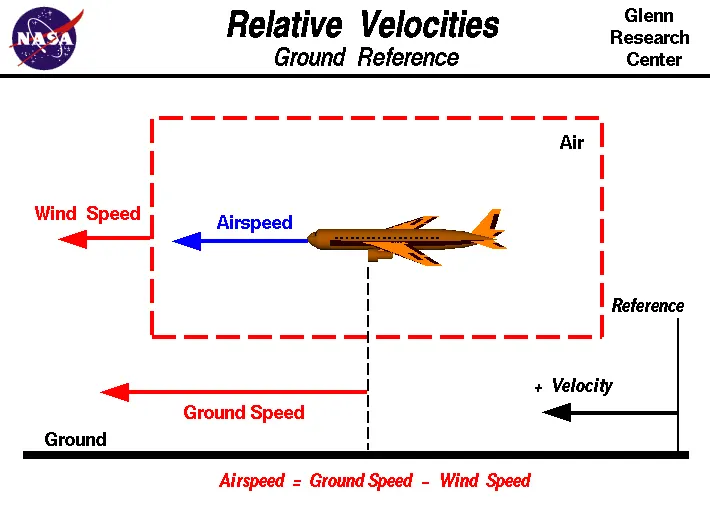
Aerodynamic forces are generated by an object moving through a fluid (liquid or gas). A fixed object in a static fluid does not generate aerodynamic forces. Hot air balloons "lift" because of buoyancy forces and some aircraft like the Harrier use thrust to "lift" the vehicle, but these are not examples of aerodynamic lift. To generate lift, an object must move through the air, or air must move past the object. Aerodynamic lift depends on the square of the velocity between the object and the air. Now things get confusing because not only can the object be moved through the air, but the air itself can move. To properly define the relative velocity, it is necessary to pick a fixed reference point and measure velocities relative to the fixed point. In this slide, the reference point is fixed to the ground, but it could just as easily be fixed to the aircraft itself. It is important to understand the relationships of wind speed to ground speed and airspeed.
Wind Speed
For a reference point picked on the ground, the air moves relative to the reference point at the wind speed. Notice that the wind speed is a vector quantity and has both a magnitude and a direction. Direction is important. A 20 mph wind from the west is different from a 20 mph wind from the east. The wind has components in all three primary directions (north-south, east-west, and up-down). In this figure, we are considering only velocities along the aircraft's flight path. A positive velocity is defined to be in the direction of the aircraft's motion. We are neglecting cross winds, which occur perpendicular to the flight path but parallel to the ground, and updrafts and downdrafts, which occur perpendicular to the ground.
Ground Speed
For a reference point picked on the ground, the aircraft moves relative to the reference point at the ground speed. Ground speed is also a vector quantity so a comparison of the ground speed to the wind speed must be done according to rules for vector comparisons.
Airspeed
The important quantity in the generation of lift is the relative velocity between the object and the air, which is called the airspeed. Airspeed cannot be directly measured from a ground position, but must be computed from the ground speed and the wind speed. Airspeed is the vector difference between the ground speed and the wind speed.
Airspeed = Ground Speed - Wind Speed
https://www.grc.nasa.gov/www/k-12/airplane/move.html
3) Why is it not recommended to use aircraft engine power to move it on the ground at Airport?
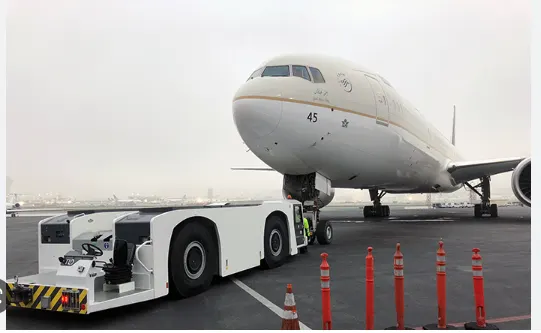
Aircraft towing equipment is typically used for the towing and pushback process to avoid some of the significant hazards posed by aircraft engines. When an aircraft's engine is activated, the thrust can create a high-speed wind that can easily cause damage to the airport terminal, surrounding ground vehicles, jetway, baggage and most importantly, ground personnel.
Suppressing the use of engines is especially important when towing a large aircraft, as their more powerful thrust capabilities can become exceedingly dangerous. Engine thrust can easily send any loose items airborne, turn the tiniest grains of dust into hazardous projectiles and create debris that can cause damage to multi-million dollar engines. Additionally, aircraft engines consume a great deal of fuel and generate extreme noise that can be harmful to ground personnel. Using a pushback tug for aircraft is simply a more economical and safer option than running the engines.
AIRCRAFT TOWING IS EASIER FOR MAINTENANCE PURPOSES
Towing and pushback tugs for aircraft are also used to make general maintenance easier for ground personnel. When an aircraft needs to be moved to a hangar for maintenance purposes or is not required for flight, the easiest way is to send an aircraft tug to the tow-in gate for transport. Aircraft towing frees up time for the airline, maintenance team, airport ground controllers and pilots who don't need to waste time getting the engines started. It's also not cost-efficient to start aircraft engines just to reposition an aircraft for maintenance purposes. Typically, ground personnel are trained to only need the aircraft brake system when towing a large aircraft.
3. PILOTS HAVE LIMITED VISIBILITY FROM THE FLIGHT DECK
Pilots do not have a clear view of the rear from the flight deck and thus rely on aircraft towing equipment for ground pushback when needed. Once the aircraft is perfectly positioned and far from the terminal tow-in gate and other vehicles, the airport tug is disconnected and the aircraft can use its engines and steering to move to the runway for takeoff.
TERMINAL TOW-IN GATES ARE CONFINED SPACES
Another common reason aircraft towing equipment is used in airports concerns aircraft safety from the taxiway to the tow-in gate. Aircraft towing from the taxiway occurs with significant time constraints, so pilots and ground personnel are under extreme pressure to navigate the aircraft quickly and efficiently. The tight confines of the terminal tow-in gate combined with the restricted view of the pilots generally always require a tow in order to arrive safely and on time.
Aircraft towing can prevent contact with other structures because ground personnel have much better visibility from the airplane tug. With the aid of ground personnel walking with the wings and tail, the airport tug driver can precisely position the aircraft to ensure it will not hit a structure, vehicle, person or another aircraft. In addition to this, the airplane tug driver is in constant communication with the pilots to ensure the aircraft will brake if an emergency occurs.
PUSHBACK TUGS FOR AIRCRAFT ARE REQUIRED FOR GOING IN REVERSE
Typically, most aircraft cannot move in reverse without the help of aircraft towing equipment. Planes are not designed with a reverse option that pilots can use for backward movement, so pushback tugs for aircraft are the only option when moving aircraft into hangars or away from the terminal building. This is because aircraft are not outfitted with gears or transmission for propulsion – power for movement is derived solely from the engines through thrust. When aircraft tugs are used to tow planes, an airline can maximize safety and optimize efficiency with on-ground operations.
While most commercial airliners with jet engines have thrust-reversing capabilities, they can only be used as additional braking power during landing. In addition to the problems mentioned above associated with using aircraft engines, reverse thrust also has what is known as the lowest-speed-of-operation limit. If reverse thrust is used below the speed of 80kts, it's very likely the engines will become heavily damaged.
4. How an aircraft is pushed to runway when its ready to take off?
Taxing : Taxiing is an important process for nearly all airplanes. From small and medium-sized airliners to large wide-body airliners, most airplanes require taxiing while on the runway. Before taking off and after landing, Taxiing refers to the movement of an airplane while on the runway. At any given moment, there are 5,000 to 10,000 commercial airplanes in the skies over the United States. As these airplanes transport passengers to their intended destination, they must land at an airport. Airports, of course, only have a limited amount of runway space. Therefore, airplanes must be taxied off the runway after landing so that they won’t block or otherwise prevent other airplanes from using the same airport.
There are different ways that airplanes can be taxied. Taxiing is most commonly performed using an airplane’s own propulsion system. For propulsion, most airplanes have either jet engines or propellers. Engaging the propulsion system allows airplanes to move while on the runway.Some airplanes also have thrust reversers. Thrust reversers live up to their namesake by changing the direction of an airplane’s thrust. In jet-engine airplanes, thrust reversers can assist with taxiing. It essentially allows airplanes to back up while on the runway.
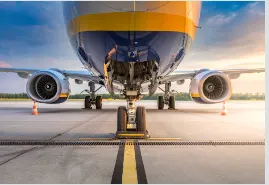
Towing: Taxiing, though, specifically involves the use of an airplane’s own propulsion system to move while on the runway. Towing, on the other hand, refers to the use of a ground vehicle. Known as a tug, these ground vehicles connect to airplanes so that they can move and turn airplanes.
5)Learn about take off power, tyre design, rolling resistance, tyre pressure, brake forces when landing.
Solution:
Take off power: A headwind will reduce the ground speed needed for takeoff, as there is a greater flow of air over the wings. Typical takeoff air speeds for jetliners are in the range of 240–285 km/h (130–154 km; 149–177 mph). Light aircraft, such as a Cessna 150, take off at around 100 km/h (54 km; 62 mph).
Takeoff is the phase of flight in which an aerospace vehicle leaves the ground and becomes airborne. For aircraft traveling vertically, this is known as liftoff.
For light aircraft, usually full power is used during takeoff. Large transport category (airliner) aircraft may use a reduced power for takeoff, where less than full power is applied in order to prolong engine life, reduce maintenance costs and reduce noise emissions. In some emergency cases, the power used can then be increased to increase the aircraft's performance. Before takeoff, the engines, particularly piston engines, are routinely run up at high power to check for engine-related problems.
The nose is raised to a nominal 5°–15° nose up pitch attitude to increase lift from the wings and effect liftoff. For most aircraft, attempting a takeoff without a pitch-up would require cruise speeds while still on the runway.
Tyre design:An aircraft tire or tyre is designed to withstand extremely heavy loads for short durations.[1] The number of tires required for aircraft increases with the weight of the aircraft, as the weight of the airplane needs to be distributed more evenly. Aircraft tire tread patterns are designed to facilitate stability in high crosswind conditions, to channel water away to prevent hydroplaning, and for braking effect.
Aircraft tires also include fusible plugs (which are assembled on the inside of the wheels), designed to melt at a certain temperature. Tires often overheat if maximum braking is applied during an aborted takeoff or an emergency landing. The fuses provide a safer failure mode that prevents tire explosions by deflating in a controlled manner, thus minimizing damage to aircraft and objects in the surrounding environment.
When it comes to safety, tyres are one of the most important components of aircraft. They help to absorb the shock of landing and provide cushioning. It also provides the necessary traction for braking and stopping of an aircraft.
An aircraft tyre is designed to withstand extremely heavy loads while landing, take off, taxing, and parking. The number of wheels required for aircraft increases with the weight of the aircraft, as the weight of the aeroplane needs to be distributed more evenly.
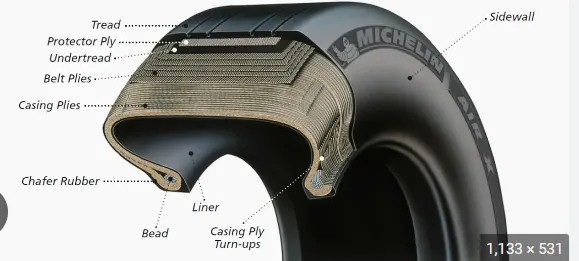
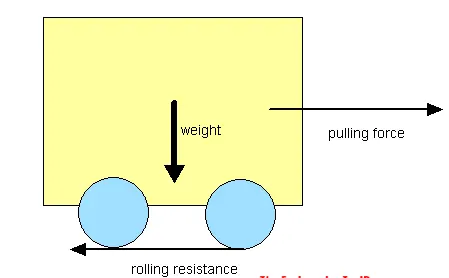
Rolling resistance: In the broad sense, specific "rolling resistance" (for vehicles) is the force per unit vehicle weight required to move the vehicle on level ground at a constant slow speed where aerodynamic drag (air resistance) is insignificant and also where there are no traction (motor) forces or brakes applied.
Tire rolling resistance is the energy that your vehicle needs to send to your tires to maintain movement at a consistent speed over a surface. In other words, it is the effort required to keep a tire rolling. The main contributor to rolling resistance is the process known as hysteresis.
Rolling Resistance Coefficient μR is defined by μR = F/G, where F is the force necessary to pull the axle of a tire horizontally in the direction of travel, and G is the vertical load on the tire which is assumed to roll on a flat horizontal surface.
Tyre pressure:
Airplane wheel/tire assemblies are inflated to high pressures (many in excess of 200 psi). In addition, the pressure in the bottle or tire-servicing cart can be as high as 3,000 psi.
Large aircraft tire pressures are ridiculously high. A Boeing 767-300 main wheel is inflated to 205 psi. The high pressure supports the tire’s maximum rated load of 51,000 lbs.
TPMS (Tire Pressure Monitoring System)
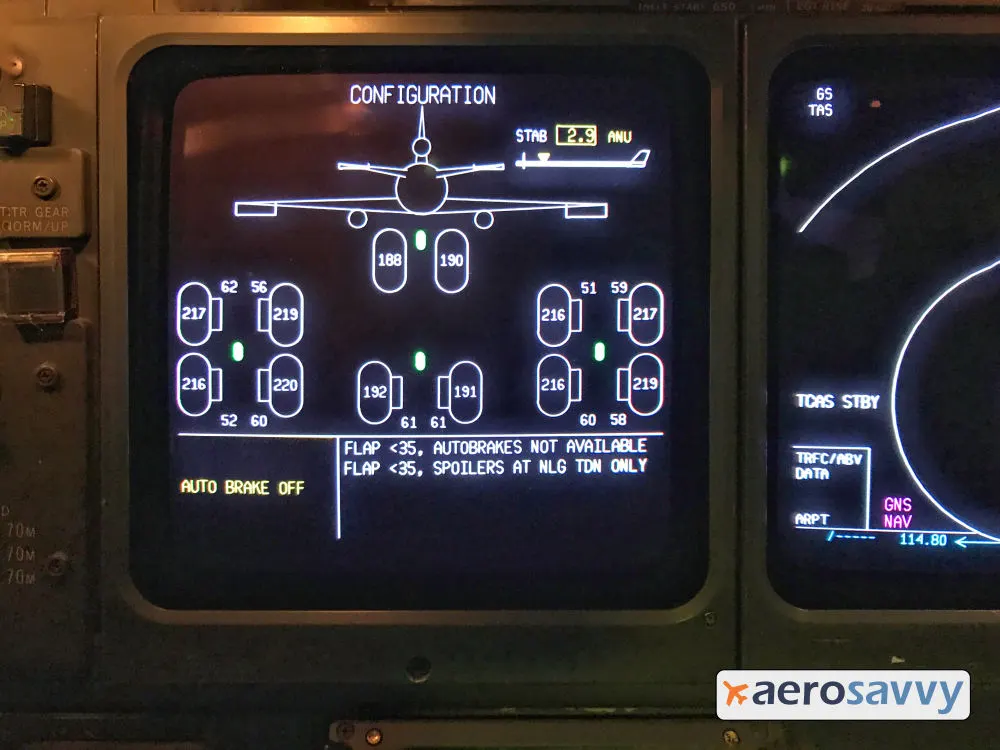
Some aircraft models have TPMS sensors in their wheels. The system is very similar to the TPMS in automobiles. Cockpit displays show tire pressures for all tires equipped with the sensors.
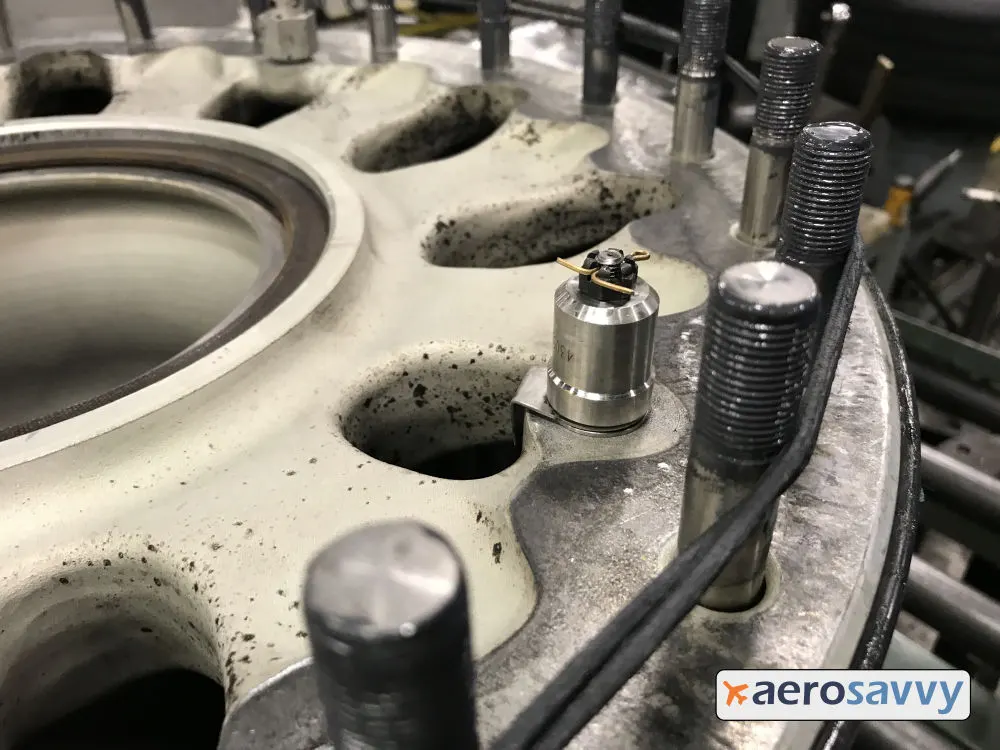
The TPMS triggers an alert in the cockpit if a tire has low pressure. The UPS fleet has two fleets with TPMS; the 747 and MD-11.
Brake forces when landing:
Airplanes rely on a braking system to safely land on runways. At cruising altitude, most commercial airplanes fly at a speed of roughly 500 to 600 mph. When landing, however, they must reduce their speed. A typical 747, for instance, has a landing speed of about 160 to 170 mph. And upon touching the runway, airplanes must quickly brake until they come to a complete stop.
Wing Spoilers
Many airplanes use wing spoilers to assist with braking when landing. Not to be confused with ailerons, spoilers are extendable flaps on the ends of an airplane’s wings. Pilots can raise the spoilers to decelerate the airplane as it approaches the runway. And even while on the runway, pilots will typically leave the wing spoilers raised. Raised wing spoilers create drag, which essentially slows down the airplane so that it’s able to brake more quickly.
Disc Brakes
In addition to wing spoilers, airplanes use disc brakes. Airplane disc brakes are similar to the braking system in automobiles. They consist of a pair of calipers that, when engaged, squeeze pads against the rotors of an airplane’s landing gear.
Disc brakes are designed to remain static at all times. In other words, they don’t rotate with the wheels of an airplane’s landing gear. As the wheels turn, the disc brakes will remain static and stationary. They are a vital component of an airplane’s braking system because they are designed to apply pressure to the airplane’s wheels. Disc brakes will squeeze the wheels, thereby slowing down the speed at which they spin. In turn, this reduces the speed of the airplane so that it can come to a complete stop on the runway.
Reverse Thrust
Finally, many jet airplanes use reverse thrust to assist with braking during landings. Reverse thrust is a feature in jet engine airplanes that, as the name suggests, involves the reversal of the engines’ thrust. When flying, the thrust is projected out the rear of an airplane’s engines. When landing, however, pilots may use the reverse thrust feature. Reverse thrust changes the direction of the engines’ thrust. Rather than projecting out the rear, the thrust will be projected out the front. This reversal of thrust provides deceleration that allows airplanes to slow down more quickly when landing.
Part B:
6. A. With necessary assumptions, calculate the force and power required to push / pull an aircraft by a towing vehicle.
Let us Assume:
Weight of the Aircraft (Boeing 747-8) = 412,770 kg
Wight of the Tugs Tractor = 54,000 kg
Rolling Resistance Coefficient of Towing Vehicle = 0.0035
Rolling resistance formula is: Rolling resistance coefficient* Mass*Gravity
Then,
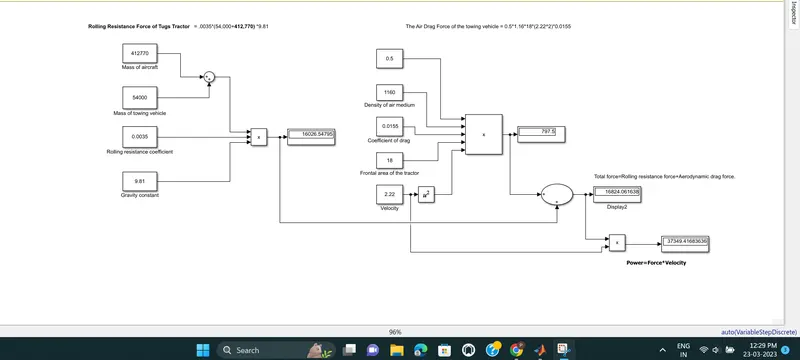
Rolling Resistance Force of Tugs Tractor = .0035*(54,000+412,770) *9.81 =16,026.54795N=16KN
Total Rolling Resistance Force = Rolling Resistance Force of Tugs Tractor =
Total Rolling Resistance Force =
The Aerodynamic Drag is given by,
rho= Density of Air Medium
A = Frontal Area Of the Vehicle which strike the Air
V = Velocity with the vehicle moves
Cd= Coefficient of Dragwhich varies different shapes of the frontal area.
Calculation:
Let us assume
The Velocity of the Towing = 8 KMPH
Density of Air medium = 1.16 kg/m3
The Coefficient of Drag of the towing vehicle = 0.0155m^2
The Frontal area of the tractor = 18m^2
Let us assume maximum speed,
The velocity of the Towing vehicle = 8 km/h = 2.22 m/s
( Towing speed is in between 5 km/h to 10 km/h and it does not exceed 10 km/h in any case )
Air Drag Force:
Air drag force is calculated using the formula = (1/2)*Drag coefficient*frontal area*Velocity^ 2 *rho
Air drag force of towing vehicle:
The Air Drag Force of the towing vehicle = 0.5*1.16*18*(2.22^2)*0.0155 = 0.799032KN
Hill climbing force is not applicable. ANd acceleration force is negligible as towing vehicle is moving at very low speed,
So the total force of required for the towing vehicle to carry the aircraft is:
Total force=Rolling resistance force+Aerodynamic drag force.
=16.026KN+0.799032KN=16.819 KN.
Power=Force*Velocity=16.819KN*2.22=37.33818Kwatt. 37.3381 Kw is the power required for the vehicle to push or pull the aircraft.
Energy of the wheels=Power/time.
Assume transmission time as 10mins=0.166hr
Energy=37.3381Kw/0.166 hr=224.118K Joules/hr.
B. Develop the model for the calculated force and power using Simulink.
Solution:The model for Rolling resistance force and aerodynamic drag force are shown in simuink model. And simulink file is attatched for refernce.
7. A. Design an electric powertrain with type of motor, it’s power rating, and energy requirement to fulfill aircraft towing application in Simulink. Estimate the duty cycle range to control the aircraft speed from zero to highest. Make all required assumptions. Prepare a table of assumed parameters. Draw a block diagram of powertrain. (Hint :DC7 Block)
Solution:
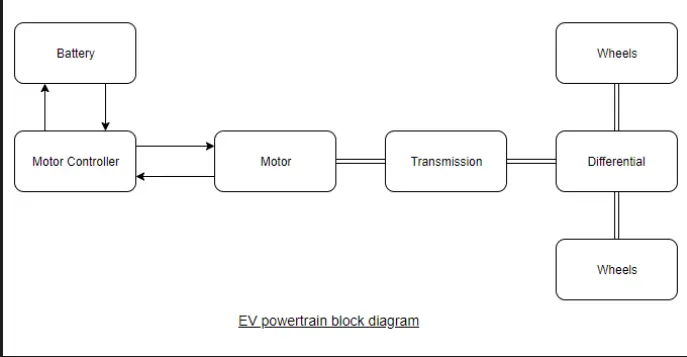
We have a power train block diagram of HEV below.
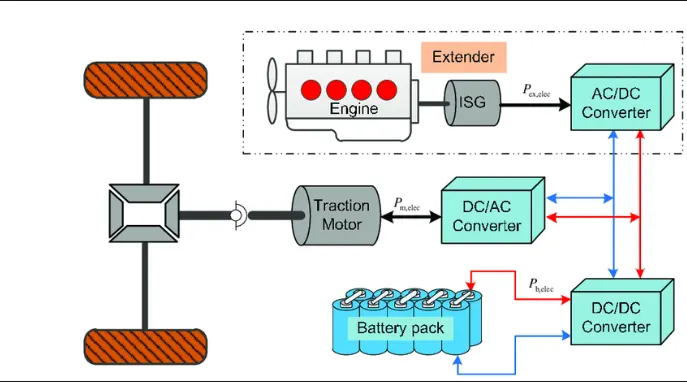
EV Powertrain Block diagram
A power required for a vehicle to run is 37.3318KW. So the motor must have capacity to generate that much power to run the vehicle. Approximating the power to 40Kw
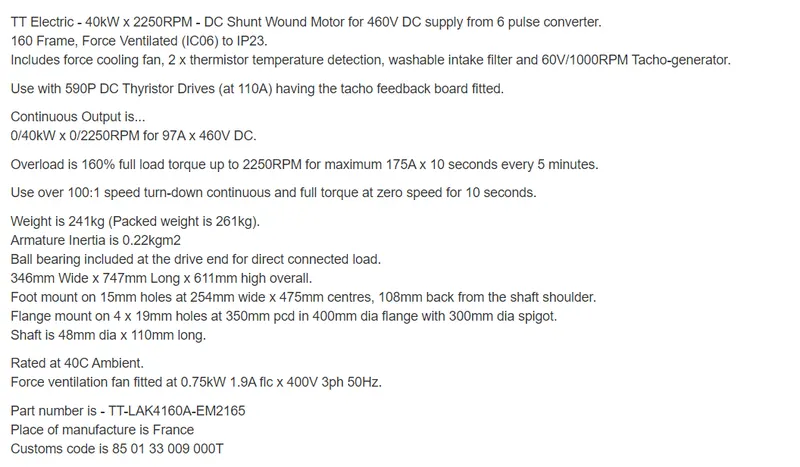
Considering below data sheet of 40KW DC motor.
Considering Transmission effeciency=95%
Motor effeciency=95%
Gear ratio=22
Tyre radius=15 inches=0.381m
Time taken for towing the aircraft=10mins=0.16hrs
Wheel torque(Tw)=Force*Radius=16,819 N*0.381mtr=6408.039Nm
Continuing on from the previous question, 37.3318 kW is the minimum amount of power rating required for the motor of towing vehicle to push/pull the aircraft.
How much torque the motor can produce is also a very important characteristic, hence before choosing a motor it is also necessary to know the rated torque needed by the ATS to tow the aircraft:
Motor Torque=Tm=Tw/(G*transmission effeciency)=[6408.039/(22*0.95)]=306.60Nm.
w=Pout/Tout
w=37.3381 Kw/306.60Nm=121.78 rad/sec
The motor needs to generate an output power of 38kW. Assuming the motor is 95% efficient:
Pin=Pout/motor effeciency
Pi=37.3381 Kw/(0.95)=39.303Kw output to be given from the battery to the motor
- Power rating of 40kW
- Rated torque of 306.60 Nm
- Max rotational speed of 2250 RPM
- Voltage rating of 460V
Battery:
Rated voltage= 460V (as given in the motor specification)
Input power=output power/rated voltage
Battery capacity=Output power/Rated voltage=39.303Kw/460=84.81 Ah-- current drawn by the motor when operating at full load
Now that Battery capacity is known, voltage of the battery Vbat can be calculated:
Vbat=Input power/Battery capacity
=39,303.1/84.81=463.42V
Since the motor rating is 460V, cannot exceed 460V, especially since the power converter is assumed to be 100% efficient. Thus:
duty cycle=outpower/inpower= ----------- refers to the voltage coming out of the power converter and given to the motor
where;
d = duty cycle=37338.1/39,303=0.95 duty cycle
Energy requirement of the battery:
E=Input power*time
Assuming the total time the battery needs to discharge its energy to the power converter and thus to the motor is 70 seconds :
E=37338.1 Watt*70=2613667 Joules
Converting Joules interms of Kwhr : One joule is equal to 2.777778⋅10-7 kilowatt-hours:
=0.7260Kwhr
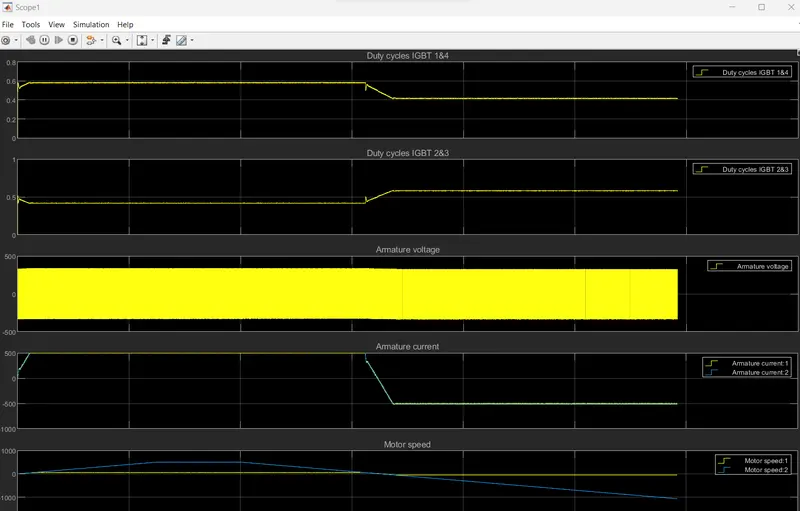
A simulink block is shown here to measure the Armature voltage, armature current and motor speed using the above calculated data.
1)Here a Lithium-ion battery having voltage rating of 464V and battery capacity of apprx=85Ah is selected and set as parameteres , we have battery output power=39.303Kw. This battery output is fed to DC motor
2) A DC motor is used with rating of 460V, approx 40Kw , and torque of 306.60Nm is calculated and same is fed to the DC motor 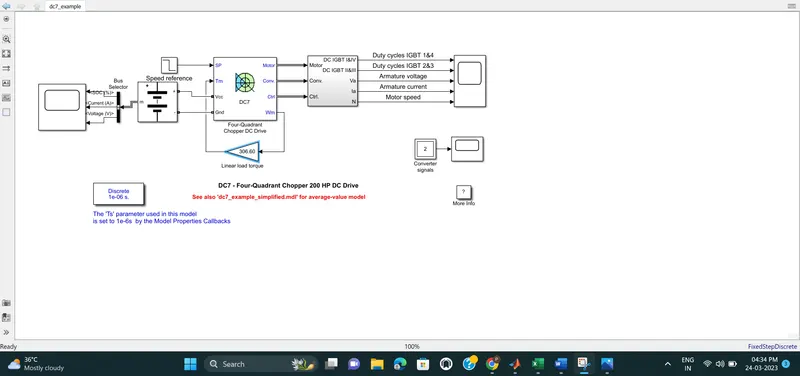
We have scope results of armature current, Voltage and speed of the motor below.
SOC , voltage and current level as below
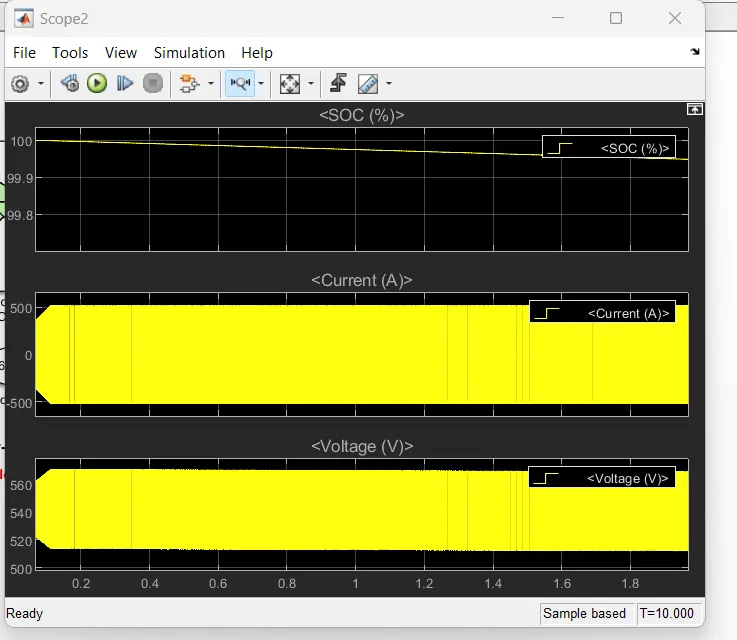
Here I have set stop time as 10 sec, so In the 10 seconds of towing, the battery has depleted from 100 to 99.95%