Project-1: Powertrain for aircraft in runways
PART A:
Question 1:
Search and list out the total weight of various types of aircrafts.
Answer:
There are various types of the aircrafts are available in the world. The selection of the aircraft are depend on the needs like travel, shipping and army ect.
Types of Aircraft:
- Airbus
- Antonov
- ATR
- Avro
- BAE Jetstream
- Beechcraft
- Boeing
- Bombardier
- Caravelle
- Cessna Citation
- Concorde
- Convair
- de Havilland Comet
- de Havilland Hercules
- Douglas DC
- Embraer
- Fokker
- Handley Page Hermes
- Hawker Siddeley Trident
- Ilyushin IL
- Learjet
- Lockheed
- McDonnell Douglas
- Pilatus
- Saab
- Scaled Composites Model 351 Startolaunch
- Tupolev
- Vickers
Total weight of the Aircrafts:
- Airbus - 575,000 - Super
- Airbus - 371,950 - Heavy
- Airbus - 83,000 - Large
- Antonov - 640,000 - Super
- Antonov - 405,060 - Heavy
- ATR - 22,800 - Large
- ATR - 18,600 - Small
- Avro - 42,000 - Large
- BAE Jetstream - 10,890 - Small
- Beechcraft - 7,765 - Small
- Boeing - 447,700 - Heavy
- Boeing - 124,000 - Large
- Bombardier - 36500 - Large
- Caravelle - 46,000 - Large
- Cessna Citation - 7,761 - Small
- Concorde - 185,000 - Heavy
- Convair - 87,500 - Large
- de Havilland Comet - 70,700 - Large
- de Havilland Hercules - 7,000 - Small
- Douglas - 147,000 - Heavy
- Douglas - 125,000 - Large
- Embraer - 48,000 - Large
- Embraer - 11,500 - Small
- Fokker - 46,000 - Large
- Handley Page Hermes - 39,000 - Large
- Hawker Siddeley Trident - 65,000 - Large
- Ilyushin IL - 270,000 - Heavy
- Learjet - 9,752 - Small
- Lockheed - 381,000 - Heavy
- McDonnell - 273,300 - Heavy
- McDonnell - 73,000 - Large
- Pilatus - 8,300 - Small
- Saab - 22,800 - Large
- Saab - 13,150 - Small
- Scaled Composites Model 351 Startolaunch - 1,300,000 - Super
- Tupolev - 104,000 - Large
- Vickers - 152,000 - Heavy
- Vickers - 30,400 - Large
******************************************************************************************
Question 2:
Is there any difference between ground speed and air speed?
Answer:
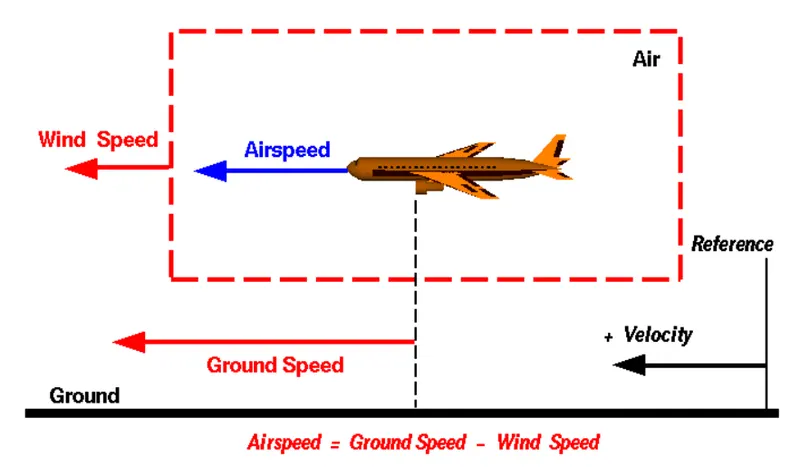
Ground Speed:
- Ground Speed is reference to the speed of the vehicle in ground or surface.
- Ground Speed is simply the sum of the Air Speed and Wind Speed.
- It is also known as horizontal speed of the aircraft with reference to the earth surface.
- Ground speed can be determined by the vector sum of the aircraft's true airspeed and the current wind speed and direction, a headwind subtracts from the ground speed, while a tailwind adds to it.
- Winds at other angles to the heading will have components of either headwind or tailwind as well as a crosswind component.
Air Speed:
- Air Speed is the Speed of the Aircraft with reference to Air.
- Calibrated airspeed is typically within a few knots of indicated airspeed, while equivalent airspeed decreases slightly from Calibrated Airspeed as aircraft altitude increases or at high speeds.
- The important quantity in the generation of lift is the relative velocity between the object and the air, which is called the airspeed.
- Airspeed cannot be directly measured from a ground position, but must be computed from the ground speed and the wind speed. Airspeed is the vector difference between the ground speed and the wind speed.
******************************************************************************************
Question 3:
Why is it not recommended to use aircraft engine power to move it on the ground at Airport?
Answer:
Aircraft is always move on the engine power on the ground and in air.
But in Airport the engine power is not used for aircraft because the aircraft engine power is very high and it produce more force on the thrust, it may lead to damage the airport components and the same the engine connected to turbine produce more force when aircraft engine turn on near airport the high speed wind rise the sand and mud it lead to harm the passange near airport.
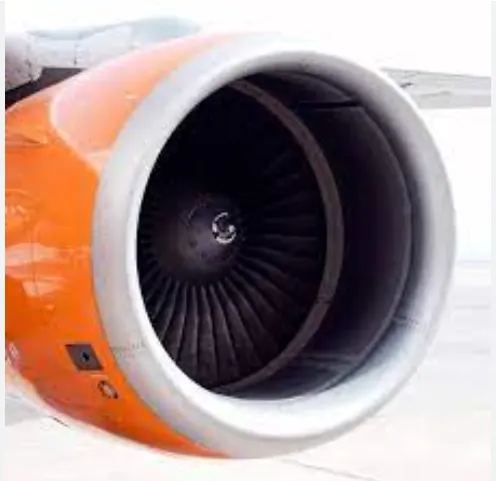
When the force of lift is greater than the force of gravity, the airplane is able to fly, and because of thrust, the airplane is able to move forward in flight. According to Newton's third law of motion, the action of the wings moving through the air creates lift.
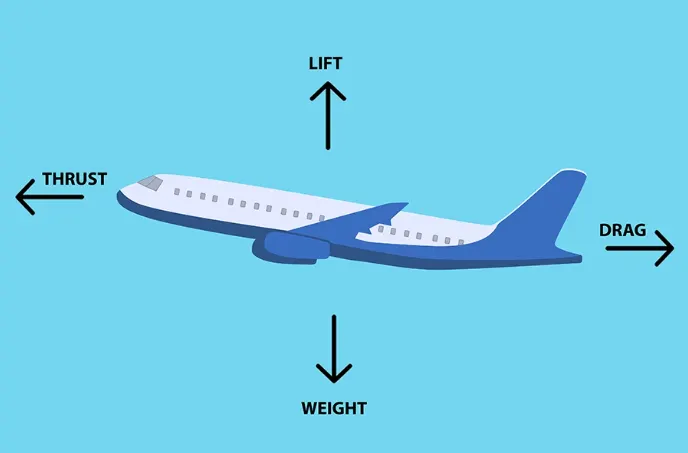
There are four force are act on the Aircraft:
- Lift
- Thrust
- Drag
- Weight
******************************************************************************************
Question 4:
How an aircraft is pushed to runway when its ready to take off?
Answer:
When an aircraft is pushed to runway by an other vehicle is called Taxing.
Taxing is the process to move the aircraft to the runway for take off.
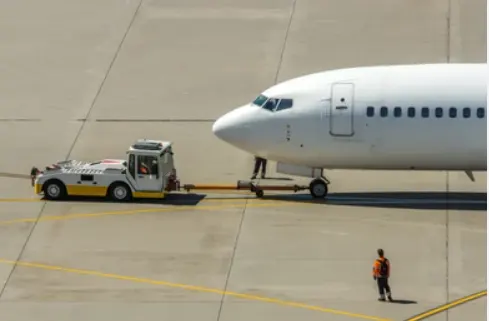
In this method the aircraft wheel is moved by the external power like vehicle to move the aircraft from one place to another place in taxiway is called taxing.
And the vehicle used to move the aircraft is called 'Tug vehicle'. Tug Vehicles are produce high torque and heavy mass so it is preferable for move the aircraft from terminal to run way.
Taxing is used because using aircraft engine lead to consumption of higher fuel and it is noisy process and it is harm for the person working near the aircraft.
******************************************************************************************
Question 5:
Learn about take off power, tyre design, rolling resistance, tyre pressure, brake forces when landing.
Answer:
Take off Power:
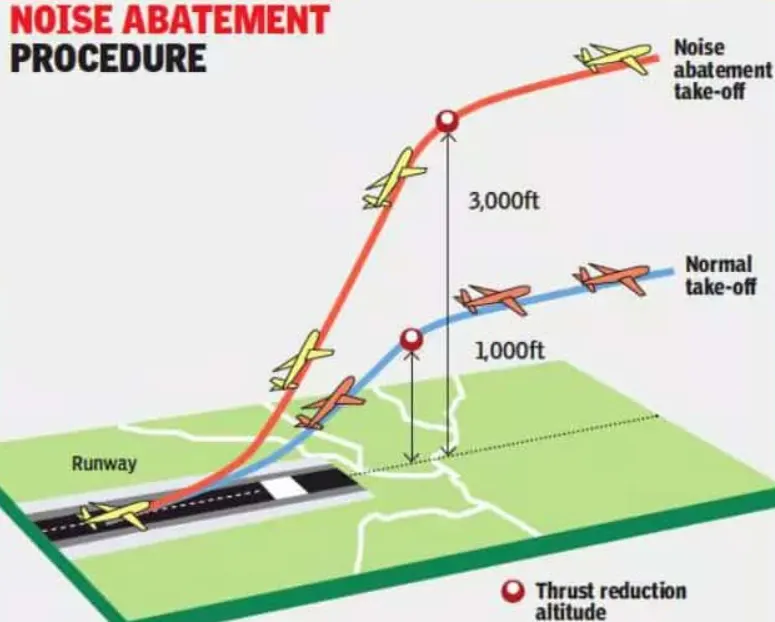
The power required to take off the aircraft from the ground level to the air level is called take-off power.
Let us consider the weight of the plane is 10000 tonnes then the power required to straight and level the aircraft is 2000 tonnes in the ration of 5:1.
Thrust = (Mass x Gravity x altitude loss)/horizontal distance flown.
Example:
Let consider the Mass of the aircraft is 10000 tonnes and gravity force constant is 9.81 m/s^2 and lift the aircraft from ground level to air with an altitude of 5 km/min and horizontal distance is 10 km/min.
Mass M = 10000 tonnes.
Gravity G = 9.81 m/s^2.
Altitude Loss (A_L) = 5 km/min.
Horizontal Distance(H_D) = 10 km/min.
Thrust = (Mass x Gravity x altitude loss)/horizontal distance flown.
Thrust = (10000*9.81*5)/10.
Thrust = 49,050 N
Tyre Design:
When it comes to safety, tyres are one of the most important components of aircraft. They help to absorb the shock of landing and provide cushioning. It also provides the necessary traction for braking and stopping of an aircraft.
An aircraft tyre is designed to withstand extremely heavy loads while landing, take off, taxing, and parking. The number of wheels required for aircraft increases with the weight of the aircraft, as the weight of the aeroplane needs to be distributed more evenly.
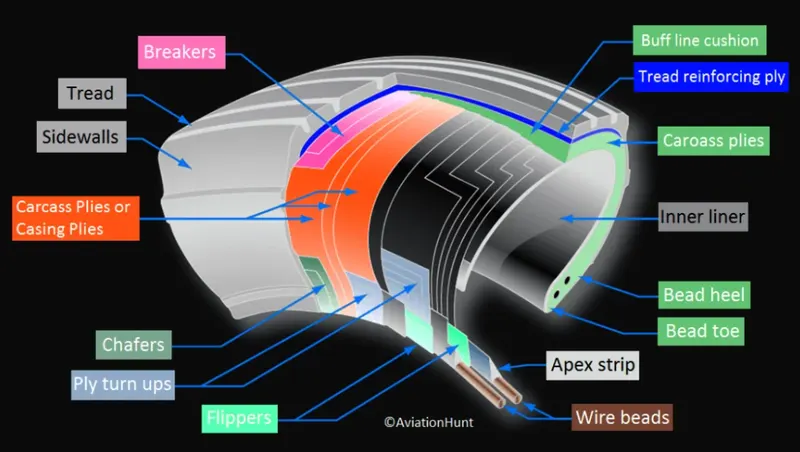
Each tyre manufacturer produces their own designs of the tyre with different tread patterns, wear patterns, wear limits etc, and in some cases, different names for the same part of the tyre. But all tyres must meet the approved standards before being accepted by the FAA or CAA.
Rolling Resistance:
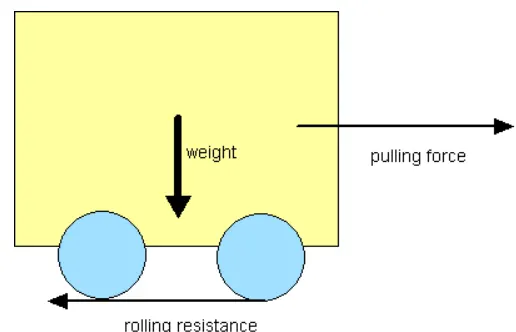
The optimal rolling resistance range is between 0.009 to 0.035. The rolling resistance of the tier may incrases with increases in the mass of the load.
If the pressure of the tyre is low then the rolling resistance is increases.
Rolling resistance coefficient of the tyre is measured by the below equation.
Cr = (1/p) * (0.01+0.0095(v/100)^2).
Example:
Let us consider that the pressure of the tyre 35 psi and speed of the air craft is 120 km/hr.
Cr = (1/p) * (0.01+0.0095(v/100)^2).
Cr = (1/35) * (0.01+0.0095(120/100)^2).
Cr = 0.0285 * (0.01+0.0095(1.44)).
Cr = 0.0285 * (0.01+0.01368).
Cr = 0.0285 * (0.02368).
Cr = 0.00067.
Tyre Pressure:
The high-flying rubber is typically inflated to 200 psi, roughly six times what you put in an automobile tire, and the tires on an F-16 fighter are pumped to 320 psi. It's really pressurized air that's so strong.
In the first moments after a plane touches down, the tires are skidding, not rolling. The airplane essentially drags them down the runway until their rotational velocity matches the velocity of the plane.
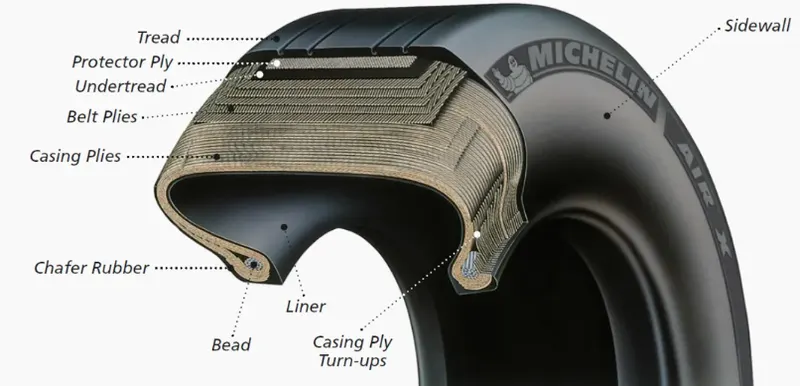
An aircraft tire or tyre is designed to withstand extremely heavy loads for short durations. The number of tires required for aircraft increases with the weight of the aircraft, as the weight of the airplane needs to be distributed more evenly. Aircraft tire tread patterns are designed to facilitate stability in high crosswind conditions, to channel water away to prevent hydroplant, and for braking effect.
The below picture shows that the why the tyre not tear or break while landing.
Braking Force:
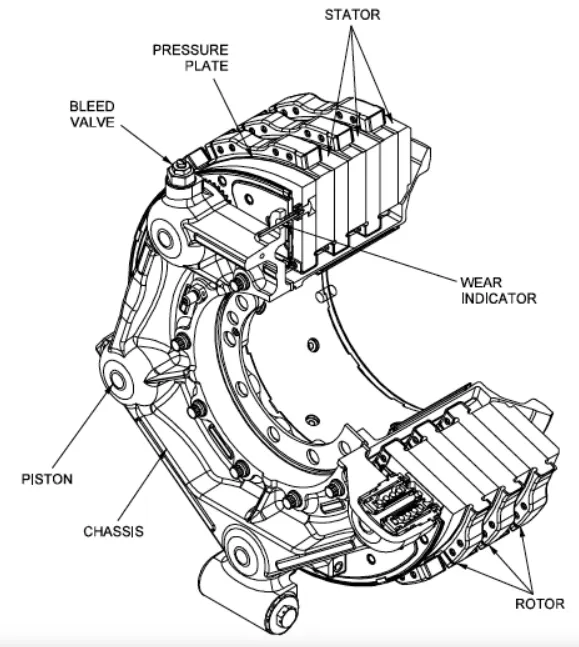
Aircraft brakes stop a moving aircraft by converting its kinetic energy to heat energy by means of friction between rotating and stationary discs located in brake assemblies in the wheels.
Brakes provide this critical stopping function during landings to enable airplanes to stop within the length of the runway. They also stop aircraft during rejected takeoff events, in which an attempted takeoff is canceled as the airplane is rolling down the runway before it lifts off from the ground due to engine failure, tire blowout, other system failure or direction from air traffic control.

Aircraft brakes also prevent motion of the aircraft when it is parked, limit its speed during taxiing and can even help steer the aircraft on the ground by applying different levels of braking force to the left- and right-side brakes.
Aircraft brakes work in conjunction with other brake mechanisms such as thrust reversers, air brakes and spoilers. Thrust reversers are surfaces that are deployed into the path of the jet blast from the engines to redirect propulsive thrust in a direction that opposes the motion of the aircraft. Air brakes and spoilers are flight control surfaces that create additional aerodynamic drag when deployed into the path of air flowing around the aircraft.
******************************************************************************************
Part B:
Question 6.A :
With necessary assumptions, calculate the force and power required to push / pull an aircraft by a towing vehicle.
Answer:
TUG Vehicle:
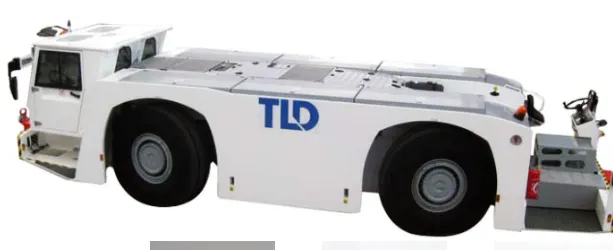
Let as consider the Tug vehicle of model TMX-550-60.
Gross Vehicle Weight (M) = 60,000 Kg
This model tug vehicle is used for below mention aircraft.
- Boeing B767, B777, B747, B787
- Airbus A300, A310, A330, A340, A350, A380.
Engine Capacity:
6 cylinders diesel engine, 205 kW at 2500 rpm.
Speed Capacity:
Max Forward Speed - 30 Km/hr.
Max Rear Speed - 22 Km/hr.
Tyre dimension:
16.00R25
Tyre rim diameter = 16 inchs
Tyre rim radius = 8 inchs
Tyre size = 0.984 inchs
Total Tyre Size = 8+0.984
Total Tyre Size = 8.984 inchs = 0.2281 meter.
R - indicate Radial.
AIRCRAFT AIRBUS A380:
The Airbus A380 is a large wide-body-airline that was developed and produced by Airbus. It is the world's largest passenger airliner and only full-length double-deck jet airliner.
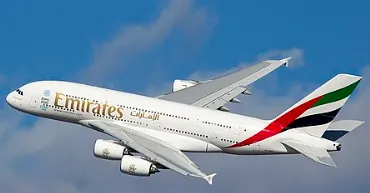
Let us consider the Aircraft Airbus A380.
Maximum Weight capacity of the vehicle (m) = 15,700 km.
Height (h) = 17 meter.
Width (w) = 40.56 meter.
Rolling resistance coefficient (µrr) = 0.0659.
Drag Coeificient (Cd) = 0.03.
Standard Air density value (ρ) = 1.225 Kg/m^3.
Speed of air craft (v) = 30 km/hr = 8.33 m/s.
Total Force:
F_total = F_rr + F_ad
Rolling Resistance Force:
F_rr = µrr * m * g.
F_rr = 0.0659 * 15,700 * 9.81.
F_rr = 10,149.72 N
Aero Dynamic Force:
F_ad = (1/2) * ρ * Cd * A * v^2.
Area (A) = Height * Width.
Area (A) = h * w.
Area (A) = 17 * 40.56.
Area (A) = 689.52 m^2.
F_ad = 0.5 * 1.225 * 0.03 * 689.52 * (8.33)^2.
F_ad = 879.1525 N.
Total Force:
F_total = F_rr + F_ad.
F_total = 10,149.72 + 879.1525.
F_total = 11,028.87 N
Total Power Required:
Power = F_total * v
Power = 11,028.87 * 8.33
Power = 91.863 KW.
The Total Force and Power required to push and pull an aircraft by the towing velocity are 11,028.87 N and 91.863 KW.
******************************************************************************************
Question 6.B :
Develop the model for the calculated force and power using Simulink.
Answer:
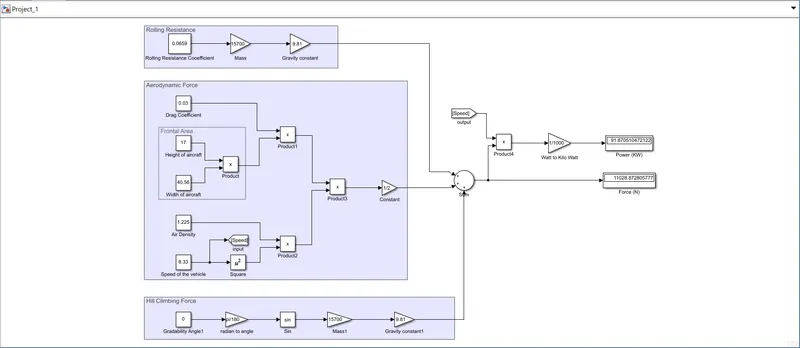
The below model shows that the types of force act on the aircraft. There are 2 main force act on the aircraft they are Rolling Resistance Force and Aero Dynamic Force where hill cimb force is not act on the aircraft.
'Constant' block is used to define the rolling resistance coefficient, Drag Coefficient, Air Density, Speed of the vehicle, Height, width and Gradablity angle.
'Gain' block is used to mulitply the certain value like mass, Gravity Constant, radian to angle, watt to kilo Watt value to the constant.
'Product' block is used to multiply the certain value.
'Sum' block is used to add all the force to get an Net force.
'Display' block is used to veiw the value of Power and Force.
******************************************************************************************
Question 7.A:
Design an electric powertrain with type of motor, it’s power rating, and energy requirement to fulfill aircraft towing application in Simulink. Estimate the duty cycle range to control the aircraft speed from zero to highest. Make all required assumptions. Prepare a table of assumed parameters. Draw a block diagram of powertrain.
(Hint :DC7 Block)
Answer:
Let us consider that the aircraft run in the run way for 15 minutes is known as towing.
Energy Calculation:
Energy = Power * Time.
Energy = 91.863 * (15/60).
Energy = 22.9657 KWh.
Let us consider that the motor used for the about aircraft is induction motor of rated power of 92 KW, Nominal Voltage of 400V and Rated Current of 230A
And the Battery capacity of 460KW with an nominal voltage of 400V with an discharge current of 1150A.
Duty Cycle:
Duty Cycle = (Required power/Rated Power).
Duty Cycle = (91.863/460).
Duty Cycle = 0.1997.
Maximum duty cycle for towing aircraft in the airport is 0.1997 for the above aircraft.
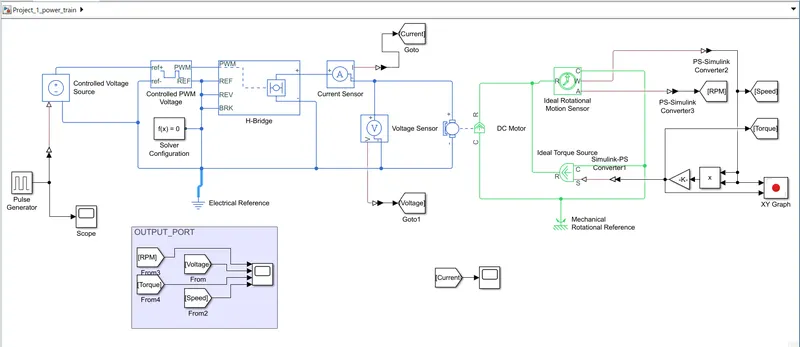
Power train design:
Simulink Model:
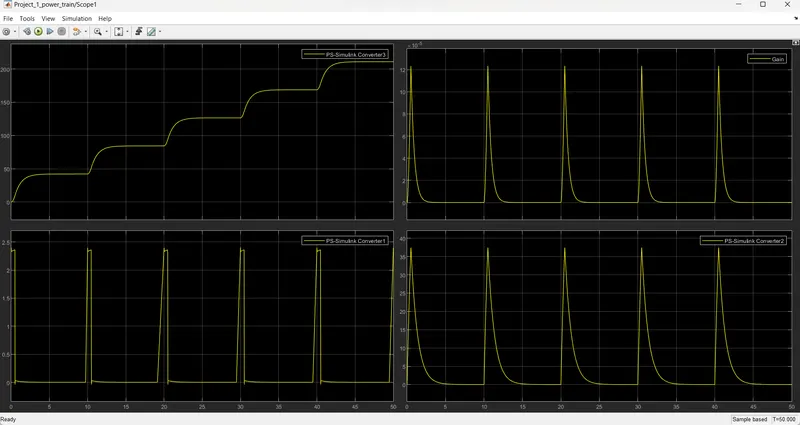
Graph:
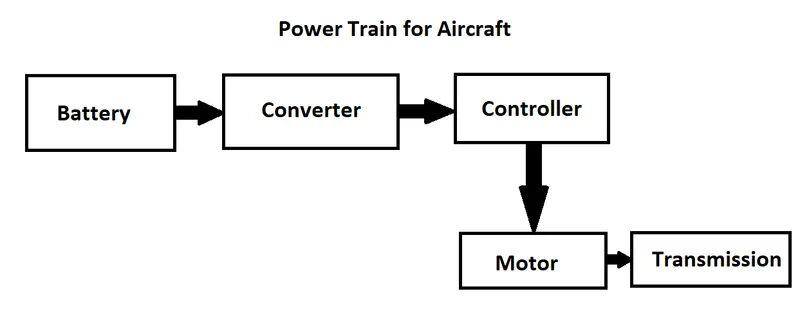
Block Diagram of the Power train:
******************************************************************************************
Question 7.B:
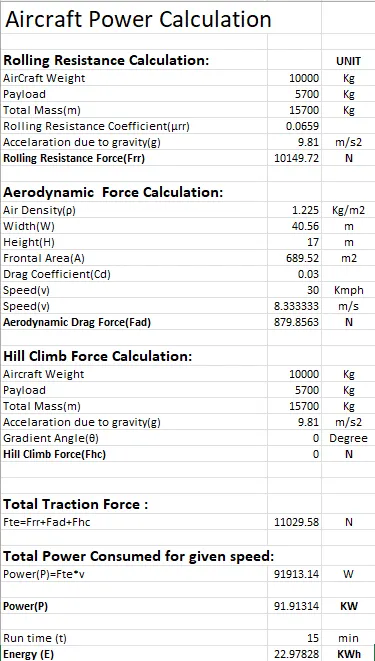
Also, Design the parameters in excel sheet.
Answer:
******************************************************************************************