Project-1: Powertrain for aircraft in runways
Part A
1. Total weight of various types of aircrafts
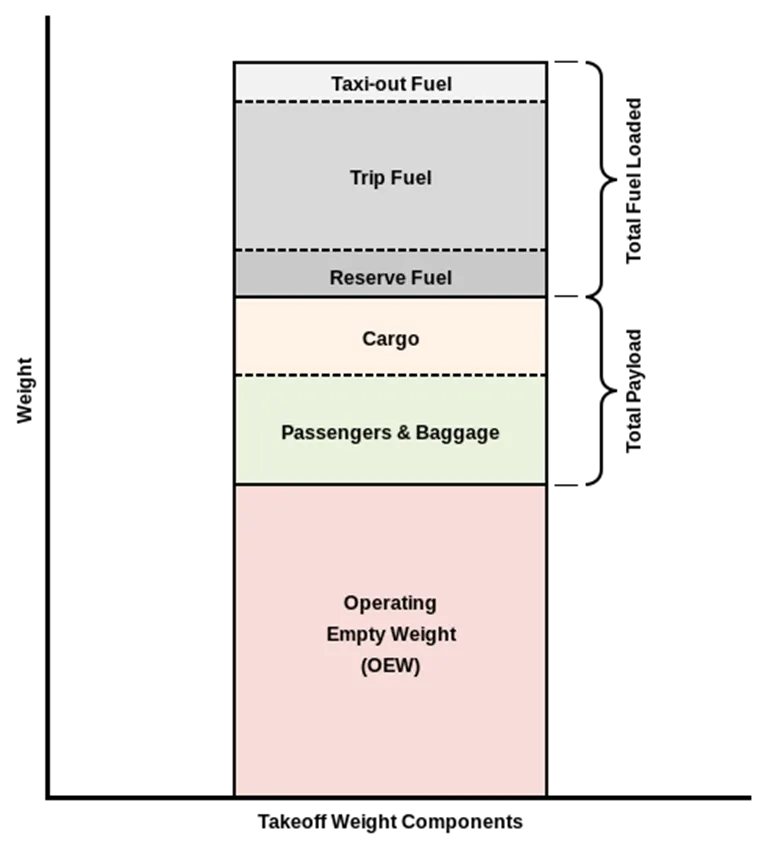
Weights of different components computed to form the TakeOff Weight of Aircraft is shown in the above image. Various Aircrafts according to Maximum Takeoff Weight is shown in below table.
| Type | MTOW [kg] | ICAO category |
| Embraer Phenom 100 | 4800 | Light |
| de Havilland Hercules | 7000 | Medium |
| Cessna Citation CJ4 | 7761 | Medium |
| Embraer ERJ 145 | 22000 | Medium |
| ATR 72-600 | 22800 | Medium |
| Bombardier Q400 | 28000 | Medium |
| Bombardier CRJ700 | 33000 | Medium |
| Douglas DC-4 | 33000 | Medium |
| Bombardier CRJ900 | 36500 | Medium |
| Douglas DC-6 | 44000 | Medium |
| Embraer 190 | 48000 | Medium |
| Douglas DC-6A | 48600 | Medium |
| Boeing 717-200HGW | 55000 | Medium |
| Airbus A220-100 | 59000 | Medium |
| Airbus A220-300 | 65000 | Medium |
| Boeing 737-600 | 66000 | Medium |
| Boeing 377 | 67000 | Medium |
| Airbus A320-100 | 68000 | Medium |
| Boeing 737-700 | 70000 | Medium |
| McDonnell-Douglas MD-83 | 73000 | Medium |
| Boeing 727-200 | 78000 | Medium |
| Airbus A321-100 | 83000 | Medium |
| Boeing 737-900 | 85000 | Medium |
| Boeing 720 | 104000 | Medium |
| Boeing 707-120B | 117000 | Medium |
| Boeing 757-300 | 124000 | Medium |
| Douglas DC-8-51 | 125000 | Medium |
| Douglas DC-8-32 | 140000 | Heavy |
| Airbus A400M | 141000 | Heavy |
| Airbus A310-200 | 142000 | Heavy |
| Douglas DC-8-61 | 147000 | Heavy |
| Boeing 707-320B | 151000 | Heavy |
| Airbus A310-300 | 157000 | Heavy |
| Boeing 767-300 | 159000 | Heavy |
| Airbus A300-600 | 163000 | Heavy |
| Concorde | 185000 | Heavy |
| Boeing 767-300ER | 187000 | Heavy |
| Airbus A300-600R | 192000 | Heavy |
| Boeing 767-400ER | 204000 | Heavy |
| Lockheed L-1011-500 | 231300 | Heavy |
| Airbus A330-300 | 242000 | Heavy |
| Airbus A330-900 | 251000 | Heavy |
| Boeing 787-9 | 254000 | Heavy |
| McDonnell Douglas DC-10 | 256280 | Heavy |
| Airbus A350-900 | 270000 | Heavy |
| McDonnell Douglas MD-11 | 273300 | Heavy |
| Airbus A340-300 | 276700 | Heavy |
| Airbus A350-1000 | 308000 | Heavy |
| Boeing 777-200LR | 347450 | Heavy |
| Boeing 777F | 347800 | Heavy |
| Boeing 777-300ER | 351800 | Heavy |
| Airbus A340-500 | 371950 | Heavy |
| Boeing 747-300 | 377840 | Heavy |
| Lockheed C-5 Galaxy | 381000 | Heavy |
| Boeing 747-400 | 396900 | Heavy |
| Antonov An-124-100M | 405060 | Heavy |
| Boeing 747-400ER | 412770 | Heavy |
| Boeing 747-8 | 443613 | Heavy |
| Boeing 747-8F | 447700 | Heavy |
| Airbus A380-800 | 575000 | Heavy |
| Antonov An-225 | 640000 | Heavy |
2. Difference between ground speed and air speed
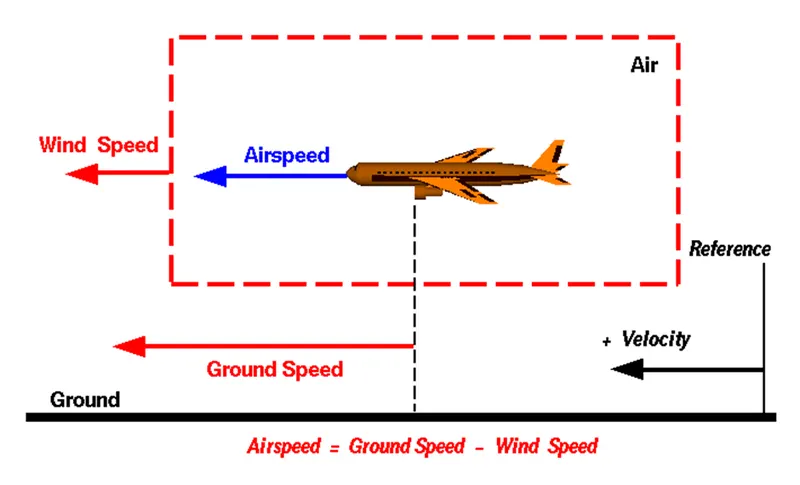
The aeroplane travels respect to a reference point at ground speed for a chosen ground reference point. The wind speed determines how far the air flows in relation to a reference point chosen on the ground. Both the speed has a magnitude as well as a direction. The airspeed, or relative velocity between the object and the air, is a crucial factor in the production of lift. From a ground location, airspeed cannot be determined directly; instead, it must be calculated out from ground speed and the wind speed.
Airspeed = Ground Speed - Wind Speed
3. Why is it not recommended to use aircraft engine power to move it on the ground at Airport?
- The thrust produced when an aircraft's engine starts up can easily damage the airport terminal, nearby ground vehicles, the jetbridge, luggage, and most critically, ground employees.
- Aircraft pushback and towing tugs are also used to facilitate general maintenance by ground staff.
- The flight deck's poor rear visibility forces pilots to occasionally rely on aircraft towing equipment for ground pushback.
- Without the aid of aircraft towing equipment, the majority of aircraft typically cannot travel backward. Pushback tugs are the sole option when pulling aircraft into hangars or away from the terminal building because aeroplanes are not constructed with a reverse option that pilots may employ for backward movement.
4. How an aircraft is pushed to runway when its ready to take off?
Pushback: occurs when tractors or tugs are used to push an airplane rearward away from the airport gate. A tug for an airplane will pull up just in front of the nose wheel as we get closer to takeoff. The tug may be a "wheel-lift" tug or it could be directly connected to the plane's nose gear with a tow bar. These tugs support the nose gear while lifting it up and then moving the aircraft. As a result, the tug driver has control over the plane's pushback direction.
Electric motors fitted to the aircraft's landing gear and pilot-controlled tugs are two examples of the new taxi technologies that are emerging. Both claim to lessen airport noise and conserve fuel.
5. Take off power, tyre design, rolling resistance, tyre pressure, brake forces when landing.
Take-off Power: The amount of power an engine is permitted to produce for a brief period of time during take-off is known as take-off power. Take-off power is typically only used for up to 5 minutes with reciprocating engines and up to 2.5 minutes with gas turbine engines. This could not always be the situation. The engine thrust is adjusted to a high "take-off power" level during take-off in order to place the aircraft to a safe height away from terrain and impediments, and the aircraft attitude is pitched up to maintain a certain speed.
Tyre Design: A plane's tyres are made to resist incredibly large weights during takeoff, landing, taxing, and parking. The number of wheels necessary for aircraft grows with the weight of the aircraft, since the weight of the airplane has to be distributed more equally. It is not required to carry a weight for an extended length of time while operating continuously, unlike a car or truck tyre. An aviation tyre, on the other hand, can operate at high speeds for a brief period of time when necessary and can also bear the heavy impact loads of landings. The tyre is made using carcass plies. They are also known as casing plies.
When retracted via landing gear, aircraft tyres must have enough room to accommodate tyre expansion and have a speed and load rating that has been certified. Tyre growth is an increase in tyre size brought on by high-speed centrifugal forces.
Rolling Resistace: Rolling resistance is the amount of effort per unit of vehicle weight needed to drive the vehicle at a steady, slow speed on level ground with little to no aerodynamic drag and without the use of any traction forces or brakes. The force restraining motion when a body rolls on a surface is known as rolling resistance, often referred to as rolling friction or rolling drag. It is mostly brought about by non-elastic effects, which means that not all of the energy required for the deformation (or movement) of the wheel, roadbed, etc., is restored when the pressure is released.
Tyre Pressure: An aviation tyre is made to support very large weights for a brief period of time. Nitrogen is typically used to inflate aircraft tyres in order to reduce the amount of expansion and contraction caused by the rapid variations in pressure and temperature that occur when the aircraft is in flight. Airliner aeroplane tyres can withstand pressures of up to 800 psi before exploding, according to tests. The typical operating pressure for aircraft tyres is high, up to 200 psi for commercial airliners and much more for business jets. Each of the twelve primary tyres of the Boeing 777-300ER weighs 120 kg, has a diameter of 134 cm (53 in), is inflated to 220 psi, and is replaced every 300 cycles while the brakes are replaced every 2000 cycles.
Brake forces when landing: By turning kinetic energy into thermal energy through friction between spinning and stationary discs found in braking assemblies in the wheels, aeroplane brakes are able to halt moving aircraft. This essential stopping function is provided by brakes during landings so that aircraft may stop within the runway's length. Moreover, they halt planes when a takeoff attempt is refused. Other braking systems, like as thrust reversers, air brakes, and spoilers, cooperate with aircraft brakes to stop a moving object. Thrust reversers are surfaces that are positioned in the engine blast's path to reroute propulsive thrust in the opposite direction from the aircraft's motion.
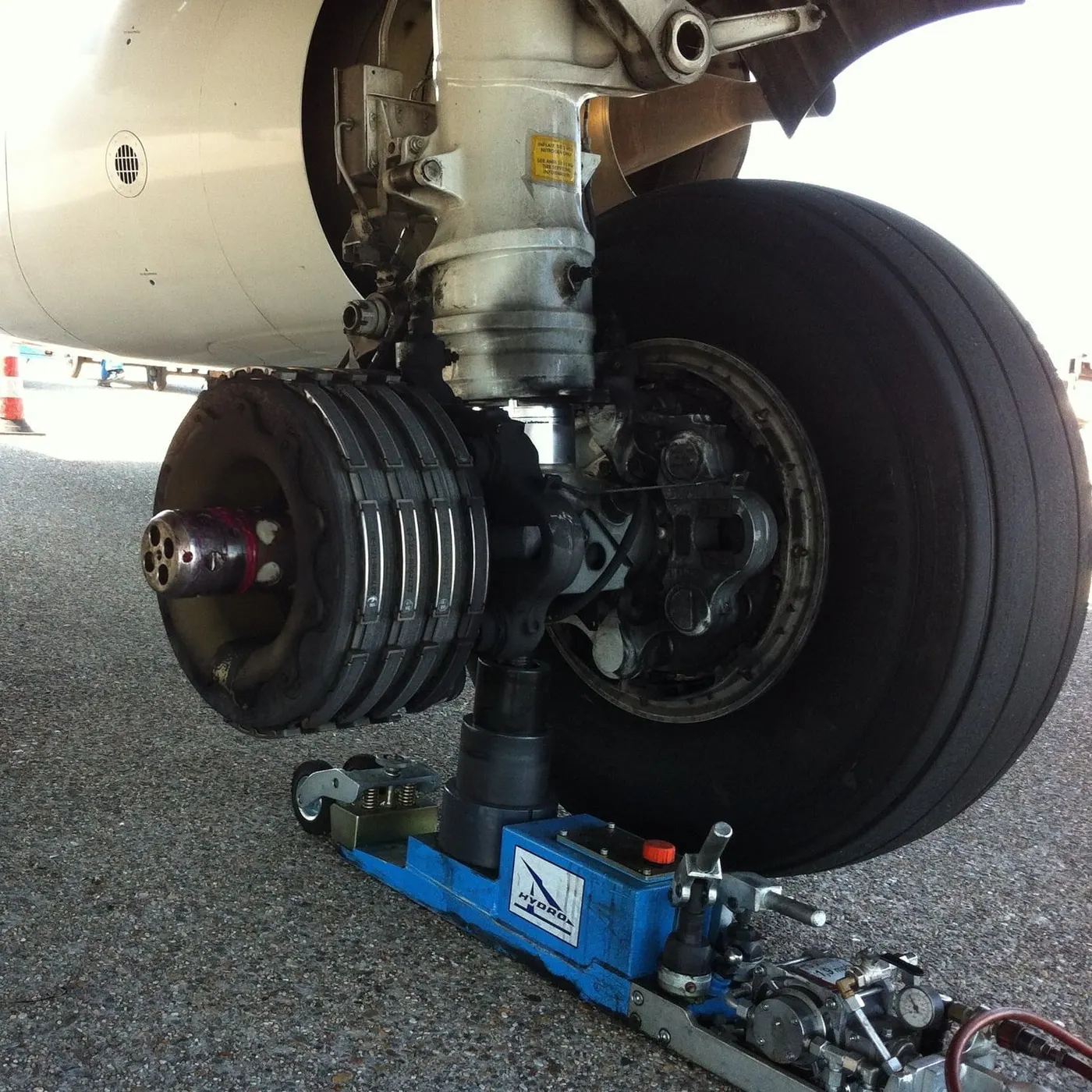
6A. With necessary assumptions, calculate the force and power required to push/ pull an aircraft by a towing vehicle.
Mass of Aircraft (`M_1`) = 5,75,000kg (Airbus A380)
Mass of Towing Vehicle (`M_2`) = 60,000kg (TLD TMX- 550)
Coefficient of rolling resistance of Aircraft (`mu_1`) = 0.04
Coefficient of rolling resistance of Towing Vehicle (`mu_2`) = 0.012
Frontal Area of Aircraft (`A_1`) = 110 `m^2`
Frontal Area of Towing Vehicle (`A_2`) = 5.23 `m^2`
Drag coefficient of Aircraft `C_(d1)`= 0.12
Drag coefficient of Towing Vehicle `C_(d2)`= 0.2
Air Density = 1.25 `(kg)/m^3`
Acceleration due to gravity (g) = 9.81 `m/s^2`
Speed of Tow/ Aircraft = 3kmph = 0.83mps
Rolling Resistance Force, Frr = `mu`M g
Rolling Resistance Force of Aircraft, `Frr_1 = mu_1 M_1 g`
= 0.04 x 575000 x 9.81
= 2,25,630 N
Rolling Resistance Force of Towing Vehicle, `Frr_2 = mu_2 M_2 g`
= 0.012 x 60000 x 9.81
= 7063.2 N
Drag Force of Aircraft, `Fd_1 = 1/2 rho A_1 C_(d1) V^2`
= 0.5x1.25x110x0.12x0.83^2
= 5.7 N
Drag Force of Towing Vehicle, `Fd_2 = 1/2 rho A_2 C_(d2) V^2`
= 0.5x1.25x5.23x0.2x0.83^2
= 0.45 N
Total Force required by tow for pull/ push the aircraft = `Frr_1 + Frr_2 + F_(d1) + F_(d2)` = 232699 N = 232.7 kN
Total Power required by tow for pull/ push the aircraft = Force x Velocity
= 232.7 x 0.83
= 193 kW
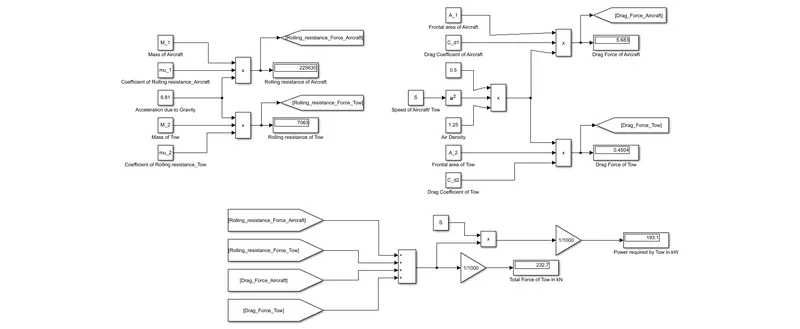
6B. Develop the model for the calculated force and power using Simulink.
7A. An electric powertrain with type of motor, it’s power rating, and energy requirement to fulfill aircraft towing application in Simulink.
From the below calculation, the power required by motor is 252.3kW. Hence a motor having capacity 580V, 261kW has chosen for the application.
| Force required at wheels of Tow | F | 232.7 | kN |
| Power required at wheels of Tow | P | 193 | kW |
| Tire size of Tow | 16.00R25 | ||
| Tire Radius | r | 700 | mm |
| Torque at wheels of Tow | T = F x r | 162.89 | kNm |
| Gear Ratio | G | 6 | No.s |
| Transmission efficiency | Et | 85 | % |
| Motor Torque | Tm = T/ (Et x G) | 31.94 | kNm |
| Motor Efficiency | Em | 90 | % |
| Motor Power | Pm = P/ (Et x Em) | 252.29 | kW |
Below showing is the simulink model of the electric drivetrain 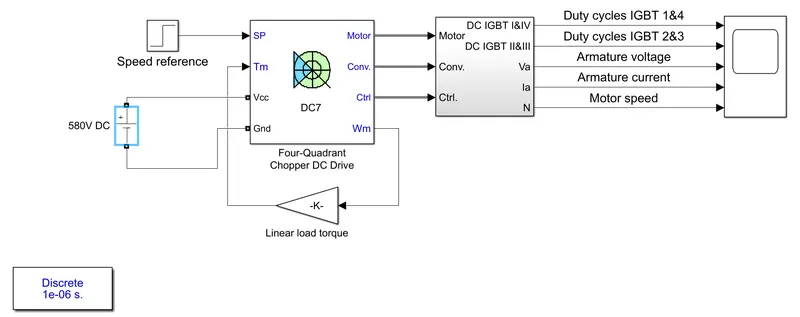
Output result is showing below.
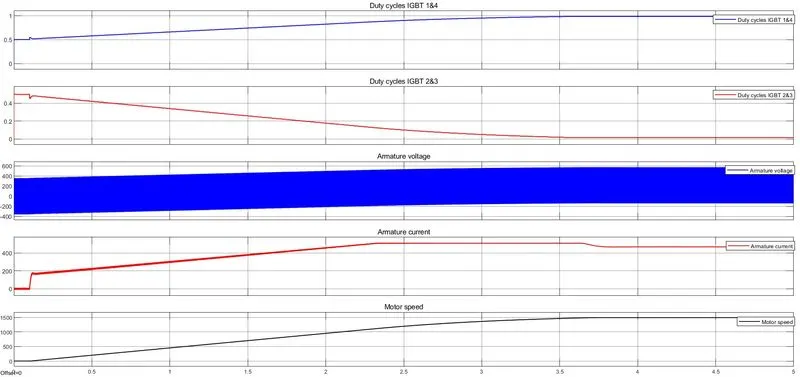
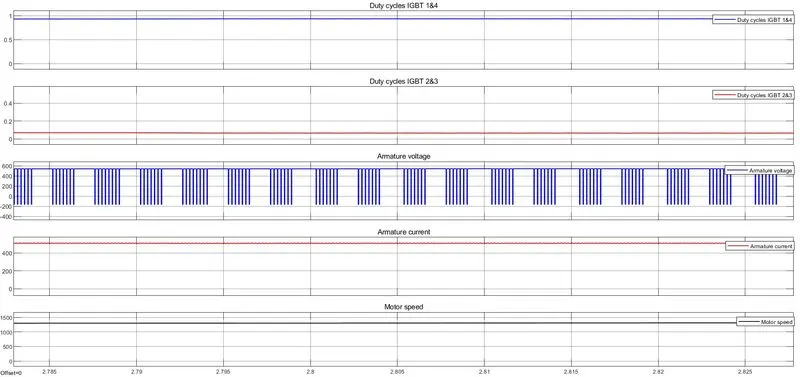
Rated power of 261kW achieved at Voltage 580V and Armature current 450A (580x450 = 261kW)
Duty cycle changes from 0 to 1 while speed varies from 0 to speed at Maximum Power.