Project-1: Powertrain for aircraft in runways
Part A
Q: Search and list out the total weight of various types of aircrafts.
An aircraft is a vehicle that is able to fly by gaining support from the air. It counters the force of gravity by using either static lift or by using the dynamic lift of an airfoil, or in a few cases the downward thrust from jet engines. Common examples of aircraft include airplanes, helicopters, airships (including blimps), gliders, paramotors, and hot air balloons. The human activity that surrounds aircraft is called aviation. The science of aviation, including designing and building aircraft, is called aeronautics. Crewed aircraft are flown by an onboard pilot, but unmanned aerial vehicles may be remotely controlled or self-controlled by onboard computers. Aircraft may be classified by different criteria, such as lift type, aircraft propulsion, usage and others.
| Type | MTOW [kg] | MLW [tonnes] | TOR [m] | LR [m] | ICAO category | FAA category |
| Antonov An-225 | 6,40,000 | 591.7 | 3,500 | Heavy | Super | |
| Scaled Composites Model 351 Stratolaunch | 5,89,670 | 3,660 | Heavy | Super | ||
| Airbus A380-800 | 5,75,000 | 394 | 3,100 | 1,930 | Heavy | Super |
| Boeing 747-8F | 4,47,700 | 346.091 | 3,100 | 1,800 | Heavy | Heavy |
| Boeing 747-8 | 4,43,613 | 306.175 | 3,100 | Heavy | Heavy | |
| Boeing 747-400ER | 4,12,770 | 295.742 | 3,090 | Heavy | Heavy | |
| Antonov An-124-100M | 4,05,060 | 330 | 2,520 | 900 | Heavy | Heavy |
| Boeing 747-400 | 3,96,900 | 295.742 | 3,018 | 2,179 | Heavy | Heavy |
| Lockheed C-5 Galaxy | 3,81,000 | 288.417 | 2,530 | 1,494 | Heavy | Heavy |
| Boeing 747-200 | 3,77,840 | 285.7 | 3,338 | 2,109 | Heavy | Heavy |
| Boeing 747-300 | 3,77,840 | 260.32 | 3,222 | 1,905 | Heavy | Heavy |
| Airbus A340-500 | 3,71,950 | 240 | 3,050 | 2,010 | Heavy | Heavy |
| Airbus A340-600 | 3,67,400 | 256 | 3,100 | 2,100 | Heavy | Heavy |
| Boeing 777F | 3,47,800 | 260.816 | 2,830 | Heavy | Heavy | |
| Boeing 777-300ER | 3,51,800 | 251.29 | 3,100 | Heavy | Heavy | |
| Boeing 777-200LR | 3,47,450 | 223.168 | 3,000 | Heavy | Heavy | |
| Boeing 747-100 | 3,40,200 | 265.3 | Heavy | Heavy | ||
| Airbus A350-1000 | 3,08,000 | 233.5 | Heavy | Heavy | ||
| Boeing 777-300 | 2,99,370 | 237.683 | 3,380 | Heavy | Heavy | |
| Boeing 777-200ER | 2,97,550 | 213 | 3,380 | 1,550 | Heavy | Heavy |
| Airbus A340-300 | 2,76,700 | 190 | 3000 | 1926 | Heavy | Heavy |
| McDonnell Douglas MD-11 | 2,73,300 | 185 | 2,990 | 1,890 | Heavy | Heavy |
| Airbus A350-900 | 2,70,000 | 175 | 2,670 | 1,860 | Heavy | Heavy |
| Ilyushin Il-96M | 2,70,000 | 195.04 | 3,115 | 2,118 | Heavy | Heavy |
| McDonnell Douglas DC-10 | 2,56,280 | 183 | 2,990 | 1,890 | Heavy | Heavy |
| Boeing 787-9 | 2,54,000 | 192.777 | 2,900 | Heavy | Heavy | |
| Boeing 787-10 | 2,54,000 | 201.849 | Heavy | Heavy | ||
| Airbus A340-200 | 2,53,500 | 181 | 2990 | Heavy | Heavy | |
| Airbus A330-900 | 2,51,000 | 191 | 3,100 | Heavy | Heavy | |
| Ilyushin IL-96-300 | 2,50,000 | 175 | 2,600 | 1,980 | Heavy | Heavy |
| Airbus A330-300 | 2,42,000 | 185 | 2500 | 1750 | Heavy | Heavy |
| Airbus A330-200 | 2,42,000 | 180 | 2,220 | 1,750 | Heavy | Heavy |
| Lockheed L-1011-500 | 2,31,300 | 166.92 | 2,636 | Heavy | Heavy | |
| Boeing 787-8 | 2,28,000 | 172.365 | 3,300 | 1,695 | Heavy | Heavy |
| Lockheed L-1011-200 | 2,11,400 | Heavy | Heavy | |||
| Ilyushin IL-86 | 2,08,000 | 175 | Heavy | Heavy | ||
| Boeing 767-400ER | 2,04,000 | 158.758 | 3,414 | Heavy | Heavy | |
| Airbus A300-600R | 1,92,000 | 140 | 2,385 | 1,555 | Heavy | Heavy |
| Boeing 767-300ER | 1,87,000 | 136.08 | 2,713 | 1,676 | Heavy | Heavy |
| Concorde | 1,85,000 | 111.1 | 3,440 | 2,220 | Heavy | Heavy |
| Airbus A300-600 | 1,63,000 | 138 | 2,324 | 1,536 | Heavy | Heavy |
| Boeing 767-300 | 1,59,000 | 136.078 | 2,713 | 1,676 | Heavy | Heavy |
| Airbus A310-300 | 1,57,000 | 124 | 2,290 | 1,490 | Heavy | Heavy |
| Vickers VC10 | 1,52,000 | 151.9 | Heavy | Heavy | ||
| Boeing 707-320B | 1,51,000 | 97.5 | Heavy | Heavy | ||
| Boeing 707-320C | 1,51,000 | 112.1 | Heavy | Heavy | ||
| Douglas DC-8-61 | 1,47,000 | Heavy | Heavy | |||
| Airbus A310-200 | 1,42,000 | 123 | 1,860 | 1,480 | Heavy | Heavy |
| Airbus A400M | 1,41,000 | 122 | 980 | 770 | Heavy | Heavy |
| Douglas DC-8-32 | 1,40,000 | Heavy | Heavy | |||
| Douglas DC-8-51 | 1,25,000 | Medium | Large | |||
| Boeing 757-300 | 1,24,000 | 101.6 | 2,550 | 1,750 | Medium | Large |
| Boeing 707-120B | 1,17,000 | 86.3 | Medium | Large | ||
| Boeing 757-200 | 1,16,000 | 89.9 | 2,347 | 1,555 | Medium | Large |
| Boeing 720B | 1,06,000 | 79.5 | Medium | Large | ||
| Boeing 720 | 1,04,000 | 79.5 | Medium | Large | ||
| Tupolev Tu-154M | 1,04,000 | 80 | Medium | Large | ||
| Tupolev Tu-204SM | 1,04,000 | 87.5 | 2,250 | Medium | Large | |
| Convair 880 | 87,500 | Medium | Large | |||
| Boeing 737-900 | 85,000 | 66.36 | 2,500 | 1,704 | Medium | Large |
| Boeing 737-900ER | 85,000 | 71.35 | 2,804 | 1,829 | Medium | Large |
| Boeing 727-200 Advanced | 84,000 | 70.1 | Medium | Large | ||
| Airbus A321-100 | 83,000 | 77.8 | 2,200 | 1,540 | Medium | Large |
| Boeing 737-800 | 79,000 | 65.32 | 2,308 | 1,634 | Medium | Large |
| Boeing 727-200 | 78,000 | 68.1 | Medium | Large | ||
| McDonnell-Douglas MD-83 | 73,000 | 63.28 | Medium | Large | ||
| Boeing 727-100 | 72,500 | 62.4 | Medium | Large | ||
| Boeing 727-100C | 72,500 | 62.4 | Medium | Large | ||
| McDonnell-Douglas MD-90-30 | 71,000 | 64.41 | 2,165 | 1,520 | Medium | Large |
| de Havilland Comet 4 | 70,700 | Medium | Large | |||
| Boeing 737-700 | 70,000 | 58.06 | 1,921 | 1,415 | Medium | Large |
| Airbus A320-100 | 68,000 | 66 | 1,955 | 1,490 | Medium | Large |
| Boeing 737-400 | 68,000 | 54.9 | 2,540 | 1,540 | Medium | Large |
| de Havilland Comet 3 | 68,000 | Medium | Large | |||
| Boeing 377 | 67,000 | Medium | Large | |||
| Boeing 737-600 | 66,000 | 54.66 | 1,796 | 1,340 | Medium | Large |
| Airbus A220-300 | 65,000 | 57.61 | 1,890 | 1,494 | Medium | Large |
| Hawker Siddeley Trident 2E | 65,000 | Medium | Large | |||
| Airbus A319[18] | 64,000 | 62.5 | 1,850 | 1,470 | Medium | Large |
| Boeing 737-300 | 63,000 | 51.7 | 1,939 | 1,396 | Medium | Large |
| Boeing 737-500 | 60,000 | 49.9 | 1,832 | 1,360 | Medium | Large |
| Airbus A220-100 | 59,000 | 50.8 | 1,463 | 1,356 | Medium | Large |
| Airbus A318 | 59,000 | 57.5 | 1,375 | 1,340 | Medium | Large |
| Boeing 717-200HGW | 55,000 | 47.174 | 1,950 | Medium | Large | |
| Douglas DC-7 | 55,000 | Medium | Large | |||
| de Havilland Comet 2 | 54,000 | Medium | Large | |||
| Boeing 717-200BGW | 50,000 | 46.265 | 1,950 | Medium | Large | |
| de Havilland Comet 1 | 50,000 | Medium | Large | |||
| Douglas DC-6A | 48,600 | Medium | Large | |||
| Douglas DC-6B | 48,500 | Medium | Large | |||
| Embraer 190 | 48,000 | 43 | 2,056 | 1,323 | Medium | Large |
| Caravelle III | 46,000 | Medium | Large | |||
| Fokker 100 | 46,000 | 39.95 | 1,621 | 1,350 | Medium | Large |
| Douglas DC-6 | 44,000 | Medium | Large | |||
| Avro RJ-85 | 42,000 | 36.74 | Medium | Large | ||
| Handley Page Hermes | 39,000 | Medium | Large | |||
| Embraer 175 | 37,500 | 32.8 | 2,244 | 1,304 | Medium | Large |
| Bombardier CRJ900 | 36,500 | 33.345 | 1,778 | 1,596 | Medium | Large |
| Embraer 170 | 36,000 | 32.8 | 1,644 | 1,274 | Medium | Large |
| Bombardier CRJ700 | 33,000 | 30.39 | 1,564 | 1,478 | Medium | Large |
| Douglas DC-4 | 33,000 | Medium | Large | |||
| Vickers Viscount 800 | 30,400 | Medium | Large | |||
| Bombardier Q400 | 28,000 | 28.01 | 1,219 | 1,295 | Medium | Large |
| Bombardier CRJ200 | 23,000 | 21.319 | 1,918 | 1,479 | Medium | Large |
| ATR 72-600 | 22,800 | 22.35 | 1,333 | 914 | Medium | Large |
| Saab 2000 | 22,800 | 21.5 | 1,300 | Medium | Large | |
| Embraer ERJ 145 | 22,000 | 19.3 | 2,270 | 1,380 | Medium | Large |
| ATR 42-500 | 18,600 | 18.3 | 1,165 | 1,126 | Medium | Small |
| Saab 340 | 13,150 | 12.93 | 1,300 | 1,030 | Medium | Small |
| Embraer 120 Brasilia | 11,500 | 11.25 | 1,560 | 1,380 | Medium | Small |
| BAe Jetstream 41 | 10,890 | 10.57 | 1,493 | 826 | Medium | Small |
| Learjet 75 | 9,752 | 8.709 | 1,353 | 811 | Medium | Small |
| Pilatus PC-24 | 8,300 | 7.665 | 893 | 724 | Medium | Small |
| Embraer Phenom 300 | 8,150 | 7.65 | 956 | 677 | Medium | Small |
| Beechcraft 1900D | 7,765 | 7.605 | 1,036 | 853 | Medium | Small |
| Cessna Citation CJ4 | 7,761 | 7.103 | 1039 | 896 | Medium | Small |
| de Havilland Hercules | 7,000 | Medium | Small | |||
| Embraer Phenom 100 | 4,800 | 4.43 | 975 | 741 | Light | Small |
MTOW = Maximum take-off weight, MLW = Maximum landing weight, TOR = Take-off run (SL, ISA+15°, MTOW), LR = Landing run (SL, ISA+15°, MLW)
Q: Is there any difference between ground speed and air speed?
Ground speed: The aircraft moves relative to the reference point at the ground speed. Ground speed is also a vector quantity so a comparison of the ground speed to the wind speed must be done according to rules for vector comparisons.
Air speed: The important quantity in the generation of lift is the relative velocity between the object and the air. Airspeed cannot be directly measured from a ground position, but must be computed from the ground speed and the wind speed. Airspeed is the vector difference between the ground speed and the wind speed.
Airspeed = Ground Speed - Wind Speed
On a perfectly still day, the airspeed is equal to the ground speed. But if the wind is blowing in the same direction that the aircraft is moving, the airspeed will be less than the ground speed.
While ground speed is the airplane’s speed relative to the surface of the Earth, airspeed – at least true airspeed – is its speed relative to the air it is flying in.
Q: Why is it not recommended to use aircraft engine power to move it on the ground at Airport?
High engine thrust during maintenance activity can cause considerable damage to airplanes and other elements in the airport environment. An example of this problem occurred after an airplane arrived at its final destination with a log entry indicating the flight crew had experienced anomalous engine operation. Subsequent evaluation resulted in replacement of an engine control component, followed by an engine test and trim run to verify proper engine operation. The airplane was positioned on an asphalt pad adjacent to a taxiway, with the paved surface extending from the wingtips aft to the empennage. During the high- power portion of the test run, a 20- by 20-ft (6.1- by 6.1-m) piece of the asphalt immediately aft of the engine detached and was lifted from the pad surface. This 4-in (10.2-cm)-thick piece of asphalt drifted up and into the core area of the left engine exhaust wake, where it shattered into numerous smaller pieces. The pieces were driven aft at substantial velocity, striking the aft fuselage and left outboard portion of the horizontal tail. The maintenance crew was alerted to the ramp disintegration and terminated the engine run. Subsequent inspection found that the outboard 4 ft (1.2 m) of the left horizontal stabilizer was missing, as was the entire left elevator. Corrective action included replacing the stabilizer and left elevator and repairing holes in the fuselage.
The aircraft manufacturer has to run tests on the same and has to make sure the aircraft can land on a single engine.
Some of the issues the pilot may face.
- Change in the aerodynamic centre of the aircraft as thrust generated will be predominantly from one side of the aircraft.
- More usage of the rudders and ailerons on the opposite side of the damaged engine. He has to be careful not to overload these control surfaces.
- Ensure the working engine is functioning in optimal and risk free range. Damage to this engine also would be catastrophic.
- Change in flight plan and fuel consumption. This has to be immediately communicated to ATC and nearest diversionary airfield should be approached
Q: How an aircraft is pushed to runway when its ready to take off?
Airplanes have engines, and they can use them to move forward along the ground. So they push themselves to the runway.
It is true that most of the time, a small vehicle is needed to push the larger commercial airplanes backwards away from the terminal building, because even if a plane can reverse it’s thrust, it’s not always safe to hit the buildings with that reverse thrust. So the little trucks push the bigger planes back away from the buildings, but after that, the planes can apply a small amount of engine power to roll forward just as all airplanes can.
Q: Learn about take off power, tyre design, rolling resistance, tyre pressure, brake forces when landing.
Take off power: The amount of power that an engine is allowed to produce for a limited period of time for take-off. The use of take-off power is usually limited to 5 min for reciprocating engines and upto 2 and half min for gas turbine engines.
That can be anything from “use full throttle for takeoff” to a textbook on calculating what to set, sometimes augmented with software for the purpose.
On really big airplanes, you don’t just use full throttle because that is incredibly expensive, both in fuel you didn’t have to burn and in engine maintenance. Not to mention being uncomfortable and making a lot of unnecessary noise. So there is a formula that gives the correct power setting for an acceptable safety margin, given the weight of the airplane, the weather, the runway length and conditions, and possibly other factors
Tyre design: When it comes to safety, tyres are one of the most important components of aircraft. They help to absorb the shock of landing and provide cushioning. It also provides the necessary traction for braking and stopping of an aircraft.
An aircraft tyre is designed to withstand extremely heavy loads while landing, take off, taxing, and parking. The number of wheels required for aircraft increases with the weight of the aircraft, as the weight of the aeroplane needs to be distributed more evenly.
Rolling resistance: Rolling resistance, sometimes called rolling friction or rolling drag, is the force resisting the motion when a body (such as a ball, tire, or wheel) rolls on a surface. It is mainly caused by non-elastic effects; that is, not all the energy needed for deformation (or movement) of the wheel, roadbed, etc., is recovered when the pressure is removed. Two forms of this are hysteresis losses (see below), and permanent (plastic) deformation of the object or the surface (e.g. soil). Note that the slippage between the wheel and the surface also results in energy dissipation. Although some researchers have included this term in rolling resistance, some suggest that this dissipation term should be treated separately from rolling resistance because it is due to the applied torque to the wheel and the resultant slip between the wheel and ground, which is called slip loss or slip resistance. In addition, only the so-called slip resistance involves friction, therefore the name "rolling friction" is to an extent a misnomer.
Analogous with sliding friction, rolling resistance is often expressed as a coefficient times the normal force. This coefficient of rolling resistance is generally much smaller than the coefficient of sliding friction.
Tyre pressure: An aircraft tire or tyre is designed to withstand extremely heavy loads for short durations. The number of tires required for aircraft increases with the weight of the aircraft, as the weight of the airplane needs to be distributed more evenly. Aircraft tire tread patterns are designed to facilitate stability in high crosswind conditions, to channel water away to prevent hydroplaning, and for braking effect. Aircraft tires also include fusible plugs (which are assembled on the inside of the wheels), designed to melt at a certain temperature. Tires often overheat if maximum braking is applied during an aborted takeoff or an emergency landing. The fuses provide a safer failure mode that prevents tire explosions by deflating in a controlled manner, thus minimizing damage to aircraft and objects in the surrounding environment.
Brake forces when landing: Aircraft brakes stop a moving aircraft by converting its kinetic energy to heat energy by means of friction between rotating and stationary discs located in brake assemblies in the wheels. Brakes provide this critical stopping function during landings to enable airplanes to stop within the length of the runway. They also stop aircraft during rejected takeoff events, in which an attempted takeoff is canceled as the airplane is rolling down the runway before it lifts off from the ground due to engine failure, tire blowout, other system failure or direction from air traffic control.
Part B
Q: With necessary assumptions, calculate the force and power required to push / pull an aircraft by a towing vehicle.
Assumptions: Mass of the aircraft (ma) = 48000kg, Coefficient of rolling resistance (μr) = 0.03, Acceleration due to gravity (g) = 9.81ms-2 Frontal area of an aircraft (A) = 85m2 Final velocity of the aircraft (vf) = 3m/s, Initial velocity of the aircraft (ui) = 0m/s, Coefficient of drag of an aircraft (cd) = 0.15, Density of air (ρ) = 1.225 kg/m3 Acceleration time of the aircraft (ta) = 10seconds
Rolling resistance force is Frr=μr m g
where, μr = coefficient of rolling resistance, m = Total mass of the vehicle (kg), g = Acceleration due to gravity (m/s2)
Frr = μr m g
Frr = 0.03 x 48000 x 9.81
Frr (a) = 14126.4N
Therefore the rolling resistance force is 14126.4N
F=m*a where, m is mass and a is acceleration
F= m x (vf – vi) / t
F= 48000 x ( 3 – 0) / 10
F= 48000 x 3 / 10
F= 4800 x 3
F(a)= 14400N
The acceleration force of the aircraft is 14400N
Aerodynamic drag force is represented by the formula:
Fd = ½ x ρ x A x cd x v2
where, Ρ = Density of air (kg/m3), A = Frontal area ( m 2), cd = Drag coefficient, v2 = Velocity (m/s)
Fd = ½ x ρ x A x cd x v2
Fd = ½ x 1.225 x 85 x 0.15 x 32
Fd (a) = 70.284
The aerodynamic drag force experienced by the aircraft when it moves on the ground is 70.284N
Mass of the Towing vehicle (ma) = 8000kg, Coefficient of rolling resistance (μr) = 0.013, Acceleration due to gravity (g) = 9.81ms-2 , Frontal area of the Towing vehicle (A) = 8m2 , Final velocity of the Towing vehicle (vf) = 3m/s, Initial velocity of the Towing vehicle (ui) = 0m/s, Coefficient of drag of the towing vehicle (cd) = 0.60, Density of air (ρ) = 1.225 kg/m, Acceleration time of the towing vehicle (ta) = 10seconds
Rolling resistance force Frr = μr m g
Frr = 0.013 X 8000 X 9.81
Frr (t) = 1020.24N
The rolling resistance force between the towing vehicle wheels and tarmac road is 1020.24N
F= m x a
F= m x (vf – vi) / t
F= 8000 x ( 3 – 0) / 10
F= 8000 x 3 / 10
F= 800 x 3
F(t) = 2400N
The acceleration force of the Towing vehicle is 2400 N
Fd = ½ x ρ x A x cd x v2
Fd = ½ x 1.225 x 8 x 0.60 x 32
Fd (t)= 26.46N
The aerodynamic drag force experienced by the Towing vehicle when it moves on the ground is 26.46N
To calculate the total tractive force required, we need to add all the forces obtained
FT = Frr (a) + F(a) + Fd (a) + Frr (t) + F(t) + Fd (t)
FT = 14274+14550+70.284+1020.24+2400+26.46
FT = 32340.984N
FT = 32.340984KN
Power required to push/pull aircraft is P = FT * V
P = 32340.984*3
P = 97022.952W
P = 97.022952KW
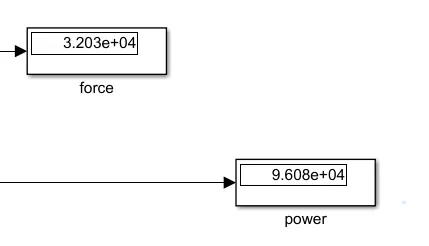
Q: Develop the model for the calculated force and power using Simulink.
Using constant block, square block, divide block, add block and display we have obtained the simulink model from the above equations
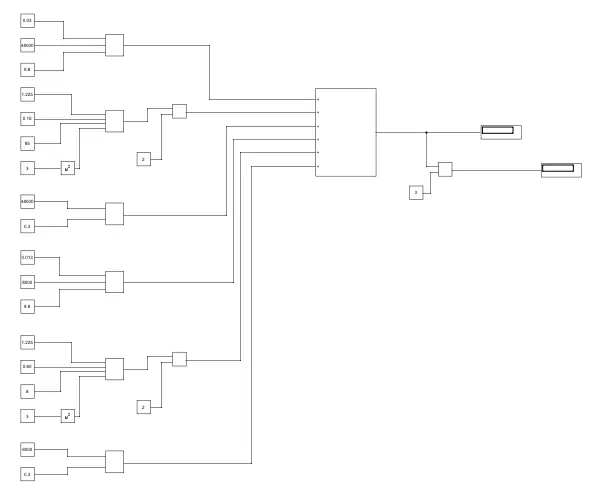
the ouput of the simulink block is
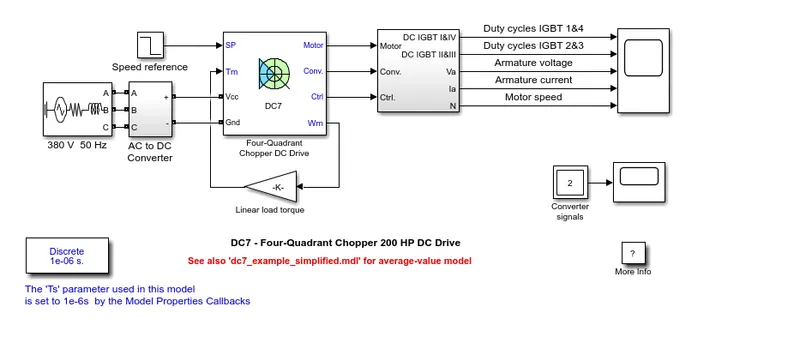
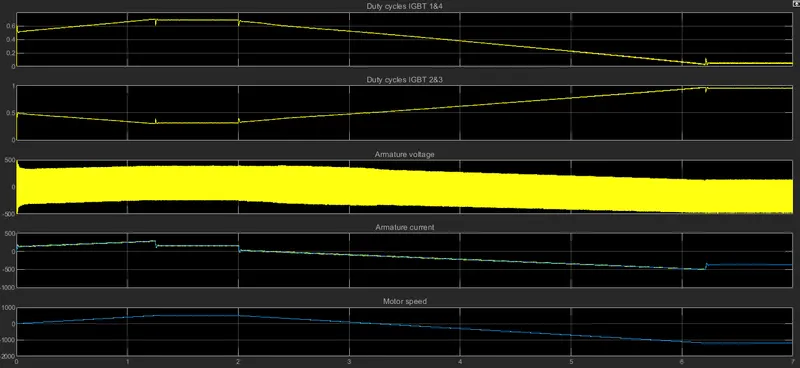
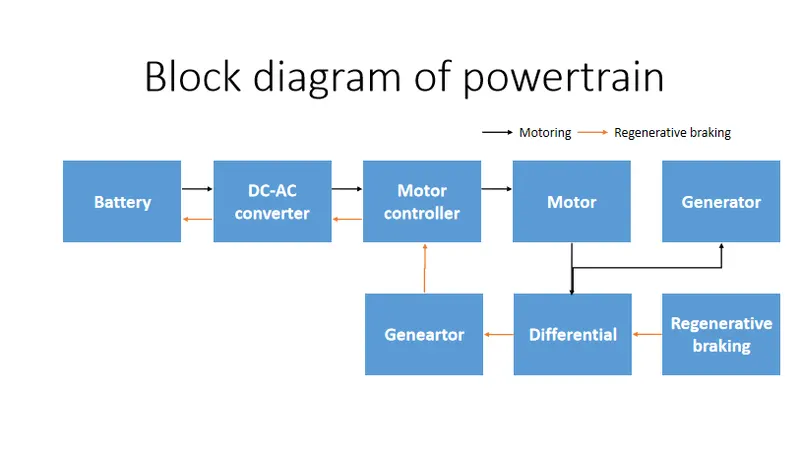
Q: Design an electric powertrain with type of motor, it’s power rating, and energy requirement to fulfill aircraft towing application in Simulink. Estimate the duty cycle range to control the aircraft speed from zero to highest. Make all required assumptions. Prepare a table of assumed parameters. Draw a block diagram of powertrain. (Hint :DC7 Block)
Assumptions of aircraft: Mass of the aircraft (ma) = 48000kg, Coefficient of rolling resistance (μr) = 0.03, Acceleration due to gravity (g) = 9.81ms-2 Frontal area of an aircraft (A) = 85m2 Final velocity of the aircraft (vf) = 3m/s, Initial velocity of the aircraft (ui) = 0m/s, Coefficient of drag of an aircraft (cd) = 0.15, Density of air (ρ) = 1.225 kg/m3 Acceleration time of the aircraft (ta) = 10seconds
Assumptions towing vehichle: Mass of the Towing vehicle (ma) = 8000kg, Coefficient of rolling resistance (μr) = 0.013, Acceleration due to gravity (g) = 9.81ms-2 , Frontal area of the Towing vehicle (A) = 8m2 , Final velocity of the Towing vehicle (vf) = 3m/s, Initial velocity of the Towing vehicle (ui) = 0m/s, Coefficient of drag of the towing vehicle (cd) = 0.60, Density of air (ρ) = 1.225 kg/m, Acceleration time of the towing vehicle (ta) = 10seconds
Power required to push/pull aircraft is 97.022952KW and total tractive force is 32340.984N.
Torque (T)= Fr * r /G
T = 32340.984 * 0.4 / 10
T = 1293.63 Nm
Motor specifications are output power – 110 KW, 150 hp, full load speed – 740 rpm, full load Efficiency – 94.5%, full load current – 210A, full load Torque – 1420 Nm, rated voltage – 400V/50 Hz
Pi = V * I
Pi = 400 *280
Pi = 112000W = 112KW
duty cycle = Po / Pi
duty cycle = 97.02 / 112 = 0.866
Therefore, duty cycle is 86%
Energy (E) = Po * t = 97.02 * 300
E = 29106kJ
To convert energy KJ to KWH we divide it by 3600
E = 29106/3600 = 8.08KW
Simulink of DC7 block